



Your personal brand is not what you meant to say. It is what the right stranger understands, trusts, and remembers after five seconds of context.
Most people test their personal brand on the public internet. They rewrite a LinkedIn headline, publish a post, change a bio, or launch a new offer page, then wait to see if anybody responds.
That is a rough way to learn. If the message is vague, the market ignores it. If it sounds too polished, people suspect it came from a prompt. If it speaks to the wrong audience, the attention you get may not help.
A better first step is to test the message privately. Not with fake certainty. Not by letting AI decide who you are. Use an AI audience simulator as a fast feedback room: a set of reader personas that can tell you what they understand, what they doubt, what feels generic, and what proof they need before you publish.
This matters more now because audiences are becoming sharper about AI-generated sameness. The Verge reported that LinkedIn’s “Seems like AI slop” button had been clicked more than one million times within weeks of launch. The lesson is not “never use AI.” The lesson is that public trust now depends on whether your message feels specific, earned, and recognizably yours.
What an AI Audience Simulator Does
An AI audience simulator is a structured way to ask AI to respond as different types of people in your real audience. Instead of asking, “Is this good?” you ask, “How would a hiring manager, a founder peer, a potential client, and a skeptical industry expert interpret this?”
Companies already use versions of this idea. Message-testing platforms diagnose whether brand language is understood, believed, relevant, and distinct. AI persona tools simulate how audience segments might react before campaigns go live. Tools like Ask Rally, and brand-message testing workflows like those described by WRITER and Conveo, show the larger trend: feedback is moving earlier in the creative process.
Personal branding needs the same discipline, just at a smaller scale. You are not testing packaging copy for a national product launch. You are testing whether your public identity makes sense to the people who might hire you, buy from you, collaborate with you, invite you, recommend you, or follow your work.
An AI audience simulator should not replace real feedback. It should help you find the confusing parts before real people have to do that work for you.
Why Personal Brands Need Message Testing
Personal branding advice often skips the hard part. It tells you to be authentic, choose a niche, post consistently, and share your story. None of that proves your message is landing.
A personal brand message has to pass five tests:
Clarity: Can a stranger explain what you do without guessing?
Relevance: Does the right audience see why it matters to them?
Credibility: Are your claims supported by evidence or experience?
Distinctiveness: Do you sound like a real person with judgment, or like a category template?
Risk: Could the message be misread, overclaim, exclude the wrong people, or make you look performative?
AI is useful here because it can play multiple readers quickly. A founder can test whether an investor, customer, and future hire read the same bio differently. A consultant can see whether an executive buyer understands the value or only sees vague advisory language. A job seeker can test whether a recruiter understands their career change. A creator can test whether a post sounds like lived experience or like a generic lesson scraped from the feed.
The point is not to chase every possible reaction. The point is to separate your intention from the signal your audience receives.
Build Your Simulator From Real Audience Evidence
The biggest mistake is inventing personas from thin air. If you ask AI to create “a busy executive,” you will get a stereotype. If you give it real context, you get better friction.
Start with five sources of audience evidence:
Questions people ask you on calls, in DMs, interviews, comments, or sales conversations.
Job descriptions, client briefs, investor questions, project requirements, or partnership notes.
Comments on your strongest and weakest posts.
Reddit threads, community posts, or forum discussions where your audience explains its doubts in plain language.
Your own rejected opportunities, stalled conversations, or moments when someone misunderstood what you do.
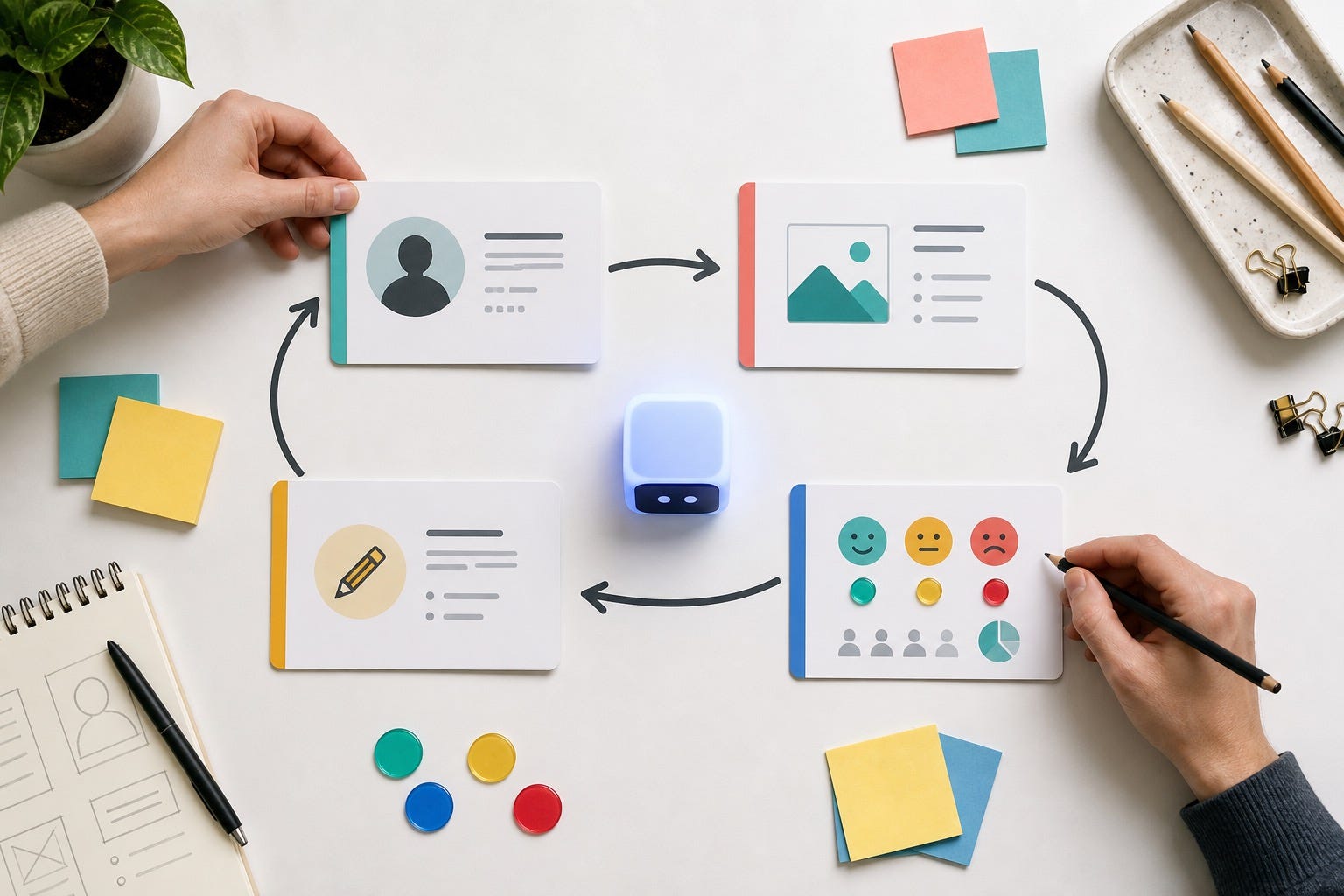
Then turn that evidence into reader cards. Each card should include the reader’s role, goal, anxiety, level of awareness, what they already believe, what they distrust, and what would make them take the next step.
For example, a consultant might create four reader cards: a skeptical VP burned by vague strategy work, a founder who wants speed, a referral partner who needs a simple explanation, and a peer expert who can spot shallow claims instantly.
That mix is more useful than one generic “target audience.” Your personal brand is seen by people with different jobs and incentives.

The Four-Part Personal Brand Message Test
Once you have reader cards, test one asset at a time. Do not paste your entire online life into AI and ask for a reinvention. Pick a LinkedIn headline, About section, Substack profile, short bio, homepage intro, pinned post, newsletter draft, service description, or speaker pitch.
1. The Five-Second Understanding Test
Ask each simulated reader to explain what you do after seeing only the asset. If the answers vary wildly, the message is too broad. If the answers repeat your exact words without explanation, the copy may be polished but empty. A strong answer should include your audience, problem, value, and evidence in simple language.
Prompt: “Act as the reader persona below. Read this profile section for five seconds. What do you think this person does? Who do they help? What feels clear or vague? Do not suggest rewrites yet.”
2. The Believability Test
Next, test whether the claims feel earned. Many personal brands fail here because they use impressive words without proof: strategic, visionary, data-driven, trusted, expert, world-class, operator, storyteller, AI-native.
Prompt: “Which claims in this copy do you believe, which do you doubt, and what evidence would make each doubtful claim stronger? Suggest proof types only: example, metric, project, case study, testimonial, artifact, public work, or specific story.”
3. The Differentiation Test
This test asks whether your message could belong to hundreds of other people. It is uncomfortable, but useful. If the simulated reader says your message sounds like a standard coach, marketer, product leader, developer, founder, or creator bio, ask what is missing.
Prompt: “What parts of this sound interchangeable with other people in the same field? What specific experience, point of view, audience choice, constraint, or result would make it more recognizable?”
4. The Risk Test
Finally, look for misreads. A strong personal brand can still create unintended signals. A founder may sound too self-promotional. A job seeker may look unfocused. A consultant may sound expensive but not concrete. A creator may sound like they are chasing trends instead of building authority.
Prompt: “What could a skeptical reader misinterpret here? What might make them hesitate, roll their eyes, assume AI wrote it, or decide this person is not for them? Give the highest-risk issue first.”
How to Interpret AI Feedback Without Becoming Bland
AI feedback can make your message clearer. It can also sand off the edge that makes you memorable. Your job is to decide which feedback improves trust and which feedback only makes you safer.
Use three buckets:
Fix now: confusion, unsupported claims, vague audience, missing proof, accidental overpromising.
Consider: tone issues, structural suggestions, examples that might help, words that may be too insider-heavy.
Ignore: advice that makes you sound generic, removes your point of view, or optimizes for an audience you do not want.
The best simulated feedback often sounds like a smart objection. “I understand you work with AI teams, but I do not know whether you help with strategy, implementation, adoption, training, or content.” That is a fix-now issue.
Do not let AI average your identity. If you test a founder bio with six personas, they will disagree. That is normal. Your personal brand should become clearer to the people you actually want to reach.
A Practical Workflow for LinkedIn, Substack, and Websites
Here is a simple workflow you can run in under an hour.
First, choose one goal. Are you trying to attract better-fit clients, look credible for a new role, build founder visibility, earn trust with peers, or explain a career shift? Without a goal, feedback becomes random.
Second, choose three reader personas. One should be your ideal opportunity. One should be a skeptic. One should be a referral source who needs to explain you to someone else.
Third, paste one asset. Keep it focused. A headline and About section. A Substack profile. A homepage intro. A pinned post. A short bio. A draft thread. A newsletter introduction.
Fourth, run the four tests: understanding, believability, differentiation, and risk.
Fifth, rewrite only the weak parts. If the problem is missing proof, add proof. If the problem is vague audience, sharpen the audience. If the problem is a generic claim, replace it with a concrete decision, constraint, example, or result.
Sixth, run a final comparison. Ask: “Between version A and version B, which is clearer, more credible, and more specific for this reader? What did version B improve, and what did it lose?”
This last question matters. A rewrite can become clearer and less human at the same time. Keep the gains. Bring back the voice.
What to Test Before You Publish
You do not need to test every sentence. Test the assets that shape first impressions or make important claims.
Test your LinkedIn headline if it lists roles but does not explain your value. Test your About section if it tells your whole career but never says what you want to be known for. Test your Substack profile if it sounds like a topic cloud instead of a promise to a reader. Test a founder announcement if it risks sounding like hype. Test a service page if it explains the method but not the buyer pain.
Also test posts that carry reputation risk: hot takes, client lessons, industry criticism, AI-generated drafts, hiring announcements, pivots, or anything that makes a strong claim about your expertise.
The goal is not to publish only safe content. The goal is to know what risk you are taking. A strong point of view may annoy the wrong audience and attract the right one. That is fine. A vague message that confuses everybody is a leak.
The Ethical Line: Simulation Is Not Research
AI audience simulation is useful, but it is not a substitute for real people. Simulated readers do not buy, hire, unsubscribe, refer, or carry full industry context. They are pattern engines.
Use them for diagnosis, not proof. It is fair to say, “This helped me see where my message was unclear.” It is not fair to say, “My audience wants this,” if your only audience was a model.
For important decisions, combine AI feedback with reality: ask a trusted peer, send two versions to a small list, watch replies, check saves and comments, or ask new calls what they understood. Real feedback should outrank simulated feedback.
Also protect private information. Do not paste confidential client details, internal documents, sensitive employee stories, or non-public metrics into any AI tool unless your data policy allows it.
A Seven-Day Message Testing Sprint
If your personal brand feels fuzzy, run this sprint before creating more content.
Day one: collect your current LinkedIn headline, About section, short bio, profile intro, and three recent posts. Do not rewrite anything yet.
Day two: create three reader cards from real evidence. Include what each reader wants, doubts, and needs to believe.
Day three: run the five-second understanding test on your profile copy. Write down the exact places where readers misread you.
Day four: run the believability test. List the claims that need proof. Add one example, metric, project, testimonial, or artifact for the top three claims.
Day five: run the differentiation test. Remove phrases that could belong to anyone. Replace them with decisions, tradeoffs, constraints, or lived experience.
Day six: run the risk test on one important post or profile update. Decide what risk is intentional and what risk is just sloppy wording.
Day seven: publish one improved asset and record what happens. Did people reply with better questions? Did the right people understand faster? Did the message feel more like you? That is the measure.
The Strongest Personal Brands Become Easier to Read
AI has made personal branding noisier, but it has also made feedback cheaper. You can now test a headline, bio, point of view, or post against several likely reader reactions before you ask the public to care.
The professionals who benefit will not be the ones who let AI produce more generic content. They will be the ones who use AI to notice confusion earlier, find unsupported claims faster, and make their real judgment easier to see.
Your personal brand does not need to be louder. It needs to be legible. Use AI audience simulation to find the fog, then use your own evidence to clear it.
FAQ
What is an AI audience simulator for personal branding?
An AI audience simulator is a workflow where you ask AI to respond as specific reader personas, such as recruiters, buyers, collaborators, peers, or skeptics. It helps you test whether your profile, bio, post, or positioning is clear, credible, relevant, and distinct before publishing.
Can ChatGPT give reliable personal brand feedback?
ChatGPT can give useful first-pass feedback, especially on clarity, vague claims, missing proof, and possible misreads. It should not be treated as final market research. Use it to improve drafts, then validate important messages with real people and real behavior.
How do I test my LinkedIn profile with AI?
Paste your headline, About section, and target audience context into an AI tool. Ask it to respond as three reader personas. Run tests for five-second understanding, believability, differentiation, and risk. Then rewrite only the sections that caused confusion or lacked proof.
What personal brand assets should I test first?
Start with assets that shape first impressions: your LinkedIn headline, About section, Substack profile, website intro, short bio, pinned post, service description, or career-change summary. These are the places where unclear messaging costs the most.
Will AI audience testing make my brand sound generic?
It can if you accept every suggestion. Use AI feedback to find confusion, not to erase your voice. Keep specific experience, opinion, examples, and judgment. Reject suggestions that make you sound safer but less recognizable.
Is AI audience simulation the same as real audience research?
No. AI audience simulation is a fast diagnostic tool, not a replacement for interviews, comments, profile data, sales calls, recruiter feedback, or actual reader behavior. The best workflow uses AI to find likely issues early, then checks the most important assumptions with real people.