


A practical guide for founders, creators, consultants, job seekers, and professionals who use AI but cannot afford to look automated.
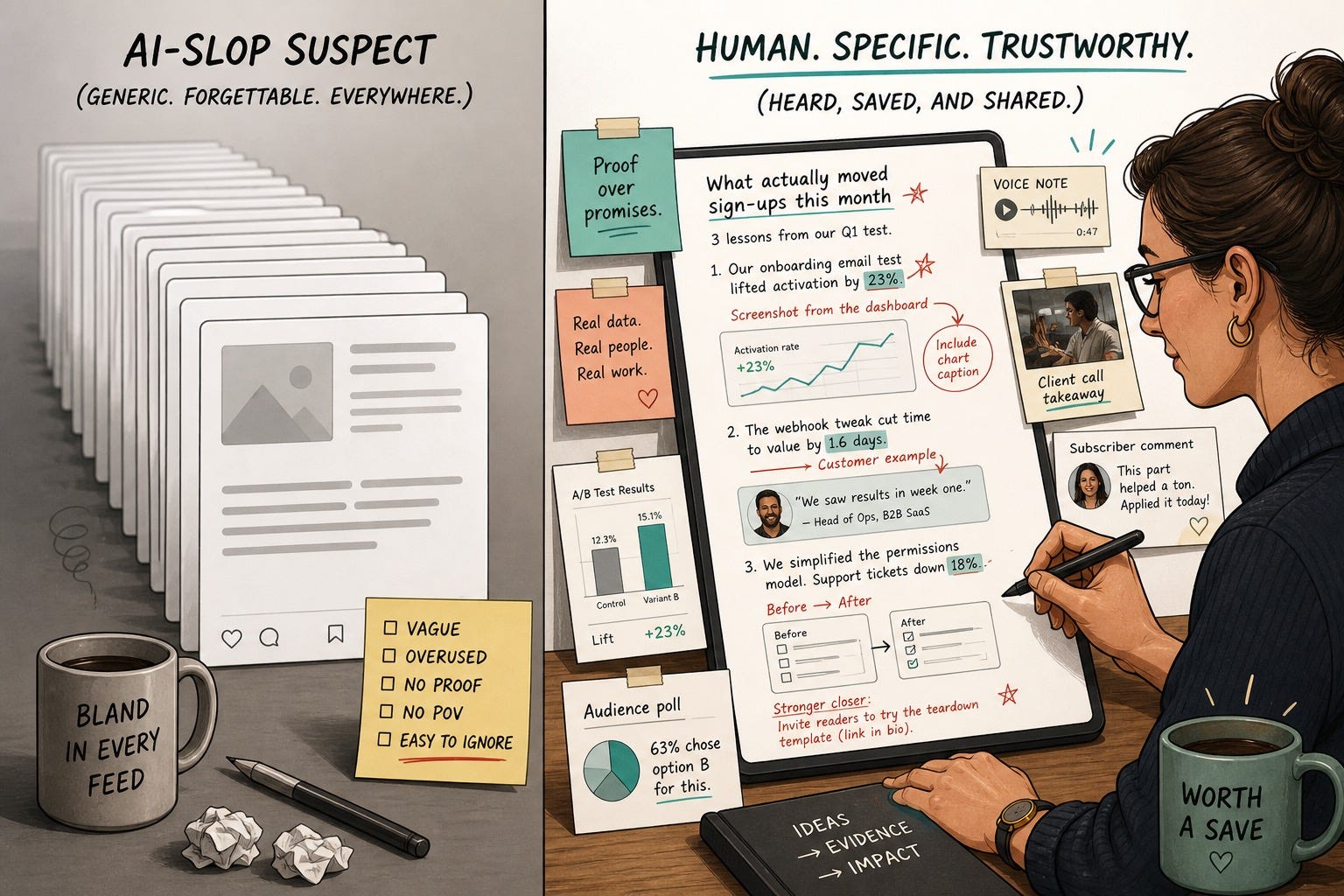
The new personal branding problem is not whether you use AI. It is whether people can still tell where your judgment begins.
That question became harder to avoid as platforms started turning AI suspicion into product features. LinkedIn added a way to report posts that seem like AI slop, according to TechCrunch. Substack explains in its support documentation that readers can scan posts, replies, and comments for estimated AI assistance. Meta has also described its approach to labeling AI-generated and manipulated media.
For a professional building a public reputation, this changes the job. A good post is no longer enough. A polished bio is no longer enough. A strong personal brand now needs to feel sourced, specific, and traceable to a real person with real experience.
If your content sounds like a capable machine could have produced it from a generic prompt, your audience may discount it before they even consider the idea. If a platform labels or downranks it, the damage is even more direct. The goal is not to panic or stop using AI. The goal is to build a personal brand that remains believable in an AI-labeled internet.
What AI Content Labels Actually Change
AI content labels are usually framed as a transparency feature. In theory, they help readers understand whether text, images, audio, or video were generated or heavily modified with AI. In practice, they also create a new trust signal.
A label can be neutral in a policy document and still feel loaded in a feed. A technical audience may see AI assistance as normal workflow. A hiring manager may wonder if the applicant has original judgment. A client may wonder whether they are paying for expertise or a wrapper around a chatbot.
There is also a false-positive problem. The Verge recently covered how AI writing detectors are creating more suspicion, including cases where accusations hurt reputations. Business Insider reported that creators worry about genuine work being misclassified as AI-made, especially when brands and audiences are sensitive to authenticity. The European Union’s AI Act transparency obligations, summarized by The Verge, show the broader direction: more disclosure, more machine-readable signals, and more attention to provenance.
That means the personal branding question has shifted from “How do I publish more?” to “How do I make my thinking easier to verify?”
The Mistake: Trying to Sound Less Like AI After the Draft Is Done
Most advice about AI detection focuses on surface edits: vary sentence length, remove obvious phrases, add a personal anecdote, use a less formal tone. Some of that helps. But if your core idea is generic, style edits only decorate the problem.
A post can have short sentences and still feel empty. A newsletter can include a story and still sound manufactured. A LinkedIn update can mention a personal moment and still read like a template. Readers are not only detecting syntax. They are detecting absence.
They notice when there is no real constraint, no tradeoff, no named experience, no lived example, no artifact, no cost, no failed attempt, no specific audience, and no opinion that could make someone disagree.
Your personal brand does not need to beat AI detectors. It needs to beat the reader’s suspicion that nothing human was at stake.
This is why the best defense is upstream. You need a human proof trail before AI touches the work.
Build a Human Proof Trail Before You Publish
A human proof trail is the set of notes, examples, decisions, edits, and artifacts that show your content came from real judgment. It does not mean you publish every draft or expose private client details. It means your public identity is fed by real source material instead of generic prompts.
Think of it as the personal branding version of showing your work. You are not asking readers to trust that you are authentic. You are giving them enough signals to feel it.
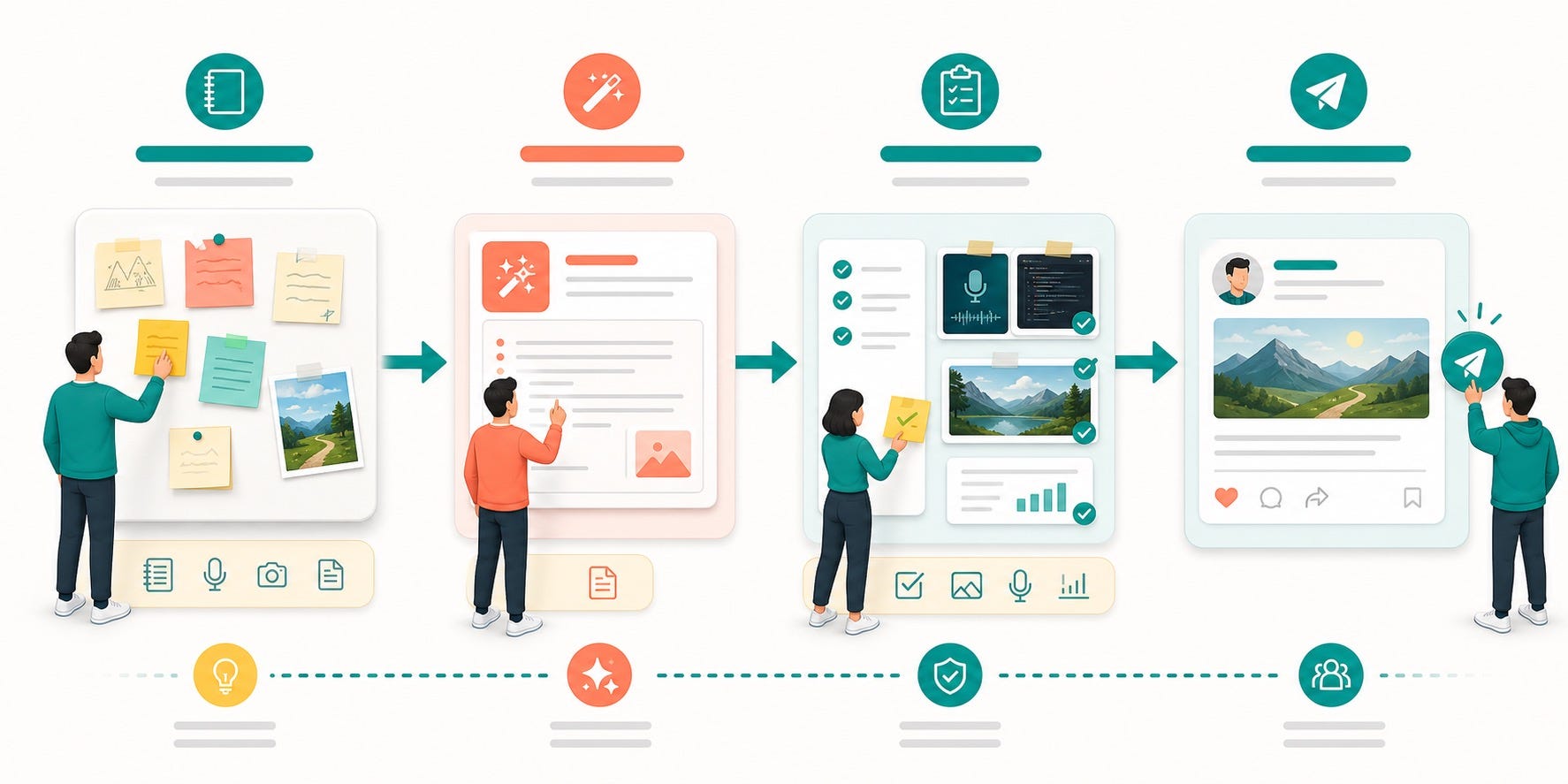
1. Keep a source file of real moments
Before asking AI to draft anything, collect raw material from your week. Save client questions, meeting notes, voice memos, project decisions, objections, rejected ideas, screenshots with sensitive details removed, metrics you are allowed to share, and lessons you learned the hard way.
This source file becomes your personal brand’s evidence layer. It makes your content more specific because AI is not inventing the substance. It is helping you organize what already happened.
Try this prompt: “Use the notes below to identify three post ideas. For each idea, include the real event it came from, the audience who would care, the uncomfortable lesson, and the proof I can safely mention. Do not invent examples.”
2. Use AI for structure, not identity
AI is useful for outlining, compressing, comparing angles, finding unclear parts, and turning messy notes into options. It is weaker when you ask it to decide who you are, what you believe, or what your audience should trust you for.
A safer workflow is to give AI the raw material, then ask it to produce several structures. You choose the one that matches your judgment. Then you rewrite the strongest claims in your own language. This keeps AI in the role of editor, not author of your identity.
For example, a consultant should not ask, “Write a thought leadership post about leadership.” A better prompt is: “Here are five leadership tradeoffs I saw during a client operating review. Which one would be most useful for a founder with a 20-person team, and what is the sharpest non-obvious lesson?”
3. Add a proof pass before the polish pass
Most people use AI to make content smoother. Do the opposite first. Ask AI to make the draft harder to dismiss.
Run a proof pass with questions like:
Where does this make a claim without evidence?
Which sentence sounds like anyone in my industry could have written it?
What real example would make this more believable?
Where can I add a constraint, result, tradeoff, or before-and-after?
What would a skeptical reader ask next?
Only after that should you polish. The order matters. Smooth content without proof becomes more suspicious, not more credible.
4. Save your drafts and decisions
You do not need to publish your entire drafting process, but you should keep it. Save the original notes, AI prompts, draft versions, manual edits, and final decisions. If someone challenges a post, asks about your process, or wants to know how you used AI, you will have a calm answer.
How to Use AI Without Looking Automated
Using AI ethically in personal branding is not about hiding the tool. It is about making sure the tool does not flatten you.
Here is a practical AI personal branding workflow that works for LinkedIn posts, Substack essays, bios, About pages, profile updates, short scripts, and newsletters.
Step 1: Start with a human input packet
Collect the facts before writing. Include what happened, who it affected, what you believed before, what changed your mind, what you tried, what failed, what worked, what you cannot share, and what the reader can apply.
If your input packet has no real facts, your output will feel like AI no matter how well you edit it.
Step 2: Ask AI for angles, not finished posts
Ask for five angles and reject the obvious ones. The first AI answer is usually the average of what the internet has already said. The value appears when you push for sharper distinctions.
Prompt: “Give me five possible angles for this personal branding post. Label each as obvious, useful, contrarian, tactical, or story-led. Then explain which angle would create the most trust with a skeptical professional audience.”
Step 3: Rewrite the opening yourself
The first three sentences carry most of the trust burden. If they sound like a template, the reader will assume the rest is a template. Write the opening yourself after reviewing the AI outline.
A weak opening says, “In today’s digital age, personal branding is more important than ever.” A stronger opening says, “The problem is not that your post used AI. The problem is that nobody can find the human decision inside it.”
Step 4: Add one uncomfortable detail
Human content usually has friction. It includes a cost, mistake, delay, disagreement, messy tradeoff, or specific constraint. Generic AI content avoids friction because it tries to be universally agreeable.
If you are a founder, mention the decision you almost got wrong. If you are a job seeker, mention the project that did not fit the role until you reframed it. If you are a consultant, mention the client objection that forced you to clarify your method.
Step 5: Run an AI-slop risk review
Before publishing, ask AI to critique the draft as a skeptical reader. This is different from asking it to improve the writing.
Prompt: “Review this draft for AI-slop risk. Flag vague claims, predictable phrases, unsupported advice, generic storytelling, inflated confidence, and places where a real example would increase trust. Do not rewrite yet. Give me a checklist.”
Then make the edits yourself. Add specifics. Cut recycled lines. Replace broad claims with earned observations. The goal is not to trick a detector. The goal is to make the piece recognizably yours.

What This Looks Like on Different Personal Brand Surfaces
LinkedIn
LinkedIn is especially sensitive because professional credibility is the product. If your posts read like auto-generated thought leadership, people may not simply ignore them. They may distrust your judgment.
Use LinkedIn for grounded observations. Mention the decision, audience, constraint, or result behind the lesson. Avoid overproduced story arcs that begin with dramatic confession and end with a universal lesson.
Substack
Substack rewards depth, but AI detection makes process matter. If you use AI to plan or edit a newsletter, keep the ideas anchored in your own reporting, lived experience, notes, examples, interviews, or analysis.
You do not need a dramatic disclaimer on every post. A calm line such as “AI helped organize the outline; the examples, argument, and final edits are mine” is often stronger than vague purity claims.
Personal websites and bios
Your website and bio should be the stable source of truth. If your social posts are fast-moving, your site should make your identity easier to verify. Include clear expertise, proof, projects, public work, speaking topics, media links, testimonials where appropriate, and a concise statement about how you use AI if your audience cares.
This is not about turning your website into a compliance page. It is about reducing ambiguity.
Visual content and AI avatars
Images, headshots, avatars, and video clips create a different trust problem because people react quickly to visual authenticity. If you use AI-generated visuals, disclose when the image could reasonably be mistaken for reality. If you use AI for editing, keep the final result consistent with how you actually appear and work.
If Your Content Is Flagged or Questioned
Do not respond defensively. A defensive response can make a minor suspicion look like a bigger trust issue.
First, check what was flagged and why. Was it the text, image, caption, edit, metadata, or an imported asset? Did a platform apply a label automatically? Did a reader simply feel the post was generic?
Second, document your process. Pull the source notes, drafts, edit history, screenshots, or original files. If the platform offers an appeal or dispute option, use calm, factual language.
Third, decide whether a public clarification is needed. Most posts do not need one. But if the label affects a major piece of work, a client relationship, a partnership, or a large audience, a short process note can help.
Simple clarification template: “This piece was based on my own notes from [context]. I used AI to organize the outline and check clarity, then rewrote and fact-checked the final version myself. The examples and conclusions are mine.”
Finally, improve the next piece. Add more concrete examples. Keep better source records. Use fewer generic AI structures. Make your process boringly clear.
The Personal Brand Advantage: Be Verifiably Human
AI will keep improving. Detectors will keep changing. Platform labels will become more common. The durable advantage is not pretending you never use AI. It is becoming the person whose ideas have visible roots.
That means your content should carry fingerprints of experience: the client question, the product decision, the failed experiment, the customer phrase, the reader objection, the field note, or the edit you made because your first take was too easy.
AI can help you move faster. It can clarify ideas, test headlines, summarize research, and turn scattered notes into structure. But it cannot supply your earned judgment. When your personal brand depends on trust, earned judgment is the product.
The next wave of personal branding will not belong to people publishing the most. It will belong to those whose human thinking is easiest to recognize.
FAQ
What are AI content labels?
AI content labels are notices, tags, metadata signals, or scan results that indicate content may have been generated or substantially changed with AI. Different platforms apply them differently, and some rely on self-disclosure while others use automated detection or third-party tools.
Do AI content labels hurt personal branding?
They can, depending on the audience and context. A transparent AI workflow may be acceptable in technical or creative settings, but a label can still create doubt if the content lacks clear human judgment, original examples, or a trustworthy process.
How can I use AI for personal branding without sounding automated?
Start with real notes, voice memos, project examples, audience questions, and proof assets. Use AI to organize and critique the material, then rewrite the opening, claims, and examples yourself. Avoid publishing first-pass AI drafts.
What should I do if my content is falsely flagged as AI-generated?
Stay factual. Review which asset was flagged, save your source notes and draft history, use any platform dispute process, and clarify your workflow only if the label affects trust, a partnership, or a major professional opportunity.
Should I disclose AI use in my personal brand content?
Disclose when AI materially shaped the final work, when the content could be mistaken for reality, when a platform requires it, or when your audience would reasonably expect to know. Keep disclosure specific: say how AI helped rather than making vague claims.
What is a human proof trail?
A human proof trail is the collection of real source material behind your public content: notes, drafts, examples, results, screenshots, interviews, voice memos, and edits. It helps your personal brand stay credible even when AI tools are part of the workflow.