



The smartest personal brands are not winning by publishing more generic AI content. They are winning by making one useful, specific, lived insight travel farther.
Most people use AI for personal branding backward. They open ChatGPT, ask for “10 LinkedIn post ideas,” pick the least awkward one, and publish something that sounds polished but empty.
The post may be grammatically clean. It may have a strong hook. It may even get a few polite likes. But it does not build much trust because it could have come from anyone.
That is the new personal branding problem. AI made content easier to create, which means average content became cheaper. Decent stops being a signal. What still signals credibility is judgment, experience, specificity, taste, and proof.
That is where AI content repurposing becomes useful. Used well, it becomes a personal brand operating system: one real idea, captured from your actual work, translated into the right format for the right audience, checked against your proof, and published without losing your voice.
The goal is to become easier to understand, remember, trust, and recommend.
Why Repurposing Matters More Than Posting More
Personal branding advice often sounds like a punishment: post daily, comment daily, publish newsletters, make short videos, write threads, update your website, and somehow also do your actual work.
That is not a sustainable system for most founders, consultants, freelancers, executives, students, job seekers, or technical professionals. It pushes people toward low-effort AI output because the calendar becomes more important than the point.
Repurposing changes the center of gravity. Instead of asking, “What should I post today?” you ask, “What did I learn, notice, solve, build, reject, test, explain, or change this week?”
That shift matters because personal branding is not just visibility. It is repeated evidence. People trust you when they can see your pattern of thinking across different moments. A single strong insight can become a LinkedIn post, a Substack section, a short X thread, a website proof note, a newsletter intro, a talk outline, a bio update, and a future FAQ answer. Each version should do a different job, but all of them should point back to the same recognizable judgment.
Recent feed research from Pangram Labs adds urgency. Their 2026 analysis of more than one million social posts found AI-generated content spreading across major platforms, with LinkedIn especially saturated among longer posts. Readers are becoming more sensitive to synthetic sameness.
At the same time, marketers are under pressure to produce more personalized content. Salesforce’s State of Marketing reporting notes that many teams are turning to AI to meet content demand, but still struggle when context is fragmented. Personal brands face the same issue at a smaller scale.
The Personal Brand Repurposing Rule
Here is the rule: do not repurpose content first. Repurpose insight first.
Content-first repurposing starts with an asset. You take a blog post and ask AI to make a LinkedIn post, a tweet, and an email. The result may be efficient, but it often feels thin because the model is remixing the outer shape of the asset.
Insight-first repurposing starts with the real thing underneath the asset: a client objection, hiring lesson, product decision, failed experiment, customer sentence, mistake, or pattern you now see faster than other people in your market.
Once the insight is clear, AI can help translate it without flattening it. The LinkedIn version can be social and direct. The Substack version can be reflective. The X version can be compressed. The website version can become proof. Same insight, different job.
This is how you avoid posting more while becoming less distinct.
A Simple Weekly AI Content Repurposing Workflow
You do not need a complex stack. You need a repeatable loop. Use this once a week, ideally at the end of a workday when the week is still fresh.
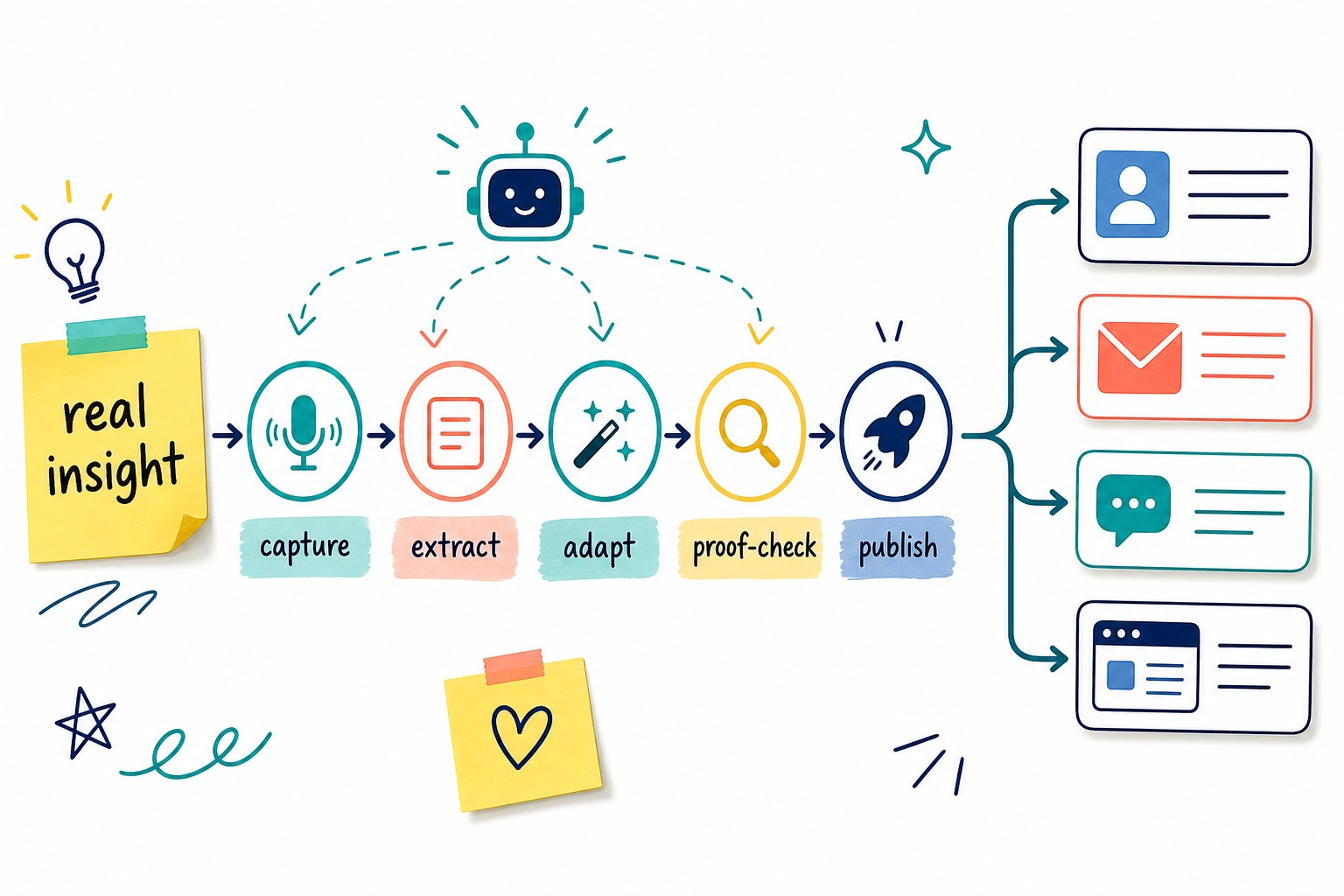
Start with a real insight, adapt it by channel, then proof-check before publishing.
Step 1: Capture the raw material
Open a notes app, voice recorder, document, or private journal. Write or say what actually happened this week. Do not make it polished yet.
Use prompts like these for yourself:
What did I change my mind about?
What did I build, ship, fix, test, or decide?
What mistake would I warn someone in my field to avoid?
What question keeps showing up in my audience, team, or market?
The raw note can be messy. In fact, it should be. The awkward details are often where your voice lives.
Step 2: Ask AI to extract the durable insight
Now bring AI in as an editor, not a ghostwriter. Paste your raw note and ask it to identify the strongest underlying idea.
Try this prompt:
Read this raw work note and extract the strongest personal branding insight. Do not write a post yet. Identify: the main lesson, the audience who would care, the tension or mistake, the proof I can mention, and three plain-English ways to say the idea in my voice.
This step prevents you from publishing a diary entry when what you really need is a clear point.
Step 3: Create a channel map
Every channel has a different job in your personal brand. LinkedIn is often where people discover and evaluate you quickly. Substack is where they decide whether your thinking has depth. X can test sharp phrasing. A personal website can store durable proof. Email can build familiarity.
Give each version a job.
LinkedIn: make the insight legible to people who may not know you yet.
Substack: expand the thinking with context, nuance, and examples.
X: compress the idea into a sharp observation or short thread.
Website: turn the idea into a proof item, case note, FAQ, or positioning line.
Email: make the idea feel personal and useful to people who already opted in.
The channel map is what keeps repurposing from becoming duplication.
Step 4: Generate format-native drafts
Once the insight and channel map are clear, ask AI for drafts. Be specific about the format, audience, and constraints.
Use a prompt like this:
Turn this insight into five format-native drafts: one LinkedIn post, one Substack section outline, one short X thread, one website proof note, and one email intro. Keep the same core idea, but make each version serve its channel. Preserve my point of view. Do not add claims, results, or stories I did not provide. Avoid generic AI phrasing, exaggerated certainty, and inspirational filler.
This is where AI is excellent. It can give you options, restructure the argument, and reveal which version has the most energy.
But do not publish the first draft. The first draft is a sketch, not a reputation asset.
Step 5: Add proof before polish
Many AI-generated personal brand posts fail because they move straight from idea to polish. For a professional audience, proof matters more than perfect phrasing.
Before editing for style, add at least one proof signal:
A specific project detail
A before-and-after observation
A lesson from a real conversation
A decision you made and why
A small metric you can responsibly share
A mistake, tradeoff, or constraint
An artifact, demo, or public example
You do not need to reveal private client information. You do need to show contact with reality.
The “One Insight, Five Assets” Example
Imagine you are a consultant who helps B2B companies improve onboarding. You notice that a client’s onboarding problem was not the checklist. It was that nobody owned the first success moment after signup.
The raw insight might be: “Most onboarding problems are ownership problems disguised as education problems.”
Here is how that one insight can become a week of personal brand content:
A LinkedIn post about adding tutorials instead of assigning ownership for the first success moment.
A Substack essay explaining the difference between education, activation, and accountability in onboarding.
An X thread with five signs your onboarding issue is not a documentation issue.
A website FAQ answer titled “What makes onboarding fail after signup?”
An email note to prospects explaining one diagnostic question you ask in onboarding audits.
None of these assets need to repeat each other. Together, they make your expertise easier to find and believe.
The same pattern works for a job seeker, AI builder, student, or freelancer. One project retrospective can become a post, proof note, profile line, thread, and interview story.
How to Keep AI From Making You Sound Generic
AI tends to sand down the parts of your thinking that feel inconvenient, odd, blunt, or specific. Unfortunately, those are often the parts people remember.

AI can multiply output, but review decides whether the result builds trust.
Use this review checklist before anything goes public:
Would someone who knows me believe I wrote or approved this?
Does this include a detail only I, or someone with my experience, would know?
Is the claim narrow enough to be defensible?
Does the post teach, clarify, challenge, or help, rather than just signal expertise?
Is there one sentence I would actually say out loud?
Can I remove the most polished sentence and make the piece stronger?
That last question is useful because AI often produces elegant filler. Strong personal branding usually has less varnish and more evidence.
The Best AI Stack Is a Source Library
The tool matters less than the operating habit. Use a general AI assistant for extraction, outlining, angle testing, and rewriting. Use Notion, Google Docs, Apple Notes, Obsidian, or a spreadsheet to store raw insights. Use transcript tools if your best thoughts come from calls or voice notes.
To make the workflow stronger, keep a small brand context document with your audience, credible topics, proof assets, ethical boundaries, and approved writing examples. You are not asking AI to become you. You are asking it to help you edit yourself.
Ethical AI Repurposing: What to Disclose and What to Avoid
You do not need to disclose every time AI helped you outline a post, summarize a transcript, or adapt a long idea into a shorter format. But you do need to protect trust.
Be careful when AI changes the nature of the artifact. If an avatar speaks for you, if a synthetic image represents a real event, if an AI-generated testimonial appears to be human feedback, or if a draft implies direct experience you do not have, disclose or do not publish it.
For ordinary writing support, the cleaner standard is accuracy and ownership. Can you stand behind the claim? Did the example happen? Are you comfortable defending the advice?
AI assistance is not the credibility problem. Unowned automation is.
A Weekly System You Can Actually Maintain
Here is a practical cadence for busy professionals:
Friday: capture three raw notes from the week.
Monday: choose the strongest insight and ask AI to extract the angle.
Tuesday: draft the LinkedIn version and one supporting asset.
Wednesday: expand the idea into a newsletter section, short thread, or website proof note.
Thursday: review everything for accuracy, voice, and proof.
Friday: save the best-performing version as source material for future bios, talks, interviews, and FAQs.
That rhythm gives you consistency without forcing daily invention. After a few months, you will have dozens of tested insights, proof notes, examples, and phrasing patterns.
Over time, this does more than fill a content calendar. It clarifies your positioning. You will see which ideas people save and which examples make people trust you faster.
Mistakes to Avoid
Do not repurpose weak ideas. If the original insight is generic, every derivative asset will be generic too. Do not treat every channel like a distribution pipe; adapt the idea to the reader’s moment. And do not let AI delete the uncertainty, constraint, disagreement, or lesson learned the hard way. Those details are not flaws. They are trust signals.
The Real Payoff
AI content repurposing for personal branding is not about becoming louder. It is about becoming more legible.
The right people should understand what you know, how you think, what you have done, and why your perspective is worth trusting. They should see the same core judgment across your posts, essays, bios, website, talks, and interviews.
That does not happen by asking AI to generate more ideas. It happens by capturing real experience, extracting the durable insight, adapting it with intention, adding proof, and reviewing it like your reputation depends on it.
Because it does.
FAQ
What is AI content repurposing for personal branding?
AI content repurposing for personal branding means taking one real insight, story, project, or proof point from your work and using AI to adapt it into credible assets across LinkedIn, Substack, X, a personal website, email, or a portfolio. The key is to repurpose the insight, not copy the same post everywhere.
How is this different from asking AI to write LinkedIn posts?
Asking AI to write LinkedIn posts often starts from a blank page and produces generic advice. A repurposing workflow starts with your actual experience, then uses AI to extract, structure, adapt, and edit. That makes the output more specific and defensible.
Can job seekers use AI content repurposing?
Yes. Job seekers can turn one project, internship, class assignment, volunteer experience, or work lesson into a LinkedIn post, portfolio note, interview story, profile update, and recruiter-friendly proof point. The goal is to make your evidence easier to find and understand.
How often should I repurpose personal brand content?
Start with one strong insight per week. That is enough to create several useful assets without lowering quality. If you have more raw material, keep it in a source library.
Do I need to disclose that AI helped me repurpose content?
For ordinary outlining, editing, summarizing, and format adaptation, disclosure is usually less important than accuracy and ownership. You should disclose or avoid publishing when AI creates synthetic media, represents an event that did not happen, speaks as you in a misleading way, or adds claims you cannot verify.