


AI can generate a plausible app screen before your coffee cools. That makes visual polish cheaper—and makes the decisions behind the screen far more valuable. Here is how product and UX designers can build a portfolio that makes that judgment easy to see.
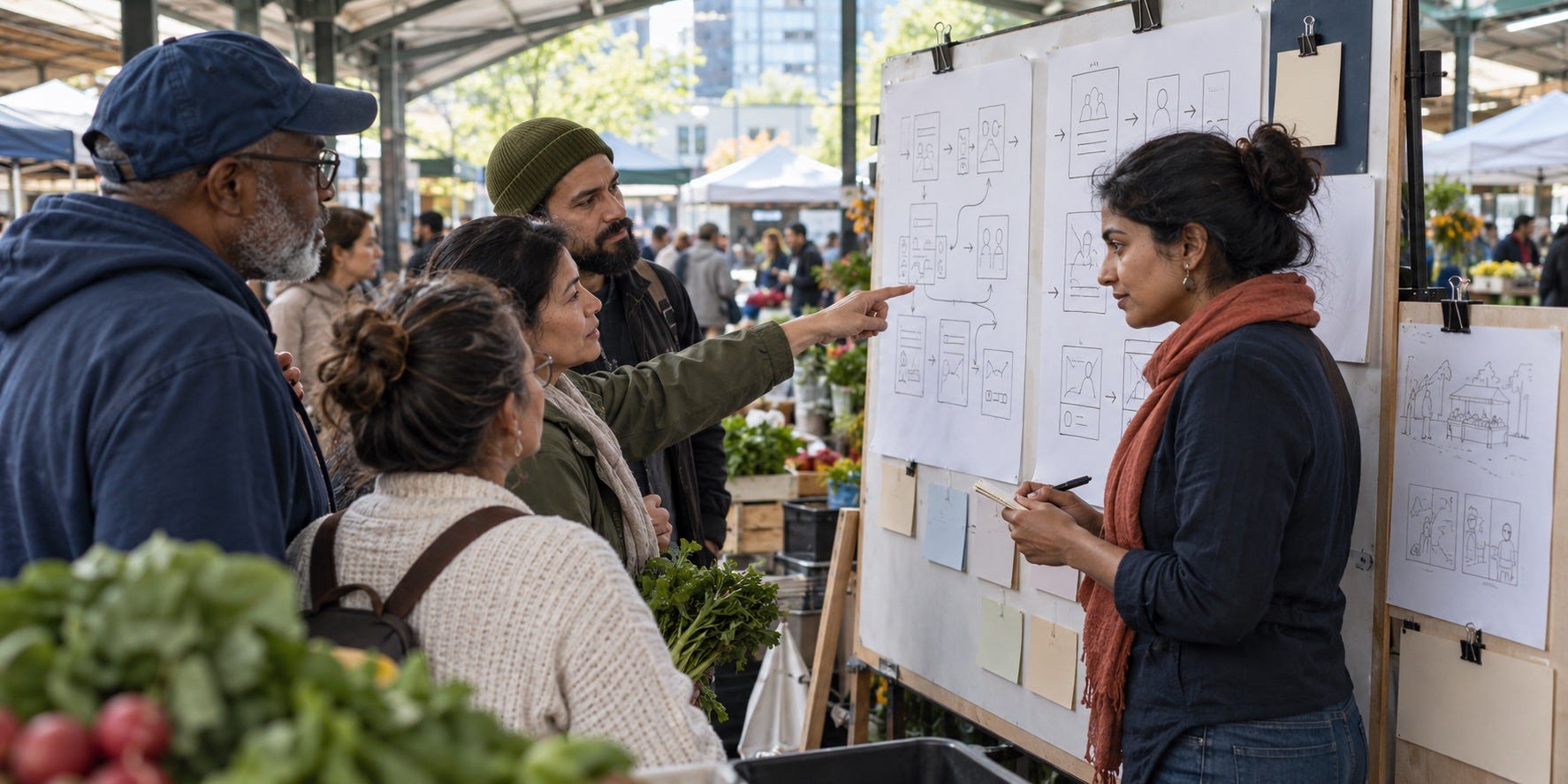
The old portfolio failure was the beautiful-but-empty case study: a dramatic before-and-after, a few neat diagrams, and a conclusion that arrived as if the product had designed itself. AI raises the stakes. When almost anyone can produce a polished prototype, a gallery of glossy interfaces may prove taste—but not product judgment.
That is not bad news for designers. It is an invitation to show the work that generative tools cannot honestly take credit for: finding the real problem, noticing a risky assumption, deciding what not to automate, testing with people, changing direction, and naming a limit. Those are also the details that make a personal brand credible to a hiring manager, a client, or a future collaborator.
An AI design portfolio should not be a catalog of prompts or a confession that you used a tool. It should be evidence that you can make useful choices in an uncertain product environment. AI can help you sort research, produce rough concepts, compare flows, and edit the story. It cannot replace your responsibility for the claims, tradeoffs, and user consequences in that story.
In an AI-shaped design market, screens are output. Judgment is the differentiator.
Why “I used AI” is not yet a portfolio story
Using AI is an implementation detail until it changes a decision. “I used an AI tool to generate five directions” tells a reviewer very little. Which direction did you reject? What evidence changed your mind? Who could be harmed or confused if the system was wrong? Those questions reveal whether you can design a product, rather than simply direct a production engine.
For AI-enabled products, the bar is even clearer. Users need a useful mental model, a way to recover from errors, and an honest sense of what the system can and cannot do. Google’s People + AI Guidebook frames these concerns as design patterns: determine whether AI adds value, help people calibrate trust, make room for feedback, and give people control when automation fails. A portfolio does not need to cite every framework. It should make the underlying judgment visible.
Start by separating three kinds of work:
AI used to make the design: synthesis, copy variations, early prototypes, asset exploration, or code assistance.
Design for an AI-enabled product: how people understand, supervise, correct, or opt out of model behavior.
Your human decision layer: research interpretation, problem framing, constraint handling, prioritization, ethical boundaries, and final accountability.
The third layer is your personal-brand asset. It is what travels across tools, companies, and trends.
Choose one case study with real friction
Do not begin by redesigning a familiar app because it will look impressive in a mockup grid. Begin with a situation that contains a real decision. The scope can be small: a volunteer organization’s messy intake form, a service you use at work, a consented usability test with a local business, or a fictional product problem built from public evidence. What matters is that the case has a user, a constraint, and a moment where a reasonable person could disagree with you.
A useful case-study prompt is: How might we help this person accomplish a specific task when the AI may be incomplete, inconsistent, or confidently wrong? That question naturally creates something worth showing: a choice about scope, language, review, recovery, or control.
For example, instead of “I designed an AI assistant for bicycle repair,” create a bounded problem: “How might a repair shop owner quickly turn a walk-in description into a repair intake note without pretending the system has diagnosed the bike?” Now you can show the uncertainty, the handoff, the wording, the human check, and the outcome you decided not to promise.
Be precise about what is real. If the project is self-initiated, say so. If an interaction is a simulated prototype, label it. If you used generated placeholder content, do not pass it off as research. Honest scope does not weaken a portfolio; blurry claims do.
Collect decision evidence before you ask AI to help write
The fastest way to sound generic is to give an AI tool a finished screen and ask it to invent a case study around it. Reverse the order. Make a compact decision record as you work. It can live in a document, a notebook, or a private board. For each meaningful turn, capture:
the observation or source that started the question;
the assumption you were testing;
two or three options you considered;
the constraint that made one option stronger or weaker;
what a person did or said when you tested the idea; and
what you changed, kept, or deliberately left unresolved.
This is not bureaucracy. It gives you raw material that cannot be recreated by asking for more confident prose later. A reviewer can see your reasoning chain. A future client can see how you work when a brief is incomplete. You can also reuse the record for interviews, talks, posts, and a stronger LinkedIn About section without copying the same paragraph everywhere.

Use AI as a research assistant with a leash
AI can accelerate the mechanical part of a decision record: grouping anonymized notes, surfacing contradictory statements, suggesting questions you failed to ask, or identifying claims that lack evidence. Keep source notes separate from model summaries. Never paste private user research, client data, or confidential product information into a tool unless you are authorized to do so.
Below are anonymized notes from three design conversations. Do not invent quotes, user needs, or findings. Group the notes into recurring themes, then list: (1) what is directly supported, (2) what is only a hypothesis, and (3) the three questions I should test next. Flag any conclusion that overstates the evidence.
[paste anonymized notes]
That prompt asks AI to organize uncertainty instead of erase it. The distinction will show up in the quality of your portfolio.
Show the decision, not every deliverable
Many design portfolios are hard to review because they confuse completeness with proof. A reader does not need every sticky note, wireframe, and UI state. They need enough evidence to follow one important choice.
Use a simple five-beat case-study spine:
The moment: What was a user trying to do, and what made it difficult?
The risk: What could go wrong if the product guessed, hid uncertainty, or optimized the wrong thing?
The options: What were the genuinely plausible directions?
The decision: Which path did you choose, why, and what evidence supported it?
The revision and limit: What changed after feedback, and what remains unproven?
For an AI feature, the risk beat is often the most interesting. Maybe a confident default would lead people to over-trust a recommendation. Maybe an editable draft works better than an automated action. Maybe the right product decision is a rule-based flow, not a model. Explaining that choice shows mature AI product design because it proves you can distinguish novelty from value.
Keep artifact captions plain. “We removed the automatic send after two participants assumed the draft had been checked for accuracy” is more persuasive than “We optimized the intelligence layer for a seamless end-to-end experience.” The first gives a reviewer something they can evaluate. The second gives them a phrase they have read before.
Make your AI workflow visible without turning it into theater
People want to know how you use modern tools. They do not need a heroic origin story about prompting. Give your workflow a small, factual section: what the tool helped you do, what you checked yourself, and where you refused to use it.
A credible disclosure might say: “I used an LLM to propose alternative error messages and cluster anonymized interview notes. I verified each theme against the source notes, wrote the final content, and did not use the tool for participant analysis or accessibility claims.” This is more compelling than either extreme: pretending AI played no role, or treating it as a cofounder with supernatural insight.
Use an AI workflow disclosure when it is material to the case. Include it near the relevant work, not as a vague badge in your footer. If the project involves synthetic images, generated research stimuli, or AI-written content, tell readers what was generated and what was reviewed. Clear labels protect both the audience and your reputation.
Act as a skeptical design hiring manager. Review this case-study section for vague claims, unsupported outcomes, missing user-risk information, and hidden AI involvement. Do not rewrite it in a more promotional tone. Return only the questions a reviewer would need answered before trusting the story.
[paste section]
Build a portfolio page that is easy to believe
Trust has a visual component, but it is not the same as visual spectacle. Make the page calm enough that the reader can find the problem, decision, evidence, and limit without hunting. Use a short opening summary. Label work-in-progress and self-initiated projects. Caption images. Remove anything that asks the viewer to take an outcome on faith.
If you have sensitive client work, do not force it into public view. Publish a safe decision pattern instead: a redacted process, a public-data analogue, a workshop artifact, a before-and-after explanation with altered details, or a private walkthrough for qualified conversations. Confidentiality can itself be a signal of professional judgment when you explain the boundary clearly.
Then connect your case study to the rest of your digital identity. Your portfolio headline, LinkedIn headline, short bio, and pinned post do not need identical wording. They do need the same center of gravity. If your case study shows that you design trustworthy AI handoffs, your public language should not only describe you as a “creative problem solver.” Name the kind of problem you make safer, clearer, or more usable.

A seven-day AI design portfolio sprint
Day 1: choose one bounded problem with a real user, constraint, and decision.
Day 2: collect public, consented, or fictional-but-labeled research material; start a decision record.
Day 3: create two or three plausible flows and write down the risk each one creates.
Day 4: test the clearest prototype with a few appropriate people; record behavior, not just compliments.
Day 5: revise one meaningful thing and document why the evidence changed the design.
Day 6: write the five-beat story and add a precise AI-use disclosure and limitation.
Day 7: ask a trusted designer to explain back what they think you decided and why; fix every point where they must guess.
This is a personal branding system, not merely a job-search asset. Each new case study gives you a reusable proof unit: one story you can adapt for a conversation, a newsletter, an interview, a conference submission, or a future client. The aim is not to publish more artifacts. It is to make your actual way of working harder to mistake for generic AI output.
Frequently asked questions
What should an AI design portfolio include?
Include a specific user problem, the risk or uncertainty involved, the options you considered, the decision you made, evidence from research or testing, a revision, and an honest limit. Add an AI-use disclosure when AI materially shaped the process or content.
Can I use a self-initiated project in an AI product design portfolio?
Yes. Label it clearly and ground it in a bounded problem, public evidence, and ethical research practices. A well-documented self-initiated case study is more credible than a vague claim of client impact you cannot show.
How do I show AI skills without looking like I used AI for everything?
State the specific task AI helped with, the sources or outputs you checked, and the decision you retained. The point is to demonstrate selective use and accountability, not tool worship.
Do product design portfolios need polished final screens?
They need readable artifacts, but polish alone is not enough. A reviewer should be able to understand the user problem and decision without admiring the visual styling. Use final screens to support the reasoning, not replace it.
How do I include confidential AI product work in my portfolio?
Never expose client or employer information without permission. Show a redacted decision pattern, a public-data analogue, a reconstructed process with altered details, or a private walkthrough if permitted. Explain the boundary rather than implying access you cannot share.
What is the biggest mistake in an AI UX case study?
The biggest mistake is presenting a model’s output as proof of user value. Show what people needed, what the system could get wrong, how users retained control, and what evidence supports the outcome.
The caption example is the strongest part of this for me. "We removed the automatic send after two participants assumed the draft had been checked for accuracy" says more about a designer's judgment than any polished screen could. As a hiring manager, that's exactly what I want to find in a case study: one real decision, told in plain words, with the evidence that changed it.