


Most professionals are asking the wrong question. The issue is not whether you use AI in your personal brand. The issue is whether your audience feels misled when they discover how you used it.
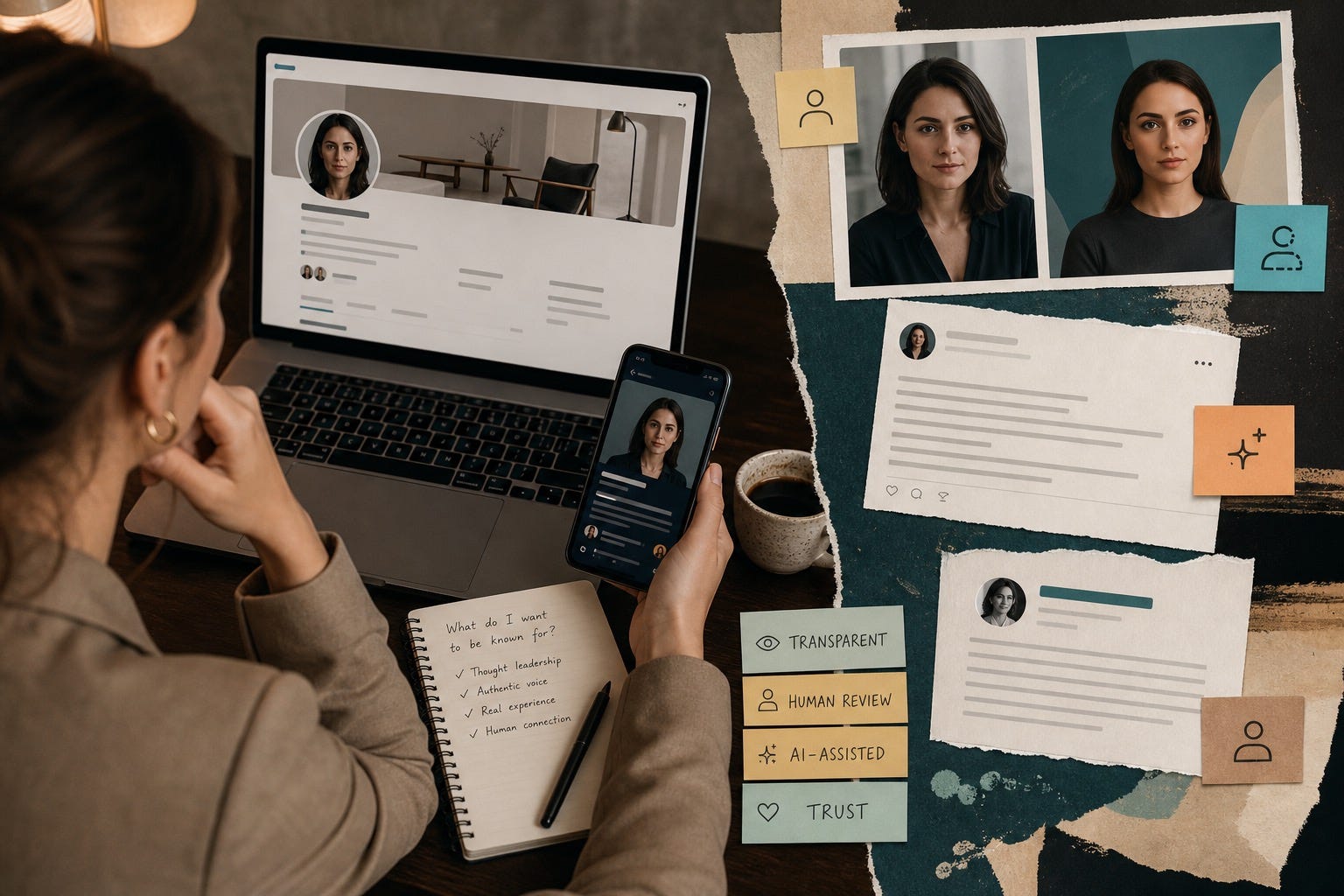
AI is now baked into the professional internet. People use it to rewrite their LinkedIn headlines, clean up their headshots, sharpen their bios, draft ghostwritten posts, build avatar videos, and repurpose voice notes into newsletters. That part is no longer surprising.
What is still messy is the trust question. If your profile photo was AI-edited, should you say so? If a founder uses AI to turn rough voice notes into a polished LinkedIn post, is that normal assistance or something that deserves disclosure? If your website uses an avatar version of you, does that make you efficient, deceptive, or both?
This matters more now because the environment is changing in concrete ways. LinkedIn already surfaces Content Credentials on supported image and video files. The European Commission says Article 50 transparency obligations under the AI Act are applicable from August 2, 2026. And Muck Rack’s May 2026 research found that earned media drives 84% of AI citations, which is another way of saying that credibility signals are becoming machine-readable, not just human-readable.
So here is the practical rule: disclose AI when not disclosing it would change how a reasonable person interprets your authenticity, your effort, or your identity. Do not turn disclosure into theater. Turn it into a trust system.
The Real Risk Is Not AI. It Is Ambiguity.
People rarely get angry because someone used AI as a drafting tool. They get uneasy when they feel a professional identity was manufactured to imply more originality, effort, realism, or personal involvement than was actually there.
That is why this conversation belongs inside personal branding, not just inside compliance or marketing ethics. Your personal brand is a reputation shortcut. It helps people answer quiet questions such as:
Is this person real?
Does this voice sound consistent across platforms?
Did they actually think this through?
Would I trust them with a client, team, audience, or budget?
AI becomes a problem when it blurs those answers.
Your audience does not need a confession every time you use AI. They need confidence that the person behind the brand is still accountable for what appears under their name.
The Three-Question Disclosure Test
Before publishing anything AI-assisted, run it through these three questions.
1. Does the output imitate your identity, likeness, or voice?
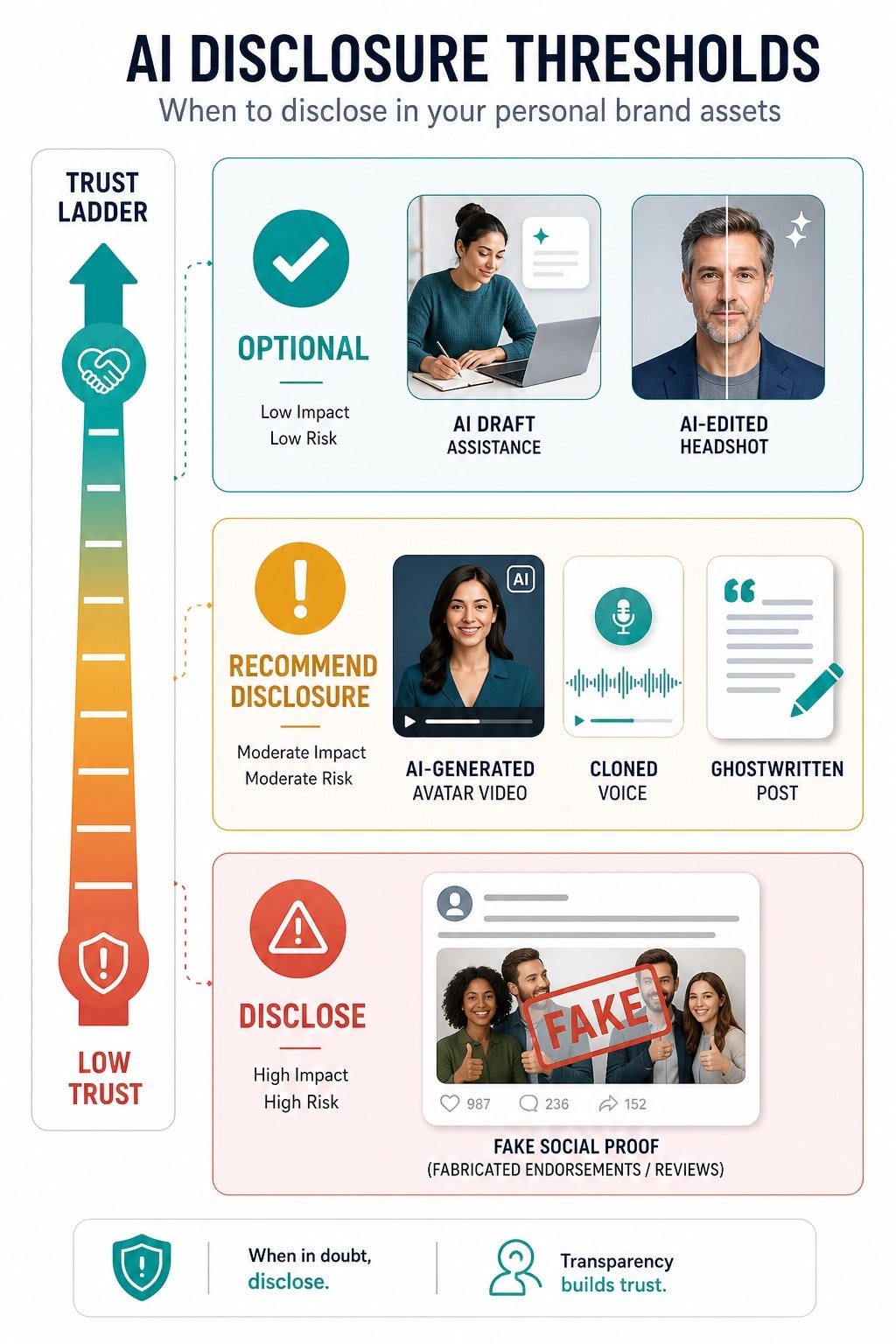
If the asset looks like you, sounds like you, or speaks as if it came directly from your mind, the bar is higher. AI avatars, cloned voice clips, synthetic speaking videos, and heavily generated headshots live here.
2. Would a reasonable person assume more direct human involvement than actually happened?
If a post reads like a deeply personal essay but was mostly assembled by AI from generic prompts, the issue is not the tool. The issue is the implied authorship.
3. Would disclosure increase trust more than it creates friction?
Not every assist needs a label. Spellcheck does not. Grammar cleanup does not. Light editing on a real photo usually does not. But if disclosure helps the audience interpret what they are seeing correctly, it is usually the better move.
Simple rule of thumb: the closer AI gets to representing your face, voice, lived experience, or opinions, the more disclosure matters.
Where Disclosure Is Usually Necessary
You do not need to announce every workflow detail. But there are a few personal-brand surfaces where disclosure is usually the smart move.
AI avatars and synthetic speaking videos
If the audience could reasonably believe they are watching you speak when they are actually watching a generated avatar, disclose it. This can be a short note in the caption, on the page, or in the intro frame. The purpose is not self-punishment. The purpose is preventing a hidden identity swap.
Cloned voice or first-person narration you did not record
If an audio clip sounds like you but was generated from text or trained from your voice data, people deserve context. This is especially important for founders, executives, educators, and consultants because voice carries authority.
AI-generated testimonials, endorsements, or composite social proof
This should be obvious, but it is worth stating plainly: never fabricate trust signals with AI. Do not generate client quotes, fake audience reactions, fake screenshots, or stylized proof that implies third-party validation. That is not a brand strategy. That is fraud in softer clothing.
Heavily generated or synthetic likeness assets
If your headshot is no longer meaningfully you, or if your website hero image presents a polished synthetic version of you that a client would not recognize on a Zoom call, you are entering disclosure territory. The more transformation involved, the more context helps.
Where Disclosure Is Usually Optional
Some professionals overcorrect and think every use of AI needs a public footnote. That creates noise, not trust.
Drafting and editing assistance
If you used AI to organize your thinking, summarize interview notes, improve readability, or convert voice notes into a first draft that you substantially reviewed, you usually do not need to disclose that. That is closer to editorial assistance than identity substitution.
Minor image cleanup
If a real photo of you was retouched for lighting, background cleanup, or blemish reduction, that is not radically different from traditional editing. The question is whether the image still reflects what someone would reasonably expect you to look like.
Research and brainstorming
Using AI to find patterns, extract FAQs, or test framing ideas is normal operational leverage. It affects process more than representation.
In short: not every AI use is a trust event. Focus on moments where AI changes what the audience believes about the person behind the output.
How to Disclose Without Sounding Defensive
The best disclosures are short, plain, and contextual. They do not sound like legal disclaimers, and they do not sound like a guilty conscience.
Good disclosure language
For an AI-edited image: “Photo based on a real headshot, lightly enhanced with AI for cleanup and lighting.”
For an avatar video: “AI avatar version of me, built from my scripts and reviewed by me before publishing.”
For AI-assisted writing: “Drafted from my voice notes with AI editing support.”
For research-heavy content: “Researched with AI support, final point of view and edits are mine.”
Notice what these do well. They explain the role of AI, preserve your accountability, and avoid melodrama.
What you want to avoid is vague language like “powered by AI” or “created with cutting-edge tools.” That kind of phrasing reads like marketing. Trust grows when the audience understands what was assisted and what was still human judgment.
The Trust Stack for AI-Assisted Personal Branding
If you want to use AI aggressively without eroding your reputation, build visible human signals around it. Think of disclosure as one layer in a larger trust stack.
1. Keep original thought visible
Publish ideas that clearly come from your experience: client lessons, field observations, operating principles, mistakes, tradeoffs, and changed opinions. AI can polish them. It cannot replace the value of having them.
2. Show proof, not just polish
Examples beat adjectives. Screenshots, frameworks, before-and-after decisions, annotated workflows, and case notes make your work harder to dismiss as synthetic fluff.
3. Maintain cross-platform consistency
If your website sounds one way, your LinkedIn another, and your Substack a third, people start to suspect outsourcing or automation drift. AI is useful here, but only if you train it on your actual language rather than generic “thought leader” patterns.
4. Use a human anchor format
One live or unmistakably human format goes a long way. This could be raw voice notes, unscripted Q&As, webinar clips, AMA threads, or commentary on your own work. It reassures people that the polished layer is not the whole story.

5. Make accountability obvious
When people can tell that you stand behind the output, disclosure becomes easier. The problem with generic AI content is not only that it sounds bland. It also feels ownerless.
Practical Workflows for Different Professional Identities
For founders
Use AI to turn voice memos, meeting notes, and rough bullet points into drafts. Review every post for specificity, opinion, and actual stakes. Disclose only when the output simulates your presence, such as avatar videos, synthetic founder updates, or image-heavy campaign assets that materially alter your likeness.
For consultants and freelancers
Your brand depends on judgment. If AI helps you package frameworks, proposals, or educational posts, that is fine. But if you present machine-generated positioning as if it came directly from client work or lived expertise, credibility drops fast. Tie every polished output back to real practice.
For job seekers
Be careful with AI headshots, bio rewrites, and first-person LinkedIn posts. Employers are not looking for technical purity. They are looking for signals that your profile still maps to a real person with real judgment. If the photo or narrative feels too manufactured, add a human counterweight such as project screenshots, a short video intro, or more concrete experience language.
For creators and educators
Your audience often cares more about process transparency than corporate audiences do. If you use AI to illustrate, summarize, narrate, or repurpose, say so when it helps the audience interpret the work. You are not reducing authority by being clear. You are showing editorial standards.
The Biggest Mistakes People Make
Hiding high-risk AI use: especially around avatars, cloned voice, and fake realism.
Over-disclosing low-risk AI use: which makes the whole brand feel oddly procedural.
Using disclosure as a substitute for quality: honesty does not rescue generic content.
Letting AI erase edge: if every sentence sounds smooth, neutral, and slightly inflated, trust falls even when nothing is technically deceptive.
Forgetting the offline test: if someone met you after seeing your brand, would the experience feel consistent?
The Better Standard
Most professionals do not need an AI disclosure policy page. They need judgment. They need a repeatable way to decide whether an audience is seeing assisted communication, synthetic identity, or plain old editing help.
The strongest personal brands will not be the ones that avoid AI. They will be the ones that use AI with clear authorship, visible proof, and selective transparency. That combination scales better than pretending everything is handcrafted and it ages better than trying to pass synthetic polish off as native credibility.
If you want one final rule to keep, use this: when AI helps you think faster, stay quiet and publish better work. When AI helps you imitate presence, be transparent.
FAQ
Should I disclose an AI headshot on LinkedIn?
If the image is a real photo lightly cleaned up with AI, disclosure is usually optional. If it is heavily generated, stylized, or materially different from how you actually look, disclosure is the safer trust-preserving choice.
Do I need to disclose AI writing on LinkedIn posts?
Usually not if AI helped with editing, structure, or rewriting your own ideas. Disclosure becomes more relevant when the post implies deep personal authorship but was mostly generated from thin input or generic prompts.
When should founders disclose AI avatars?
Founders should usually disclose AI avatars whenever viewers could reasonably think they are watching a real recording. A short caption or opening note is enough as long as it is clear.
Does AI disclosure hurt personal brand credibility?
Bad disclosure can sound awkward, but clear and proportionate disclosure often improves credibility. What hurts trust more is the feeling that something important was hidden.
What is the difference between AI assistance and AI deception in personal branding?
AI assistance helps you clarify, organize, or polish your work. AI deception changes what people believe about your identity, originality, or effort without giving them the context needed to interpret it correctly.
Should consultants and freelancers create a public AI disclosure policy?
Most do not need a full policy page. A lightweight internal rulebook is usually enough: disclose identity-simulating outputs, avoid synthetic proof, and keep final accountability clearly yours.