


A polished chatbot demo can show that you can call an API. An evaluation portfolio shows that you know when an AI system should not be trusted yet. That difference is becoming a career advantage.

There is a very common AI portfolio: a handsome interface, a short demo video, a GitHub repository, and a claim that the agent is “production-ready.” It is understandable. Shipping something visible feels like progress.
But a serious reader has a quieter question: How did you decide it works? What inputs break it? What did you compare? What did a human check? What changed after the first test?
An AI evaluation portfolio answers those questions in public. It is a small collection of well-documented evaluation case studies that make your judgment visible. For an AI engineer, technical founder, data professional, or career switcher, that can become a more credible personal-brand asset than another generic “AI enthusiast” post.
In a market full of demos, showing your testing discipline is one of the clearest ways to show that you can be trusted with real systems.
This is not a call to publish client data, make inflated accuracy claims, or build a giant benchmark. It is a practical way to turn careful work into visible proof—while keeping the human responsibility in the frame.
Why an AI evaluation portfolio makes a stronger personal brand
Personal branding is often mistaken for self-description. In technical work, it is better understood as repeated evidence. A good evaluation case study lets someone infer useful things about you: you can define a problem, create a fair test, notice limits, revise your work, and communicate tradeoffs without hiding behind jargon.
That matters because generative AI is non-deterministic. A smooth answer on one prompt does not prove reliability on the next fifty. The NIST AI Resource Center frames testing, evaluation, verification, and validation as core resources for putting AI risk management into practice. Meanwhile, the OpenAI Evals documentation treats an evaluation as testing criteria plus a data source, and supports running it across models and settings.
You do not need to be a standards body to borrow the habit. Your public portfolio can make a simple promise: “I do not confuse a plausible output with a validated system.”
What this signals to the right people
To hiring managers: you can move past tutorials and test a real failure boundary.
To clients: you understand that quality, safety, latency, cost, and user trust are design decisions.
To technical peers: you have a point of view about what “good” means, not just a list of tools.
To yourself: you have a reusable body of work that gets sharper whenever models change.
Choose a case study with an honest scope
Start smaller than you think. A personal brand does not improve because you publish the biggest project. It improves when people can understand what you tested, why it mattered, and what you learned.
Good portfolio scopes are specific, safe, and repeatable. You might evaluate whether a retrieval assistant cites supplied sources, whether a meeting-note assistant preserves action owners, whether a support-response prompt refuses unsafe requests, or whether three models follow a structured extraction format under noisy inputs.
Avoid using proprietary prompts, customer conversations, sensitive documents, or someone else’s benchmark without permission. Create synthetic but realistic examples, use public-domain material, or carefully anonymize your own data. If de-identification could still leave a person, company, or user recognizable, do not publish it.
A useful test: Could a skeptical colleague reproduce the core logic of your evaluation without needing private access or taking your conclusion on faith? If yes, you probably have a publishable scope.
The five-part structure of a credible evaluation case study
Think of every case study as a compact argument. You are not trying to look flawless. You are making your decisions inspectable.
1. Name the user task, not the technology
“I tested a RAG app” is vague. “I tested whether a benefits assistant answers employees only from a supplied policy pack” gives the reader a real job to understand. State the intended user, the task, and what a bad result would cost. This keeps the work connected to human use instead of model spectacle.
2. Write a small, representative test set
Create 20 to 50 cases rather than thousands of random prompts. Include normal requests, ambiguous requests, edge cases, and a few adversarial or misleading ones. Record why each case exists. A case is more valuable when it represents a known risk: unsupported claims, missing fields, poor refusal behavior, stale context, or a confident but wrong answer.
3. Define the rubric before you look at results
Choose a handful of observable criteria. For a source-grounded assistant, that might be factual support, citation correctness, completeness, helpfulness, and appropriate uncertainty. Decide what counts as pass, partial pass, and fail before you compare outputs. Otherwise, it is too easy to grade in favor of the answer you wanted.
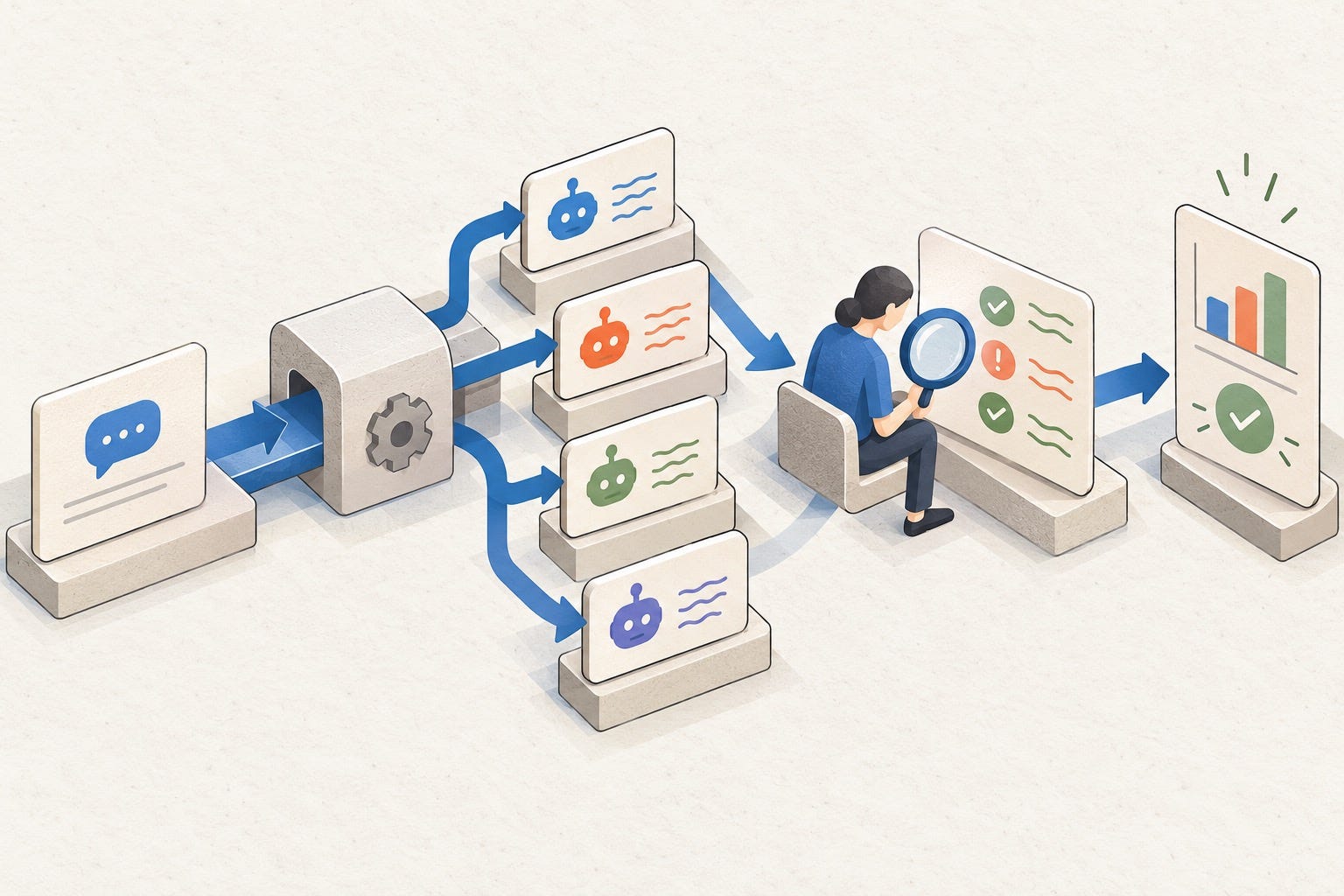
4. Show a failure, then show the revision
This is the section most portfolios omit, and it is often the strongest one. Include a de-identified example of a bad output. Explain the failure in plain language. Then describe the change you made: a better retrieval rule, a constrained output schema, a revised prompt, a human escalation step, or a narrower product claim. Re-run the test set and report what changed—and what did not.
Do not cherry-pick a single win. If you use model-based grading, say so and retain a human spot-check. A judge model can be helpful, but it is not a magic source of truth. The question is whether your evaluation method is proportionate to the risk and honest about its blind spots.
5. End with limitations and next tests
The final section should answer: where would this system still need a human? What did this test not measure? What would you test before a real deployment? This does not make you sound less capable. It makes your decision-making easier to trust.
Turn one evaluation into a personal-brand system
One well-made case study can travel farther than one social post. The key is not mass repurposing. It is translating the same evidence for different readers while keeping the original claim intact.
Your portfolio page: Publish the full case study with the problem, test set design, rubric, key examples, limits, and links to any safe code.
Your LinkedIn post: Share one surprising failure and the principle it taught you. Skip the “10x” claim; invite thoughtful disagreement about the tradeoff.
Your GitHub README: Make setup, data provenance, evaluation criteria, and known limitations easy to find before the installation steps.
Your bio: Replace “passionate about AI” with a defensible positioning line, such as “I build and evaluate source-grounded AI workflows for teams that need auditable answers.”
Your interview stories: Use the case study as a narrative: situation, risk, test design, surprise, revision, and what you would do next.
The system works because every asset points back to the same recognizable trait: you are someone who makes AI work more reliably, not merely someone who makes AI look impressive.
Use AI to accelerate the work—without outsourcing the judgment
AI is useful inside this workflow. It can propose edge cases, cluster recurring failure patterns, normalize a rubric, draft documentation, and turn your raw notes into a readable case-study outline. But it should not invent test outcomes, write a conclusion you have not verified, or decide that a system is safe.
Try this prompt after you have written your own rough notes:
I am documenting an AI evaluation case study for a public portfolio.
Here is my user task, test-set rationale, rubric, and human-reviewed observations:
[paste notes]
Help me create a concise case-study outline. Preserve uncertainty. Separate observed results from hypotheses. Flag any claim that would need more evidence. Do not invent metrics, users, deployment results, or citations. End with five questions a skeptical technical reviewer would ask.
Then review every sentence yourself. Your name is attached to the conclusion. The public value of the piece is precisely that your judgment remains visible.

Three mistakes that make the work less credible
Calling a score “accuracy” when it is not
Use the name that fits the measurement. A rubric score, preference rating, pass rate, or model-judge result is not automatically accuracy. State the denominator, the criteria, who reviewed it, and the scope. Precision in language is a personal-brand signal.
Publishing only happy-path demos
If every example works perfectly, experienced readers will assume the testing is thin. A controlled failure plus a reasonable mitigation tells a much more believable story.
Borrowing authority you have not earned
Do not imply you audited a production system, represent a client, or achieved compliance because you built a small experiment. Use clear labels such as “prototype,” “synthetic test set,” and “educational case study.” The NIST AI Risk Management Framework is useful context, but citing a framework is not the same thing as claiming certification.
A practical seven-day launch plan
Day one: Pick one user task with a real failure cost and write a one-sentence scope.
Day two: Draft 25 test cases, including five that should fail or escalate.
Day three: Create a plain-language rubric and ask one peer to challenge it.
Day four: Run the evaluation, save raw observations, and do human spot-checks.
Day five: Fix one meaningful weakness. Re-run the same set instead of changing the test to flatter the result.
Day six: Write the case study, including a limitation section and safe evidence links.
Day seven: Publish the full artifact and one short lesson from it. Ask for critique of the method, not applause for the demo.
That is enough to begin. Repeat it for a different class of risk next month. Over time, you will have a body of work that says something much more useful than “I use AI.” It says: “I know how to question it, test it, and take responsibility for what I ship.”
Frequently asked questions
What is an AI evaluation portfolio?
An AI evaluation portfolio is a collection of documented case studies showing how you test AI systems. It focuses on task definition, test cases, criteria, observed failures, revisions, and limits, so others can see your technical judgment.
Do I need to be an AI engineer to build an AI evaluation portfolio?
No. Product managers, QA professionals, researchers, developers, technical writers, and career switchers can create one. Choose a scope that matches your experience and be explicit about what you did and did not test.
How many examples should an LLM evaluation portfolio include?
One thoughtful case study is enough to start. Aim for a manageable test set—often 20 to 50 representative cases—rather than a huge collection you cannot explain or review.
Can I use AI-generated test cases in my portfolio?
Yes, if you review them. AI can help surface edge cases, but you should check that each case is relevant, safe, and correctly labeled. Document that AI assisted your process when that context helps a reader understand the work.
What should I avoid publishing in an AI testing portfolio?
Avoid private customer data, confidential prompts, credentials, personal information, proprietary documents, and claims you cannot substantiate. Use synthetic or permissioned data, redact carefully, and keep a human review step for anything sensitive.
How does an AI evaluation portfolio help personal branding?
It gives your personal brand an evidence base. Instead of asking people to trust a list of AI tools, you show how you frame risk, test outputs, learn from failures, and communicate tradeoffs—skills that are hard to fake and easy to recognize.