


A practical way for founders, executives, and experts to get help with public writing without outsourcing the judgment that makes their name worth following.

There is a new kind of personal-brand mistake. A founder posts regularly. The writing is crisp. The ideas sound plausible. Yet people who know the person cannot hear them in it.
This does not happen only when someone hires a ghostwriter. It happens when a busy professional hands a few thin bullets to an editor, an AI assistant, or a marketing teammate and expects a public point of view to appear. The output fills in the missing context with safe language. Soon, every post sounds competent and none of it sounds owned.
The answer is not to do every word alone. Good personal branding has always involved help: researchers, editors, designers, producers, and colleagues. The important question is whether the help preserves authorship. Can a reader still tell what you noticed, what you believe, what tradeoff you made, and what you would stand behind in a difficult conversation?
Your personal brand can be collaborative. Your judgment cannot be outsourced.
AI makes this distinction urgent because it removes the friction of producing polished language. That is useful for preparation, structure, and revision. But when a model, writer, or team starts deciding the opinion, inventing the example, or smoothing away the uncertainty, the content becomes less credible at the exact moment it becomes more publishable.
The real problem is not ghostwriting. It is a broken handoff.
Most leaders do not need another prompt. They need a clearer transfer of responsibility. In a strong workflow, the leader owns the experience and final position. The AI assistant organizes and challenges. The human editor shapes the piece for a real reader. Each person has a job that the others cannot quietly take over.
Without those boundaries, a few predictable failures follow. The writer receives a topic but not the tension behind it. AI sees a role title but not the actual work. The leader reviews late, when changing the argument feels expensive. Everyone assumes someone else checked the claim, the source, the confidential detail, or the tone. The piece is then “approved” because it is grammatically finished, not because it is true.
A better system starts by treating public writing as a handoff, not a request. The handoff should carry enough human material that a good editor can sharpen it without manufacturing a personality.
The four-stage AI ghostwriting handoff
1. Capture the raw signal before anyone writes
Start with a ten-minute voice note, a meeting reflection, an annotated article, or rough bullets. Capture the moment while the details still have texture. What happened? What did you expect? What made the decision hard? What did you reject? What would you do differently next time?
Do not begin with “write a LinkedIn post about leadership.” Begin with the actual work. A technical founder might explain why the team delayed an automation. A consultant might describe a client question that exposed a bad assumption. An executive might unpack a hiring decision that changed a team principle. These are not anecdotes for decoration. They are evidence of how you think.
Handoff rule: give collaborators the source material before you give them the desired format. A useful opinion comes from the specific situation, not the other way around.
2. Let AI prepare questions, not declare the lesson
AI is strong at finding gaps, contradictions, repeated themes, and missing context. Use that strength before drafting. Ask it to behave like a skeptical interviewer. The goal is to make the human source richer, not to make a premature paragraph prettier.
You are helping prepare a personal-brand essay. Do not draft it yet.
Based only on the notes below, identify the real tension, the decision or belief at stake, the reader who would care, and the claims that need evidence. Then ask five precise follow-up questions. Do not invent anecdotes, outcomes, credentials, or numbers.
Notes: [paste voice-note transcript, rough bullets, or meeting reflection]
That last instruction matters. A useful AI assistant should make a leader pause and remember, not rush them toward an impressive sentence. If it cannot find enough source material, the right output is a question—not a generic draft.
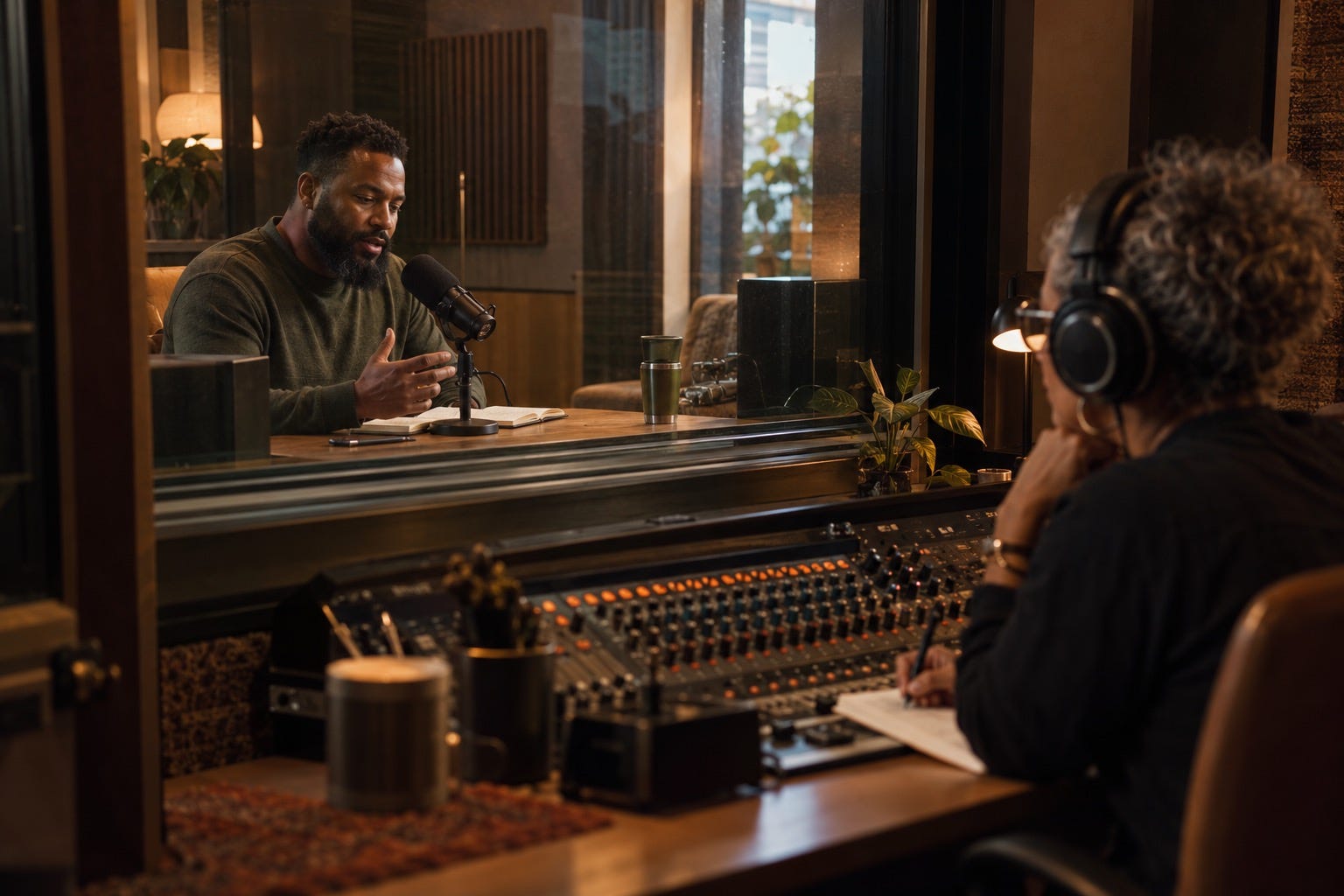
3. Give the editor a handoff sheet, not a blank assignment
A human editor or ghostwriter should receive more than a topic and a target length. Create a simple handoff sheet for each important piece. It can fit on one page:
Reader: Who needs this, and what pressure are they under?
Point of view: What do you believe that is more useful than the default advice?
Proof: Which lived example, result, observation, or source makes the point believable?
Constraint: What does the advice not cover? What cannot be shared?
Language: Which phrases sound natural, and which phrases would you never say?
Decision owner: Which claim, example, or conclusion needs the leader’s explicit approval?
This is not bureaucracy. It protects the leader from false fluency and protects the writer from guessing. It also makes a fairer collaboration possible. The editor is judged on clarity, structure, and reader usefulness—not on their ability to impersonate a person from a job title.
4. Review for ownership, not just polish
Many leaders review a draft by asking, “Does this sound good?” That is too low a bar. A polished draft can still be wrong, bland, overconfident, or strangely unlike its named author.
Instead, run an ownership review. Read the draft aloud and ask:
Would I say this to a smart peer without a script?
Can I point to the real experience behind every important claim?
Did the draft preserve the rejected option, constraint, or uncertainty that makes the lesson credible?
Is any sentence pretending I had more control, certainty, or success than I did?
Does this answer a reader’s real question, or does it only make me look informed?
If the answer to the first question is no, do not merely swap a few adjectives. Return to the source. Record a two-minute response about what feels false. That often gives the editor exactly the missing material.
What AI can own—and what must stay human
AI is useful when the task is organizational or comparative. Let it transcribe a voice note, group recurring questions, create an outline, identify vague claims, compare versions of a bio, suggest a clearer order, or flag missing evidence. These are high-leverage jobs because the system can save time without pretending to have lived your work.
Keep direction with a human when the task changes what readers believe about you. A person should own the opinion, the story selection, the claim, the disclosure decision, the response to criticism, and the final approval. That is especially true for customer stories, hiring, layoffs, health, safety, legal issues, investor communications, political views, and anything that can create a promise or a misunderstanding.
The boundary is not “AI or no AI.” The boundary is whether AI is helping you express evidence or creating the appearance of evidence. If it is the latter, slow down.
How the handoff changes by role
Founders should hand off customer patterns, product decisions, failed assumptions, and strategic tradeoffs. Do not let a writer turn a private roadmap into a motivational story or a team win into a solo-founder myth.
Executives should give collaborators a clear boundary between personal observation and company position. A polished post that appears to speak for the whole organization can create trouble when it was only one leader’s thinking.
Consultants should anonymize client material before it reaches a broad AI workspace. The useful lesson is usually the pattern, not the identifying detail. Tell the editor what proof can be named, what must be generalized, and what should not be published.
Creators and independent experts can use the workflow to keep speed from flattening their perspective. Send an editor the original voice note or messy first draft, not only an AI summary. Your unexpected examples and turns of phrase are often the strongest part of the brand.
A weekly workflow that will actually survive a busy calendar
On Monday, save one voice note or work reflection. On Tuesday, let AI ask follow-up questions. On Wednesday, choose one idea that has a clear reader and real proof. On Thursday, hand the source packet and handoff sheet to an editor, or use them to shape your own draft. On Friday, do the ownership review and publish only if the named person can defend every important sentence.
That rhythm produces less volume than an automated content machine. It produces something more valuable: a body of work that accumulates recognizable judgment. Over time, your profile, essays, interviews, and short posts begin to carry the same signal. People understand what you notice and when you are useful.

That is the point of an AI ghostwriting workflow for personal branding. It is not to make one person look like a larger content team. It is to make the real person easier to recognize, understand, and trust—even when a team helps bring the work to life.
FAQ
Is AI ghostwriting bad for personal branding?
No. It becomes risky when it replaces the person’s judgment, experiences, or accountability. It can be useful for research, transcription, outlining, editing, and repurposing when the named author provides real source material and approves the final claims.
How do I keep AI-written content in my own voice?
Start with your own voice notes, annotated drafts, examples, and opinions. Ask AI to interview and organize that material before it drafts. Then read the result aloud, remove language you would not naturally use, and add the constraint or experience that makes the idea yours.
What should I give a ghostwriter or editor?
Give them the reader, the point of view, proof, a real example, confidentiality limits, phrases to use or avoid, and a list of claims requiring approval. A topic alone forces a writer to guess.
Should founders disclose AI assistance in personal-brand content?
Consider disclosure when AI materially changes what a reasonable reader would believe about authorship, identity, evidence, or effort. Quiet editing and organization usually carry lower risk than synthetic testimony, fabricated visuals, cloned voice, or a bylined story built without real input.
Can an AI assistant publish content for me automatically?
Automatic publishing is usually a poor fit for opinionated or reputation-sensitive work. Keep a human approval gate for posts, comments, direct messages, strong claims, and stories that could create trust, risk, or confusion.
How often should I publish AI-assisted personal-brand content?
Choose a rhythm you can sustain while keeping source quality high. One useful, well-owned piece each week is more valuable than a daily stream of generic posts that nobody can connect to your actual work.
Further reading: LinkedIn’s guidance on responsible professional participation, Google Search Central’s helpful, reliable, people-first content guidance, and recent discussions on executive ghostwriting workflows.