



If you use an AI headshot for LinkedIn, most people will not care that AI was involved. They will care whether the image feels honest, current, and believable. That is the real test.
That question matters more now because the tools got better and the audience got more skeptical at the same time. Search demand around AI headshots has stayed strong over the past year, while recent LinkedIn and career threads keep circling the same anxiety: “Will this make me look polished, or will it make me look fake?”
That anxiety is rational. Your LinkedIn photo sits beside your name, headline, comments, DMs, and thought leadership. It is not just decoration. It is part of your digital identity. If the image looks too perfect, too young, too smooth, or too unlike you in real life, the photo quietly starts working against your personal brand.
The best AI headshot is not the most impressive one. It is the one nobody stops to question.
There is another reason this topic matters: trust is now the real currency of professional content. In the 2024 Edelman-LinkedIn B2B Thought Leadership Impact Report, 73% of decision-makers said thought leadership is a more trustworthy basis for judging capabilities than marketing materials. That means the visual layer around your profile has to support trust, not introduce doubt.
The short answer: yes, you can use one, but only if it passes a credibility test
An AI headshot for LinkedIn can be a smart move when you need a recent, clean, affordable image and you do not have time for a photographer. It can also be a bad move when you use it to look richer, younger, thinner, more glamorous, or more “executive” than you really are.
Use an AI headshot when it accurately represents how you look today.
Use it when it improves lighting, crop, wardrobe clarity, and background quality.
Do not use it when it changes your face, age, body, ethnicity, or overall presence.
Do not use it when meeting people in real life soon would make the photo feel misleading.
If you remember only one idea from this article, remember this: on LinkedIn, believable beats beautiful.
The seven-point credibility test
1. Does it still look like you on a normal Tuesday?
This is the first filter. If someone met you on Zoom tomorrow, would they recognize you immediately? A good AI headshot should look like the polished version of your real self, not a parallel-universe upgrade. If your haircut changed, your age looks off, your jawline suddenly sharpens, or your skin texture disappears, you are no longer improving the photo. You are changing the person.
2. Is the expression trustworthy, not over-engineered?
Most bad AI headshots fail here. They push the expression into an uncanny middle ground: too symmetrical, too intense, too eager, or too frozen. For most professionals, a calm, alert, approachable expression wins. Founders can lean more direct. Consultants can lean warm. Executives can lean composed. But almost nobody benefits from the hyper-perfect “I am a startup guru” face.
3. Does the styling match your field?
A strong personal brand looks context-aware. If you work in enterprise software, your headshot should not look like a nightclub campaign. If you are a designer, it does not need to look like a law firm directory. The point is not to flatten your personality. It is to signal that you understand the social rules of your market.

4. Does the texture feel human?
Over-smoothed skin, glassy eyes, too-clean teeth, and perfect gradients create the “scammy” reaction people describe in comment threads. Real people have pores, tiny asymmetries, soft shadows, and fabric folds. If your AI image removes every trace of physical reality, viewers may not consciously know what is wrong, but they will feel something is off.
5. Is the background helping, or trying too hard?
The safest backgrounds are simple studio tones, a clean office feel, or a muted outdoor blur. Most professionals do not need a skyline penthouse, dramatic neon, or luxury set dressing. Your background should frame your face, not try to sell an invented lifestyle.
6. Does it match the rest of your profile?
This is where many people miss the real issue. A polished AI headshot can still fail if the rest of the profile looks neglected. If the photo says “high-trust operator” but the headline is generic, the About section is vague, and your last post was 14 months ago, the image creates friction instead of authority. Personal branding works when your signals agree with each other.
7. Would you be comfortable if someone asked, “Is this AI?”
If that question makes you panic, the image is probably too far from reality. You do not need to announce the workflow in every case. But you should be comfortable saying something like, “Yes, I used an AI-assisted headshot based on current photos because I needed a clean update quickly.” If that sentence sounds embarrassing, rethink the image.
Who should use an AI headshot, and who should be more careful?
Job seekers
Job seekers can use AI headshots, but only with restraint. In hiring markets flooded by fake profiles and low-trust applications, a too-perfect image can trigger the wrong instinct. A realistic AI-assisted update is better than a cropped wedding photo or an old selfie. But if you are applying in law, finance, government, or senior corporate roles, a real photographer still gives you the safest signal.
Founders and consultants
You have more flexibility, but also more downside. Your personal brand often sits close to sales, partnerships, and investor conversations. People are not just evaluating whether you look professional. They are evaluating whether you look real. If you publish regularly on LinkedIn, the better question is not “Can I get away with AI?” It is “Does this image strengthen my trust stack?”
Creators and indie experts
If your brand is already opinion-led and internet-native, audiences will tolerate more experimentation. But even here, authenticity still matters. If your written voice is sharp, specific, and human while your image looks strangely frictionless, the mismatch becomes noticeable fast.
Executives and public-facing leaders
Be the most conservative. The higher the role, the less useful “good enough” becomes. If you speak at events, appear in media, or lead a visible company, people compare your image to real-world appearances more often. An AI headshot may still work, but it has to be almost invisible as a workflow.
How to create an AI headshot without damaging your personal brand
The safest workflow is simple and boring, which is exactly why it works.
Start with recent photos taken in natural light from multiple angles.
Choose wardrobe that you would actually wear to a client call, interview, or conference.
Generate several restrained options, not one dramatic “best” option.
Reject anything that changes your age, face shape, hairline, skin tone, or body.
View the image at small LinkedIn sizes, not just full screen.
Ask two people who know you well: “Would this feel normal if you saw it on my profile?”
That last step matters. Personal branding is not self-expression in isolation. It is perception. The image has to survive contact with other humans.
One more practical note: do not select the most glamorous output. Select the most plausible output. That is usually the one with slightly less perfect lighting, less aggressive retouching, and more recognizable facial character.
What about AI avatars?
This is where professionals need a clearer rule. An AI headshot is a still image that can act as a clean update to an existing identity. An AI avatar is more powerful and riskier because it performs your identity in motion.
Use an AI avatar only when it helps you distribute ideas you already own, and when the audience would still feel respected if they knew how it was made. That usually means short, useful, clearly positioned content. It does not mean pretending an avatar is the same as your unmediated presence.
If your whole personal brand depends on trust, nuance, or high-stakes relationships, treat the avatar as support, not substitution. Your audience can forgive efficient production. They rarely forgive feeling tricked.
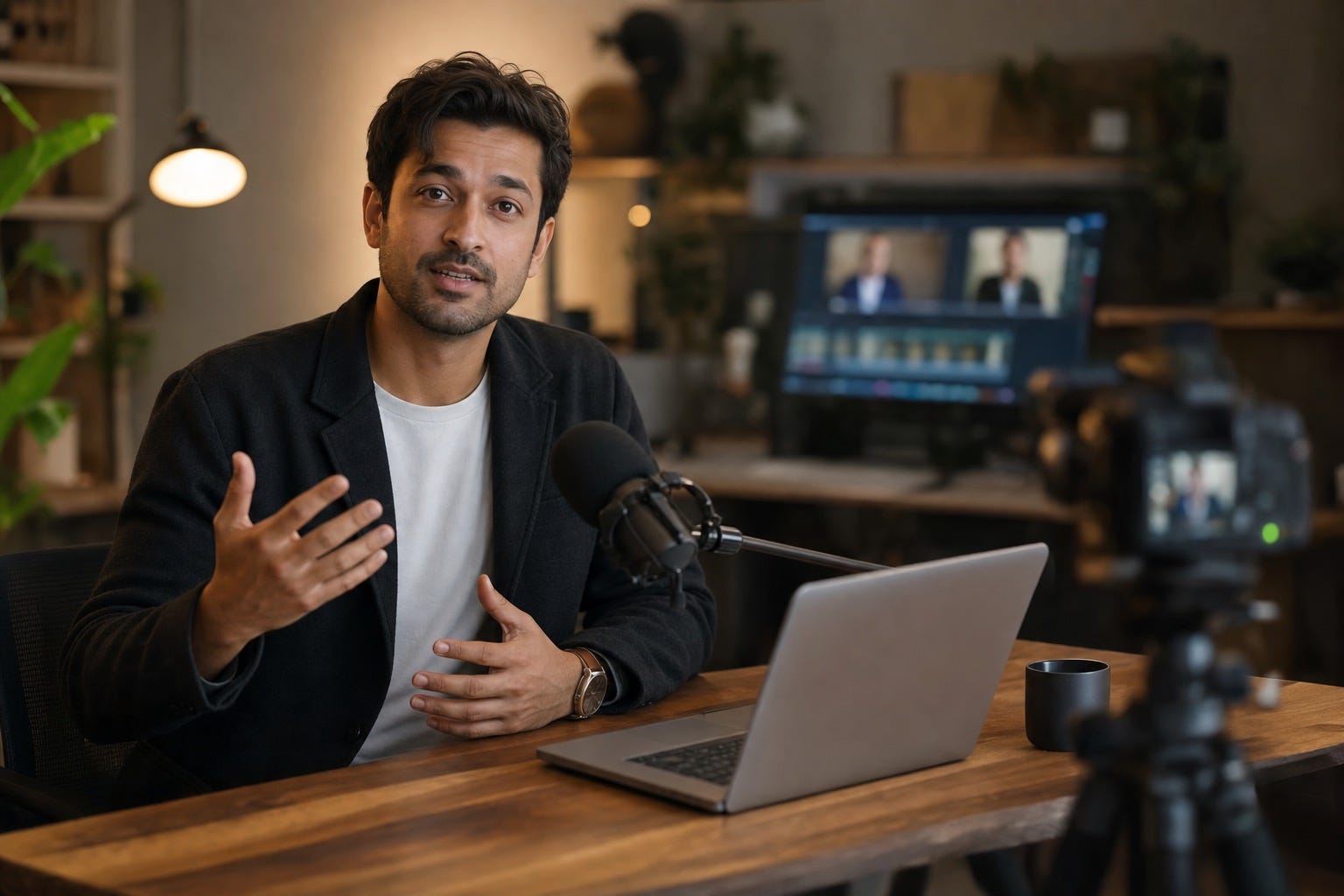
Your photo is only one layer of the trust stack
This is the bigger strategic point. Many people obsess over the image because it feels easy to fix. But a stronger headshot does not rescue a weak personal brand. What actually creates authority is a stack of aligned signals:
A clear headline that says what you do and who it helps.
A specific About section that sounds like a person, not a generic positioning statement.
Proof of work in Featured, posts, comments, or case studies.
A consistent voice that does not sound copied from every other AI-assisted profile.
A face that looks like the same person who wrote the profile.
That last point is why this debate matters. People are tired of AI sameness. On LinkedIn especially, the audience is already suspicious of content that feels mass-produced, heavily optimized, or emotionally synthetic. A believable AI headshot can still work, but it has to sit inside a profile that feels lived-in and human.
The good news is that this creates an opening. If everyone else is using AI to become more polished, you can use AI to become more consistent while staying recognizable. That is a better personal branding strategy.
The better standard for 2026
The wrong standard is “Can AI make me look impressive?” The better standard is “Can AI help me look current, credible, and easy to trust?”
That shift sounds subtle, but it changes everything. It moves you away from vanity and back toward reputation. It keeps AI in the role it plays best: helping you remove friction, not invent a false version of yourself.
If your AI headshot helps people recognize you, trust you, and keep reading, it is doing its job. If it makes them hesitate for even half a second, it is too polished for the role you need it to play.
FAQ
Are AI headshots acceptable on LinkedIn in 2026?
Yes, if they look like a truthful, current version of you. The problem is usually not the use of AI itself. The problem is when the result looks artificial, misleading, or inconsistent with how you appear in real life.
Will recruiters reject me for using an AI headshot?
Most recruiters are not screening for AI as a category. They are screening for trust, professionalism, and plausibility. A believable AI headshot can be fine. An uncanny or over-polished one can quietly raise doubts.
Should I disclose that my LinkedIn headshot was AI-generated?
You usually do not need a formal disclosure for a still image if it accurately represents you. But you should be comfortable being honest if asked. If the image depends on hiding how synthetic it is, it is probably not the right image.
Is an AI headshot better than no photo on LinkedIn?
In many cases, yes. A clean, believable AI-assisted headshot is often stronger than no photo, an outdated image, or a poor-quality selfie. But a low-trust AI image can be worse than a simple real photo.
What makes an AI headshot look fake?
The usual giveaways are plastic skin, strange eyes, impossible symmetry, over-dramatic lighting, invented wardrobe signals, and a version of you that looks ten years younger or much more glamorous than reality.
Can founders use AI avatars for LinkedIn videos?
They can, but with caution. AI avatars work best when they help distribute real expertise more consistently. They work poorly when they replace genuine presence in high-trust relationships or feel like a performance designed to hide the human behind the brand.