


The labor market is splitting in two. General tech hiring is still shaky, but specialized AI-linked roles keep growing. In that kind of market, a polished LinkedIn profile is useful. A personal branding video for LinkedIn is stronger because it shows how you think, what you have built, and why someone should trust you.
This week’s headlines made the shift hard to ignore. New reporting on May 6 and May 7 showed AI hiring continuing to rise even as overall tech layoffs keep climbing. That sounds contradictory until you look closely. Companies are not paying extra for generic talent. They are paying for people who can explain problems clearly, ship work fast, and adapt to AI-heavy workflows.
That is why the old playbook is weakening. A text-only profile can list your skills. It cannot easily prove judgment, communication, or presence. A strong personal branding video for LinkedIn can do all three in under two minutes, and it can keep working for you long after you post it.
This article is for professionals, founders, consultants, and job seekers who want something more credible than vague thought leadership. You will learn what to say, what to show, how to use AI without sounding machine-made, and how to turn one video into a repeatable career asset.
Why this matters now
In a loose market, you can blend in and still get interviews. In a tighter market, blending in becomes expensive. Recruiters skim faster. Buyers compare more options. Clients want evidence. Founders want operators. Managers want people who can reduce noise and increase speed.
The new premium is not just skill. It is legible skill. People need to understand your value quickly.
That is what video does well. It compresses context. Someone can hear your framing, see your examples, and decide whether you sound credible within seconds. LinkedIn is especially important because it sits at the intersection of reputation, distribution, and search visibility. A personal branding video for LinkedIn is not entertainment content. It is a trust asset.
There is another reason this format is timely. AI video tools are getting easier and cheaper. More professionals can now create polished content without hiring a production team. That lowers the barrier, but it also raises the standard. If anyone can make a smooth-looking clip, the people who win will be the ones who say something precise, useful, and memorable.
What most LinkedIn video advice gets wrong
Most guides focus on surface mechanics. They talk about aspect ratio, captions, thumbnails, and ideal length. Those details matter, but they are not the core problem. The real challenge is positioning.
Weak videos usually fail in one of five ways:
They introduce the person, but not the value they create.
They sound polished, but too generic to trust.
They talk about goals, but show no proof of work.
They use AI to speed up writing, then keep the robotic phrasing.
They ask for attention before earning it.
The better model is simple. Treat the video like a compact case study about your professional edge. Do not answer “Who am I?” first. Answer “Why should this person keep watching?”
The job your video needs to do
A personal branding video for LinkedIn should accomplish four things in sequence.
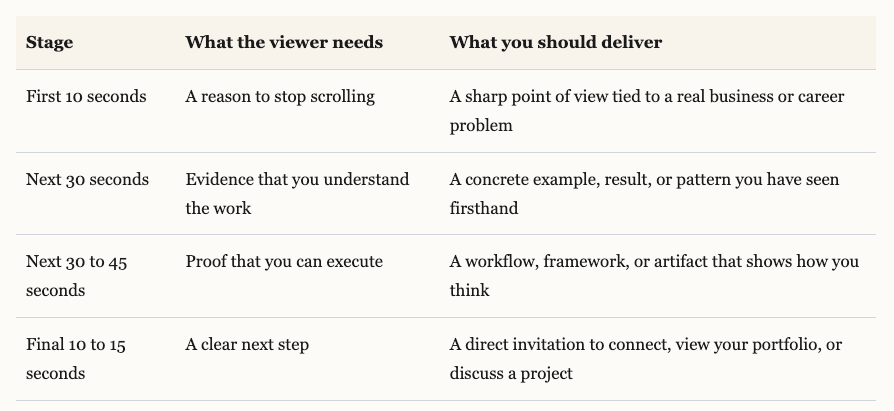
This structure works because it respects professional attention. You are not trying to go viral. You are trying to make the right person think, “This person gets it.”
A better script framework for 2026
Here is a practical structure that works for consultants, marketers, operators, founders, designers, engineers, and AI builders.
Part 1: Start with a market truth
Open with something timely and defensible. For example: “AI hiring is still growing, but the people getting picked are the ones who can show clear proof of work.” That is stronger than “Hi, I’m a passionate professional.”
Part 2: Define your lane
State the category you operate in and the problem you solve. Keep it plain. “I help B2B teams turn messy product knowledge into buyer-ready content systems.” Or: “I build AI automations that remove manual reporting from finance workflows.”
Part 3: Show one proof point
Use one example, not five. A single clear example is more persuasive than a list of adjectives. Mention a workflow you built, a process you improved, or a content system you launched.
Part 4: Explain your method
This is where professionals stand out. Explain how you approach the work. Good employers and clients are hiring for thinking style as much as task execution.
Part 5: End with a clean next step
Invite a specific action. “If you are hiring for AI-enabled operations, I’d be glad to share the workflow behind this.” Direct beats clever.
How to use AI without sounding fake
AI is useful in the production process, but it should not replace your professional voice. The right workflow is assisted, not outsourced.
Use AI for these tasks:
Turning raw notes into a rough first structure
Generating alternative hooks for different audiences
Condensing a long case study into a 60-second version
Creating caption drafts and shot lists
Testing multiple calls to action
Do not let AI do these tasks without heavy editing:
Writing your final opening sentence
Describing your professional values
Inventing fake confidence or fake metrics
Adding empty phrases like transformative, game-changing, or passionate
A useful rule: if a sentence could belong to ten thousand other professionals, cut it.
One simple workflow is to write your raw answer out loud first, then let AI compress it. That keeps the source material human. If you want a fast draft environment for turning a script, headshot, and work samples into a cleaner talking-video prototype, https://portfoliovideo.com is one option, but the differentiation still has to come from your ideas and examples.
What to show on screen
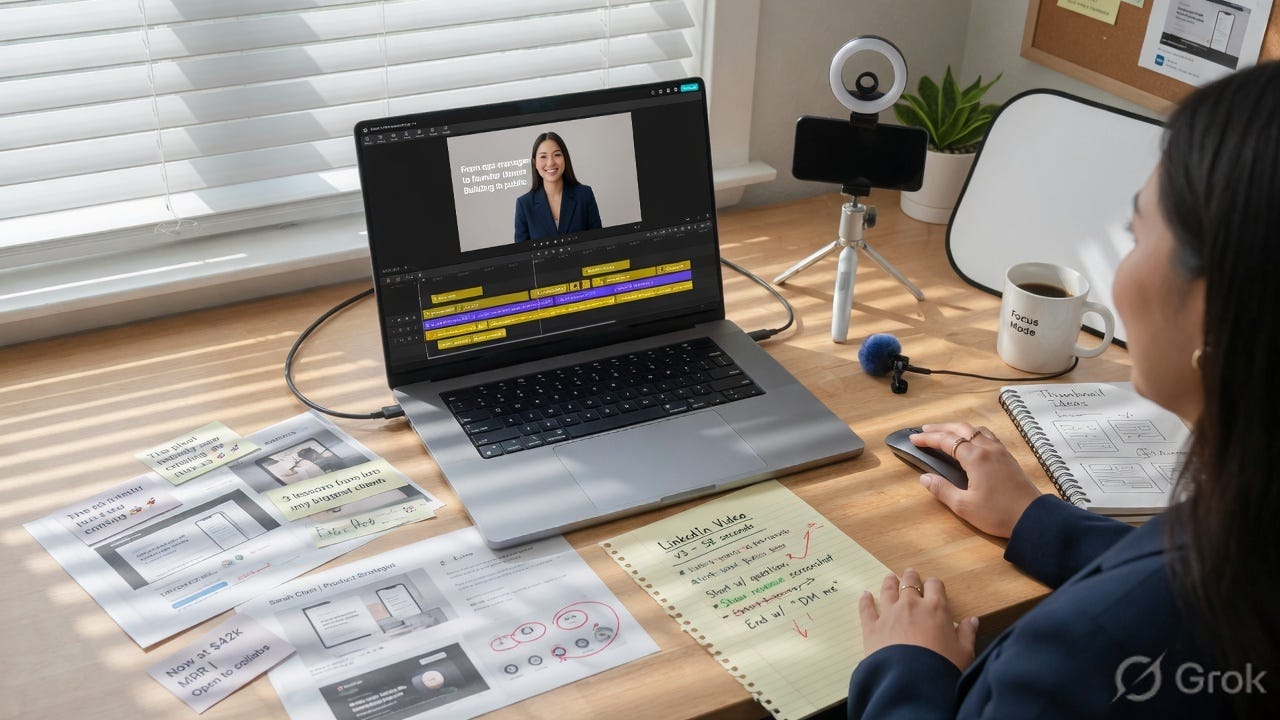
The best personal branding video for LinkedIn is rarely just a face talking to camera. For professional audiences, visual proof helps. Your visuals should make your expertise easier to believe.
Useful on-screen assets include:
A one-line positioning statement
A short list of problems you solve
Before and after screenshots
A process diagram
Client deliverable excerpts with sensitive details removed
Metrics snapshots, if they are real and contextualized
Product interfaces, dashboards, or prototypes you worked on
Think of your visuals as receipts. They do not need to be flashy. They need to reduce doubt.
A practical production workflow
You do not need a studio. You need a repeatable system. Here is a lightweight workflow that balances speed and quality.
Write one sharp claim tied to a current market reality.
Choose one audience: recruiter, buyer, client, collaborator, or investor.
Draft a 120 to 180 word script.
Pull three proof visuals from your existing work.
Record or generate a clean talking-head segment.
Add captions because many professionals watch without sound first.
Trim any sentence that sounds inflated.
Post natively on LinkedIn with a short text introduction that frames the point.
If you want the process to stay consistent across multiple videos, document the inputs once. This can be as simple as a JSON-style brief.
{
  "audience": "AI operations hiring manager",
  "market_truth": "teams want people who can automate recurring work without breaking trust",
  "proof_point": "reduced weekly reporting time from 6 hours to 40 minutes",
  "visuals": [
    "workflow diagram",
    "before-after dashboard",
    "checklist for handoff"
  ],
  "cta": "connect if you are hiring for AI-enabled operations"
}
This kind of brief helps you or your team generate variations without drifting into blandness.
Examples by audience
For job seekers
Your goal is not to summarize your resume. Your goal is to show how you operate. A strong video resume or video portfolio should translate your best work into outcomes, constraints, and decisions. Talk about one project and what changed because of your contribution.
For founders
Use the video to show clarity of narrative. Investors, advisors, and early partners want to see conviction without chaos. Explain the problem, why now, and what insight gives you an edge. Keep jargon low. Specificity builds confidence.
For consultants and freelancers
Focus on trust transfer. Buyers want to know whether you can understand their business quickly. Use your video to demonstrate diagnosis, not just delivery. Show how you frame a messy problem and what your first thirty days usually look like.
For in-house professionals
If you are not job hunting, the video still matters. It can create internal leverage, attract speaking invitations, strengthen your network, and make you easier to remember when new roles appear.
Common mistakes that quietly hurt conversion
Starting with your title instead of your insight
Talking too long before showing anything concrete
Overusing AI voice polish until your delivery feels sterile
Trying to sound impressive instead of understandable
Posting once and expecting compounding results
Ignoring comments and follow-up conversations after publishing
LinkedIn is not just a publishing platform. It is a response loop. If your video attracts the right people, the next opportunity often comes from the conversation beneath it, not from the post itself.
How to measure whether the video is working
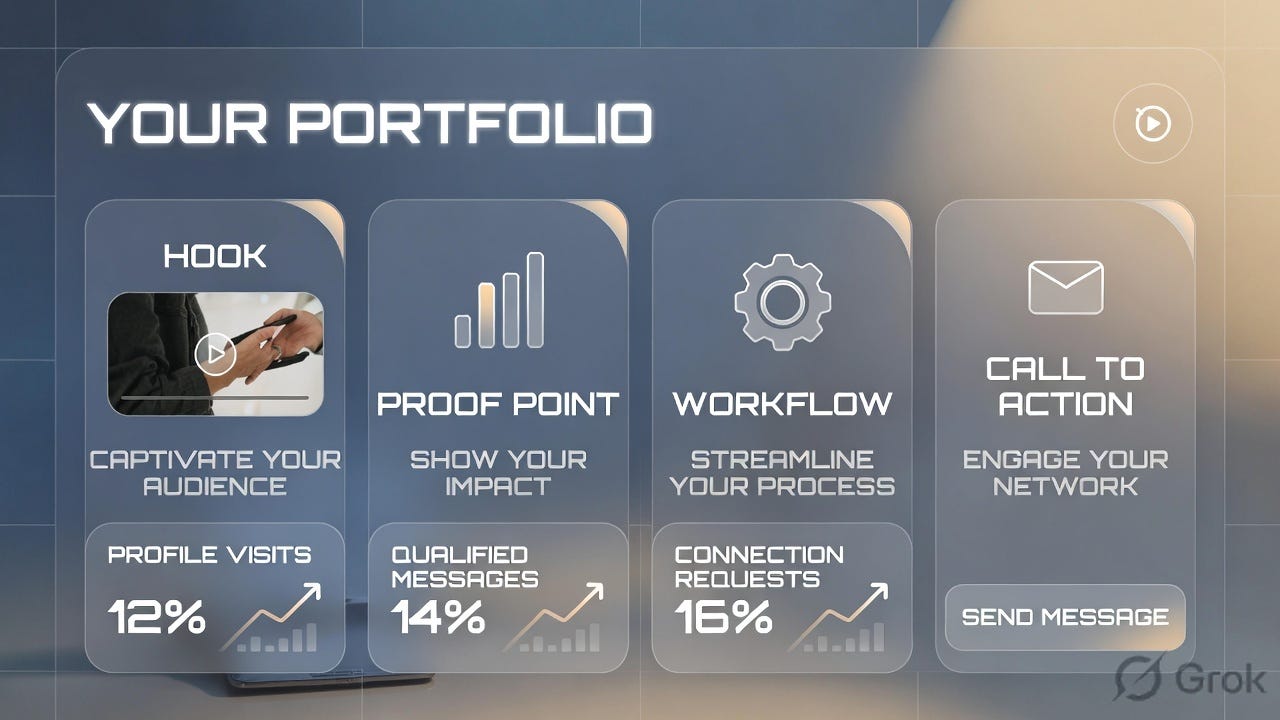
Vanity metrics can distract you. A personal branding video for LinkedIn should be evaluated like a business asset.
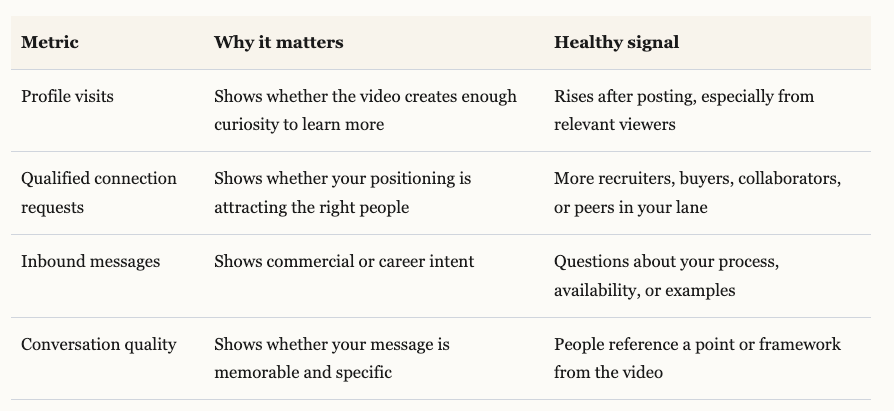
Notice what is missing from that table. Raw impressions. Reach is useful, but trust is the real output.
Your next move
The professionals who benefit most from this moment will not be the loudest ones. They will be the clearest ones. As AI keeps changing how teams hire, buy, and evaluate talent, the people who can package real expertise into a short, credible format will keep gaining ground.
A personal branding video for LinkedIn gives you leverage because it is reusable. It can support your profile, your outreach, your applications, your creator strategy, your consulting funnel, and your internal reputation. One good video can do the work of dozens of scattered claims.
Do not wait until you urgently need visibility. Build the asset while you still have time to think well. Pick one professional truth, one proof point, and one audience. Then make the clearest case for your value that you can.