


Most people use AI to make LinkedIn recommendations faster. The smarter move is to use AI to make them more specific, more credible, and more human.
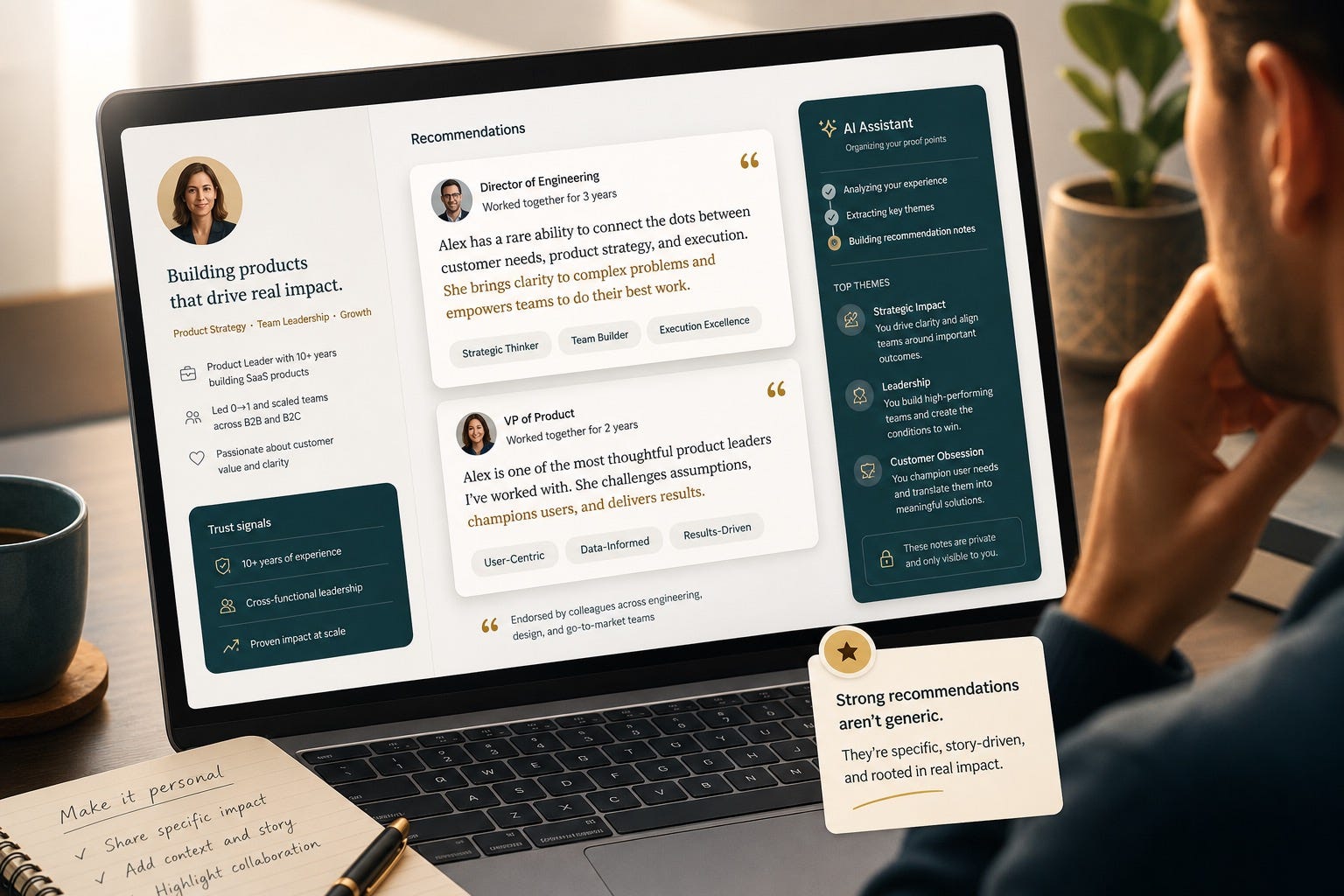
Recommendations still work best when AI helps you remember the facts, not replace your voice.
LinkedIn just gave professionals a very clear signal about where the platform is going. In its June 4, 2026 pressroom update on authenticity, LinkedIn said low-effort AI content that lacks real perspective is less likely to spread beyond a person’s immediate network. In the same update, the company said its early testing identifies generic content correctly 94% of the time. That matters if you are building a personal brand with AI.
It means the bar has moved. Polished is no longer enough. Fast is no longer enough. If your profile, posts, comments, and recommendations all sound like they came from the same prompt library, you may look efficient, but you will not look memorable.
That is exactly why LinkedIn recommendations matter more now, not less. They are one of the few public trust assets on the platform that still feel grounded in lived experience. Someone else is attaching their name to your work. They are not just endorsing a skill with one click. They are telling a story about what it was like to work with you.
The mistake is assuming AI should write that story for you. It should not. AI should help you surface details, organize evidence, and remove blank-page friction. The final language still needs to sound like a real human who remembers a real project.
In an AI-saturated credibility market, vague praise is weaker than silence. Specific praise is social proof.
Why LinkedIn recommendations are a better trust signal than most people realize
Many professionals treat recommendations like profile decoration. They focus on the headline, profile photo, banner, and featured section, then leave recommendations alone for years. That is a miss.
LinkedIn’s own help documentation defines a recommendation as a commendation written by a member to recognize your work. More importantly, LinkedIn says recommendations are visible to your network after you accept them, and your public profile shows the number of people who have recommended you plus a maximum of two received recommendations. That last detail changes the strategy.
If public visitors only see the count and up to two recommendation excerpts, you do not need twenty-five interchangeable blurbs. You need a handful of highly credible recommendations that reinforce the exact reputation you want to build.
For a founder, that might mean one recommendation that proves strategic clarity and another that proves execution under pressure. For a consultant, it may be one recommendation from a client and one from a partner. For a job seeker, it may be one manager recommendation and one peer recommendation that shows collaboration, ownership, and communication.
Simple rule: optimize recommendations for reputation shape, not recommendation count. Ask yourself, “If a stranger only reads two of these, what should they conclude about me?”
What AI should do in the recommendation process
AI is useful in three parts of the workflow.
Memory recovery. It helps the writer remember projects, outcomes, timelines, and specific contributions.
Pattern finding. It helps identify what themes show up repeatedly in how others describe your work.
Draft structuring. It helps turn rough notes into a clean first draft that a human can revise.
AI is not useful when it becomes the source of the praise itself. The second the recommendation starts sounding universally applicable, the trust disappears. Generic adjectives such as “hardworking,” “strategic,” “great communicator,” and “collaborative” only become believable when they are attached to scenes, decisions, and outcomes.
The trust-first workflow for asking for LinkedIn recommendations
The best recommendation requests reduce effort for the other person without scripting their opinion for them. That is a delicate line. You want to help, not ghostwrite yourself into a flattering testimonial.
Step 1: Choose the role each recommendation should play
Before you ask anyone, decide what trust gap you are trying to close. Most people request recommendations randomly from whoever likes them. That creates a messy profile.
Instead, map the recommendation types you need:
Authority recommendation: from a manager, founder, executive, or respected client who can validate high-level impact.
Collaboration recommendation: from a peer, partner, or cross-functional teammate who can show how you work with others.
Transformation recommendation: from a client or stakeholder who can describe a before-and-after result.
This is where AI can help. Paste your target audience, role, and current positioning into your AI tool and ask it to identify the top two trust gaps on your profile. Then use that output to decide who to approach.
Step 2: Prepare a fact sheet, not a fake script
LinkedIn allows you to request a recommendation from a first-degree connection and include a personalized message. Use that message well. Do not send “Would you mind recommending me?” and hope for the best.
Create a short fact sheet with AI help. Include:
What you worked on together
The rough timeframe
The outcome or result
Two or three qualities they directly observed
Why their perspective is valuable
Then turn that into a request message that sounds like you. Example:
We worked together on the product launch last year, and I realized that if someone lands on my profile today, they do not see much proof of how I handle cross-functional work under pressure. If you are open to it, I would really value a recommendation focused on that launch, especially anything you saw around decision-making, communication, and follow-through. Happy to send a few reminder bullets if useful.
This works because it is specific, respectful, and easy to answer honestly.
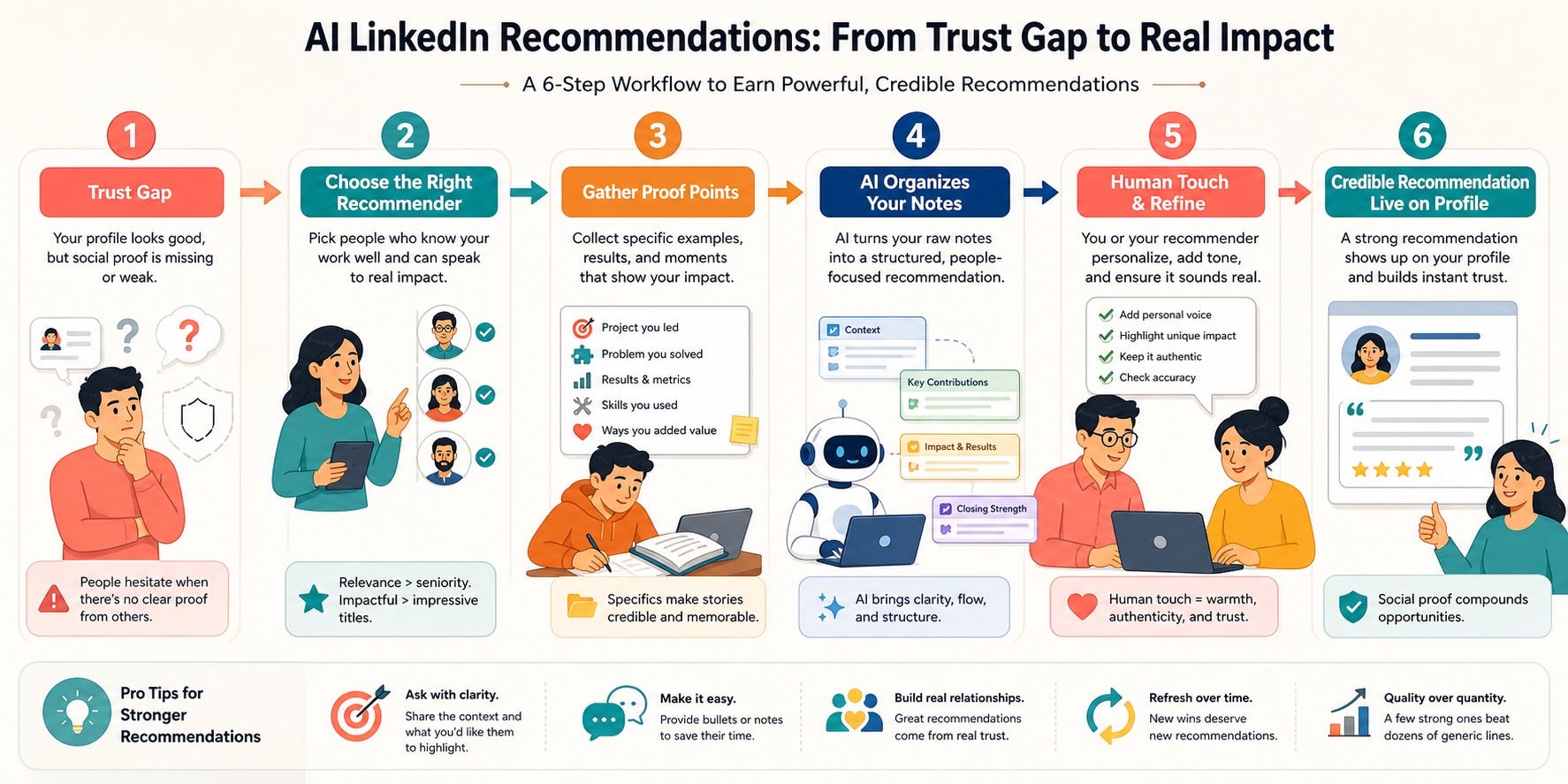
AI works best as a memory-and-structure layer, not a replacement for actual professional judgment.
Step 3: Offer optional prompts, not finished praise
Some people appreciate a draft. Others hate it. The safest middle ground is to offer prompts or bullet points they can ignore, edit, or use however they want.
Ask AI to generate three short prompt questions the recommender can answer, such as:
What problem was I brought in to solve?
What did I do that changed the outcome?
What was distinctive about how I worked?
Those questions give them something concrete to respond to while preserving authorship.
How to use AI when you are the one writing the recommendation
This is where most people go wrong. They ask AI for “a strong LinkedIn recommendation,” receive a polished paragraph, and paste it in. The result is clean, bland, and suspiciously familiar.
Instead, give AI raw material first. Voice notes are ideal. Bullet points are fine. The goal is to feed it evidence, not vibes.
Use a prompt shape like this:
Turn these notes into a LinkedIn recommendation draft. Keep it grounded, specific, and natural. Avoid hype, cliches, and generic praise. Use one concrete example, one clear result, and one sentence about working style. Make it sound like a real colleague, not a marketing page.
Then paste your notes:
How you know the person
The project or context
The problem they solved
What they did that impressed you
The result
Any trait that showed up repeatedly
Once AI gives you a draft, do not publish yet. Edit it for texture. Add the phrase you would naturally use. Remove any sentence you would never say out loud. If you would be embarrassed to read it to the person directly, it is not ready.
The anatomy of a recommendation people actually believe
The strongest LinkedIn recommendations usually have six parts.
1. Relationship context
Say how you know the person and in what setting. This establishes credibility fast.
2. Problem or responsibility
What were they there to do? Specific context beats abstract praise.
3. Distinctive contribution
What did they do that was unusually effective, thoughtful, or reliable?
4. Result or consequence
What changed because of their work? Numbers help, but clarity matters more than forced metrics.
5. Working style
How did they show up? Calm, sharp, clear, fast, rigorous, organized, generous, decisive.
6. Forward-looking trust sentence
Would you hire, work with, recommend, or trust them again? That closing line has weight when it feels earned.
Example skeleton:
I worked with [Name] during [context]. They were brought in to [problem or responsibility]. What stood out was [specific contribution]. As a result, [outcome]. Beyond the results, [working-style observation]. I would gladly [work with / hire / recommend] them again.
That structure is simple, but it works because it forces reality back into the paragraph.
The biggest mistakes to avoid
Using AI before gathering facts. If the model starts from nothing, it will fill the page with filler.
Overusing superlatives. “Best ever,” “incredible,” and “world-class” often weaken credibility when unsupported.
Letting every recommendation sound the same. If five people describe you in nearly identical language, readers will assume you supplied the script.
Ignoring audience fit. A recommendation that helps a consultant win clients may not help a job seeker get interviews.
Forgetting LinkedIn’s visibility reality. Since public visitors only see the count and up to two excerpts, prioritize standout quality.
A simple recommendation system for founders, consultants, and job seekers
If you want a practical operating rhythm, use this quarterly system.
Review your profile and identify your current trust gap.
Choose one person whose perspective would close that gap.
Use AI to build a fact sheet and a respectful request message.
If needed, offer prompts or reminder bullets, not a vanity script.
When a recommendation arrives, ask for revision only if it is vague, inaccurate, or mismatched to your goals.
Repeat slowly until your top recommendations reflect the reputation you want to be known for.
This is also where recommendations connect to your broader AI personal branding strategy. Recommendations should reinforce what your headline claims, what your About section promises, what your Featured section proves, and what your content demonstrates. When those layers agree, your personal brand feels coherent. When they do not, it feels assembled.

The final edit should sound like someone who remembers the work, not someone who remembers a prompt.
The right way to think about AI and social proof
AI should not help you pretend more people trust you. It should help you express genuine trust more clearly.
That distinction matters. On LinkedIn, credibility is becoming easier to verify and easier to doubt at the same time. LinkedIn says verified members see more profile views and more engagement on average, and it is now filtering generic AI content more aggressively. In that environment, every visible trust signal has to carry more truth, not less.
A recommendation is powerful because it compresses reputation into a few sentences. Done badly, it looks outsourced. Done well, it makes a stranger think, “Someone credible has actually seen this person work.”
That is what you want from AI in personal branding now. Not synthetic polish. Better recall. Better structure. Better specificity. More evidence. More signal.
If you remember that, LinkedIn recommendations stop being a neglected profile section and become what they should have been all along: public proof that other people trust your work enough to say so in their own name.
FAQ
Do LinkedIn recommendations still matter for personal branding?
Yes. They remain one of the clearest forms of social proof on LinkedIn because they attach another person’s name to your work. In an AI-heavy environment, that outside validation can feel more credible than self-written profile copy.
How many LinkedIn recommendations should I have?
You do not need a huge number. Since LinkedIn says your public profile shows the count and a maximum of two received recommendations, focus first on having a few strong, specific recommendations that reflect the reputation you want to build.
Is it okay to use AI to write a LinkedIn recommendation?
Yes, if AI is helping organize facts or produce a rough draft from real notes. No, if it is inventing generic praise or replacing your actual perspective. The final version should still sound like the person giving it.
Should I draft recommendation language for someone who is recommending me?
Sometimes, but carefully. It is better to provide reminder bullets, project details, or prompt questions than a fully flattering script. You want to reduce friction without controlling their opinion.
Can I edit a recommendation someone writes for me?
You cannot directly rewrite it yourself, but LinkedIn allows you to ask for revision before accepting it. That is useful if the wording is inaccurate, too vague, or not aligned with your current positioning.
Who should I ask for LinkedIn recommendations first?
Start with people whose perspective fills a trust gap on your profile: a manager for authority, a client for transformation, or a peer for collaboration. Choose based on the reputation you want a new visitor to understand quickly.