


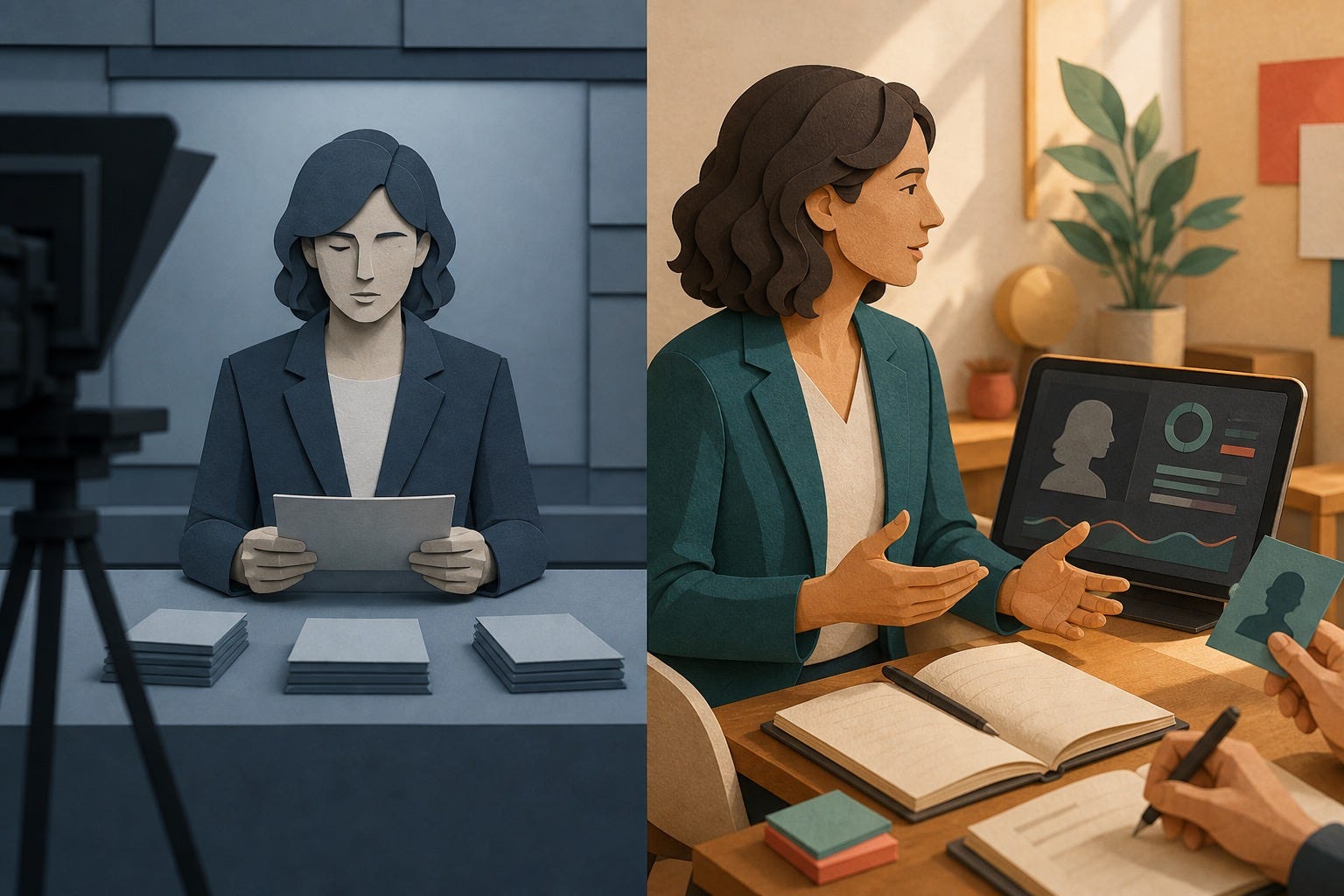
The next personal brand advantage is not posting more. It is learning to answer better when the right people are already listening.
A lot of smart professionals have a strange personal branding problem: their written profile looks sharp, their work is real, and their ideas are useful, but the moment they are asked to explain themselves out loud, the brand gets fuzzy. They ramble on podcasts. They freeze on panels. They turn a simple founder story into a five-minute backstory. Then they go back to LinkedIn and publish another polished post because writing feels safer than being heard in real time.
That gap matters more now. Business publications are expanding video and live programming, founders are being asked to show up on podcasts and webinars, and even job seekers are told to prove communication skill in more public ways. At the same time, professionals are tired of performative LinkedIn posting and AI-written sameness. Business Insider recently described the pressure many workers feel to build a personal brand even when the feed feels cringe and increasingly AI-generated. The better answer is not louder self-promotion. It is better public presence.
This is where AI media training becomes useful. Not AI writing your answers. Not a fake spokesperson. Not a voice clone pretending to be you. AI should be the practice room: the interviewer, the editor, the skeptical audience, the timing coach, and the mirror that helps you notice where your message gets weak.
What AI Media Training Actually Means
Media training used to sound like something reserved for politicians, crisis teams, and CEOs walking into national television interviews. That version still exists, but the need has moved downstream. A consultant on a niche podcast needs media training. A technical founder explaining a product category needs it. A creator doing a live Q&A needs it. A senior operator interviewing for a leadership role needs it.
AI media training for personal branding is a repeatable practice system for high-leverage conversations: podcast interviews, panels, livestreams, sales conversations, hiring conversations, investor chats, community AMAs, and short-form video answers. The goal is not to become slick. The goal is to make your real judgment easier to hear.
Good media training answers four questions before you speak:
What do I want to be remembered for?
Which questions will expose whether I actually know my field?
Which stories prove my point without sounding rehearsed?
Where do I tend to ramble, hedge, over-explain, or hide behind jargon?
AI is good at making those questions cheaper to practice. Tools now simulate journalists, score clarity and composure, roleplay difficult follow-ups, analyze pacing, and turn notes into practice prompts. One corporate example, MediaTraining.AI, frames the workflow around practicing with AI journalists and evaluating clarity, confidence, composure, and message consistency. The pattern is useful: feed AI the situation, ask it to challenge you, record your answer, then improve the structure without sanding off your personality.
The Content Gap: People Need Practice, Not More Prompts
The search results around this topic are revealing. There are articles about media training for founders, product pages for corporate AI coaching, and podcast posts about researching a host. Those help, but they often miss the personal-branding layer: how do you become easier to trust when people hear you think in real time?
Reddit threads show the same pattern in plainer language. In r/PublicSpeaking, one technical professional wanted AI help with spontaneous communication after moving into a more business-facing role. The pain was not stage performance. It was sounding friendly, executive, and natural without losing clarity. Another thread came from someone who rambled at work when they could not prepare. In r/podcasting, a host asked how to get better stories from startup executives who had strong experience but little media training.
Those are personal branding questions even when nobody calls them that. Your brand is not only the bio people read. It is the answer they remember after hearing you under mild pressure.
A strong personal brand is not a script. It is a set of ideas, stories, and proof points you can retrieve when the room changes.
Why Interviews Reveal Your Real Brand Faster Than Posts
Written content lets you edit away uncertainty. That can be good. It can also hide the difference between borrowed language and lived expertise. Interviews do the opposite. They compress your positioning, judgment, examples, energy, and self-awareness into a few minutes.
That is why a single good podcast appearance can make someone feel more credible than months of polished posts. You hear how they handle follow-up questions. You hear whether their ideas have edges. You hear whether they can explain tradeoffs, admit uncertainty, and still give a useful answer.
Public speaking anxiety is real, so this is not a simple confidence lecture. Research summarized in a peer-reviewed paper available through PubMed Central notes that public speaking is one of the most commonly reported fears, and that more than 61 percent of U.S. university students in one cited study reported fear of public speaking. The point is not that everyone should love being on camera. The point is that avoidance now has a bigger career cost because trust increasingly moves through voice, video, and live conversation.
Your personal brand becomes stronger when you can answer the same core questions across formats:
What problem do you understand better than most people?
What mistake do you see smart people making?
What did real experience teach you that generic advice misses?
What are you willing to say with useful specificity?
AI media training is how you practice those answers before the opportunity arrives.
The Five-Part AI Media Training Workflow
You do not need a huge system. You need a practice loop that is specific enough to improve your answers and light enough to repeat every week.
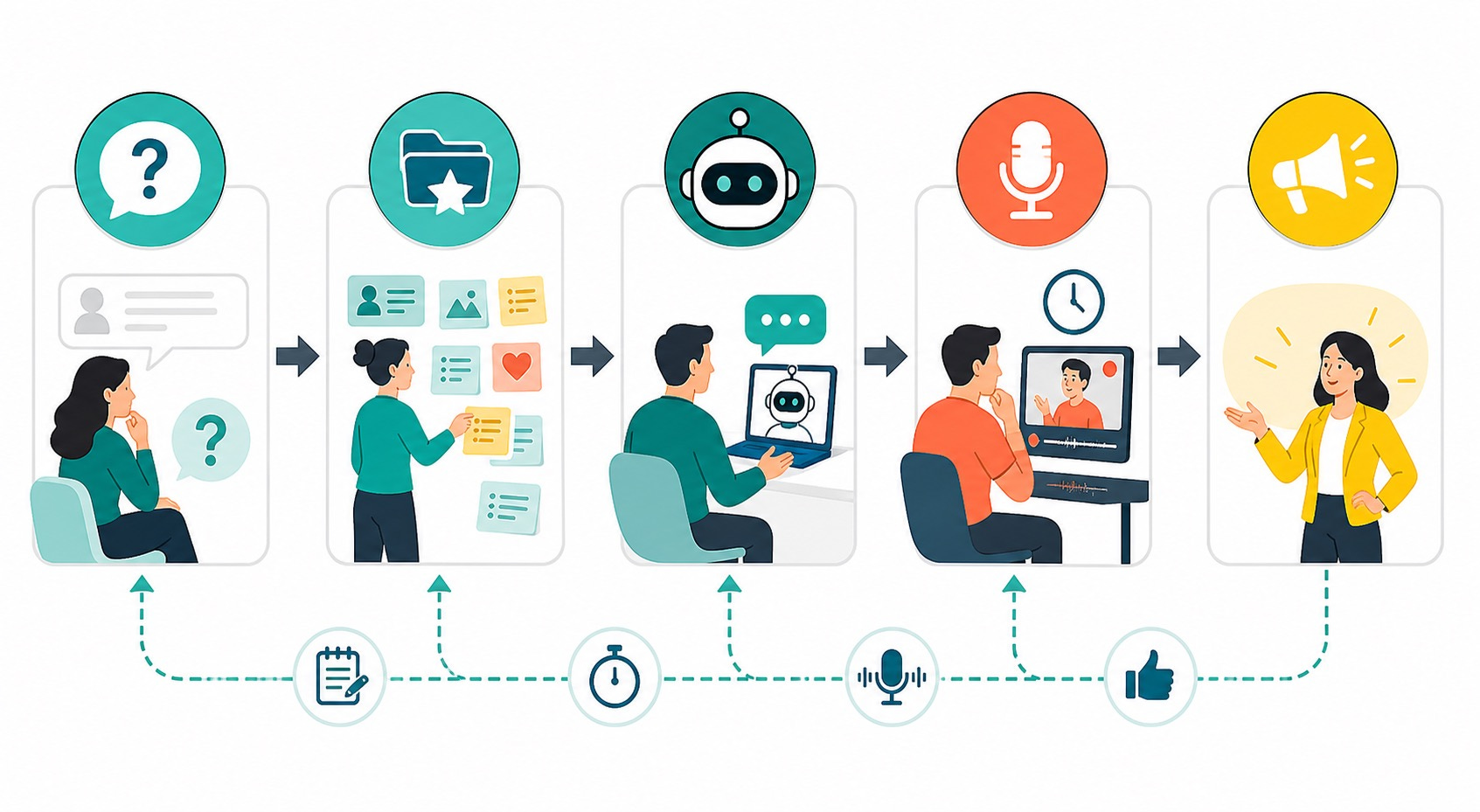
1. Build Your Message Spine
Before asking AI to interview you, give it a clear source of truth. A message spine is a short document that names your audience, your expertise, your core beliefs, your proof, and the topics you are willing to speak about. It should be specific enough that AI can challenge you instead of generating generic advice.
Use this prompt:
Act as a media trainer for my personal brand. Interview me to clarify my message spine. Ask one question at a time. Help me define the audience I serve, the problem I understand, the proof I can discuss publicly, the ideas I want to be known for, and the topics I should avoid.
Do not let AI write the final version without you. Let it question you. The value is in forcing clearer choices: who you help, what you believe, what you can prove, and what you will not pretend to know.
2. Create a Story Bank for Spoken Answers
Most people sound scripted because they memorize claims instead of organizing stories. A better story bank gives you examples you can retrieve naturally. Each story should have five parts: situation, tension, decision, result, and lesson. Keep them short.
Ask AI to extract stories from your work history, but make it ask before it writes:
Ask me about five moments from my work that changed how I think. For each one, help me turn it into a 60-second story with a clear point, one concrete detail, and one lesson a listener can use.
When the story feels too perfect, rough it up. Add the constraint you faced. Add what you did not know at the time. Add the tradeoff. Personal brands become believable when the story includes judgment, not just victory.
3. Run Mock Interviews With Increasing Pressure
Start with friendly questions, then raise the difficulty. A useful AI interviewer should not merely ask “tell me about yourself.” It should push on contradictions, ask for examples, interrupt politely, and make you explain jargon. That is where your public thinking gets stronger.
Try this practice prompt:
You are a sharp but fair podcast host interviewing me for an audience of skeptical professionals. Ask me ten questions about my area of expertise. Include follow-up questions when I sound vague, overconfident, generic, or too promotional. After each answer, score me on clarity, specificity, warmth, proof, and memorability.
Record your answers aloud. Do not type them. Typing rewards polish. Speaking reveals where the idea breaks.
4. Turn Rambling Into Reusable Answer Shapes
If you ramble, you probably do not need more confidence. You need answer architecture. AI can help you notice which shape fits which question.
For a direct advice question, use point, reason, example, action. For a founder-story question, use before, problem, decision, consequence, lesson. For a controversial question, use agreement, distinction, evidence, boundary. For a technical question, use plain-English answer, example, caveat, next step.
Paste a transcript of your spoken answer into AI and ask:
Rewrite this answer into a tighter spoken version without changing my meaning. Keep my natural tone. Show me what to cut, what to keep, and which answer structure fits the question best. Do not make it sound like marketing copy.
The goal is not to memorize the rewrite. The goal is to see the pattern. After a few rounds, you will start hearing the structure while you speak.
5. Build a Personal Brand Soundbite Library
A soundbite is not a slogan. It is a compact answer people can repeat accurately. Your library should include clear responses to recurring questions: what you do, who you help, what mistake you see, what changed your mind, what trend is misunderstood, and what you recommend first.
Keep each soundbite flexible. If every answer sounds identical, you are overtraining. The best version gives you a stable point with enough room to sound present.
How to Use AI Feedback Without Becoming Generic
AI feedback can quietly make everyone sound the same. It tends to reward smoothness, balance, and complete sentences. Those qualities are useful until they erase your edge. Your job is to separate mechanical improvement from personality removal.
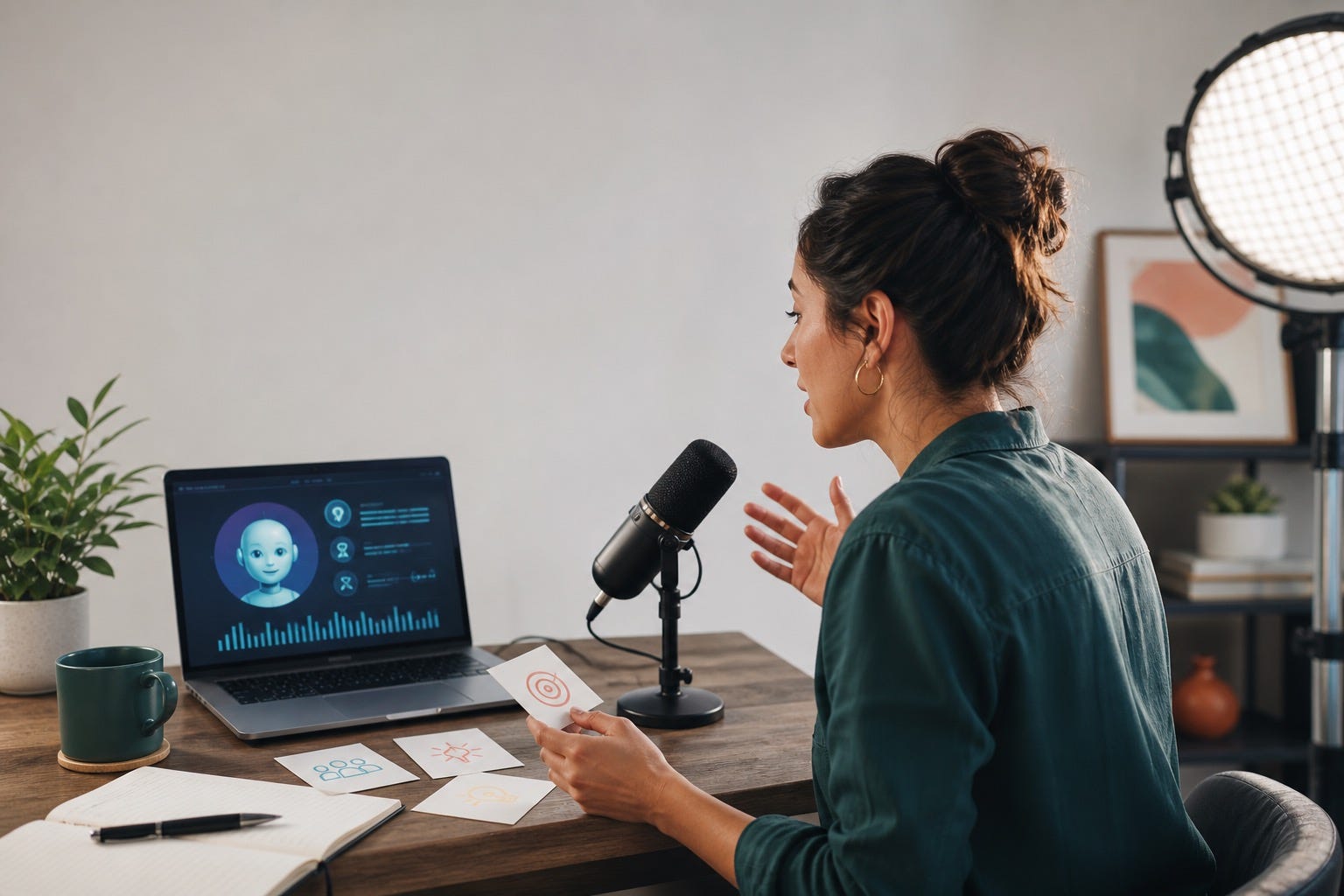
Use AI to improve answer length, jargon, filler words, missing examples, unclear openings, unsupported claims, and weak endings. Protect your point of view, natural phrasing, honest uncertainty, humor, lived examples, and the details only you would mention.
A simple rule helps: AI can edit the route, but you choose the destination. If AI changes what you believe, deletes the useful caveat, or turns your direct answer into a polished corporate paragraph, reject the improvement.
The Ethical Line: Preparation Is Fine, Performance Fraud Is Not
There is a clean line between using AI to prepare and using AI to mislead. Preparing with AI is like practicing with a coach or researching the host. Misleading with AI is pretending a generated persona, voice, or answer is spontaneous human expertise when it is not.
For personal branding, the ethical test is simple: would the audience feel tricked if they knew how the answer was made? If you used AI to find blind spots, practice questions, or tighten structure, most people will not care. If an AI tool fed you real-time answers during a high-stakes interview where people expected your judgment, trust gets weaker.
This matters because a personal brand is a trust asset. Every shortcut should be judged by what it does to trust after discovery, not only by how impressive it looks in the moment.
A Weekly Practice Routine That Actually Fits Real Work
The best routine is small enough to survive a busy week. Here is a 45-minute loop.
Pick one upcoming or imaginary public situation: podcast, panel, sales call, interview, webinar, or leadership meeting.
Ask AI for ten likely questions from that audience.
Choose three questions that make you slightly uncomfortable.
Record spoken answers without notes.
Transcribe the answers and ask AI to identify vagueness, rambling, missing proof, and moments that sounded scripted.
Rewrite only the opening sentence and the final sentence of each answer.
Record again and save the strongest version in your soundbite library.
This practice compounds. After four weeks, you will have twelve stronger answers. After three months, you will have a usable library of stories, definitions, examples, and points of view. More important, you will have practiced retrieving them under pressure.
Use Cases by Professional Type
Founders can practice explaining the company without turning every answer into a pitch. Consultants can turn abstract expertise into concrete examples. Creators can prepare for sponsorship conversations, guest appearances, and community Q&As without flattening their personality. Job seekers can turn experience into confident stories so nerves do not bury the proof. Technical professionals can translate expertise for business audiences without pretending the technical depth is not there.
The Metrics That Matter
Do not measure media training by whether AI gives you a high score. Measure whether humans understand you faster and remember you more accurately. Track practical signals: fewer confusion-based follow-up questions, more invitations to explain your work, better podcast clips, stronger comments after live sessions, and clearer inbound opportunities.
The strongest personal brands do not only publish. They make ideas usable. They sound consistent across every public format.
Final Takeaway
AI media training is not about becoming camera-ready in a fake way. It is about building retrieval strength for your own judgment. You are practicing how to answer when someone gives you attention, asks a real question, and waits.
That is the personal branding opportunity most people miss. They spend hours making the public profile look credible, then hope their spoken presence catches up later. Reverse the order. Practice the answers first. Let the posts, bios, talks, and interviews grow from the same source.
Your audience does not need you to sound perfectly trained. They need you to sound clear, specific, useful, and real when it counts.
FAQ
What is AI media training for personal branding?
AI media training for personal branding is the use of AI interviewers, feedback tools, transcripts, and roleplay prompts to help you explain your expertise more clearly in podcasts, panels, videos, interviews, and live conversations.
Can AI media training make me sound fake?
Yes, if you let AI replace your judgment or over-polish your answers. Use it to improve structure and clarity, but keep your stories, beliefs, examples, and natural phrasing intact.
How often should I practice AI media training?
One focused 45-minute session per week is enough for most professionals. Practice three hard questions, tighten the answers, and save the strongest versions.
Is it ethical to use AI before a podcast or interview?
It is ethical to use AI for preparation, research, practice questions, and feedback. It becomes risky when AI secretly supplies real-time answers where people expect your judgment.
How does AI media training improve a personal brand?
It helps people remember what you stand for because your spoken answers become clearer, more specific, and more consistent. That strengthens trust across podcasts, panels, LinkedIn, Substack, websites, and private conversations.