


A practical system for founders, consultants, executives, creators, and professionals who want an AI-assisted newsletter that builds authority, trust, and recognizable voice instead of sounding outsourced.

Most people are using AI on the wrong part of their personal brand.
They use it to manufacture more posts, more captions, more takes, and more polished filler. The result is usually the same: higher output, lower recognition. Nothing sounds wrong, but nothing feels memorable either.
A newsletter changes that. Not because email is magical, and not because Substack is some secret growth hack. A newsletter works because it forces depth. It gives you room to explain what you believe, what you are seeing, what you are changing your mind about, and how your judgment works. In an era where AI can imitate competence on the surface, that depth is one of the fastest ways to make your personal brand feel more human, not less.
The opportunity in 2026 is not to let AI write your newsletter for you. The opportunity is to use AI as a research, structuring, and repurposing layer around your real expertise, then publish work that compounds across inboxes, search, social, and answer engines.
If you do that well, your Substack becomes more than a newsletter. It becomes your cleanest public record of taste, thinking, consistency, and credibility.
Why a newsletter matters more for personal branding now
Social feeds still matter, but they are bad at proving depth. A great short post can earn attention. It rarely proves that you have a durable point of view. A newsletter can.
That matters for personal branding because the strongest professional brands are not built on exposure alone. They are built on pattern recognition. People need to understand what you care about, how you frame problems, what standards you hold, and what kind of work your name should trigger in their minds.
Substack is especially useful here because it sits between a social platform and an owned channel. You can publish long-form writing, build a subscriber list, show your profile publicly, use Notes for lighter visibility, and turn deeper essays into a body of work that people can forward, quote, and return to later. Substack’s own 2026 product documentation also shows how much of the platform now centers around public profiles, notes, comments, chat, metrics, and even live video. In other words, it is not just an inbox tool anymore. It is an authority surface.
Social media is where people discover you. A good newsletter is where they decide what you stand for.
That distinction is why an AI-assisted newsletter system is such a strong personal branding play right now. AI can help you operate consistently. But the newsletter itself is where you prove you are not generic.
Where AI helps and where it quietly damages your brand
AI is useful in newsletter creation. It is just useful in different places than most people think.
Where AI helps
Turning rough voice notes, meeting notes, or scattered ideas into draft outlines.
Finding recurring themes in your recent writing, calls, comments, and audience questions.
Stress-testing headlines, subheads, and opening hooks against different search intents.
Repurposing one strong issue into a LinkedIn post, X thread, short summary, FAQ, and talking points.
Creating a repeatable editorial operating system so you publish without starting from zero each week.
Where AI hurts
Writing from a blank prompt with no original material from you.
Over-smoothing your tone until every issue sounds professionally dead.
Stuffing in generic transitions, consensus opinions, and broad “three ways to win” language.
Publishing thoughts you have not actually tested, believed, or argued yourself.
Replacing lived examples with synthetic examples that feel plausible but not earned.
The simplest rule is this: AI should reduce friction, not remove authorship. If your readers cannot tell what is specifically yours, the workflow is broken.
Pick a newsletter promise before you pick a content calendar
The biggest mistake professionals make on Substack is starting with frequency instead of positioning. They decide they will publish every Tuesday, then wonder why the writing feels thin by week three.
Before you use AI to help with anything, define the promise of the publication. A strong newsletter promise answers four questions:
Who is this for?
What recurring problem or tension does it help them think through?
What lens do you bring that is unusually credible or specific?
What emotional payoff does the reader get every time they open it?
For example, “weekly AI news for everyone” is weak. “A weekly memo for B2B founders using AI without sounding like every other founder online” is much stronger. The second version tells readers who it is for, what problem it addresses, and what point of view you will bring.
Your personal brand strengthens when the reader can predict your lens without predicting your exact words.
A useful test: If someone forwarded your last three issues with your name removed, would a smart reader still be able to tell they came from the same person?
The AI-assisted Substack workflow that actually builds authority
Here is the workflow I recommend for professionals building a personal brand with Substack. It uses AI heavily behind the scenes, but it keeps your judgment visible in the final product.
1. Capture raw thinking first
Start with your own source material. That can be voice notes after meetings, friction points you keep seeing with clients, objections that keep appearing in sales calls, patterns from your job search, or opinions you have repeated in conversations all month.
Do not ask AI, “What should I write about?” until you have first given it evidence of what you actually think. Your voice is not a tone preset. It is a trail of repeated judgments.
2. Ask AI to cluster, not create
Once you have raw material, use AI to cluster it. Ask questions like:
What three recurring themes show up in these notes?
Which tension would matter most to founders, consultants, or job seekers right now?
What is the sharpest argument hidden in this material?
What headline options create curiosity without becoming clickbait?
This is where AI saves time without flattening you. It finds structure. You still provide judgment.
3. Build the issue around one claim
Good newsletters are usually organized around one claim, not ten tips. Even when the format is practical, there should be a central sentence holding the piece together.
For this article, the central claim is simple: an AI-assisted newsletter is one of the best personal branding assets in 2026, but only if AI helps you operate your expertise instead of replacing it.
That kind of claim gives your writing tension. It also gives readers a reason to keep scrolling.

4. Draft in layers
Instead of one giant AI prompt, use layered drafting:
Ask AI for three possible outlines based on your source notes.
Choose one and rewrite the outline in your own words.
Draft the opening yourself, because the opening sets voice and authority.
Use AI to expand only the sections where you already know the argument.
Rewrite every paragraph that sounds universally true but personally empty.
This process is slower than copy-pasting a fully generated draft. It is also how you avoid publishing the same voice as everyone else in your category.
5. Add proof-of-mind, not just proof-of-information
Anyone can now generate information-shaped content. What your newsletter needs is proof-of-mind. That means visible signs of human judgment:
A specific example from your work.
A distinction you wish more people made.
A tradeoff you are willing to state clearly.
A sentence that reveals your standard, not just your summary.
Those are the details that make a personal brand memorable. They show what you notice that other people miss.
How one issue can power your whole personal brand system
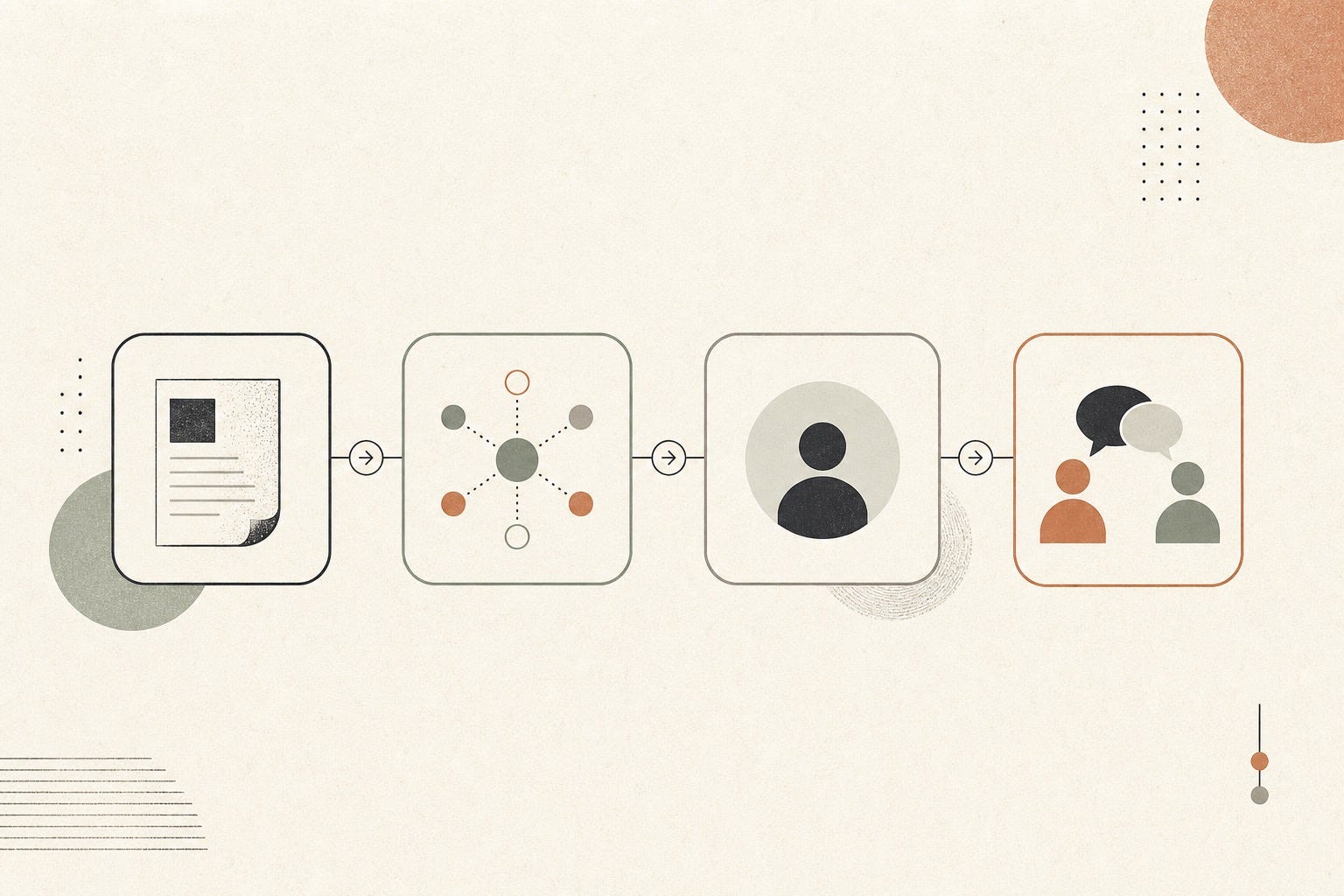
The strongest newsletter operators are not creating separate ideas for every platform. They are publishing one strong piece, then turning it into a distribution system.
One Substack issue can become:
A LinkedIn post built around the sharpest paragraph.
A Notes post sharing the one-line argument.
A short X thread built from the section headers.
A speaking prompt for a podcast or live session.
An FAQ on your website.
A searchable archive entry people can send to others when your name comes up.
This matters because personal branding is not just about reach. It is about consistency across surfaces. If your LinkedIn, Substack, website bio, comments, and podcast appearances all sound like disconnected versions of you, trust weakens. If one core argument travels across those surfaces in different formats, trust compounds.
AI is very good at this repurposing layer. After the main issue is written, you can ask it to extract platform-native versions while preserving the original claim, tone rules, and audience.
What you should not do is publish the repurposed versions without human review. Compression creates distortion. A smart long-form argument can become cringe in short-form very quickly.
The trust rules for using AI in a personal brand newsletter
If you want your newsletter to strengthen credibility, set rules before scale starts tempting you.
Rule 1: Never publish a generated opinion you would not defend live
If a sentence sounds smart but you would hesitate to say it on a podcast, in a client call, or under your own name in a room full of peers, cut it.
Rule 2: Keep your real examples rough around the edges
Many writers over-edit the exact details that make them believable. The small imperfect specifics are often what make the piece feel real.
Rule 3: Use AI to sharpen, not inflate
AI can easily turn a clear idea into an overbuilt one. If the wording gets more impressive while the thought gets less specific, you are going backward.
Rule 4: Decide your disclosure standard early
Not every newsletter needs a giant AI disclaimer. But you should know your own line. If AI helped with research, structure, or editing, that is different from letting it draft the article from scratch. Your standard should match the role AI actually played.
Rule 5: Protect your recognizable language
Every strong personal brand has recurring phrases, distinctions, metaphors, and standards. Save those. Build a voice guide from them. Feed that guide into your AI workflow. Your newsletter should become more recognizably yours over time, not more polished and anonymous.
What to measure on Substack if personal branding is the goal
If you are using Substack to build authority, not just vanity metrics, your scoreboard should be different.
Look at subscriber growth, but also watch for these signals:
Which issue titles create subscription spikes.
Which posts generate replies, not just likes.
Which topics bring profile visits from outside platforms.
Which issues people forward privately to colleagues.
Which ideas keep getting referenced back to you in calls or messages.
Substack’s own metrics guidance now makes it easier to connect subscriber growth to specific posts and traffic sources. That is useful, but the deeper question is qualitative: what type of thinking makes the right people trust you faster?
A personal brand is working when your content changes the quality of inbound opportunities, not just the quantity of impressions.
A 30-day plan to start without sounding automated
Pick one audience and one recurring problem you can explain better than most people.
Collect 20 pieces of raw source material from your own notes, calls, comments, and voice memos.
Create a short AI voice guide with your recurring phrases, banned phrases, tone rules, and audience assumptions.
Draft four issue ideas from that source material before publishing the first one.
Publish one essay that makes a specific argument, not a generic roundup.
Repurpose it into one LinkedIn post, one Notes post, and one short summary for your profile or website.
Track which version attracts the most relevant conversation.
If you repeat that for a month, you will not just have a newsletter. You will have the beginning of a public intellectual asset: a growing archive that teaches people how to understand your work.
That is the real personal branding win. AI can help you move faster. But only clarity, standards, and repeated judgment make people remember your name.
FAQ
Is Substack good for personal branding in 2026?
Yes, especially for people whose brand depends on expertise, judgment, and trust. Substack is less useful as a fast-growth hack and more useful as a depth channel that shows how you think over time.
Can I use AI to write my Substack newsletter?
You can use AI to support the process, but fully generated newsletters usually weaken personal brand trust. Use AI for research, clustering, outlining, editing, and repurposing. Keep the core argument and final voice under human control.
What should a personal branding newsletter focus on?
It should focus on one audience, one recurring set of problems, and one recognizable lens. The goal is not to cover everything you know. The goal is to become known for a specific kind of insight.
How often should I publish on Substack for personal branding?
Weekly is strong if you can maintain quality. Biweekly is fine if the work is deeper. Consistency matters, but clarity matters more. A forgettable weekly post does less for your brand than a sharp essay every two weeks.
How do I keep AI-generated newsletter writing from sounding generic?
Start with your own raw material, create a voice guide, build the issue around one real claim, and rewrite any paragraph that sounds polished but empty. The safest rule is simple: if the sentence could belong to anyone in your niche, it does not belong in your newsletter.
Should I promote my newsletter on LinkedIn and other platforms?
Yes, but promote the idea inside the issue, not just the existence of the issue. Pull out one strong argument, one useful distinction, or one practical framework and let that earn the click.