


Your About page should not recite your career. It should help the right person understand why your work matters-and what makes you believable.

The raw material for a credible public story is rarely a perfect résumé. It is the specific work, people, and decisions that shaped how you help.
Most About pages fail in the first paragraph. Not because their owners have nothing to say, but because they try to sound professional before they try to be understood.
So the page opens with a job title, a row of broad adjectives, and a vague promise to “help ambitious people thrive.” It could belong to a strategist, a coach, a designer, or a person who has not done the work at all. In an AI-saturated web, that blandness is no longer just forgettable. It is a trust problem.
AI makes the first draft easy. It also makes the default draft dangerously average. Give a model a role, a few accomplishments, and the phrase “write my About page,” and it will usually return polished filler: passionate, results-driven, innovative, dedicated. None of those words tells a future client, collaborator, hiring manager, or reader what you notice that other people miss.
The opportunity is bigger than better copy. A strong AI-assisted personal brand About page becomes a credibility architecture: a short, truthful path from “Who is this?” to “What can I trust them to help with?” It gives your audience enough context to recognize themselves, enough proof to believe you, and a simple reason to continue the conversation.
Your story is not the list of things you have done. It is the evidence behind the kind of problem people can trust you to solve.
Why AI-generated About pages feel generic
Generic output is usually an input problem. When you give AI only a LinkedIn summary, it has no access to the details that make your work distinct: the awkward first version you rejected, the constraint you navigated, the people you serve well, the language they use, or the outcome you can responsibly describe. It fills the gaps with familiar professional language because familiar language is all it has.
That is why a better prompt alone is not the answer. First, create a small source packet. Then ask AI to help you see the pattern inside it.
It also serves search without turning your page into a keyword dump. Your About page needs accurate, human-readable facts about who you are, what you do, and why someone should care.
The diagnostic: If the first paragraph could be pasted onto another professional’s site without changing a word, it is not yet an About page. It is a template wearing your name.
Start with a source packet, not a prompt
Set a timer for 25 minutes. Open a private document and collect fragments; do not try to write elegantly. The point is to give AI material that only you could supply.
1. Three moments of useful work
Write down three situations where someone came to you with a real problem. For each, capture the starting tension, what you noticed, the decision you made, and the honest result. Protect confidentiality. You can remove names, numbers, and sensitive details while keeping the shape of your judgment.
A product leader might write, “New users were getting lost before the first useful action. I argued for simpler onboarding, even though it delayed launch.” Those details are more useful than ten adjectives.
2. Your honest boundaries
List the work you do not do, the people you are not trying to serve, and the shortcuts you do not take. Boundaries create recognition. A consultant who says, “I help small teams decide what not to build; I do not offer a generic innovation playbook,” is more memorable than one who claims to help everyone grow.
3. Evidence you can stand behind
Gather links or notes for a few verifiable signals: a project, an article, a talk, a credential, a client-approved quote, an open-source contribution, a public workshop, or a named method you genuinely use. Do not ask AI to invent a statistic, sharpen an outcome, or turn a friendly message into a testimonial. Evidence is not decoration. It is the reader’s permission to believe you.
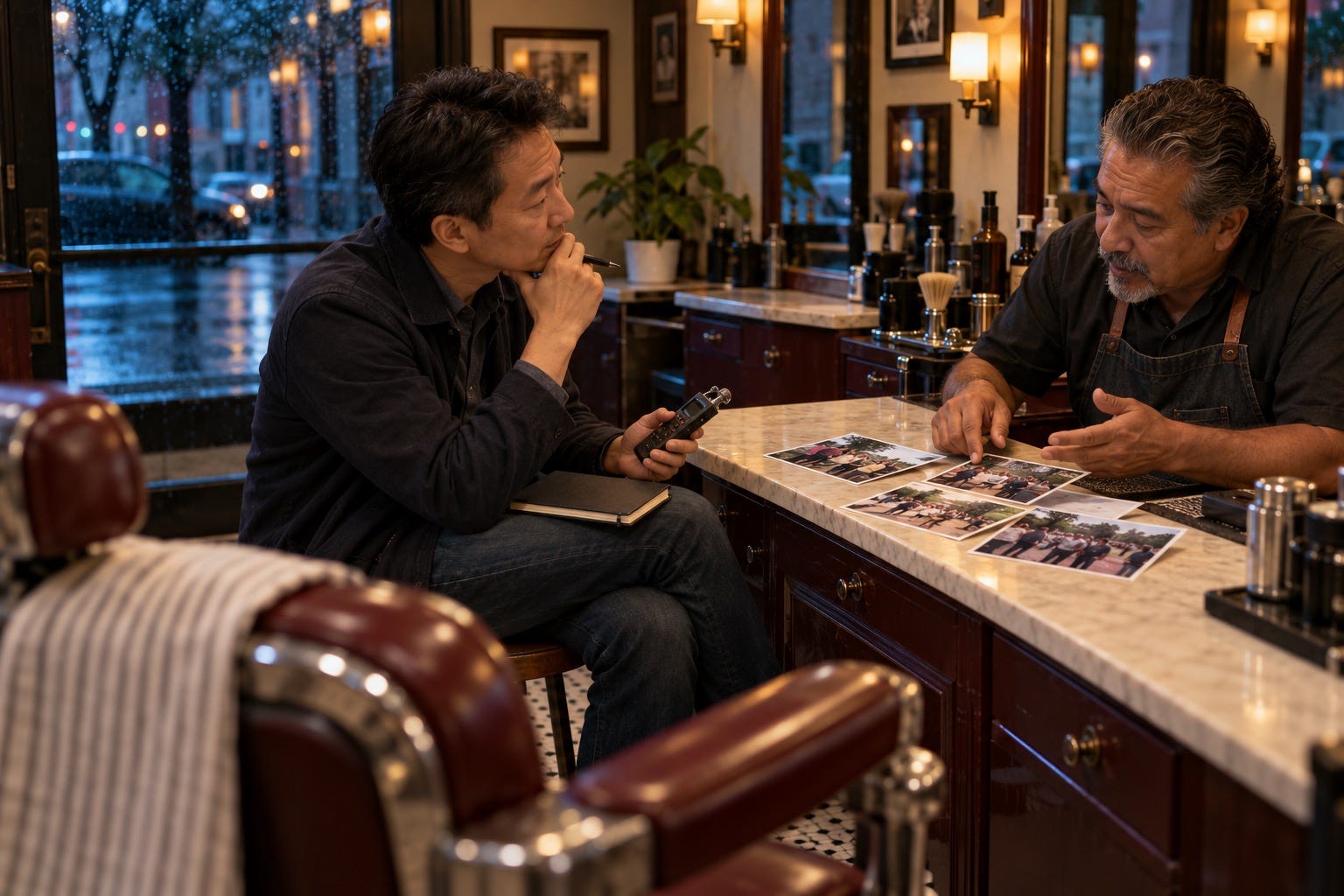
Specific stories are better source material than a résumé dump. They reveal context, judgment, and the people your work actually serves.
Use AI as an interviewer before you use it as a writer
The most useful AI workflow begins with questions. Paste your source packet into a private workspace that is appropriate for the material. If it contains client, employer, or personal data, remove identifying details first and follow the relevant confidentiality rules.
Then ask the model to interview you. It should not write a page until it has found the thread running through your work.
Interview prompt: “Act as a rigorous personal-brand editor. Read the notes below. Do not draft an About page yet. Ask me 12 concise follow-up questions that would help identify: the specific people I help, the recurring problem I notice, the evidence behind my approach, the trade-offs I make, and the words I should avoid because they would overstate my role. Flag any vague claim that needs proof.”
Answer in your own words. It supplies the human context a tidy career chronology cannot.
Next, ask for three possible positioning hypotheses. A hypothesis is not a slogan. It is a testable statement about the connection between your experience and the problem you are known to help with.
For example:
“I help technical teams make complex decisions legible to the people who must act on them.”
“I help independent experts turn scattered experience into a point of view that a client can evaluate.”
“I help mission-led organizations find the practical friction behind a well-intended service.”
Choose the hypothesis you can prove in the next five minutes.
The six blocks of a credible personal-brand About page
Once you have a working hypothesis, use this structure. You do not need every block to be long. In fact, most personal sites improve when the page is shorter, clearer, and supported by links to deeper proof.
Block 1: The reader-recognition opening
Start with the situation your ideal reader recognizes—not your childhood, not a grand mission statement, and not a list of credentials. Name the tension in plain language.
Example: “When a smart team cannot explain a difficult decision simply, the problem is usually not a lack of expertise. It is a missing shared frame.”
Then say who you are in relation to that problem. This lets a busy reader decide quickly whether to keep going.
Block 2: The work you are known for
Describe the type of work, audience, and context with useful specificity. “I work with founders” is broad. “I work with early-stage founders who need to turn technical product knowledge into a customer conversation” is a real filter. It tells the right person they are in the right place and gives everyone else permission to move on.
Block 3: One proof story
Tell a brief story with a constraint. What was unclear, what did you notice, what changed, and what is the limit of the example? The best proof story does not make you a hero. It makes your judgment inspectable.
A useful sentence stem is: “In one project, the apparent problem was ___. After ____, we chose ____. The result was ____, and the limitation was ___.” If the details are confidential, say so and describe only the transferable decision.
Block 4: Your method or principles
Name three to five ways you work. These should be observable behaviors, not personality claims. “I start with the person who will use the thing” is stronger than “I am customer obsessed.” “I show the trade-off before recommending a solution” is stronger than “I am strategic.”
Block 5: Your evidence trail
Link out to a few durable pieces of proof: selected work, writing, talks, collaborations, research, or a clear profile. Google’s ProfilePage documentation explicitly recognizes an “About Me” page as a valid use case when it focuses on a single person. That is a technical reminder of a human principle: keep identity claims consistent, accurate, and connected to work people can inspect.
Block 6: A low-pressure next step
Do not end with “Let’s connect!” Tell the reader what a useful first conversation is about. “If you are deciding whether your product story has become too technical, send me the one sentence that is not landing.” A specific invitation feels more generous, and it protects you from attracting every possible request.
Draft with constraints that protect your voice
Now—and only now—ask AI for a draft. Give it the source packet, the positioning hypothesis, the six blocks, and strict boundaries. Ask for two versions: one in your natural speaking style and one slightly more direct. Never publish either without a read-aloud edit.
Draft prompt: “Write a first-person About page of 550–700 words using only the supplied source material. The audience is [describe the reader]. Open with their real tension, not a biography. Include one bounded proof story and a short evidence trail. Use short, plain sentences. Do not invent facts, credentials, outcomes, or testimonials. Avoid these words unless they are specifically supported: passionate, innovative, transformative, world-class, visionary, seamless. Mark every sentence that needs my verification with [VERIFY].”
AI can smooth transitions and find structure. It should not fill evidence gaps. A visible blank is more trustworthy than an invented detail.
Run the substitution test before publishing
Highlight every line that could belong to another person in your field. Too many turn a page into generic AI copy.
Replace each one with one of four things:
A decision you made under a real constraint.
A phrase your audience actually uses.
A precise boundary or limitation.
A link to evidence someone can inspect.
Then perform the spoken test. Read the page to someone who knows your work, or record yourself reading it aloud. Where do you hesitate? Where do you sound like a brochure? Where would they say, “You would never put it that way”? Fix those places first.
If AI materially generated an image, video, or apparent first-hand passage, add proportionate context. For structural or editing help, accurate evidence and your final review matter more than a ritual disclosure.

The strongest personal brand is demonstrated in context: specific work, shared standards, and people who can see how you think.
Make the page easy to keep true
Personal brands decay when the page describes a past version of the work. Put a 30-minute review on your calendar every quarter. Ask:
Does the opening still describe the problem I want to be known for?
Are my current role, location, links, and evidence accurate?
Has a new project given me a better proof story?
Have my boundaries changed?
Would I say every sentence out loud to the person I most want to help?
Often one sharper proof story, one retired claim, or one improved invitation will keep it alive.
The page is a promise, not a performance
When someone visits your About page, they are not asking for your complete life story. They are deciding whether your public identity is coherent enough to trust with their attention, problem, or opportunity.
AI can help you get past the blank page. Let it organize your fragments, challenge your vagueness, and produce options you can reject. But the parts that create a durable personal brand—the work you can defend, the people you understand, the limits you name, and the proof you offer—have to come from you.
Build that architecture first. Then let the writing make it visible.
Frequently asked questions
Can AI write a personal brand About page?
AI can help interview you, organize source material, test positioning options, and produce a first draft. It should not invent the experiences, proof, voice, or outcomes that make the page credible. Start with a source packet and personally verify every claim before publishing.
How long should an About page be for a personal brand?
There is no universal length. A focused page of roughly 500–800 words is often enough to explain the reader’s problem, your work, one proof story, your principles, and a next step. Use links for deeper evidence instead of forcing every detail onto one page.
What should a personal brand About page include?
Include a reader-recognition opening, a specific description of the work you do, a bounded proof story, practical principles or method, links to inspectable evidence, and a clear invitation for the right next conversation.
How do I keep an AI-written About page from sounding generic?
Do not begin with a résumé or a vague prompt. Give AI specific work stories, audience language, decisions, constraints, and evidence. Then run the substitution test: replace any sentence that could belong to another professional with a real decision, boundary, audience phrase, or proof link.
Should I disclose that I used AI on my About page?
Consider disclosure when AI materially generated or altered something a reader might mistake for your experience, likeness, or work—especially synthetic media or substantive first-person claims. Simple editing assistance usually matters less than accurate claims, human review, and visible evidence.
Does an About page help personal brand SEO?
A useful About page can help people and search systems understand who the page is about, what that person does, and how their public work connects. Prioritize clear, accurate facts and relevant links over keyword stuffing. If appropriate, a site owner can also use ProfilePage structured data for a true person-focused About Me page.
Sources consulted: Google Search Central on people-first content and Google’s ProfilePage documentation.