



Most professionals do not have a personal branding problem. They have a memory problem.
When it is time to post on LinkedIn, write a bio, pitch a podcast, update a website, or introduce yourself in a community, the useful material is rarely missing. It is buried inside client calls, hard decisions, failed experiments, odd questions, private wins, and lessons you already forgot you learned.
That is why the strongest use of AI for personal branding is not asking, “Write me a thought leadership post.” That usually produces the same polished fog everyone else is publishing. The stronger move is asking AI to interview you first. A good AI personal brand interview pulls real stories out of your week, turns vague experience into usable raw material, and gives you something much harder to fake: specificity.
This matters more now because professional platforms are starting to push back against generic AI content. Pangram reported that more than 40% of longform LinkedIn posts in its sample were flagged as fully AI-generated, and The Verge reported that LinkedIn added a way for users to report posts that seem like AI slop. Substack is also moving toward more AI-use transparency through Pangram-powered checks, according to Business Insider Africa.
The signal is clear: using AI is not the issue. Sounding replaceable is the issue.
The Mistake: Asking AI to Perform Before It Understands You
Most AI personal branding workflows start too late. They begin with the final artifact: “Write a LinkedIn post about leadership,” “write my About section,” or “give me ten content ideas for founders.” The model responds with competent language because that is what it is built to do. But competent language is not the same as personal credibility.
Your reputation does not grow because a paragraph sounds polished. It grows when people can connect your name with a pattern of judgment. You saw something before others did. You solved a hard problem. You changed your mind. You built a method. You made a mistake and extracted a useful principle from it.
AI cannot invent that without making you less trustworthy. But it can help you find it.
The goal is not to make AI sound like you. The goal is to feed AI enough real material that the useful version of you becomes easier to express.
An AI personal brand interview flips the normal workflow. Instead of using AI as a ghostwriter, you use it as a patient interviewer, pattern spotter, and editor. It asks follow-up questions. It notices what you skim over. It turns “I had a normal week” into a set of raw stories about decisions, tradeoffs, conversations, and lessons.
What an AI Personal Brand Interview Actually Is
An AI personal brand interview is a structured conversation where ChatGPT, Claude, Gemini, or another AI assistant interviews you about your work, values, audience, proof, and recent experiences. The output is not a finished post at first. It is a story inventory.
Think of it as a weekly debrief with a thoughtful editor. You bring messy facts. The AI asks what happened, why it mattered, who it helped, what changed, what surprised you, and what someone else could learn from it. Then it helps sort those answers into content assets.
A good interview produces several types of raw material:
Origin stories that explain why you care about your field.
Decision stories that show how you think under constraints.
Failure stories that make your expertise more believable.
Client or project stories that prove your method without exposing private details.
Contrarian stories that clarify what you no longer believe.
Teaching stories that turn one lesson into a repeatable framework.
Boundary stories that show who you are not for.
This is useful for founders, consultants, freelancers, creators, job seekers, executives, students, and AI builders because personal branding is not just broadcasting. It is making your judgment easier to recognize.
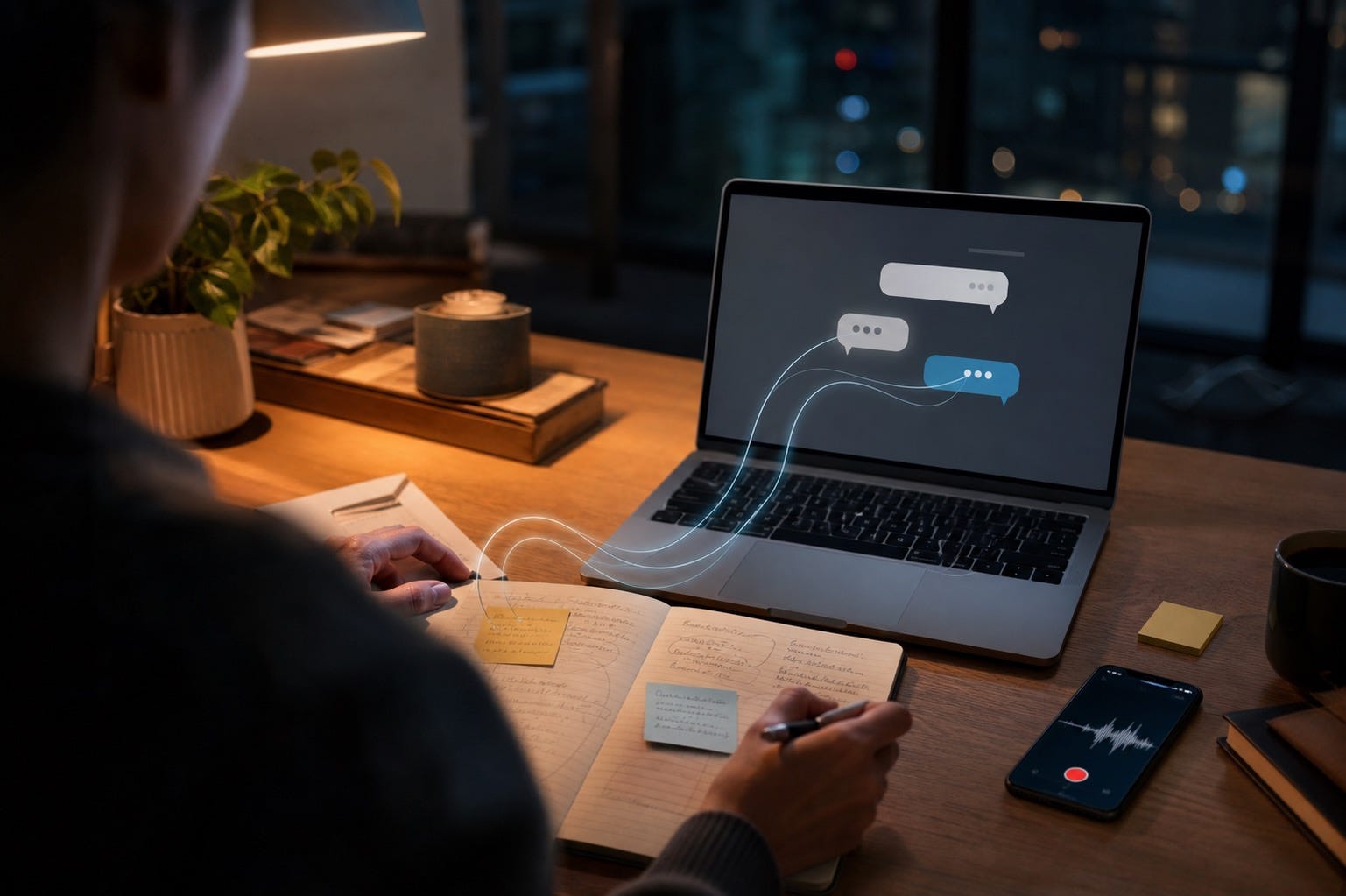
The best AI branding workflow starts with extraction, not publication.
The Weekly Interview Workflow
You do not need a complex content system to start. You need 25 minutes, a notes app, and one AI chat that is allowed to ask one question at a time.
Step 1: Give AI the role and the rule
Start by telling the AI that its job is to interview, not write. This single boundary improves the whole session because it stops the model from rushing toward generic output.
Use this prompt:
You are my personal brand interviewer and editorial strategist. Do not write posts yet. Interview me one question at a time about my recent work, decisions, lessons, mistakes, conversations, and opinions. Your goal is to extract specific stories that could become credible LinkedIn posts, newsletter sections, website copy, podcast talking points, or bio material. Ask follow-up questions when my answer is vague. After the interview, summarize the strongest story angles and explain why each one builds trust.
The “one question at a time” rule matters. If AI asks 12 questions at once, you will answer like you are filling out a form. One question at a time feels more like a real interview, and real interviews produce better details.
Step 2: Start with the week, not the brand
Do not begin with “What is my personal brand?” That question is too abstract. Begin with what actually happened.
Ask the AI to explore:
What conversation kept coming back to mind this week?
What problem did you solve that looked simple from the outside?
What decision did you make that required a tradeoff?
What did a client, teammate, user, manager, or reader misunderstand?
What changed your mind recently?
What did you repeat for the third time because people keep asking?
What felt obvious to you but useful to someone else?
These questions work because they locate proof. Your personal brand becomes stronger when it is built from real scenes, not adjectives. “Strategic,” “curious,” and “results-oriented” are claims. Specific decisions are evidence.
Step 3: Make AI push for concrete details
The first answer is usually too clean. You might say, “I helped a client clarify their positioning.” That is not a story yet. It is a category.
Train the AI to ask follow-ups like:
What was unclear before?
What did the person believe that changed?
What exact phrase, question, or moment unlocked the shift?
What would a beginner miss about this situation?
What did you decide not to do?
What is the lesson without naming the private client or company?
This is where personal branding starts to become defensible. The detail does not need to be dramatic. It needs to be observed. A tiny real moment beats a big generic claim.
The Five Story Types Worth Extracting
If you only ask, “What should I post?”, you will get content ideas. If you ask for story types, you get a system you can reuse.
1. The before-and-after story
This is the simplest trust builder. It shows a change from confusion to clarity, scattered to focused, stuck to shipped, hidden to visible. For a consultant, it might be a client who stopped selling five services and started owning one problem. For a job seeker, it might be turning a messy project into a public case study. For an AI builder, it might be replacing a flashy demo with a boring workflow users actually repeated.
2. The tradeoff story
People trust professionals who can name the cost of a choice. A tradeoff story might explain why you chose speed over polish, privacy over reach, depth over frequency, or a narrower audience over broader visibility. These stories are strong because they reveal judgment.
3. The failure story
A failure story is not public self-punishment. It is proof that you learn in public. The key is to keep the lesson useful and avoid performative vulnerability. What failed? What did you misread? What will you do differently? Who is this lesson for?
4. The repeated-question story
If three people ask you the same thing, that is not a distraction. It is content research. Your audience is telling you what language they use and what problem they have not solved. Ask AI to turn repeated questions into posts, FAQ answers, newsletter sections, and profile copy.
5. The belief-change story
One of the strongest personal brand signals is a clear update to your thinking. “I used to believe X, but after Y, I now believe Z” is memorable because it has motion. It also gives readers permission to change their own minds.
Turn the Interview Into Useful Brand Assets
Once the interview is done, do not immediately ask for a finished post. First ask for a story map. This creates reusable source material.
Use this prompt:
Review my answers and create a story map. For each story, include the core moment, the audience who would care, the trust signal it creates, the risky part to keep private, the strongest lesson, and 3 possible formats: LinkedIn post, newsletter section, and website proof point. Do not exaggerate. Do not add facts I did not provide.
This second prompt protects you from the biggest AI branding failure: making things sound more impressive than they are. A personal brand is not a movie trailer. It is a reputation system. If the AI adds drama, numbers, client details, or emotional intensity that you did not provide, cut it.
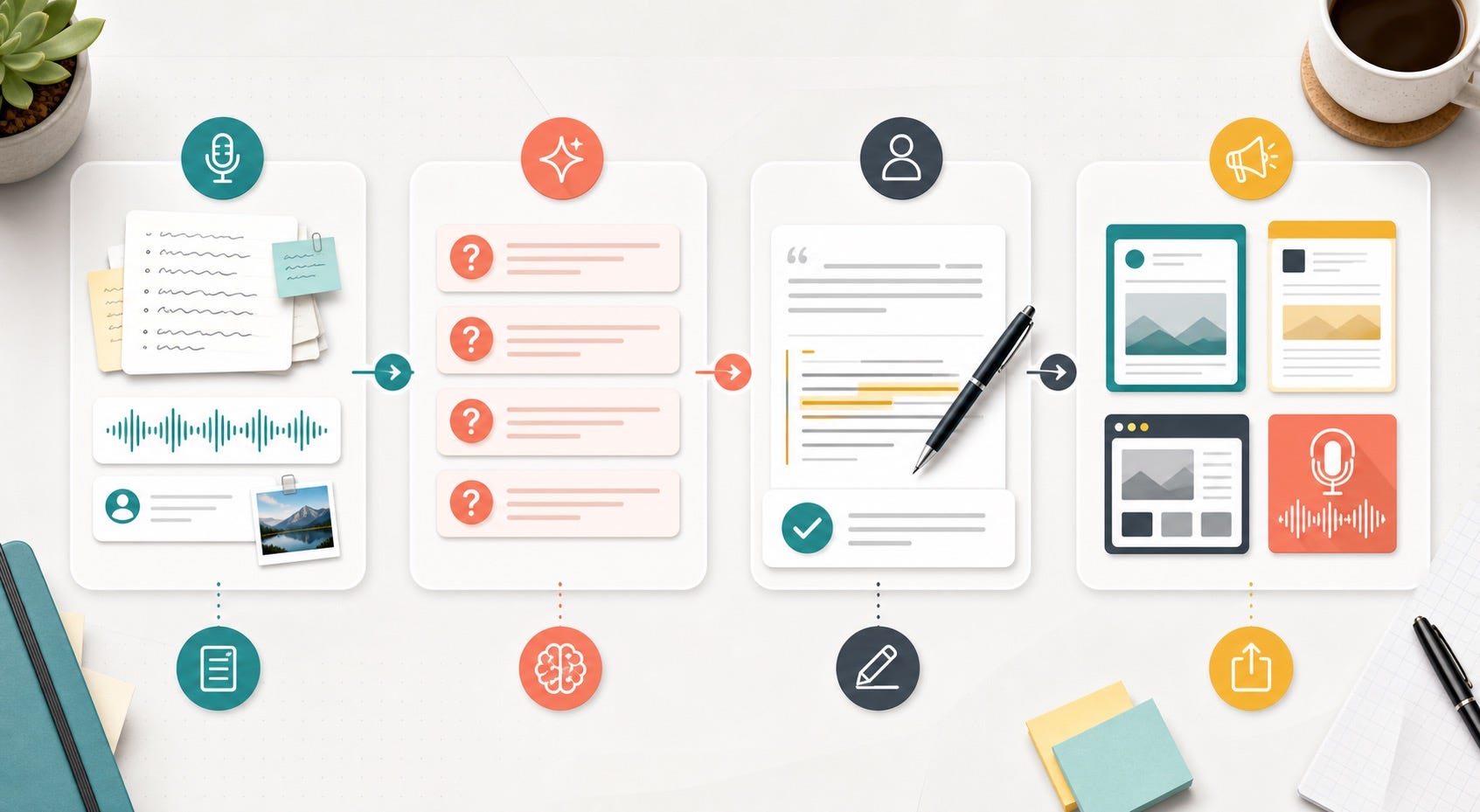
From one interview, you can usually create several assets:
A LinkedIn post built around one specific lesson.
A Substack paragraph that expands the lesson into a broader point of view.
A website proof point that explains your method.
A bio line that replaces vague adjectives with a concrete pattern.
A podcast talking point that gives hosts a stronger angle.
A private story bank you can reuse when the blank page returns.
A Practical Example
Imagine a freelance product strategist who says, “I help startups improve onboarding.” That is accurate, but it is not memorable.
In an AI personal brand interview, the assistant asks what happened this week. The strategist says a founder wanted to add more onboarding steps because users were confused. The AI asks what changed. The strategist explains that the real issue was not missing education; it was that the product asked for setup before proving value. They removed two steps, moved the first win earlier, and used tooltips only after the user had context.
Now there is a story. The LinkedIn post could start: “A founder asked me to add more onboarding. We removed two steps instead.” The newsletter section could explain the principle: education works better after motivation. The website proof point could say: “I help teams shorten the path to first value before adding more instructions.”
AI did not create the expertise. It asked enough questions to uncover it.
Ethical Rules for AI-Assisted Personal Branding
If AI is involved in your personal brand, your ethics should be simple: use AI to clarify, compress, structure, and repurpose your real experience. Do not use it to fabricate experience, borrow emotion, invent client results, or impersonate expertise you do not have.
Keep these rules close:
Never publish a story if the core event did not happen.
Remove or anonymize private client, employer, teammate, student, or user details.
Do not let AI add numbers, outcomes, or authority signals you cannot prove.
Keep one sentence that sounds exactly like you, even if it is less polished.
Disclose AI use when the format, platform, or audience expectation calls for it.
Use AI as an editor, not as a substitute for judgment.
The irony of AI personal branding is that the more powerful the tools get, the more valuable your real constraints become. Your messy experience, local context, odd phrasing, specific audience, and actual tradeoffs are what separate a credible personal brand from a content machine.
The 25-Minute Personal Brand Interview Template
Here is a simple weekly routine you can repeat every Friday or Monday.
Open a fresh AI chat and paste the interviewer prompt.
Answer questions for 15 minutes without trying to sound polished.
Ask for a story map with audience, trust signal, lesson, and privacy risks.
Choose one story that feels specific and useful.
Ask for three draft options, but require the AI to preserve your facts and voice.
Edit the best draft by adding one sentence only you would write.
Save unused stories in a private story bank for later.
That last step is where compounding begins. After four weeks, you may have 15 to 25 usable story fragments. After three months, you have a personal brand archive: lessons, proof points, examples, beliefs, mistakes, and audience questions. That archive can feed your LinkedIn posts, Substack essays, speaker applications, website copy, sales calls, job interviews, and introductions.
You stop asking, “What should I say?” because you have a body of evidence to draw from.
The Bottom Line
AI will keep making polished content easier. Platforms will keep looking for signs of low-effort automation. Readers will keep getting better at sensing when a post has no person behind it.
The answer is not to avoid AI. The answer is to move AI earlier in the process. Use it before writing, while the story is still raw. Let it ask questions. Let it find patterns. Let it challenge vague claims. Then make the final judgment yourself.
Your personal brand is not the content you generate. It is the trust people build after seeing your judgment show up again and again. An AI personal brand interview helps you find that judgment before the blank page turns it into noise.
FAQ
What is an AI personal brand interview?
An AI personal brand interview is a structured chat where an AI assistant asks you questions about your work, lessons, values, and stories before helping you turn those answers into brand assets. The goal is to extract real material, not invent a persona.
How is this different from using AI to write LinkedIn posts?
Most AI writing starts with the final post. An interview starts with your real experience. That makes the finished content more specific, more credible, and less likely to sound like generic AI thought leadership.
Can ChatGPT help me find my personal brand story?
Yes, if you use it as an interviewer. Ask it to question you one step at a time about your work history, turning points, mistakes, repeated lessons, and audience. Then review the patterns yourself before publishing anything.
What should I do if AI makes my story sound exaggerated?
Cut the exaggeration immediately. Tell the AI to preserve only facts you provided, remove unsupported claims, and write in a plainer voice. Your personal brand gets weaker when the story sounds bigger than the evidence.
How often should I run a personal brand interview?
Weekly is enough for most professionals. A 25-minute weekly debrief can produce several story fragments, one strong post, and source material for future bios, newsletters, website updates, or speaking ideas.