


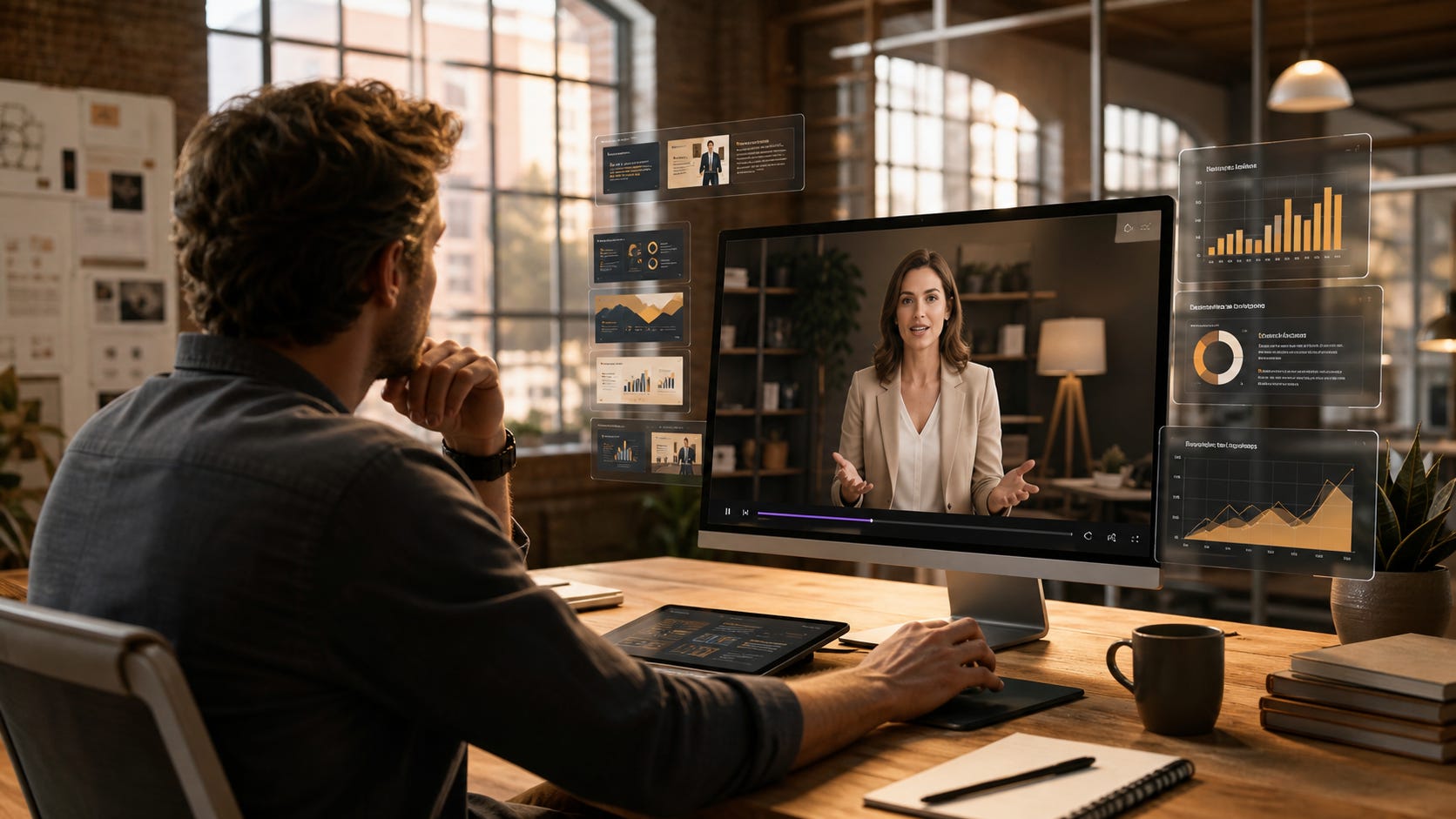
If your current fundraising workflow still ends with “I just sent the deck, let me know what you think,” you are making the investor assemble the case by themselves. That is a bad trade. Investors skim fast. Advisors forward materials without context. Warm intros often happen asynchronously. A clean pitch video gives your problem, traction, and ask a voice, a pace, and a point of view.
The opportunity is bigger than polish. An AI pitch video generator helps you compress a founder story into a format that works before the meeting, after the meeting, and between meetings when the real decision-making happens. Used well, it becomes a repeatable asset for investor outreach, sales conversations, partner pitches, accelerator applications, and internal alignment.
The short version: a pitch video is not a prettier deck. It is a tighter argument. The best ones remove friction, highlight proof early, and keep the audience moving toward one next step.
Why static decks keep stalling
Most founders assume their deck problem is visual. Usually it is structural. Static slides force the audience to decide what matters, what order to read in, and how strongly to weigh each claim. That creates four common failure points.
The opening takes too long to explain the problem.
The best proof appears too late.
The product demo is implied instead of shown.
The ask is buried in a final slide with no emotional momentum behind it.
An AI pitch video generator solves those issues by sequencing the story. It lets you decide exactly when the audience sees the pain, the product, the traction, the market, and the ask. That sounds simple, but it changes how the pitch lands. Instead of hoping a reader notices the important slide, you control when it arrives and what the narration makes them pay attention to.
A good investor video does one job exceptionally well: it reduces the effort required to understand why this company matters right now.
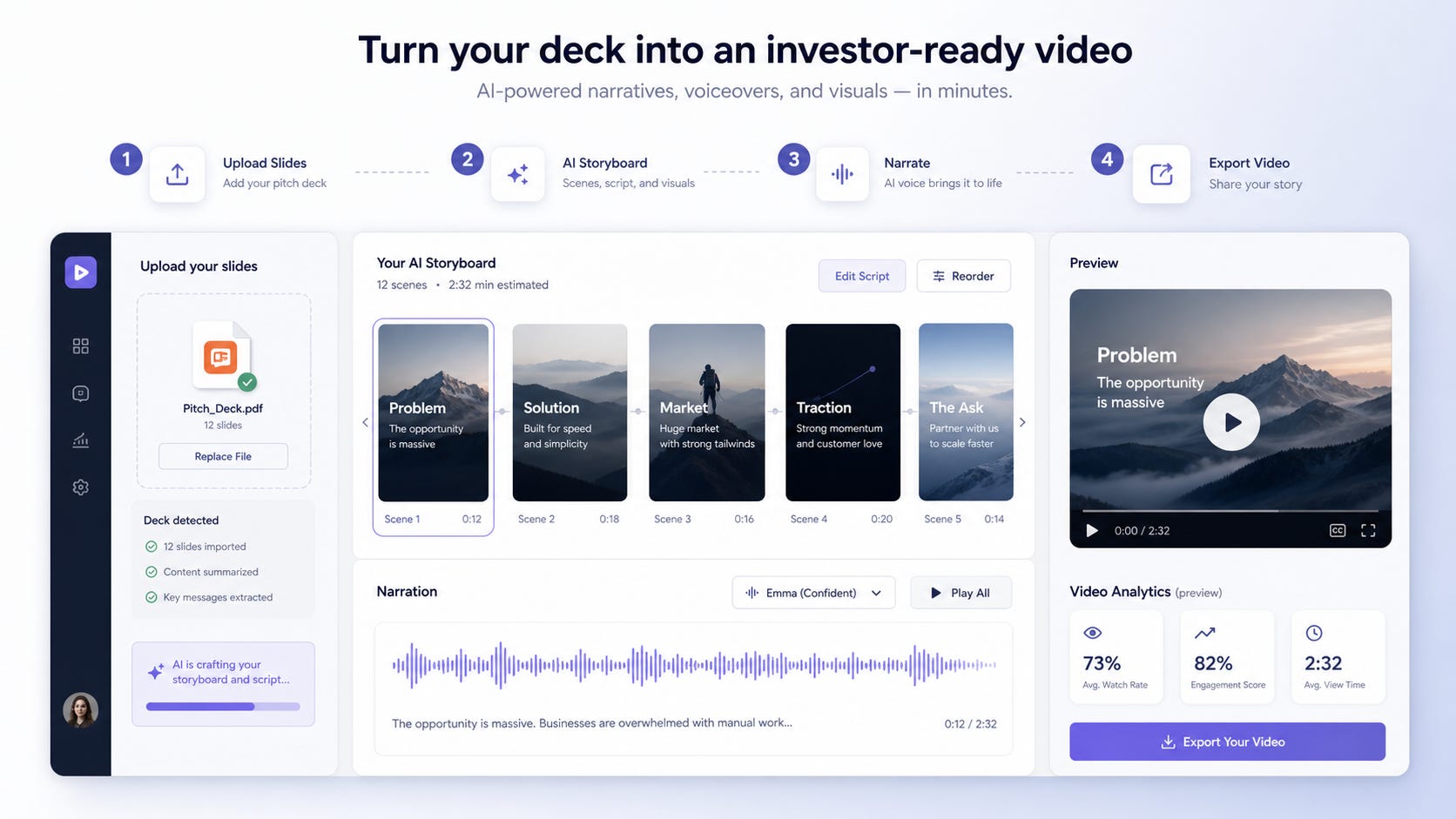
What an AI pitch video generator actually needs from you
The tool is not the hard part. The raw material is. If your slides are vague, your output will be vague faster. Before you generate anything, you need five inputs that are brutally clear.
InputWhat good looks likeWhat usually goes wrongProblemOne painful, expensive, urgent problem in plain languageToo broad, too academic, or loaded with jargonSolutionA concrete before-and-after explanationFeature list instead of transformationTractionSpecific proof such as revenue, usage, waitlist, or retention“Strong growth” with no numbersAudienceOne investor type or buyer lens per versionTrying to speak to everyone at onceAskA crisp next step with amount, purpose, and timingWeak ending with no clear action
If those five inputs are solid, the tool can help with narration, pacing, scene transitions, captions, avatar delivery, brand consistency, and export. If they are fuzzy, the tool will simply help you produce an attractive miss.
The seven-step founder workflow
1. Rewrite the deck as a spoken story
Do not read your slides aloud. Write a spoken layer for them. Spoken language needs shorter sentences, cleaner transitions, and more explicit emphasis than slide text. When founders skip this step, the pitch video sounds robotic even if the voice sounds human.
A good rule: every scene should answer one question. What is broken? Why now? Why us? Why this product? Why will this scale? Why should I believe it? Why act now?
2. Front-load proof
The first 30 to 45 seconds should contain at least one hard proof point. That could be revenue growth, users, retention, conversion, pilots, or a customer result. Many pitch videos delay evidence because the founder wants to “set the stage.” That is usually backwards. Attention is earned by proof, not by suspense.
3. Match one visual idea to one spoken claim
If the narration says churn dropped, show the curve. If the narration says users complete setup in five minutes, show the workflow. If the narration says the market is crowded but under-served, compare old friction against your new path. The more tightly your visuals map to your spoken claim, the more persuasive the video becomes.
4. Keep the runtime short
For first-touch investor outreach, two to three minutes is the sweet spot. For product-heavy follow-ups, three to five minutes can work. If you are crossing six minutes, you are almost always mixing a pitch with a full meeting recording. Split the content instead.
5. Build a version for the audience in front of you
A generalist seed investor, a strategic partner, and a sales prospect do not care about the same details in the same order. One base structure can still support multiple versions. Swap the opening hook, proof emphasis, and ending CTA. That is where an AI pitch video generator becomes useful operationally, because versioning should be fast, not a week-long production cycle.
6. Add a lightweight demo moment
You do not need a full product tour. You do need one moment that makes the product feel real. That could be a quick interface walkthrough, a transformation snapshot, or a sequence that shows input, processing, and output. Investors want to know what changes in the world when the product runs.
7. End with a real ask
Do not fade out on branding. End with the raise amount, what it unlocks, and the exact next step. If the viewer should reply, book a call, review a data room, or intro another partner, say it. Friction compounds when the ending is vague.
A practical scene map you can use today
If you want a fast starting structure, use this nine-scene flow. It works well for early-stage fundraising, partner pitches, and polished follow-up videos.
{
  "scene_1": "Hook: name the expensive problem and who feels it",
  "scene_2": "Proof: one traction signal or urgent market shift",
  "scene_3": "Solution: explain the product in one sentence",
  "scene_4": "Demo moment: show the product doing the work",
  "scene_5": "Why now: market timing, regulation, or behavior change",
  "scene_6": "Business model: how money moves",
  "scene_7": "Defensibility: data, workflow, distribution, or team edge",
  "scene_8": "Roadmap: what the next 12-18 months unlock",
  "scene_9": "Ask: funding amount, use of funds, next step"
}
You can hand that structure to a content strategist, a founder, or a video tool and get much better first drafts immediately. It also makes revisions cleaner because each scene has a single job.

The content gap most ranking pages still miss
Look at the current results for AI pitch video generator and related terms and a pattern shows up fast. Most pages do one of three things: they advertise the tool, they list features, or they promise speed. Very few teach founders how to shape investor attention. That is the gap worth filling.
The stronger angle is not “make a pitch video in minutes.” It is “build an investor-ready narrative that survives async viewing.” That framing matches how people actually share decks now. One person opens it. Another forwards it. A third person sees it out of context. The story must still hold.
This is why a platform such as PortfolioVideo is most useful when it is treated as a story-delivery system, not just a video export button. The leverage comes from speed of iteration, clear narration, and reusable versions for different meetings.
Mistakes that make an investor video feel weaker than a deck
Using long paragraphs on-screen while narration says the same thing.
Opening with brand mission instead of painful reality.
Adding an avatar when plain voiceover would be clearer.
Showing every feature instead of the one decisive workflow.
Using a polished tone that strips out conviction.
Sending the same version to every investor regardless of thesis.
The avatar point matters. Not every pitch needs a face on screen. If the strongest asset is product clarity, use narration and visuals. If founder credibility is central to the decision, an avatar or presenter layer can help. Choose the format that reinforces trust, not the one that looks most futuristic.
How to measure whether the pitch video is working
You do not need a huge analytics stack to know if the asset is helping. Start with three questions.
Are more people watching past the opening proof point?
Are follow-up calls better because the basics are already understood?
Are recipients forwarding the video or deck more often inside their team?
If watch-through falls early, your hook is weak or your proof arrives too late. If calls feel confused, the narrative map is muddled. If nobody forwards it, the video may be too long, too generic, or too hard to summarize in one sentence. Treat the pitch video like a living asset. Revise it after real conversations, not once per quarter.
One useful rule: every revision should remove one point of confusion or add one point of proof. Random polish rarely moves outcomes.
What to do this week
If you already have a deck, do not start from scratch. Pull out your current slides and ask four blunt questions. Which scene creates the earliest trust? Which slide proves demand? Which part actually shows the product? Which ending tells the viewer what to do next? Once those answers are clear, the video build becomes straightforward.
The founders who benefit most from an AI pitch video generator are not the ones chasing novelty. They are the ones reducing friction in high-stakes conversations. In a crowded inbox, clarity is a competitive advantage. In an async workflow, guided storytelling is a competitive advantage. In fundraising, that combination matters more than another decorative deck redesign.
A static deck can explain your company. A good pitch video can make the next conversation easier to earn. That is the standard worth aiming for.
FAQ
What is the ideal length for an AI pitch video generator output?
For first-touch investor outreach, keep it between two and three minutes. That is long enough to explain the problem, product, proof, and ask without asking for too much attention up front. Longer versions work better as follow-up assets.
Is an AI pitch video generator better than sending a normal pitch deck?
It is better when the story needs guidance. A deck is still useful for detail and diligence, but a video is stronger when you need a clear narrative, better pacing, and an easier asset to forward internally.
Should every founder use an avatar in their investor pitch video?
No. Use an avatar or presenter layer only if it strengthens trust or helps explain the story. For some products, a direct voiceover plus screen-based visuals will feel sharper and more credible.
What keywords matter most around AI pitch video generator search intent?
The strongest adjacent terms usually include AI pitch deck generator, investor pitch video, startup pitch video maker, pitch deck video, deck to video, and async investor outreach. These terms map closely to how founders describe the problem they are trying to solve.
Can I use the same pitch video for fundraising and sales?
You can reuse the structure, but not the exact version. Investors care about market timing, defensibility, and upside. Buyers care about workflow, pain reduction, and return on spend. Keep the base story, then swap the proof and ending.
How often should I update my investor pitch video?
Update it whenever a major proof point changes, such as revenue, retention, pilots, or roadmap progress. If you are fundraising actively, reviewing the asset every two to three weeks is a practical rhythm.