


Your strongest work may be the work you cannot post. A confidentiality-first AI workflow can help you show the thinking behind it without treating a client’s trust as raw material.

The first decision is not what AI should write. It is what you have the right to make public.
Most professionals do not have a portfolio problem. They have a permission problem.
The project that best shows your judgment may involve an unreleased product, a private client, a sensitive audience, internal data, or an agreement you should take seriously. So the public version becomes thin: a blurred screenshot, a vague claim about impact, and a line about a “leading company.” It protects the client, perhaps. It rarely helps anyone understand how you think.
AI makes this tension sharper. It can turn a messy project archive into a readable first draft in minutes. It can also preserve, recombine, or confidently elaborate details that should never have left your notes. The answer is not to avoid AI entirely. It is to put a human confidentiality gate before the prompt.
This article is a system for consultants, freelancers, founders, product leaders, designers, and technical professionals who need to build a credible personal brand from real but partly private work. It is not legal advice, and it cannot override your contract, client relationship, employer policy, or local law. When the permission is unclear, the safest and most professional move is to pause and ask the person authorized to answer.
A portfolio case study is not proof that you can reveal secrets. It is proof that you can make good decisions when the stakes are real.
Why this matters more in an AI-saturated feed
When anyone can generate a polished project story, polish has become cheap. What stays scarce is evidence of judgment: how you framed a problem, what you ruled out, how you worked within a constraint, and what you learned. A careful case study makes that visible.
That is also why a vague, AI-smoothed case study can weaken a personal brand. Readers notice when the story contains big verbs but no decisions. “Transformed,” “optimized,” and “drove” do not tell a prospective client, hiring manager, or collaborator what you would actually do in their situation. Specificity does.
Confidentiality does not force you to be generic. It forces you to separate four things that are often tangled together:
The client’s identity: name, recognizable context, brands, people, and relationships.
The protected material: documents, screens, data, commercial terms, roadmap details, methods, and other non-public information.
Your contribution: the role you actually played, the decision you owned, the collaboration you joined, and the limits of your claim.
The transferable lesson: the principle, question, or approach that another reader can learn from without reverse-engineering the original engagement.
AI is useful only after you have made those distinctions. Until then, it is a very fast way to blur them.
Start with a publication safety gate
Do not begin by uploading project files, screenshots, meeting transcripts, client briefs, or dashboards to a general-purpose AI tool. Begin with a gate: a short, written review that decides what category of information you are handling and whether the tool and use are approved.
Ask these questions before you collect material:
What explicitly permits publication? Look for written portfolio rights, client approval, an employer policy, a public launch, or a specific release. “I worked on it” is not the same as permission to publish it.
Could several harmless details identify the client together? Industry, geography, timing, a distinctive problem, staff roles, screenshots, and a result can form a fingerprint even when the name is missing.
What can the AI tool retain or use? Follow your organization’s approved-tool and data-handling rules. If you cannot explain why a detail may be entered, keep it out.
Who can approve the public version? Name a real person or role. A vague plan to “be careful” is not a review process.
What is the smaller truthful story? If the original project cannot be shared, can you discuss a general problem pattern, an approved artifact, a reconstructed example clearly labeled as illustrative, or a public outcome already released by the client?
The gate is not bureaucracy. It is a brand signal. Someone deciding whether to trust you with a sensitive problem will notice that you respect the people who trusted you before.
Build a source card, not a secret archive
Once you know what may be used, create a source card. This is a brief, deliberately minimal record for one public case study. It should contain only material already cleared for this purpose or rewritten at an appropriate level of abstraction. Do not treat it as a place to paste the full confidential history and ask a model to “make it safe.”
A strong source card has six fields:
Approved context: a non-identifying description of the setting, such as “a regional service organization,” but only if that description itself is allowed.
Your real role: use plain language and name collaborators where appropriate. “I led the research synthesis with a two-person product team” is more honest than “I transformed the experience.”
The decision: the hard choice, trade-off, or question you helped handle.
Approved evidence: a public link, authorized quote, permitted metric, or observable artifact. If there is no publishable evidence, say less rather than manufacturing a result.
What is excluded: client name, exact dates, internal tools, unreleased features, customer data, private numbers, or any other boundary.
The reader lesson: one useful principle a peer can apply elsewhere.
Think of this as a tiny contract with yourself. It gives AI a bounded assignment: arrange approved meaning. It does not give AI permission to infer the rest.

A source card makes the boundary visible before the draft becomes persuasive.
Give AI a narrow editorial job
“Write a case study about this project” is the wrong prompt. It asks a model to fill gaps, make transitions, and create a satisfying narrative from information it cannot verify. A better request describes the audience, the permitted source material, the prohibited material, and the format.
A confidentiality-first AI prompt
“Using only the approved source card below, draft a 500-word personal portfolio case study for [audience]. Explain the problem pattern, my specific role, one decision or trade-off, and one transferable lesson. Do not name or guess the client, industry, location, dates, team members, tools, metrics, or outcomes unless they appear verbatim in the approved card. Do not add achievements, testimonials, or causal claims. Flag every sentence that makes a factual claim so I can review it. If the evidence is too thin, say what is missing rather than inventing a bridge.”
This prompt does two useful things. First, it tells the model that silence is better than invention. Second, it turns the first draft into a review aid. The model is helping you see the claims you must own; it is not acting as an expert witness for your career.
Ask for a few different structures rather than a single polished answer. A concise “decision story” may be safer and stronger than a conventional before-and-after case study:
The situation: a broadly stated, approved problem pattern.
The constraint: the kind of limit that shaped the work, without naming a secret.
Your move: the question you asked, framework you used, or option you tested.
The evidence: only an approved observation, public artifact, or carefully scoped result.
The lesson: what the experience changed in your approach.
Notice that this structure does not require a heroic ending. A credible personal brand often gets stronger when it admits uncertainty: what you could not test, what you would do differently, or which part of the work belonged to the team rather than to you.
Run the fingerprint test before you publish
A case study can remove every obvious identifier and still be identifiable. A former colleague, competitor, or client may recognize a launch sequence, a niche feature, a distinctive crisis, a location, and a percentage when they appear together.
Read the draft with the mindset of a person trying to identify the project. Circle anything that narrows the field: dates, customer segments, screenshots, uncommon vocabulary, partner names, team sizes, sequence of events, exact results, or visual style. Then ask an informed peer who was not involved: “Could this point to a real client or project?” Their answer is often more useful than your own familiarity.
AI can assist with this check, but never use it as a legal clearance. You can paste the already-sanitized draft into an approved environment and ask for categories of potentially identifying clues. Then make the final judgment with the people and agreements that govern the work.
Four ways to make a case study safer without making it empty
Use ranges only when they are approved. Do not casually swap an exact number for a percentage and assume it is safe. A relative change can still reveal commercially sensitive information.
Recreate a teaching artifact from scratch. If permitted, use an original generic diagram to explain your approach. Label it clearly as illustrative; do not disguise a reconstruction as the original client asset.
Focus on the decision, not the interface. A reader may learn more from how you prioritized competing needs than from an unreleased screen.
Offer an approved next proof step. This can be a public talk, published article, authorized reference, or a conversation about your process. Do not promise a private portfolio if sharing it would breach the same boundary.
Do not let the draft steal credit
AI writing has a predictable failure mode: it makes shared work sound like individual achievement. The fix is not to bury your contribution. It is to make it precise.
Compare “I redesigned the onboarding journey and increased adoption” with “I led the customer-interview synthesis that helped a cross-functional team choose which onboarding friction to address first.” The second sentence may feel less dramatic. It gives a reader a much better picture of what it is like to work with you.
Review every strong verb. Did you lead, support, facilitate, advise, build, test, recommend, or approve? Was the outcome caused by your work alone, or did your work contribute to a larger effort? Is the result public and authorized? AI can make an overclaim sound natural. Your reputation absorbs the cost when someone discovers it is not quite true.
This is where a small human review circle helps. Ask one person who understands the work and one person who represents the intended reader to read the draft. The first checks for accuracy and boundaries. The second checks whether the story is concrete enough to be useful. You want both kinds of feedback before the copy becomes part of your public identity.
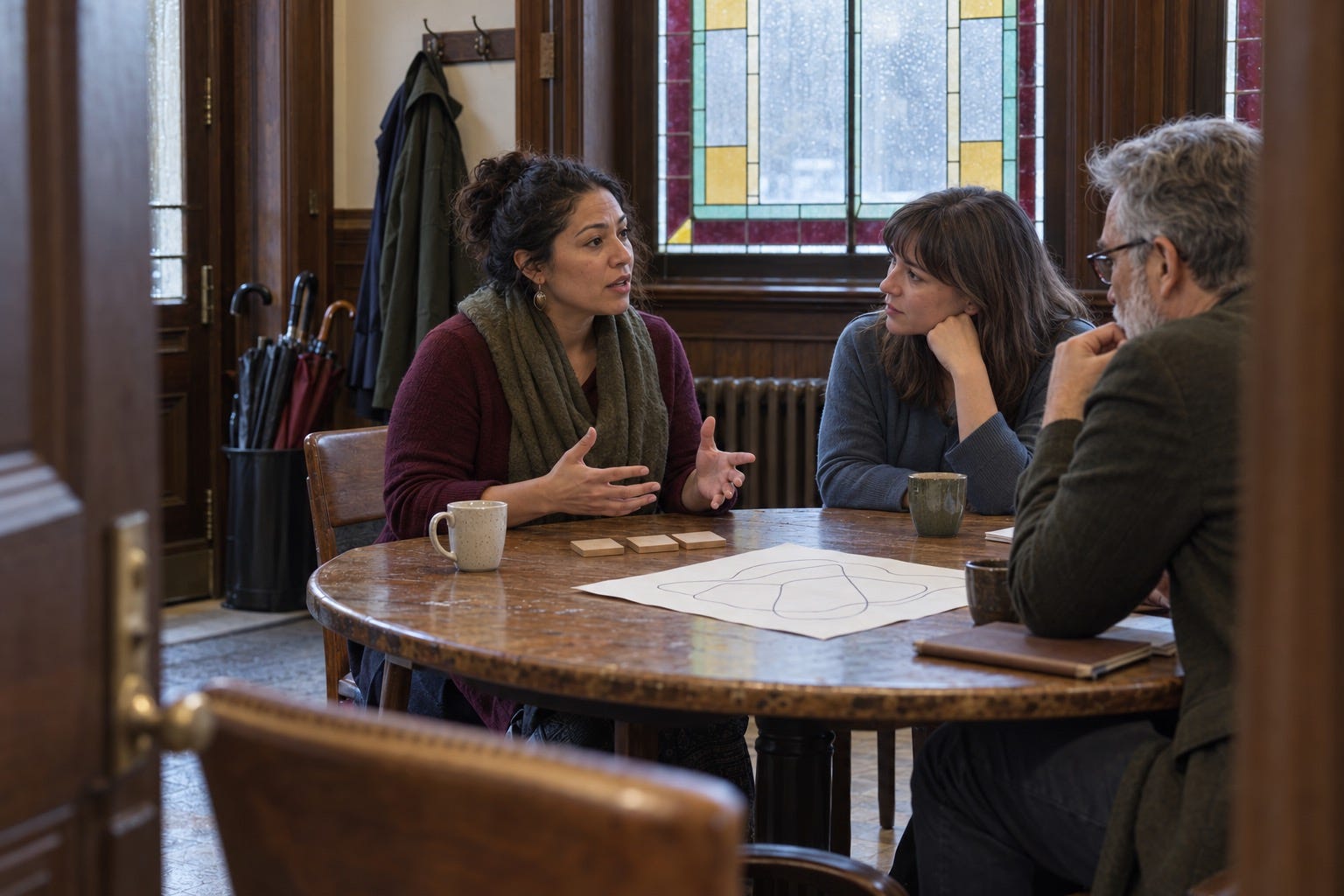
The goal is not to recreate a confidential project. It is to make your professional judgment legible.
A 40-minute case-study sprint
If you have one afternoon, do not attempt to build a complete portfolio. Build one trustworthy proof asset.
Spend ten minutes on the safety gate. Stop if permission is uncertain.
Spend ten minutes making a minimal source card from approved material only.
Spend ten minutes asking AI for two short, tightly constrained structures.
Spend five minutes on the fingerprint test and the credit check.
Spend five minutes revising in your own voice and deciding whether the draft needs formal approval before publication.
Save the approved source card beside the final copy. The next time you need an About-page example, LinkedIn post, talk anecdote, proposal proof point, or interview story, you will start from a truthful boundary instead of reopening a risky archive. That is a personal-brand system worth maintaining.
FAQ: AI portfolio case studies and confidential client work
Can I use AI to write a portfolio case study about confidential client work?
Only use material you are authorized to use and only in tools approved for that material. Create a minimal, sanitized source card first. AI can organize approved facts, but it should not receive confidential project files or decide what your agreement permits.
Can I put NDA work in my portfolio?
It depends on the agreement, the client or employer policy, and the specific material. An NDA is not a standard template with one universal answer. Seek permission from the appropriate authority when the scope is unclear, and do not assume a password protects an unauthorized disclosure.
How do I show work without naming the client?
Describe only an approved general context, your accurate role, a transferable decision, and an authorized form of evidence. Remove combinations of clues that could identify the client. If the work cannot be described safely, use a different proof asset.
What should I ask AI to do when writing a case study?
Ask it to organize verified, approved inputs into several short structures; flag factual claims; identify generic language; and compare clarity. Explicitly prohibit it from adding names, metrics, client details, achievements, or causal claims that are not in the source card.
Is a blurred screenshot safe for a public portfolio?
Not automatically. Screens can retain recognizable layouts, data shapes, branding, metadata, or context clues. Assess the entire story, not only visible text, and use a clean original teaching diagram only when that is allowed.
How can a confidential case study strengthen my personal brand?
It can demonstrate discretion, clear thinking, and responsible collaboration. Focus on the professional judgment you can truthfully explain, not on trying to recreate confidential artifacts or make the project sound larger than it was.
Should I say that a case study is anonymized?
If you have permission to say so, a short, plain note can set expectations: some identifying details have been omitted or generalized to respect confidentiality. Do not use the note as a substitute for actual clearance and careful review.
Make discretion part of the proof
The most durable personal brands are not built on the illusion that every story is yours to tell. They are built on a repeatable pattern: choose work you can stand behind, tell only the truth you are entitled to share, show your contribution without erasing others, and use AI to sharpen the story rather than invent one.
That restraint will not make every case study louder. It will make the right reader more confident that you bring the same care to their work.
Practical note: confidentiality obligations vary. Review the agreement and get professional advice when needed; this article is a personal-brand workflow, not legal guidance.