


Your LinkedIn profile is no longer just a page for recruiters to skim. It is now machine-readable brand infrastructure. That changes how you should write it, what you should prove, and which trust signals matter.

Last week, a LinkedIn user hid a prompt injection in their bio and got recruiter bots to message them in Old English and call them “My Lord.” It was funny. It was also useful. The stunt exposed something many professionals still treat as a theory: public profiles are increasingly being read, summarized, ranked, and acted on by AI systems before a serious human ever shows up.
If you are a founder, consultant, executive, student, job seeker, or creator, that changes the job of your profile. Your LinkedIn page is no longer just a digital business card. It is a machine-readable statement of identity, expertise, and trustworthiness. It has to do two things at once: help AI systems understand where you fit, and help humans feel safe trusting what they see.
That is why “optimize your profile with keywords” is no longer enough. A profile can be searchable and still feel fake. It can be polished and still trigger skepticism. It can even be verified and still sit in an ecosystem full of bots, scams, and generic AI slop.
The better goal is an AI-safe LinkedIn profile: one that is easy for recruiter AI, LinkedIn hiring agents, and search systems to parse, but still sounds like a real person with clear experience, visible proof, and strong trust signals.
The short version: make your profile literal enough for machines, specific enough for humans, and credible enough for both.
Why this matters now
LinkedIn has made the shift explicit. Its own help documentation says AI hiring agents help hirers find candidates, match profile data to qualifications, and summarize why someone fits a role. In other words, your profile is being processed as structured input. LinkedIn also says this can include your work experience, location, education, skills, summary, certifications, publications, and other profile fields.
The hiring side is moving fast too. In LinkedIn’s January 7, 2026 research release, 93% of recruiters said they plan to increase their use of AI in 2026, and 59% said AI is already helping them discover candidates they would not have found otherwise. That means machine readability is not optional anymore.
At the same time, trust is getting harder, not easier. LinkedIn’s 2026 Job Search Safety Pulse says 57% of professionals are now more likely to question whether a job is a scam than they were a year earlier. It also says 70% of recruiters believe verification of the job, recruiter, or company page is now a must-have. The market is telling you something simple: visibility without trust is weak personal branding.
A strong profile in 2026 does not just answer “Can this person do the work?” It also answers “Does this person look real, credible, and worth engaging with?”
The mistake most people make
Most LinkedIn advice still splits into two camps.
The first camp tells you to stuff the profile with keywords so recruiter systems can find you. The second camp tells you to “be authentic” in a vague, emotional way that often produces soft, generic writing with no hiring relevance.
Both approaches break down in the AI hiring era.
If you over-optimize for machines, your profile starts to sound templated. Humans feel that immediately. Reddit threads across marketing, recruiting, and LinkedIn communities are full of the same complaint: people are tired of profiles and messages that feel like AI wrote them for another AI.
If you over-optimize for personal expression, machines may not understand your fit cleanly enough to surface you for the right roles, partnerships, or collaborations. A beautiful profile that hides your actual capabilities behind clever phrasing is still a weak asset.
The winning move is not to choose one side. It is to write a profile that is machine-legible and human-believable.
What an AI-safe LinkedIn profile actually looks like
An AI-safe LinkedIn profile has five traits.
1. It is literal where machines need clarity
Recruiter AI cannot reliably infer your role from vague identity language. “Growth-minded builder helping ambitious brands thrive” may sound polished, but it hides the information a matching system needs. If you are a product marketer in B2B SaaS with experience in lifecycle, onboarding, and pricing, say that directly.
2. It is specific where humans need proof
Humans trust details, not adjectives. “Strategic leader” is forgettable. “Led pricing research across three product lines and launched a new packaging model that increased expansion revenue” is believable.
3. It is consistent across sections
If your headline says one thing, your About section says another, and your experience bullets tell a third story, you create ambiguity. AI systems struggle to summarize mixed signals well. Humans read inconsistency as inflation.
4. It contains proof-of-life signals
In a scam-heavy environment, people want evidence that a profile belongs to a real, active professional. Recent activity, coherent experience, recommendations, a sane photo, a filled-out work history, and verified details all help.
5. It does not outsource your judgment to AI
AI can help you tighten phrasing, compare versions, and spot gaps. It should not be allowed to flatten your experience into the same corporate oatmeal everyone else is serving.

How to rewrite your profile for AI recruiters without sounding AI-generated
Start with your headline
Your headline is high-value territory because both humans and systems use it as a fast classifier. A weak headline is either too vague or too ornamental.
A better structure is:
role or identity
domain or market
1 to 3 core strengths
optional proof or outcome
For example:
Weak: Building cool things at the intersection of innovation and impact
Better: Product Marketing Manager for B2B SaaS | Lifecycle, Positioning, Onboarding | Turning customer insight into revenue growth
The second version is easier for AI to match and easier for humans to trust.
Then fix your About section
Your About section should not read like a motivational speech. It should answer three questions quickly:
What do you actually do?
Who do you help or where do you operate?
What kind of evidence supports your claim?
A strong structure looks like this:
one sentence defining your current role and lane
two to four sentences on what problems you solve
one short proof block with outcomes, scope, or notable work
one sentence on what you are interested in next
This is where AI can help, but only after you provide raw material. Feed the model facts, achievements, tone constraints, and examples of how you naturally speak. Never start from “write my LinkedIn bio.” Start from “clean up these real details without changing meaning.”
Turn your experience section into evidence, not archive
Many professionals waste the experience section by listing responsibilities. That is a loss on both fronts. Machines learn less about your strengths, and humans get no proof.
Instead of writing what the role was supposed to include, write what you actually changed, improved, shipped, led, or learned. Use concrete nouns, specific tools, named functions, and measurable outcomes where possible.
Good bullets often follow this shape:
action
scope
method
result
That gives AI more usable signals and gives humans something worth believing.
Use the skills section more strategically
The skills section still matters because it creates structured matching signals. But random skill hoarding can make you look inflated. Your top skills should support the story your profile is already telling. If you want to be found for a target role, your headline, About section, experience bullets, and skills list should all reinforce the same professional lane.
Useful test: if a recruiter or AI summary tool read only your headline, About section, last two roles, and top skills, would it describe you the way you want to be described?
Trust signals matter more than ever
Searchability gets you surfaced. Trust gets you replies.
LinkedIn’s own safety research shows job seekers are looking for proof that the person, job, and company on the other side are real. That logic runs both ways. If you want better inbound opportunities, your profile should reduce uncertainty fast.
Here are trust signals that matter more in 2026:
a recent, professional photo that looks like a real person, not an overcooked AI portrait
a coherent work history with sensible dates and role progression
a headline that describes work, not aspiration theater
featured links, projects, publications, talks, or portfolio evidence
recommendations or endorsements that align with your actual positioning
verified profile details when available
recent activity that sounds like your brain, not a prompt library
This is where many personal brands quietly lose. They polish the surface but neglect the evidence. In an AI-heavy environment, proof matters because both people and systems use it to resolve uncertainty.
How to use AI without weakening your personal brand
You do not need to reject AI to stay credible. You need to assign it the right job.
Use AI for:
extracting repeated keywords from target job descriptions
finding missing proof points in your profile
rewriting long paragraphs into cleaner prose
comparing two headline versions for clarity
turning messy notes into structured first drafts
Do not use AI for:
inventing expertise you cannot defend
writing fake authority language
inflating outcomes
copying “thought leader” phrasing you would never say aloud
publishing untouched outputs full of generic rhythm and empty confidence
A good rule is simple: AI may compress your thinking, but it should not replace your memory, your taste, or your judgment.
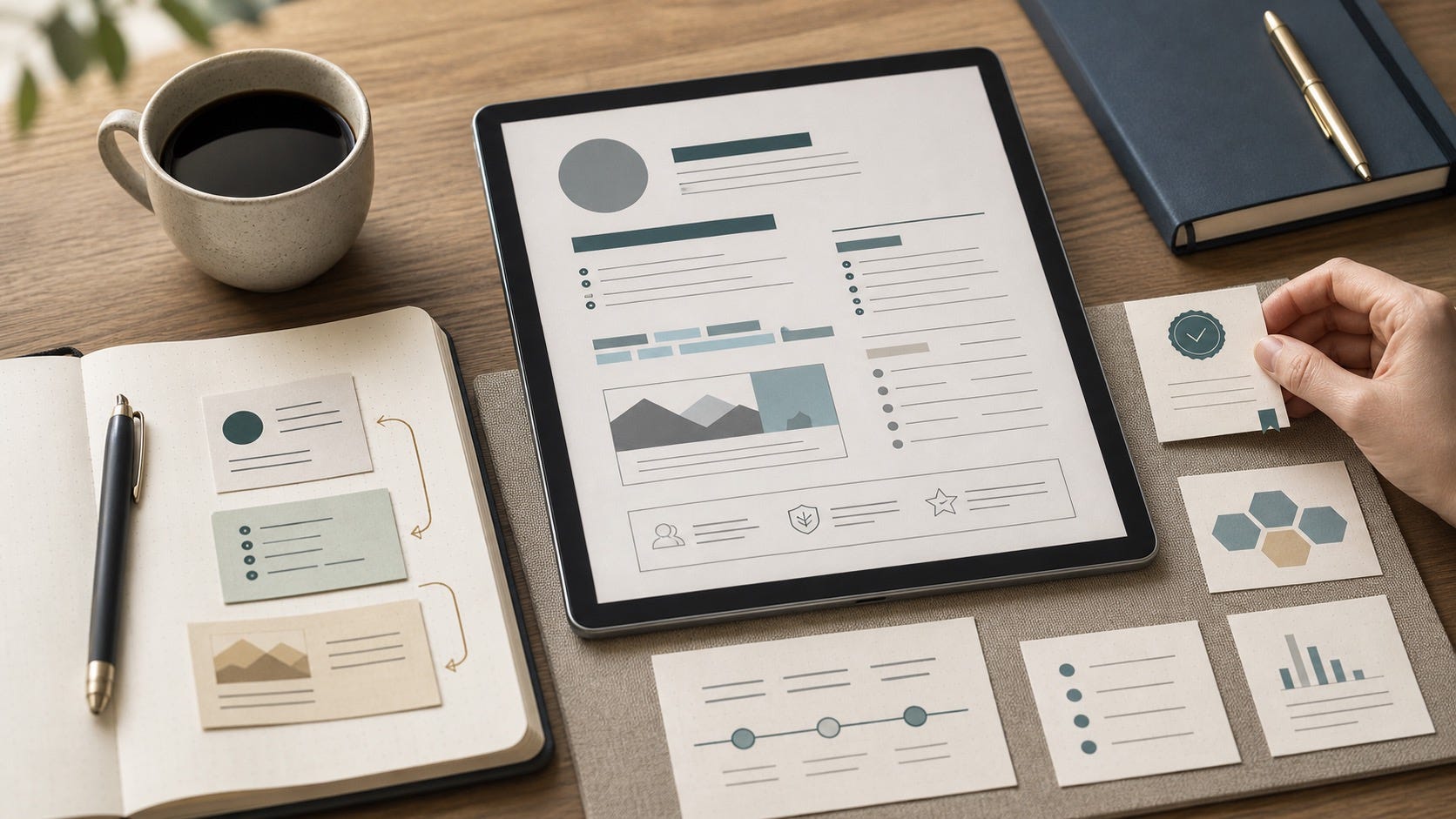
A practical 30-minute AI-safe LinkedIn profile audit
If you want a fast reset, do this in one sitting.
Minutes 1 to 5: define your target sentence
Write one sentence that starts with: “I want a recruiter, founder, client, or collaborator to understand that I am…” If that sentence is fuzzy, the profile will be fuzzy too.
Minutes 6 to 10: audit your machine-readable fields
Check headline, About section, top skills, current title, location, and the first two experience entries. Make sure the same role direction appears across all of them.
Minutes 11 to 18: replace adjectives with evidence
Search your profile for words like strategic, passionate, innovative, results-driven, visionary, dynamic, and dedicated. Replace each one with a fact, scope marker, tool, domain, or outcome.
Minutes 19 to 23: add one trust asset
Add a featured item, a case study, a project link, a deck, a repo, a talk, a writing sample, or a recommendation request. One visible proof asset is better than ten vague claims.
Minutes 24 to 27: check for scam-era friction
Read the profile like a skeptical stranger. Does anything feel inflated, oddly generic, or too polished to trust? Would a real person know how to verify you from what is on the page?
Minutes 28 to 30: humanize one section
Pick one sentence in the About section or recent activity and rewrite it in plain speech. Not casual for the sake of casual. Just less robotic. You want clarity with pulse.
The real shift: personal branding is now systems design
The deeper lesson is bigger than LinkedIn.
Your digital identity is increasingly interpreted by systems before it is interpreted by people. Search engines, answer engines, recruiter AI, internal sourcing tools, and workflow bots all touch your public presence. That means personal branding is no longer just messaging. It is systems design for credibility.
The professionals who win this shift will not be the loudest people on the feed. They will be the clearest. They will make it easy for machines to classify them, easy for humans to verify them, and hard for skeptics to dismiss them as synthetic noise.
That is the standard to aim for now. Not a perfect profile. A trustworthy one.
FAQ
What is an AI-safe LinkedIn profile?
An AI-safe LinkedIn profile is a profile that is easy for AI hiring systems to parse accurately while still feeling credible, specific, and human to the people who read it.
How do AI recruiters use LinkedIn profile data?
LinkedIn says AI hiring agents can use profile fields such as experience, education, skills, summary, certifications, publications, and job-seeking data to match and summarize candidates for hirers.
Should I optimize my LinkedIn profile for AI recruiters?
Yes, but not by stuffing keywords everywhere. The better approach is to make your role, domain, skills, and proof points explicit so both machines and humans understand your fit.
Can using AI to write my LinkedIn profile hurt my personal brand?
It can if you publish generic outputs unchanged. AI is useful for editing, tightening, and comparing drafts, but weak when it replaces your judgment or invents authority you cannot support.
What trust signals matter most on LinkedIn in 2026?
Clear positioning, coherent work history, visible proof of work, profile verification where available, a realistic photo, and recent human-sounding activity all improve trust.
What is the connection between prompt injection and personal branding?
The recent LinkedIn prompt-injection incident showed that bots may be reading public bios mechanically. That makes your profile part of a machine-readable environment, not just a human-read page.
How often should I update my LinkedIn profile for AI-era visibility?
Review it every one to two months, and again whenever your target role, offer, industry focus, or proof assets change. Small, regular updates are usually better than total rewrites.