



AI fluency is quickly becoming a professional baseline. The people who stand out will not be the ones who say they use AI. They will be the ones who can prove how they use it, where they apply judgment, and what changed because of their work.
A strange thing is happening in careers, consulting, freelancing, and founder visibility. More professionals are adding AI tools to bios, LinkedIn headlines, service pages, and project descriptions. At the same time, buyers, hiring managers, collaborators, and audiences are becoming more skeptical of polished output.
That skepticism is fair. Anyone can publish a clean document, a tidy automation, a shiny product mockup, or a clever content system with AI assistance. The real question is harder: do you understand the work well enough to defend it?
An AI skills portfolio answers that question before someone asks. It is not a resume. It is not a gallery of AI-generated artifacts. It is a public or semi-public proof system that shows how you collaborate with AI while keeping human judgment visible.
This matters because AI adoption is moving from novelty to operating reality. The Stanford AI Index analysis from Lightcast found rising AI skill demand in job postings. PwC’s AI Jobs Barometer argues that AI-exposed roles are changing faster and increasingly reward judgment, creativity, empathy, and leadership.
The brand implication is simple: “I use AI” is no longer a differentiator. “Here is how I solve real problems with AI responsibly” is.
The Mistake: Showing Output Without Showing Ownership
The weakest AI personal brands have the same problem: the work looks impressive, but ownership is blurry. A founder posts a perfect thread, but nobody can hear their lived experience. A student shares a complex app, but cannot explain the architecture. A consultant publishes an automation case study, but hides the messy diagnosis that made the work valuable.
Reddit discussions around AI portfolios are full of this tension. Recent threads ask how to show AI workflows without overdoing it, prove practical AI skills, choose portfolio projects, and explain AI-assisted work in interviews or client conversations. One recurring worry is sharp: people can build impressive portfolio projects with AI and still freeze when asked to explain how the thing works.
That is not just a student problem. It is a personal branding problem for anyone whose public identity depends on trust.
Your AI skills portfolio should make one thing obvious: the tool helped, but the judgment was yours.
Most AI portfolio advice still focuses on the artifact. Build a chatbot. Build a RAG system. Build an automation. Build a dashboard. Those can be useful, but they are not enough. A strong AI skills portfolio shows the thinking around the artifact: the problem, constraints, rejected alternatives, risks caught, and evidence that the work made something better.
What an AI Skills Portfolio Actually Is
An AI skills portfolio is a curated set of proof pages, project notes, examples, and decision records that show how you work with AI in real professional contexts. It can live on a personal website, Notion page, GitHub repo, Substack post, LinkedIn Featured section, or private client-facing page.
The format matters less than the signal. The portfolio should help a reader answer five questions quickly:
What problem were you trying to solve?
Where did AI help, and where did it not?
What human decisions shaped the final outcome?
How did you check quality, accuracy, safety, or taste?
What result, lesson, or business value came from the work?
This is why an AI skills portfolio belongs inside your personal branding system. It turns vague claims into inspectable evidence. It also protects you from two bad impressions: looking behind the curve because you never mention AI, or looking replaceable because your work sounds machine-made.
The Four Proof Assets Every AI Skills Portfolio Needs
You do not need twenty projects. You need a few pieces of proof that make your judgment visible from different angles. Start with these four assets.
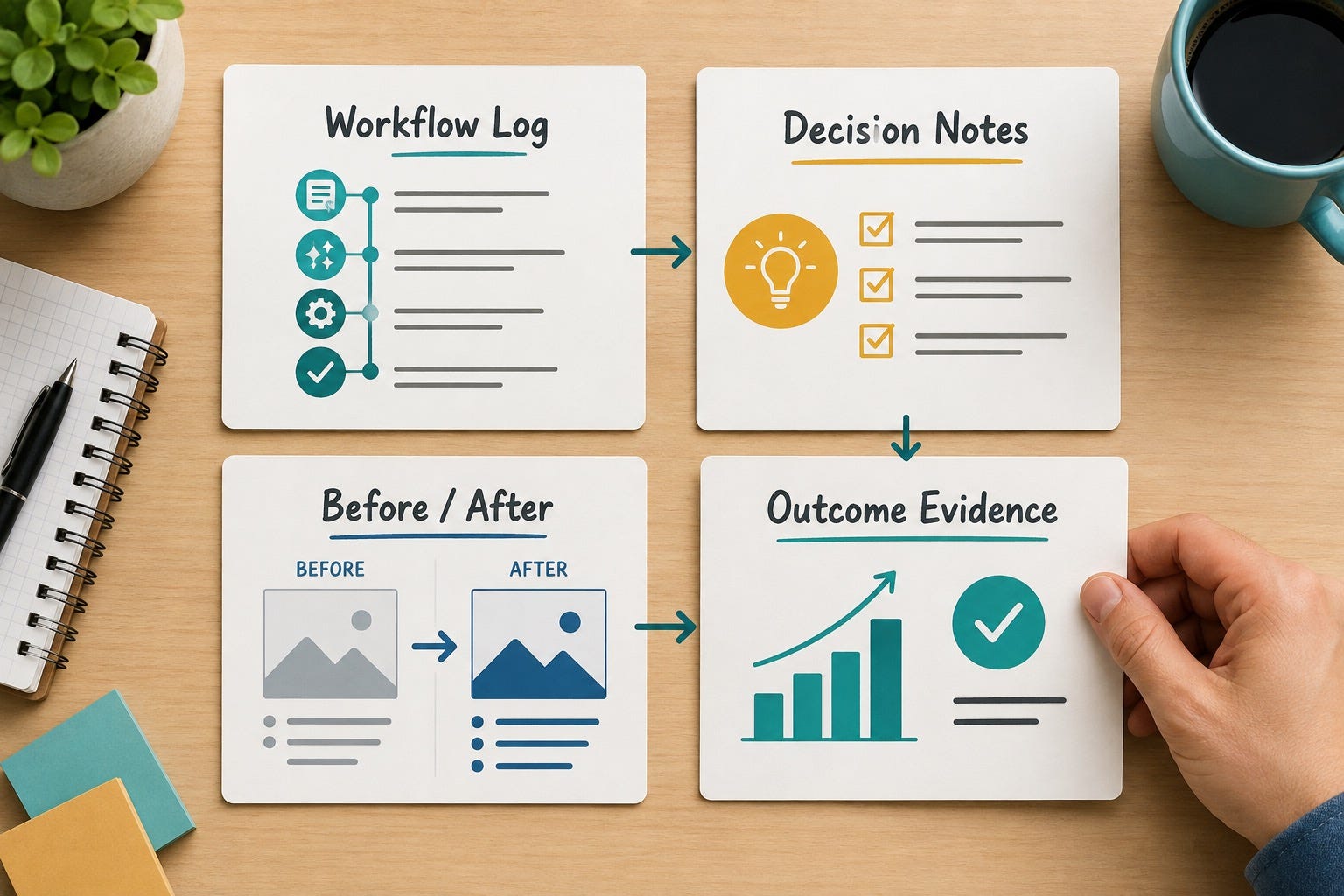
1. A Workflow Log
A workflow log shows the path from problem to result. It does not need to expose every prompt or proprietary detail. It simply explains the sequence of work.
For example, a marketer might show how they used AI to cluster customer interviews, extract recurring objections, draft messaging options, and then rewrite the final copy by hand after comparing it with actual sales calls. A developer might show how they used AI to generate test cases, review edge cases, and explore refactoring options, while personally making the final architecture decision.
The key is to name the boundary. Do not just say “used ChatGPT for research.” Say what kind of research, what sources were excluded, what assumptions were checked, and what you changed after review.
2. Decision Notes
Decision notes show that you are not outsourcing taste, ethics, or strategy to a model. They can be short. A good decision note might explain why you rejected an AI-generated headline, why you chose a simpler automation instead of a complex agent, or why you removed a claim that sounded impressive but lacked evidence.
Decision notes reveal maturity. Clients and employers do not only want speed. They want someone who knows when speed creates risk.
3. A Before-and-After Sample
Before-and-after proof works because it makes improvement visible. Show the rough starting point, the AI-assisted intermediate version, and the final human-edited version. This is especially useful for writers, designers, analysts, educators, product managers, consultants, operators, and founders.
The important move is to avoid fake polish. A clean “after” image tells people almost nothing. A clear explanation of why the after version is better tells them a lot. Did it become more specific? More accurate? Easier to scan? More useful to a stakeholder? More aligned with a brand voice? More honest about uncertainty?
4. Outcome Evidence
Outcome evidence keeps the portfolio from becoming self-congratulatory. It can include performance data, client feedback, stakeholder approval, user behavior, faster turnaround, fewer support questions, cleaner documentation, or a concrete lesson learned.
Not every result needs a dramatic metric. “Reduced a weekly manual reporting task from two hours to twenty minutes” is better than “built an AI automation.” “Turned a vague founder story into a clear investor narrative after three interviews” is better than “used AI for storytelling.”
How to Choose Projects That Strengthen Your Personal Brand
The best AI skills portfolio projects sit at the intersection of audience pain, your real expertise, and visible proof. Do not build a project only because it sounds trendy. Build one that helps the right people trust you faster.
Use this filter before you choose a project:
Relevance: Does this project connect to the work you want to be known for?
Explainability: Can you walk through the core decisions without hiding behind buzzwords?
Proof: Can you show inputs, process, constraints, or outcomes without violating privacy?
Judgment: Does the project reveal how you handle ambiguity, risk, quality, or taste?
Repeatability: Could someone imagine you applying the same skill in their context?
A consultant might publish a “client onboarding AI workflow” that shows how intake notes become a sharper diagnosis. A product manager might show how AI helped synthesize feedback, but also where they disagreed with the model. A student might document a small research project and explain the tradeoffs they understood. Small is often better: a project you can explain builds more trust than a grand project that feels borrowed.
The AI Collaboration Case Study Template
If you only build one asset, build a two-page AI collaboration case study. It is compact enough to publish, but substantial enough to prove how you think.
Use this structure:
Context: What was the situation, audience, constraint, or opportunity?
Problem: What was unclear, inefficient, risky, or underperforming?
AI role: What did AI help you generate, analyze, compare, summarize, or test?
Human role: What did you decide, verify, reject, rewrite, prioritize, or take responsibility for?
Quality controls: How did you check accuracy, bias, privacy, compliance, originality, or brand fit?
Outcome: What changed after the work?
Lesson: What would you do differently next time?
This template works because it makes collaboration legible. You are not pretending to be a lone genius who never uses tools, and you are not pretending the tool deserves all the credit.
Prompts That Help You Build the Portfolio
AI can help you assemble the portfolio, but it should not invent the substance. Feed it real notes, screenshots, project summaries, meeting notes, changelogs, drafts, or outcomes. Then use it as an interviewer and editor.
Try these prompts:
“Interview me about this project so we can identify the human decisions, tradeoffs, and quality checks that are not obvious from the final output.”
“Turn these rough project notes into a concise AI collaboration case study. Preserve uncertainty. Do not exaggerate impact. Mark any claim that needs evidence.”
“Review this portfolio page as a skeptical hiring manager or client. What sounds vague, overclaimed, or generic?”
“List the moments in this workflow where human judgment mattered. Separate strategy decisions, ethical decisions, taste decisions, and verification decisions.”
“Rewrite this project description for clarity and trust. Make the AI role specific, but make my ownership unmistakable.”
The best prompt is not “make me look impressive.” It is “make my real work easier to inspect.”
How to Talk About AI Without Triggering Distrust
AI disclosure is not one sentence you paste everywhere. It is a context decision. A public post, client case study, academic project, creative portfolio, internal promotion packet, and founder thought-leadership page do not carry the same expectations.
Still, a few principles hold up across most professional settings.
First, be specific. “AI-assisted research synthesis” is more credible than “powered by AI.” “Used a language model to draft alternate explanations, then fact-checked against source material” is more useful than “used AI to write this.”
Second, disclose where AI materially shaped the work. If AI generated imagery, wrote code, summarized interviews, scored leads, drafted outreach, or simulated user feedback, say enough for the reader to understand the role it played.
Third, keep accountability human. Never use disclosure as a shield. “AI may be wrong” is weak. “I checked claims against named sources” is stronger.

Fourth, do not make AI the whole personality of your brand unless that is truly your field. For most professionals, AI is a capability layer. Your brand still needs a point of view, proof, values, audience understanding, and recognizable judgment.
Where to Publish Your AI Skills Portfolio
You can publish the same proof system in different levels of depth.
On LinkedIn, use your Featured section for one strong case study, one before-and-after example, and one post that explains your AI working principles. In your About section, mention AI only where it supports the problems you solve.
On a personal website, create a focused page called “AI Workflows,” “How I Work With AI,” “AI Collaboration Case Studies,” or “AI Skills Portfolio.” Three strong examples beat a long archive of experiments.
On GitHub, Substack, or a blog, document the reasoning behind the work in plain English. Include decisions, limitations, screenshots, lessons, and known failure modes. For private opportunities, redact sensitive details but preserve the structure of your thinking.
The 30-Minute Starter Version
If this feels too big, start with one small proof page. Pick a project from the last month where AI genuinely helped you do better work. Open a blank document and answer these questions:
What was I trying to improve?
What did I ask AI to help with?
What did AI get wrong or miss?
What did I change because of my own experience?
How did I check the result?
What proof can I safely show?
What did this make faster, clearer, better, or less risky?
Then write one paragraph for each answer. Add one screenshot, one process note, and one outcome. That is enough for a first version.
The goal is not to create a museum of everything you have ever done with AI. The goal is to make your professional judgment easier to trust.
Common AI Skills Portfolio Mistakes
Mistake one: listing tools instead of outcomes. A stack of logos does not prove competence. Show what the tools helped you accomplish.
Mistake two: hiding the rough work. If every artifact looks perfect, readers cannot see your process. Share enough of the messy middle to make the improvement believable.
Mistake three: overclaiming automation. Do not imply that a workflow is autonomous if it still needs heavy review. Name the handoff points, failure modes, and human checks.
Mistake four: publishing confidential proof. Redact names, numbers, screenshots, datasets, and proprietary logic when needed.
Mistake five: sounding like a prompt library. Show judgment, not just inputs.
The Point of the Portfolio
AI is making output cheaper. That does not make personal branding irrelevant. It makes proof more important.
Your audience is trying to answer a practical question: can this person be trusted with real work when the tools are powerful, fast, and occasionally wrong?
An AI skills portfolio gives them a better answer. It shows that you can use modern tools without becoming generic. It shows that you understand the difference between acceleration and delegation. It shows that you have taste, standards, and accountability.
That is the personal-brand advantage. Not louder posting. Not more AI content. Better evidence.
FAQ
What is an AI skills portfolio?
An AI skills portfolio is a curated collection of project notes, examples, workflow logs, decision records, and outcomes that show how you use AI to solve real problems. It focuses on proof of judgment, not just polished output.
Who needs an AI skills portfolio?
Founders, consultants, freelancers, job seekers, students, creators, product managers, marketers, developers, analysts, and executives can all use one. It is especially useful when your audience needs to trust that you can work with AI responsibly.
How many projects should I include?
Start with three strong examples. One should show a workflow, one should show a before-and-after improvement, and one should show an outcome. A smaller portfolio with clear ownership is better than a large portfolio full of vague experiments.
Should I disclose that I used AI?
Yes, when AI materially shaped the work. Be specific about the AI role and clear about your human review. Good disclosure should increase trust by showing boundaries, quality checks, and accountability.
What should I avoid putting in an AI skills portfolio?
Avoid confidential client material, unsupported performance claims, fake screenshots, tool-name stuffing, generic AI-generated writing, and projects you cannot explain. If you cannot defend the decisions behind the work, do not use it as proof.
Can non-technical professionals build an AI skills portfolio?
Yes. Your portfolio does not need to be code-heavy. You can show AI-assisted research, writing, sales preparation, operations workflows, customer analysis, teaching materials, strategy work, design exploration, or decision support as long as the proof is concrete.