



The fastest way to sound generic online is to ask AI what to say before you understand your audience. Use AI to listen first, then write.
A lot of personal branding advice starts in the wrong place: What should I post today? What hook will get attention? How do I publish more often?
Those are useful questions later. They are bad first questions. If you start with output, AI will usually give you output that sounds tidy, confident, familiar, and forgettable.
The better question is: What are the people I want to reach already confused about, skeptical of, afraid to ask, tired of hearing, or quietly trying to solve?
That is where AI social listening for personal branding becomes powerful. Not as a replacement for your voice, but as a research assistant that helps you notice real audience language before you publish your next essay, profile update, newsletter, comment, bio, or talk track.
This matters more now because audiences have become unusually sensitive to generic AI content. LinkedIn has been rolling out community feedback for posts that feel like low-quality AI output, and recent reporting from Business Insider says users have clicked that feedback option more than one million times since launch. Another Business Insider report described the growing pressure professionals feel to post, even when the performance culture around it feels awkward.
So the problem is no longer simply “be visible.” The problem is to become visible in a useful, specific, earned way.
What AI Social Listening Means for an Individual
Traditional social listening is usually explained for companies: monitor mentions, track competitors, analyze sentiment, and find trends. Coursera describes it as analyzing online conversations around your brand and industry to learn what your audience cares about. Emplifi’s guide to social listening highlights pattern detection, sentiment analysis, trend spotting, and revenue opportunities.
That is useful, but it is too corporate for most personal brands. A founder, consultant, developer, coach, freelancer, creator, or job seeker does not need an enterprise command center. You need a repeatable way to hear the market before you speak into it.
For a personal brand, social listening means collecting small signals from the places where your audience already talks, then turning them into better judgment.
Those signals can come from:
Reddit threads where people ask questions they are too embarrassed to ask on LinkedIn.
Comments under posts from respected people in your field.
Podcast reviews and episode comments.
Job descriptions and freelance briefs that show how buyers describe the problems you solve.
Search suggestions and community forum posts.
Customer calls, sales notes, DMs, and office-hour questions.
Your own past posts, especially the replies, saves, shares, and private follow-ups.
AI helps because the raw material is messy. It can summarize patterns, cluster objections, pull exact audience phrases, and suggest where your experience can add something useful.
The goal is not to let AI decide your opinion. The goal is to let AI show you where your opinion is actually needed.
The Search Gap: Most Advice Tells Brands to Listen, Not People
When you search for social listening guidance, most results are built for marketing teams. They explain tools, dashboards, sentiment analysis, brand mentions, crisis monitoring, and customer-care workflows. That is not wrong. It is just incomplete for personal branding.
The underserved question is narrower: How should one person use AI to understand an audience before building authority online?
That is a different job. You are not trying to measure market share. You are trying to become easier to trust by tracking the pain, doubts, vocabulary, and decision criteria of the people you want to serve.
Reddit and forum searches show recurring demand around this problem. Professionals ask whether personal branding actually helps careers, what they should talk about, how to avoid sounding fake, and why AI-assisted content feels so bland. Those questions are less about content volume and more about confidence: “How do I know I am saying something worth saying?”
AI social listening gives you a better input layer.
The Five-Part Listening Workflow
Here is a simple system you can run once a week. It works whether you publish on LinkedIn, Substack, X, a personal website, internal company channels, or a niche community.
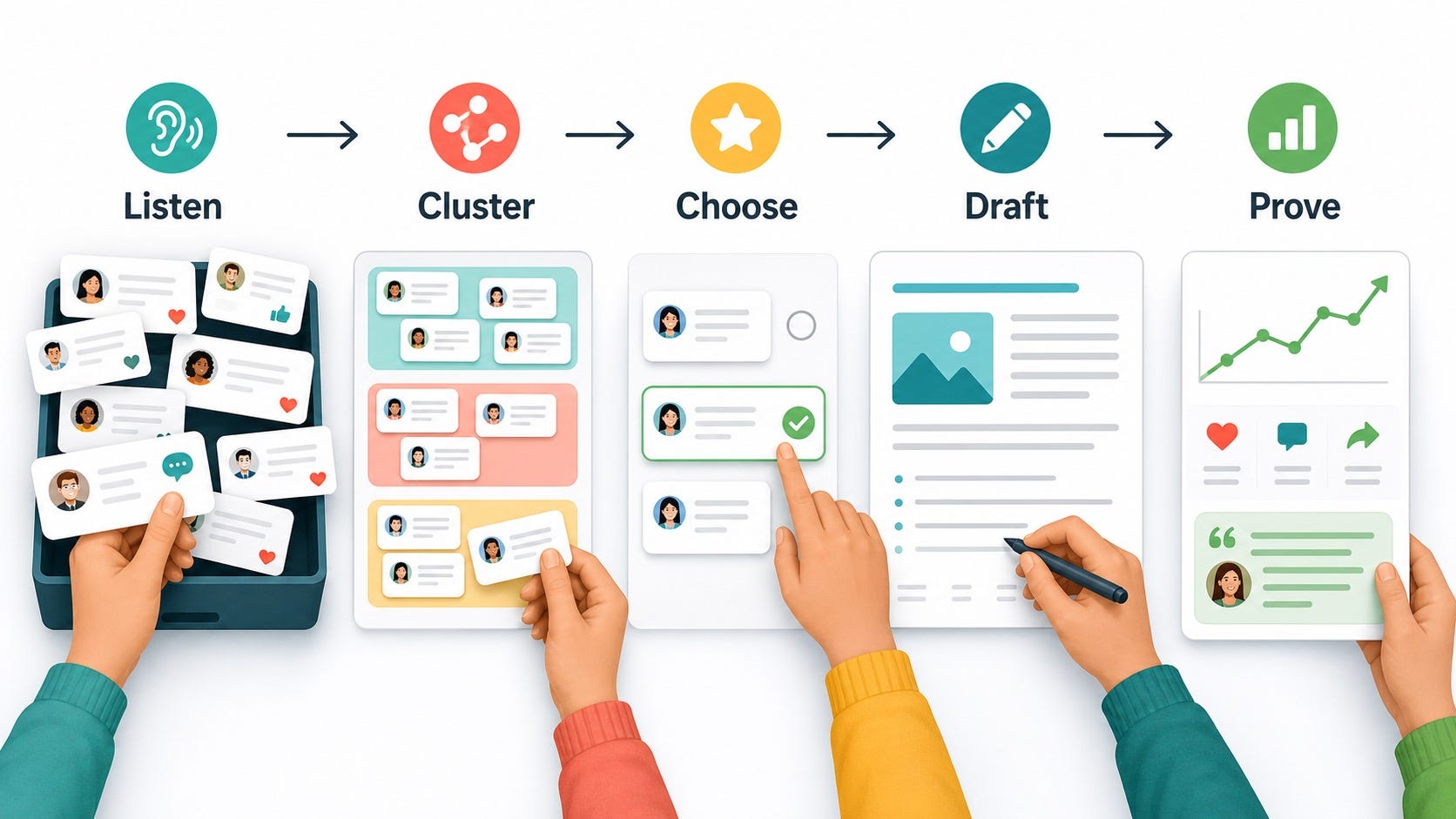
1. Listen: collect raw audience language
Spend 30 minutes gathering examples before you open a blank draft. Copy posts, comments, questions, reviews, forum threads, search prompts, sales notes, and DMs into a document. Do not clean them up yet.
Use this prompt with ChatGPT, Claude, Gemini, or Perplexity:
Analyze these raw audience comments. Extract the repeated questions, fears, objections, goals, phrases, and moments of confusion. Do not write content yet. Return only patterns, examples of exact language, and possible personal branding angles I could address from real experience.
The “do not write content yet” instruction matters. If you ask for posts immediately, the model will rush toward polished sameness. Force it to stay in research mode.
2. Cluster: turn noise into themes
Once you have a pile of raw material, ask AI to cluster it into themes. Good clusters usually sound like audience problems, not content categories.
Weak cluster: “LinkedIn tips.” Strong cluster: “People want to post but fear looking performative.” Weak cluster: “AI tools.” Strong cluster: “People want AI help but are worried readers will detect it.”
Ask AI to label each cluster with three things: the audience’s visible question, the hidden fear underneath it, and the proof you personally have that could help.
3. Choose: pick the topic where you have earned insight
This is where human judgment comes back in. AI can show demand, but it cannot know what you have truly lived, built, tested, or witnessed unless you tell it.
Before choosing a topic, ask yourself:
Have I solved this problem for myself, a client, a team, a student, or a customer?
Can I give a concrete example without exposing private information?
Do I disagree with common advice in a useful way?
Can I explain the tradeoff, not just the tactic?
Would this still be useful if the algorithm changed next month?
The best personal brand topics sit at the intersection of audience demand and lived credibility. If you only chase demand, you sound like a content farm. If you only write from your own head, you may miss what people are ready to hear.
4. Draft: let AI help with structure, not identity
After listening and choosing, you can let AI help draft. But give it better source material than a generic command like “write a LinkedIn post about personal branding.”
Use a prompt like this:
Using the audience patterns below, draft a practical article outline in my voice. Preserve my point of view: [insert your belief]. Include the audience’s real objections, one personal example, one mistake to avoid, and one step-by-step workflow. Do not exaggerate results. Do not sound like a motivational influencer.
You can also ask AI for headline options, but compare them like an editor. Choose the one with the clearest search intent and strongest promise. A better title names the audience, tool, problem, and payoff.
5. Prove: attach evidence before you publish
This is the step most AI-generated personal branding skips. A post or article should not only sound good. It should carry evidence that a real person is behind it.
Evidence can be small:
A short anonymized customer question.
A decision you changed your mind about.
A mistake you made and how you now avoid it.
A specific constraint from your industry.
A useful source, report, or platform update.
Proof is what turns AI-assisted content into personal branding instead of content decoration.
How to Use This on Different Personal Brand Surfaces
The same listening system can feed multiple surfaces, but each surface needs a different output.
LinkedIn
Use listening to find posts that answer one live tension at a time. Instead of posting “5 ways to build a personal brand,” write about a specific friction point: “Why your first three LinkedIn posts should probably be replies, not announcements.”
Also use listening to improve comments. Thoughtful comments are often lower pressure than full posts and can reveal which ideas earn real conversation before you turn them into longer pieces.
Substack
Use listening to build essays that answer the second and third questions readers ask after the obvious one. If the obvious question is “How do I use AI for my personal brand?” the deeper questions might be “How do I avoid sounding generic?” and “What should stay human?”
Those deeper questions keep readers moving because they feel understood.
Personal websites and bios
Use audience language to rewrite your positioning. If buyers say “we need someone who can make technical strategy clear to nontechnical leaders,” do not describe yourself only as an “AI transformation strategist.”
A useful bio is not a trophy shelf. It is a relevance bridge between what you have done and what the right people need next.
The Anti-Slop Filter
Generic AI content usually has three problems: certainty without evidence, polished language nobody actually says, and broad lessons where a specific answer was needed.
Before publishing anything AI helped create, run this filter:
Could any competent person in my field have posted this?
Does this include a detail only I, my customers, my work, or my audience would know?
Does the opening sentence create a real reason to keep reading?
Does the piece answer an actual audience question I have observed?
Have I removed phrases that sound impressive but do not change the reader’s next action?
Would I say this in a conversation with a serious peer?

If the answer to the first question is yes and the second is no, keep editing. Add proof. Add friction. Add a tradeoff. Add a real example. Add what you changed your mind about.
A Weekly 45-Minute AI Social Listening Routine
You do not need to turn personal branding into a second job. Try this once a week.
First, spend 10 minutes collecting raw signals. Save five questions, five comments, two search prompts, and one private note.
Second, spend 10 minutes clustering them with AI. Ask for themes, objections, repeated phrases, and hidden fears.
Third, spend 10 minutes choosing one idea. Pick the topic where audience demand meets your strongest proof.
Fourth, spend 10 minutes drafting a rough outline or post. Do not polish yet. Focus on claim, example, lesson, and next step.
Fifth, spend 5 minutes adding the trust layer: a source, example, screenshot, story, constraint, or personal note.
That routine can create one strong post, a newsletter section, thoughtful comments, a bio update, or a future essay idea.
Ethical Boundaries: Listen Without Becoming Creepy
AI social listening can become invasive if you treat people like data points instead of humans. Keep the boundaries simple.
Use public conversations for pattern recognition, not personal targeting. Do not copy private messages into AI tools unless you have permission or can anonymize them properly. Remove names, companies, emails, and identifying details from customer notes. Do not quote someone in a way that exposes them. Do not fake engagement by using AI to mass-reply at scale.
There is also an authenticity boundary. Listening should make your work more relevant, not more manipulative. The point is to understand the room well enough to speak with more care.
The Real Advantage: Better Inputs Than Everyone Else
Most people use the same AI tools. Many use the same prompts. A lot of them publish into the same feeds, with the same hooks, in the same format.
Your edge is not access to a secret model. Your edge is better inputs: your audience notes, your proof, your judgment, your examples, your unpopular but useful opinions, and your willingness to listen before you perform expertise.
That is how personal branding becomes durable. It stops being a schedule of posts and becomes a reputation for noticing what matters, saying something useful, and backing it up.
FAQ
What is AI social listening for personal branding?
AI social listening for personal branding is using AI to analyze public audience conversations, questions, comments, search prompts, reviews, and community discussions so you can create more relevant, trusted personal brand content.
How is social listening different from social media monitoring?
Monitoring tracks mentions and immediate activity. Social listening looks for patterns underneath those mentions: repeated questions, sentiment, objections, topic momentum, language, and unmet needs. For personal branding, listening is more strategic than checking notifications.
Which AI tools can I use for personal brand social listening?
You can start with general AI tools such as ChatGPT, Claude, Gemini, or Perplexity. Use them to cluster comments, summarize threads, analyze search questions, compare audience phrases, and turn messy notes into content angles.
Can AI social listening help me avoid generic AI content?
Yes, if you use it before drafting. The mistake is asking AI to create posts from thin prompts. A stronger workflow gives AI real audience language, your point of view, your proof, and clear boundaries. That produces content with more specificity and less generic polish.
How often should I run a social listening routine?
Once a week is enough for most professionals. A 45-minute routine can produce one strong post, a newsletter idea, several thoughtful comments, or a profile improvement.
Is it ethical to use AI to analyze audience conversations?
It can be, if you respect privacy and context. Use public conversations for pattern recognition, anonymize private notes, avoid exposing individuals, and never use AI to mass-produce manipulative replies. Listening should help you serve people better, not treat them as targets.