


A practical guide for founders, executives, and experts who want AI to amplify real judgment instead of flattening their reputation into generic content.
For professionals building executive presence, founder visibility, and durable digital trust.

AI made publishing cheap. That sounds like good news until you look at what happened next: every feed filled up with polished emptiness, every “thought leader” started sounding suspiciously interchangeable, and smart people began to treat fluent content as a weak signal rather than a strong one.
That shift matters if your personal brand supports a real career. If you are a founder, executive, consultant, operator, or subject-matter expert, your reputation is not built by volume alone. It is built by judgment. People want to know whether you think clearly, whether your ideas hold up under pressure, and whether your public content actually connects to real work.
That is why AI thought leadership is now a systems problem, not a writing problem. The winners are not the people publishing the most. They are the people using AI to capture raw expertise, sharpen it into a point of view, support it with evidence, and turn it into durable assets that make them easier to trust.
In the AI content era, the scarce asset is not output. It is believable insight attached to a real human being.
If you treat AI like a ghostwriter that manufactures opinions for you, your personal brand gets weaker. If you treat AI like a research assistant, interviewer, editor, and repackaging system around your real expertise, your authority compounds. That is the distinction this article is about.
Why AI Thought Leadership Matters More Now
Recent platform signals make this more urgent, not less. LinkedIn’s recent executive thought leadership guidance leans hard on authenticity, personal storytelling, quality over quantity, and multi-format consistency. Their recent AI discovery guidance also makes the new reality explicit: written posts, articles, newsletters, structured profile metadata, and thoughtful engagement all feed machine-readable authority signals.
At the same time, recent CEO research from IBM argues that AI is moving from the invisible infrastructure layer into the visible surface layer of work. That means leaders are increasingly judged not only on whether they use AI, but on whether they can explain their thinking, show restraint, and communicate tradeoffs clearly.
In plain English: your executive presence now lives in two places at once.
It lives in human perception: what buyers, hiring managers, peers, investors, and collaborators think when they see your name.
It lives in machine-mediated discovery: what AI systems, search results, and recommendation layers can infer from your public footprint.
If your public content is generic, repetitive, or obviously synthetic, it hurts you in both places. Humans trust you less, and machines have less distinctive signal to work with.
What Real AI Thought Leadership Is Not
Before building a better system, it helps to define the failure mode.
Bad AI thought leadership usually looks like this: a generic prompt, a polished but empty draft, a post that could belong to anyone in your category, and a publish button pressed too early. It may still get impressions. It may even get surface-level engagement. But it does not make you memorable, quotable, or referable.
Real thought leadership is not the same as content consistency. It is not “posting every day.” It is not hot takes detached from lived experience. And it is definitely not letting a model invent conviction for you.
Real thought leadership has four ingredients:
A specific point of view you can defend.
Evidence, examples, or operator-level detail behind that view.
A repeatable connection between your expertise and your audience’s problems.
A recognizable voice that feels like a person, not a content machine.
AI can support all four ingredients. It just cannot replace them.
Start With Source Material, Not Content
The biggest mistake professionals make is asking AI to generate finished posts before they have created enough raw material. If you do not have a source layer, AI will fill the gap with averages.
Your source layer should contain the things only you can supply:
Voice notes after meetings, launches, client calls, or hiring conversations.
Decision logs that explain why you chose one path instead of another.
Repeated objections, misconceptions, or bad assumptions you keep seeing in your market.
Small stories, failures, tradeoffs, and near-misses that reveal judgment.
Artifacts such as decks, memos, frameworks, onboarding notes, teardown comments, or product reviews.
Most people think they have a content problem when they actually have an evidence-capture problem. AI becomes genuinely useful once you feed it something richer than “write me a LinkedIn post about leadership.”
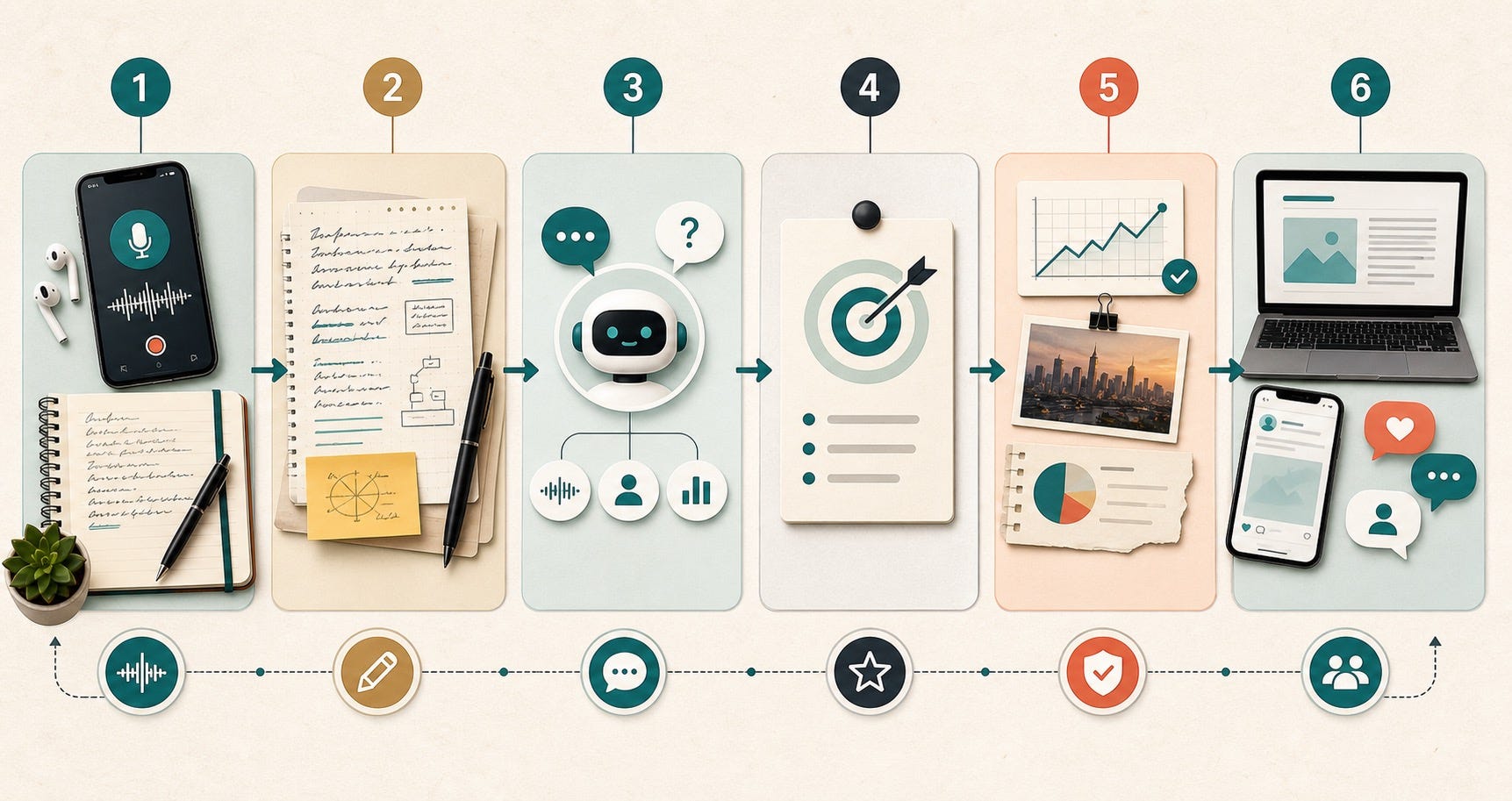
The 5-Layer AI Thought Leadership System
Here is the system that works better than chasing random posts.
1. Capture the raw signal
At least twice a week, record short notes on what you changed your mind about, what surprised you, what your audience keeps misunderstanding, and what tension you are seeing in your industry. Do this while the context is fresh. Raw signal is highest before you polish it.
2. Let AI interview you
Instead of asking AI to perform, ask it to interrogate. A good prompt is not “write the post.” A good prompt is “ask me seven hard questions about this claim, pull out specifics, challenge weak assumptions, and surface the strongest non-obvious angle.”
This changes the model’s role from generator to extractor. That is a much better use case for personal branding because it increases originality instead of suppressing it.
3. Distill one strong claim
Every piece should revolve around one idea sharp enough to disagree with. “AI is changing branding” is too weak. “The professionals winning with AI are publishing fewer opinions and more proof” is stronger. “Executives should build durable authority assets before optimizing daily posting” is stronger still.
If the draft contains five fuzzy themes, you do not have thought leadership yet. You have topic soup.
4. Add proof before style
Proof can be a client pattern, a workflow screenshot, a before-and-after example, a hiring observation, an internal rubric, or a sourced market signal. The goal is not to sound smart. The goal is to reduce disbelief.
This is where many AI-heavy personal brands fail. They optimize fluency before credibility. Readers now notice that instantly.
5. Turn one idea into a durable asset stack
Do not stop at a single post. Turn one well-developed idea into:
a long-form article or newsletter issue
a short post with one sharp argument
a comment strategy for adjacent industry conversations
a concise founder or executive memo for your team
a talk track for podcasts, panels, sales calls, or recruiting conversations
This is how AI becomes a leverage layer for authority building. It helps one real idea travel across surfaces without diluting the original thinking.
A Weekly Cadence Busy Leaders Can Actually Keep
You do not need a full media company around your name. You need a rhythm that fits real work.
A practical weekly cadence looks like this:
Monday: capture two to three raw observations from the previous week.
Tuesday: use AI to interview you and stress-test the strongest one.
Wednesday: draft one core article, memo, or newsletter section.
Thursday: slice that idea into one post, two comments, and one speaking point.
Friday: review what triggered meaningful replies, not just vanity metrics.
This matters because the best personal branding systems are not built around “content creation time.” They are built around reflection time. AI saves effort after the insight exists. It cannot replace the insight creation itself.
The Trust Rules That Protect Your Brand
If you want AI-assisted personal branding to compound instead of backfire, you need rules. Not vague values. Operating rules.
Use AI to clarify, not counterfeit
Never publish invented experience, synthetic certainty, or fake operator detail. If you have not lived it, tested it, or sourced it, do not write as if you have.
Disclose when the format could confuse people
You do not need a disclaimer on every edited sentence. But if AI substantially shaped the output, if an AI avatar is involved, or if you are using generated media that could mislead, be direct. Trust grows when people can tell where the human judgment sits.
Prefer provenance over polish
As content authenticity standards such as C2PA gain traction, the broader direction is obvious: digital trust is moving toward verifiable context, not just attractive output. Personal brands that prepare for that future will look stronger than those still optimizing for plausible fakery.
Track conversation depth, not just reach
One credible reply from a peer, buyer, recruiter, or investor is often worth more than a hundred shallow reactions. LinkedIn’s own executive thought leadership guidance points in the same direction: quality of conversation is a better KPI than raw frequency.

Three Prompts That Produce Better Thought Leadership
Prompt 1: The interviewer
“I want you to act like an experienced journalist interviewing an executive. Ask me 7 questions that force specificity, examples, tradeoffs, and unpopular truths about this topic. Do not draft content yet.”
Prompt 2: The distiller
“From my answers, extract 3 possible arguments. For each one, state the core claim, the proof required, the audience that would care most, and what would make the argument sound generic or weak.”
Prompt 3: The skeptic
“Challenge this draft like a smart buyer, recruiter, or peer. Tell me which parts sound borrowed, inflated, unsupported, or too polished to trust. Suggest where I need a story, number, or concrete example.”
These prompts work because they force AI to improve your thinking process, not impersonate your expertise.
The Long-Term Goal: Become Easy to Cite
Strong personal branding in the AI era is not about becoming omnipresent. It is about becoming easy to cite, easy to remember, and easy to trust. That happens when your public footprint contains original claims, real artifacts, clear language, and enough repetition for people to associate you with something specific.
That is also why durable assets matter more than endless posting. A great article, a sharp framework, a memorable founder memo, or a well-structured point of view page can keep working long after a feed post disappears. AI can help you produce those assets faster, but only if you use it to organize real insight instead of manufacturing fake depth.
The professionals who win this next phase of personal branding will not be the loudest people with the most content. They will be the ones whose ideas still sound human after AI has touched every channel.
FAQ
What is AI thought leadership?
AI thought leadership is the use of AI tools to research, extract, structure, and distribute expert ideas without replacing the human judgment behind those ideas. Done well, it strengthens authority. Done poorly, it produces generic content that weakens trust.
How do I use AI for thought leadership without sounding generic?
Start with raw source material such as voice notes, decisions, failures, and market observations. Use AI to interview you, challenge your assumptions, and improve structure. Add proof before polishing tone.
Is AI thought leadership good for executive personal branding?
Yes, if the system preserves your point of view and connects it to real work. For executive personal branding, AI is most useful as a capture, editing, and repurposing layer around authentic experience.
What is the difference between AI ghostwriting and AI thought leadership?
AI ghostwriting often focuses on output efficiency. AI thought leadership focuses on authority, credibility, and defensible perspective. The difference is whether the content reveals real thinking or just simulates it.
Which metrics matter most for AI-assisted personal branding?
Track signals such as qualified replies, conversation depth, profile visits from the right audience, speaking invitations, investor or recruiter inbound, and how often people repeat your framing back to you. Those are stronger indicators than raw impressions alone.
Should I disclose AI use in personal brand content?
When AI materially affects the format, media, or perceived authorship, disclosure is the stronger trust move. The more your audience could reasonably feel misled, the more explicit you should be.