


Most professionals do not have a personal branding problem. They have a proof retrieval problem. Their best work is buried in forgotten messages, project folders, meeting notes, and half-remembered compliments.

You can see the damage whenever someone tries to build a personal brand from scratch. They ask AI for LinkedIn post ideas, a sharper bio, a better About page, or a confident introduction. The AI gives them polished sentences. The sentences sound fine. The problem is that nothing in them proves anything.
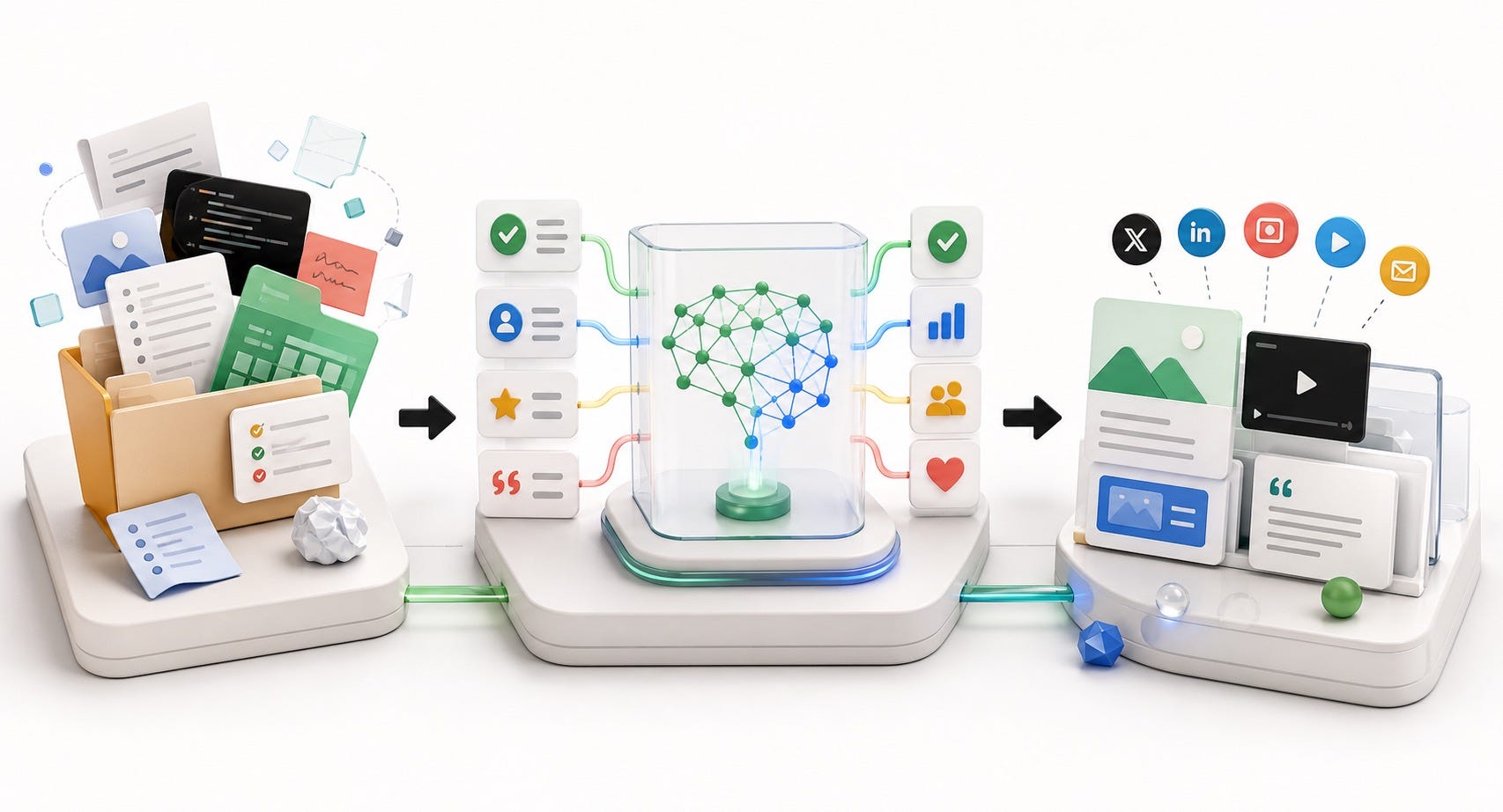
That is why a brag document is becoming one of the most useful personal branding tools in the AI era. Not because you should brag more. Because you need a private, structured source of truth that helps AI find the real evidence behind your reputation.
A good brag document template does more than help you prepare for a performance review. It gives you raw material for credible LinkedIn posts, website copy, speaker bios, newsletter ideas, portfolio summaries, client updates, and thoughtful introductions. It keeps your public identity grounded in work you actually did.
The timing matters. LinkedIn has been publishing more guidance around AI visibility and professional trust, noting that credibility and expert authorship increasingly shape what gets discovered in AI-powered search. PwC’s AI jobs research also points to a labor market where judgment, leadership, and human expertise are becoming more valuable as AI changes job requirements. In plain language: generic claims are getting cheaper, but specific proof is getting more valuable.
Here is the practical system I would use to build a personal brand from quiet wins instead of loud self-promotion.
What a Brag Document Really Is
A brag document is a private record of your useful work: outcomes, decisions, skills, feedback, lessons, context, and evidence. Julia Evans helped popularize the idea for performance reviews, especially for work that is easy to overlook because it is collaborative, technical, operational, or hard to measure. Her advice still holds: a brag document is not just a list of trophies. It should explain the bigger picture of your work and the patterns behind it.
For personal branding, that bigger picture is the point.
Your personal brand is not a slogan. It is the reputation people can verify when they encounter your name. A brag document helps you collect the receipts before you need them. Instead of asking, “What should I post today?” you can ask, “Which real pattern in my work would help the right person trust me?”
That shift changes the quality of everything you publish. You stop producing generic advice. You start sharing earned insight.
A brag document is not a public victory lap. It is a private evidence bank for future credibility.
Why AI Makes This More Important, Not Less
AI tools are excellent at summarizing, sorting, remixing, and formatting information. They are weak when the source material is vague. If you give AI a thin prompt like “write a personal brand post about leadership,” it will produce something that sounds like everyone else. If you give it six concrete stories about decisions you made under pressure, feedback you received, tradeoffs you handled, and measurable outcomes, it can help you turn those details into useful public assets.
This is the core rule: use AI after capture, not instead of capture.
The professionals who benefit most from AI personal branding are not the ones who automate the most posts. They are the ones who build the best personal evidence base. Founders can capture customer conversations, product decisions, hiring lessons, and investor questions. Consultants can capture before-and-after client states, repeated objections, anonymized patterns, and frameworks that emerged from real work. Job seekers can capture projects, improvements, learning curves, collaboration moments, and examples of judgment. Students can capture class projects, experiments, community work, and early proof of initiative.
AI can help turn each of those into different formats. But it cannot truthfully invent the lived experience underneath them. That part has to come from you.
The Brag Document Template for Personal Branding
Keep the template simple enough that you will actually use it. A giant knowledge base sounds impressive until Friday afternoon arrives and you avoid updating it. Start with six sections.
1. Wins Worth Remembering
Capture anything that created value, reduced risk, clarified confusion, helped a person, improved a system, or moved a project forward. Do not wait for dramatic results. Small wins often become strong personal brand stories because they show how you think.
Use this format:
What happened?
What was the problem or tension?
What did I do?
What changed afterward?
Who benefited?
What evidence do I have?
2. Proof and Receipts
This section stores the evidence behind your claims. Include screenshots, anonymized feedback, metrics, links, testimonials, public artifacts, shipped work, before-and-after examples, and short notes about context. The goal is not to publish all of it. The goal is to avoid relying on memory.
If a piece of proof includes private information, mark it clearly as private. AI should help you anonymize or summarize sensitive material, not expose it.
3. Patterns I Keep Seeing
This is where a brag document becomes a personal branding engine. Once a month, scan your wins and ask: what keeps repeating?
Maybe people come to you when technical decisions need business translation. Maybe clients trust you when projects are messy. Maybe your strongest value is not “strategy” but turning vague ambition into a clear next step. These patterns become positioning language, content pillars, and thought leadership topics.
4. Lessons and Mistakes
Credibility is not only built from wins. It is also built from honest lessons. Capture mistakes, bad assumptions, surprising constraints, and things you would do differently. This material makes your personal brand feel human because it shows judgment, not perfection.
5. Useful Feedback
Save compliments, critiques, referrals, introductions, and recurring phrases people use to describe your work. The exact wording matters. Other people often describe your value more clearly than you do because they are naming the benefit they experienced.
6. Public Asset Ideas
Every time a private entry could become a public asset, add a quick note. Do not draft immediately. Just tag the format: LinkedIn post, Substack essay, website section, bio line, case study, talk idea, FAQ answer, outreach paragraph, or portfolio summary.

The Weekly AI Workflow
The best system is boring. Once a week, spend ten minutes adding raw notes. Once a month, spend thirty minutes using AI to find patterns and prepare public material. This rhythm prevents your personal brand from depending on panic, mood, or sudden inspiration.
Here is the weekly capture prompt:
Prompt: Ask me five specific questions that will help me capture this week’s useful work for my brag document. Focus on decisions, outcomes, feedback, collaboration, problems solved, and lessons learned. After I answer, organize my notes into wins, proof, patterns, lessons, feedback, and possible public asset ideas. Do not exaggerate. Flag anything that needs evidence.
Answer in rough language. Do not try to sound impressive. The goal is capture, not polish.
Then use this monthly pattern-finding prompt:
Prompt: Review the past month of my brag document. Identify recurring themes in my work, the problems I seem trusted to solve, the audiences who benefit, the strongest proof points, and any stories that could become useful public content. Separate factual evidence from interpretation. Suggest five personal branding angles that are specific, credible, and not boastful.
This is where AI becomes genuinely useful. It can notice clusters you missed. It can see that three unrelated wins are actually about the same professional strength. It can help turn a messy accomplishment log into sharper personal brand positioning.
How to Turn Private Wins Into Public Proof
The mistake is publishing your brag document directly. That usually sounds self-centered. The better move is to convert each private win into a reader-useful asset.
Use this translation rule:
A win becomes a lesson when you explain what changed your mind.
A metric becomes proof when you explain the constraint behind it.
A client result becomes useful when you anonymize the pattern and show the decision process.
A compliment becomes credible when you connect it to a behavior, not a personality trait.
A mistake becomes trust-building when you explain the repair.
For example, “I helped a client improve onboarding” is weak. It is a claim. A stronger version is: “The onboarding problem looked like a documentation issue, but the real blocker was that new users did not know which first action mattered. We removed two early choices, rewrote the first email around one decision, and support tickets dropped the next month.” That gives the reader a decision, a constraint, a result, and a useful takeaway.
This is how personal branding avoids sounding like self-promotion. You are not saying, “Look how great I am.” You are saying, “Here is a problem I saw up close, what I learned, and how you can think about it.”
Channel Examples: What the Same Win Can Become
One good brag document entry can support several public surfaces without sounding repetitive. On LinkedIn, it can become a short lesson about a decision or tradeoff. On a personal website, it can become a proof block with context but no confidential details. In a newsletter, it can become a deeper story about what you tried, what failed, and what changed. In a bio, it can become positioning language that came from real repeated work, not a branding exercise.
How to Avoid Sounding Like You Are Bragging
Many capable people avoid personal branding because they do not want to sound inflated. That instinct is healthy. It means your reputation matters to you.
The answer is not to hide your work. The answer is to frame proof with context, contribution, and usefulness.
Use these rules:
Lead with the problem, not your greatness.
Name collaborators when it is appropriate and allowed.
Show the constraint that made the work hard.
Use numbers only when you can explain what they mean.
Share the lesson someone else can use.
Do not turn every private compliment into public proof.
AI can help here too. Ask it to remove hype, reduce vague adjectives, and identify claims that need evidence. A useful prompt is:
Prompt: Rewrite this accomplishment as a useful personal branding post without hype. Keep the claim modest, specific, and evidence-backed. Start with the problem or lesson, include my contribution, acknowledge uncertainty or collaborators where relevant, and remove any sentence that sounds inflated.
This one prompt can save you from the two most common personal branding errors: underselling the useful part and overselling the impressive part.
The Search and AI Visibility Benefit
A brag document also helps with discoverability. Not because you stuff keywords into every profile, but because you can describe your expertise in natural, repeatable language across multiple trusted surfaces.
Search engines and AI systems need consistent signals. Humans need them too. If your LinkedIn says one thing, your website says another, your newsletter says something vague, and your public examples are thin, people struggle to understand what you are known for.
Your brag document gives you the source material to align those signals. It helps you name the problems you solve, the audience you serve, the proof you can show, and the language real people use when they value your work.
This is especially useful for professionals whose work is not visually obvious. Operators, strategists, engineers, researchers, product managers, consultants, analysts, and founders often create value through decisions, synthesis, risk reduction, and judgment. Those contributions are easy to miss unless you document them.
A Simple 30-Day Plan
Do not rebuild your whole personal brand this week. Build the source layer first.
Week 1: Create the Document
Set up the six sections and add ten past wins from memory. Do not edit heavily. Your first version should be messy.
Week 2: Add Evidence
Attach links, screenshots, metrics, anonymized feedback, project notes, or artifacts. Mark anything private.
Week 3: Ask AI for Patterns
Give AI your sanitized entries and ask it to identify recurring strengths, audience problems, and proof themes. Delete anything that sounds generic.
Week 4: Publish Three Small Assets
Create one LinkedIn post, one website proof block, and one longer note or newsletter idea. The goal is learning how real work translates into public trust.
The Personal Branding Principle Behind This
The best personal brands are not built from constant expression. They are built from repeated evidence.
AI makes expression easier. That is useful, but it also floods every channel with polished sameness. Your advantage is not that you can produce more words. Your advantage is that you can feed AI better raw material: real stories, concrete decisions, honest lessons, useful proof, and a point of view earned through work.
A brag document template gives you a quiet way to collect that material before the world asks for it. It helps you stop treating personal branding as performance.
You do not need to become louder. You need to become easier to trust.
FAQ
What is a brag document for personal branding?
A brag document for personal branding is a private record of accomplishments, feedback, proof, lessons, and patterns that can later be turned into credible public assets. It helps you build a personal brand from real evidence instead of generic claims.
How is a brag document different from a resume?
A resume is a short public summary tailored to a role. A brag document is a detailed private source of truth. It can include raw notes, screenshots, feedback, mistakes, context, and ideas that would never fit on a resume but are useful for personal branding, interviews, reviews, and content.
Can AI write my brag document for me?
AI can help organize, summarize, question, and rewrite your entries, but it should not invent the achievements. The best workflow is to capture real work first, then use AI to find patterns, sharpen language, remove hype, and adapt the material for different channels.
What should I include in a brag document template?
Include wins, proof, metrics, feedback, project context, lessons learned, mistakes, repeated strengths, and ideas for public assets. The most useful entries explain what happened, why it mattered, what you contributed, who benefited, and what evidence supports the claim.
How do I use a brag document without sounding boastful?
Lead with the problem, lesson, or useful takeaway instead of your status. Add context, acknowledge collaborators where relevant, avoid exaggerated adjectives, and show evidence. Good personal branding makes your work easier to understand, not louder than it needs to be.
Further reading: Julia Evans’ guide to brag documents, LinkedIn’s notes on AI visibility and professional credibility, and PwC’s AI Jobs Barometer on the rising value of judgment and leadership.