



A practical system for founders, builders, consultants, and professionals who want public credibility without turning their workday into a performance.
Build in public used to sound simple: share what you are making, post the numbers, let people follow the journey, and turn transparency into trust. That advice is now too shallow. AI made it easier to create content, but it also made generic founder updates, copied product ideas, and suspiciously polished posts easier to spot.
The better question is not, “Should I build in public?” It is, “What should I make public, what should I keep private, and how can AI help me share the useful parts without flattening my voice?”
This is where build in public personal branding becomes powerful. Done well, it is not public journaling. It is a reputation system. You show your thinking, decisions, standards, lessons, taste, and proof of progress in a way that makes people trust how you work.
Why Build in Public Feels Different Now
The old build-in-public playbook rewarded radical transparency. Founders posted revenue charts, user counts, product screenshots, roadmaps, experiments, launch threads, and lessons learned. It worked because people wanted to follow the story behind the product.
That still matters, but the risk model has changed. Arvid Kahl recently argued that AI and agentic coding tools have made copycat risk sharper for software founders, especially when they share too many product details, systems, numbers, and implementation clues. His useful filter is simple: share what is interesting to participate in, but not easy to clone.
At the same time, social platforms are getting more sensitive to AI sameness. Recent coverage of LinkedIn “AI slop” has shown how formulaic professional posts can still receive engagement while damaging credibility. Other creator-economy reporting has highlighted the reputational risk creators face when audiences think AI is being used carelessly or deceptively.
So the modern personal-branding problem has two sides:
You need visibility because invisible expertise is easy to ignore.
You need restraint because overexposure, generic AI output, and premature transparency can weaken trust.
AI is useful here, but not as a ghostwriter that turns every update into a polished thread. Its better role is editorial: helping you notice what happened, sort the public from the private, sharpen the lesson, and preserve the human judgment that makes the update worth reading.
The Core Mistake: Treating Build in Public Like a Content Calendar
Most people fail at build in public because they start with the wrong unit of work. They ask, “What should I post today?” That question creates pressure, and pressure creates filler.
Better build-in-public content starts from evidence:
A decision you made.
A mistake that changed your process.
A customer question that exposed a blind spot.
A tradeoff you had to explain.
A rejected idea and the reason you rejected it.
A before-and-after improvement in your work.
A principle you now believe because experience forced you to believe it.
Those are not “content ideas.” They are reputation assets. They show how you think under real constraints. That is what readers remember.
A strong personal brand is not built by announcing that you are disciplined, strategic, customer-obsessed, technical, ethical, creative, or resilient. It is built by repeatedly showing small moments where those qualities are visible.
Do not use AI to invent a more impressive journey. Use AI to notice the useful parts of the real one.
A Safer Build-in-Public Filter
Before you post anything, run it through four filters. This is especially important if you are a founder, consultant, executive, or builder whose work contains sensitive details.
1. The Audience Value Filter
Ask: “Would this help the right person think better, decide faster, or feel less alone?”
If the answer is no, the update is probably vanity. “We shipped a feature” is usually weak. “We almost shipped the wrong feature because we misunderstood how customers described the problem” is useful. One is an announcement. The other is a lesson.
2. The Proof Filter
Ask: “What does this update prove about how I work?”
A personal brand grows when each public signal reinforces a useful perception. For a founder, that might be customer empathy, speed, taste, or resilience. For a consultant, it might be diagnostic ability. For a job seeker, it might be learning velocity. For an AI builder, it might be responsible experimentation.
3. The Confidentiality Filter
Ask: “Does this reveal a number, workflow, customer detail, architecture, roadmap, pricing insight, or market wedge that should stay private?”
You can usually share the lesson without sharing the blueprint. Instead of posting a full conversion funnel, share what surprised you about buyer hesitation. Instead of posting a roadmap, share the principle you now use to choose what not to build.
4. The Timing Filter
Ask: “Is this ready to share now, or will it be stronger after the result is clearer?”
Some updates are valuable while they are still unresolved, especially decision posts and open questions. Others are safer after you have tested the lesson. If a post could create confusion, invite copycats, or mislead people before you know what happened, save it for later.
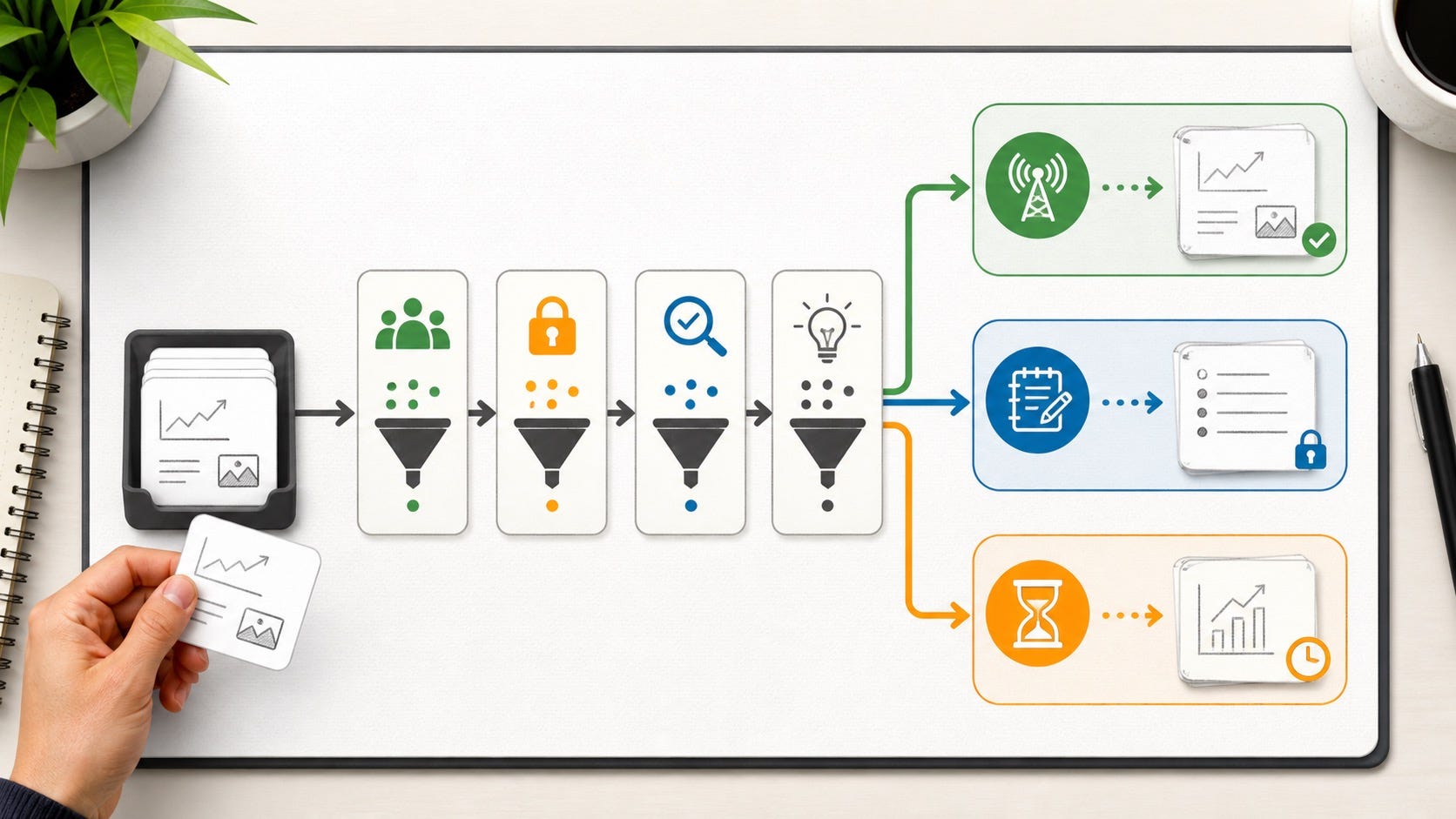
Use AI as a Public-Private Sorting System
AI is excellent at turning scattered notes into options. That does not mean it should decide what you publish. The human job is judgment. The AI job is organization.
Here is a simple workflow you can use at the end of each workday or week.
Step 1: Capture Raw Work Notes
Write fast. Do not polish. Capture what happened:
What did I work on?
What surprised me?
What did I change my mind about?
What question did a customer, teammate, recruiter, client, or reader ask?
What decision was harder than expected?
What evidence did I collect?
What would I do differently next time?
These notes can be messy. The goal is not to write content yet. The goal is to preserve the real source material before memory smooths it into something generic.
Step 2: Ask AI to Find the Public Lessons
Use a prompt like this:
Review these work notes. Identify 10 possible public personal-brand updates. For each one, label the audience value, the reputation signal, the risk level, and what details should be removed before publishing. Do not draft the posts yet.
This prompt keeps AI in analyst mode. You are not asking it to perform as you. You are asking it to help you see what is worth shaping.
Step 3: Choose One Post Type
Most build-in-public updates fit into one of six useful formats:
Decision post: “I had to choose between two paths. Here is how I evaluated them.”
Lesson post: “I expected one thing, but the work taught me another.”
Process post: “Here is the small system I use to handle this repeated problem.”
Question post: “I am trying to decide something and want informed input.”
Principle post: “This experience changed one of my operating rules.”
Proof post: “Here is a concrete artifact, result, or before-and-after that shows progress.”
The strongest personal brands mix these formats. If every update is a win, people stop believing you. If every update is a struggle, people stop trusting you. If every update is advice, people stop feeling the work behind it. Variety creates credibility.
Step 4: Draft With Your Voice Constraints
Once you choose the angle, give AI constraints that protect your voice:
Draft this as a concise public update in my voice. Keep it plainspoken. Avoid hype, broetry, moralizing, vague inspiration, fake vulnerability, and exaggerated certainty. Preserve the specific decision and the lesson. Do not add facts I did not provide.
Then edit it yourself. Cut the first sentence if it sounds like a hook template. Add one concrete detail only you would know. Replace abstract claims with direct observations. If the post could have been written by anyone else in your field, it is not finished.
What to Share When You Have Nothing “Big” to Announce
Many professionals think they cannot build in public because they are not launching constantly. That is backwards. The best material often comes from small, repeated moments.
If you are a founder, share what you are learning about the market, not every feature you are building. If you are a consultant, share the patterns you see across client problems without exposing clients. If you are a student, share what your projects are teaching you about your field. If you are a job seeker, share how you are improving your thinking, not desperate availability. If you are an AI builder, share your evaluation process, failure modes, and safety boundaries.
Useful build-in-public updates often sound like this:
“A customer described the problem differently than I did. That changed the way I explain the category.”
“I removed a feature because the support burden taught me the value was not real enough.”
“I tried using AI to speed up research, but the real improvement came from forcing it to show uncertainty.”
“I changed my onboarding question because the old one made people give polite answers instead of honest ones.”
“I thought the bottleneck was consistency. It was actually deciding what not to say.”
Notice the pattern. These updates are specific, but not reckless. They make the work visible without turning the whole business, project, or career into public property.
The “Do Not Post” List
A strong build-in-public personal brand needs boundaries. Some material is better kept private, delayed, or translated into a safer lesson.
Do not post customer details without permission. Do not post screenshots that reveal private data. Do not post raw revenue, pipeline, roadmap, pricing experiments, internal tools, architecture, vendor stack, acquisition channels, or exact prompts if those details are strategically sensitive. Do not post drama while you are emotionally hot. Do not let AI turn a half-formed reaction into a confident public position.
Also be careful with fake vulnerability. “I failed, here are 11 lessons” can work when the story is real and useful. It becomes performative when the failure is merely a costume for self-promotion.
The safest rule is this: share the lesson at the level of abstraction that helps your audience without harming people, breaking trust, or giving away the hard-won details that make your work defensible.
Build a Weekly AI Review Loop
Instead of asking AI to create more posts, ask it to review your public signals. Once a week, paste your recent posts, comments, newsletter notes, or profile updates into a private document and ask:
What reputation am I actually building from these public signals? What topics am I overusing? What proof is missing? Where do I sound generic? What questions would my target audience still have about my credibility?
This turns AI into a mirror. It helps you see whether your content is compounding toward a recognizable identity or scattering into noise.
Then create a short plan for the next week:
One decision post.
One lesson from customer, audience, or market feedback.
One proof artifact or before-and-after.
One thoughtful comment on someone else’s relevant work.
One private note you intentionally choose not to publish yet.
A mature personal brand is shaped as much by restraint as by visibility.
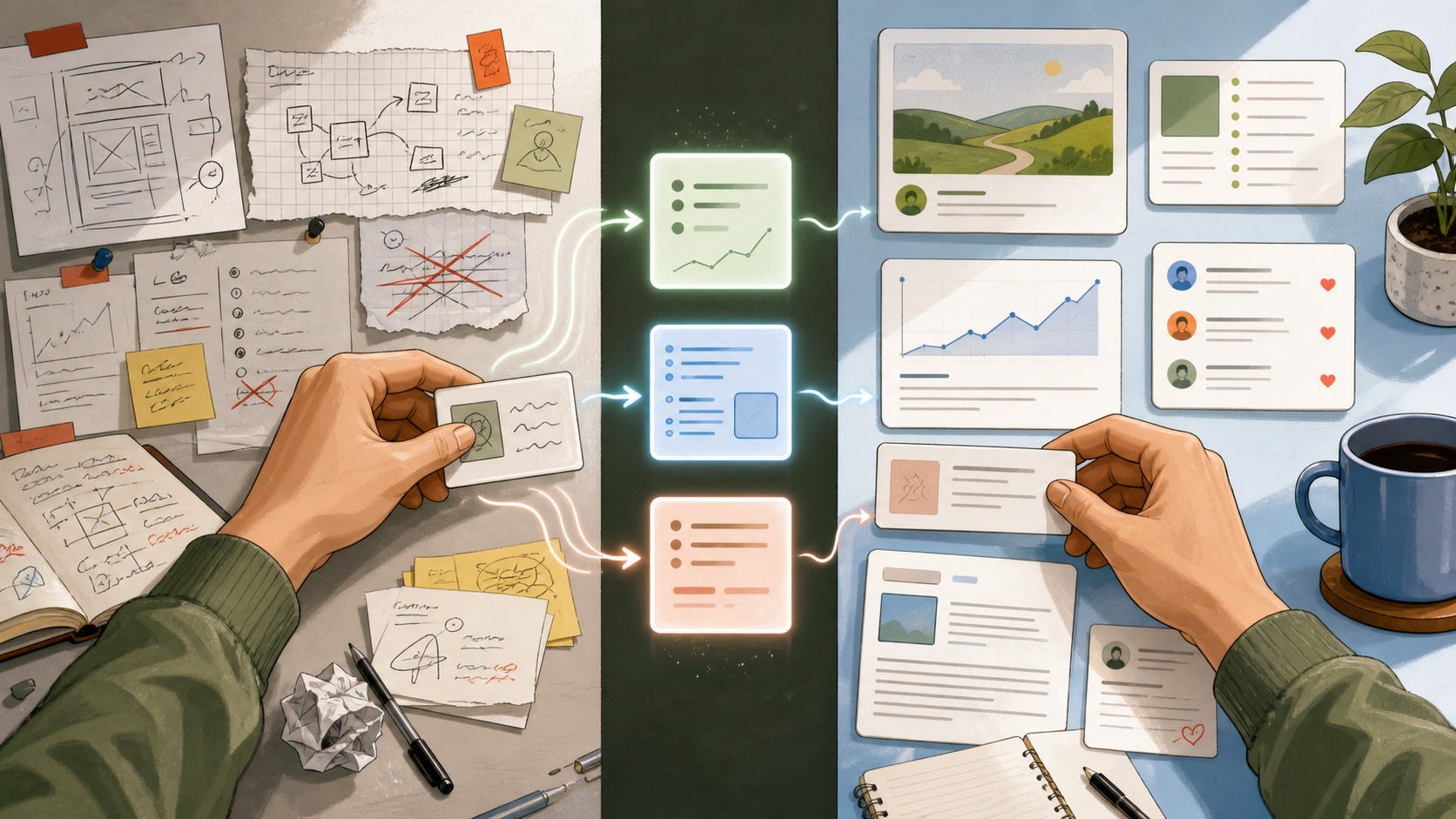
A Practical Prompt Stack
Here is a simple prompt stack you can reuse without turning your voice over to AI.
Prompt 1: Extract Signals
From these work notes, extract possible personal-brand signals. Separate them into decisions, lessons, proof, questions, and risks. Identify which ones are useful to share publicly and which should stay private.
Prompt 2: Remove Risk
For the selected idea, list any details that could expose confidential information, make the work easy to copy, exaggerate the result, or harm trust. Suggest safer phrasing that keeps the lesson useful.
Prompt 3: Draft Plainly
Draft a short post from this idea. Use direct language, specific details, and a clear lesson. Avoid hype, generic inspiration, fake humility, AI-sounding rhythm, and unsupported claims.
Prompt 4: Humanize by Evidence
Point out where this draft sounds generic. Tell me what concrete detail, lived observation, or proof would make it more recognizably mine. Do not invent those details.
Prompt 5: Create a Longer Asset
Turn the strongest post from this week into an outline for a longer essay, case study, or profile update. Preserve the original lesson, add sections that answer likely reader questions, and mark where I need to add real examples.
This workflow keeps AI close enough to help and far enough away that it does not take over your reputation.
What Success Looks Like
The goal is not to become famous for posting. The goal is to become easier to trust before someone needs you.
Success looks like a recruiter understanding your judgment before the interview. It looks like a customer arriving with better context. It looks like an investor seeing your learning velocity. It looks like a peer remembering your point of view. It looks like a reader saying, “This person pays attention to the right things.”
Build in public personal branding is not about showing everything. It is about showing enough of the real work that people can trust the person behind it.
FAQ
What is build in public personal branding?
Build in public personal branding is the practice of sharing useful parts of your work process, decisions, lessons, and progress so people can understand how you think and what you are building trust around. It is not the same as posting every detail of your business or career.
How can AI help me build in public without sounding fake?
Use AI to organize notes, identify useful lessons, flag risky details, and suggest clearer structure. Do not use it to invent stories, exaggerate results, or replace your judgment. The best AI-assisted posts still need real evidence and human editing.
What should founders avoid sharing when building in public?
Founders should avoid sharing sensitive customer details, exact revenue, private metrics, roadmap specifics, system architecture, pricing experiments, acquisition channels, and any detail that makes the business easier to copy. Share the lesson, not the blueprint.
Is build in public only for startup founders?
No. Consultants, freelancers, students, job seekers, executives, creators, and AI builders can use the same approach. The key is to share work-backed lessons that make your expertise visible without overexposing private information.
How often should I post build-in-public updates?
Start with one or two useful updates per week. Consistency matters, but quality matters more. A specific decision, lesson, or proof artifact is better than daily generic posts that train people to ignore you.
What is the safest way to start building in public?
Begin with lessons from completed work, not sensitive live details. Write about what surprised you, what you changed, what you learned, and what principle you will use next time. Keep private data out of the post and delay anything that could create avoidable risk.