


A trust-first system for founders, consultants, and experts who want their public ideas to come from the work-not an empty prompt box.

The useful insight is usually already in the conversation. The work is noticing it without exposing the person who gave it to you.
If you have ever opened LinkedIn, stared at the blank composer, and asked AI what an expert in your field should post, you have seen the problem. It can produce a competent answer in seconds. So can everyone else.
The content that earns a durable personal brand usually begins somewhere less polished: a customer says the thing they were afraid to say in the sales call. A client describes the problem in a phrase you would never have used. A prospect asks a question for the fifth time. You change your mind after hearing what happens on the other side of a decision.
That is customer research for personal branding. Not mining people for quotable lines. Not turning private calls into public theater. It is a disciplined way to listen for patterns, protect context, and teach the part of the lesson that can genuinely help more people.
The goal is not to make your audience feel observed. It is to make them feel understood.
This distinction matters more in an AI-heavy feed. LinkedIn’s own guidance says AI-assisted content should still reflect the member’s voice, perspective, and experience—and that generic, low-substance content weakens real conversation. That is a useful editorial standard, not merely a platform rule. Your customer conversations are a source of lived context. AI should help you organize it, not pretend it had the conversation for you.
Why customer research makes a personal brand harder to copy
Most personal-brand advice begins with the speaker: pick your niche, choose your pillars, share your story. Those steps matter. But a reputation only becomes valuable when another person can recognize themselves in your thinking.
Customer research gives you three things a generic content calendar cannot.
It gives you the audience’s language
Experts often use accurate language that does not match the moment a buyer is living through. A cybersecurity consultant might talk about “identity governance” while a customer is worried that “we don’t know who still has access.” Neither phrase is wrong. One tells you what the audience will actually search, repeat, and understand.
It gives you useful friction
A repeat question, hesitation, misunderstanding, or objection is not a nuisance to explain away. It is a clue. It can become a clear post, a newsletter issue, a talk section, or an FAQ that saves the next person from the same confusion. The public asset proves you pay attention before you prescribe.
It gives you an earned point of view
A point of view is not a louder opinion. It is a conclusion you can show your work behind. “Most teams do not need more AI tools; they need a clear approval rule” is stronger when it grows out of a repeated pattern you have witnessed, tested, and can explain without naming anyone.
That is also why founder content built from customer conversations can travel farther than polished company updates. Recent founder-brand guidance emphasizes decisions, surprises, and customer conversations because they carry the firsthand perspective a company page cannot manufacture. The same principle works for consultants, freelancers, executives, and technical professionals.
Start with a listening contract, not a recording habit
Before you capture a useful phrase, decide what you are allowed to do with it. Personal branding does not override a client relationship, an NDA, an employment agreement, or common decency.
Use three simple categories in your notes:
Private: names, commercial details, internal friction, exact results, screenshots, and anything said in confidence. Do not feed this into a general AI tool unless your organization has explicitly approved that use.
Pattern: a de-identified observation that appears across conversations. “Three operations leaders described the same approval bottleneck” is a pattern; it is not a case study.
Publishable: an idea you can explain without allowing a reader to identify a person, company, deal, or sensitive situation. When in doubt, ask permission or keep it private.
Tell people when you are taking notes. If you want to quote them, ask for approval of the exact wording and the intended placement. Do not make “anonymous” do work it cannot do: a distinctive job title, time frame, market, and outcome can still make a person obvious to their peers.
A useful test: Could the person who shared this feel respected if they saw the final post? If the answer is not an easy yes, turn the insight into a broader lesson—or do not publish it.
Use the five-signal note after every meaningful conversation
You do not need to interview dozens of people before you can build a smarter public presence. Start with the work already happening: discovery calls, project reviews, onboarding sessions, support conversations, workshops, interviews, office hours, and comments. After one meaningful interaction, capture five small signals while your memory is fresh.
The question: What did they ask in their own words?
The tension: What were they trying to avoid, protect, decide, or prove?
The surprise: What did they believe before the conversation that changed or became more nuanced?
The trade-off: What did a good answer require them to give up, delay, or choose between?
The teaching opportunity: What could another person learn without needing this person’s private details?
Do not write a social post yet. These are field notes, not content. The discipline of separating the raw observation from the eventual story protects accuracy. It also stops you from confusing a memorable one-off comment with a genuine audience pattern.
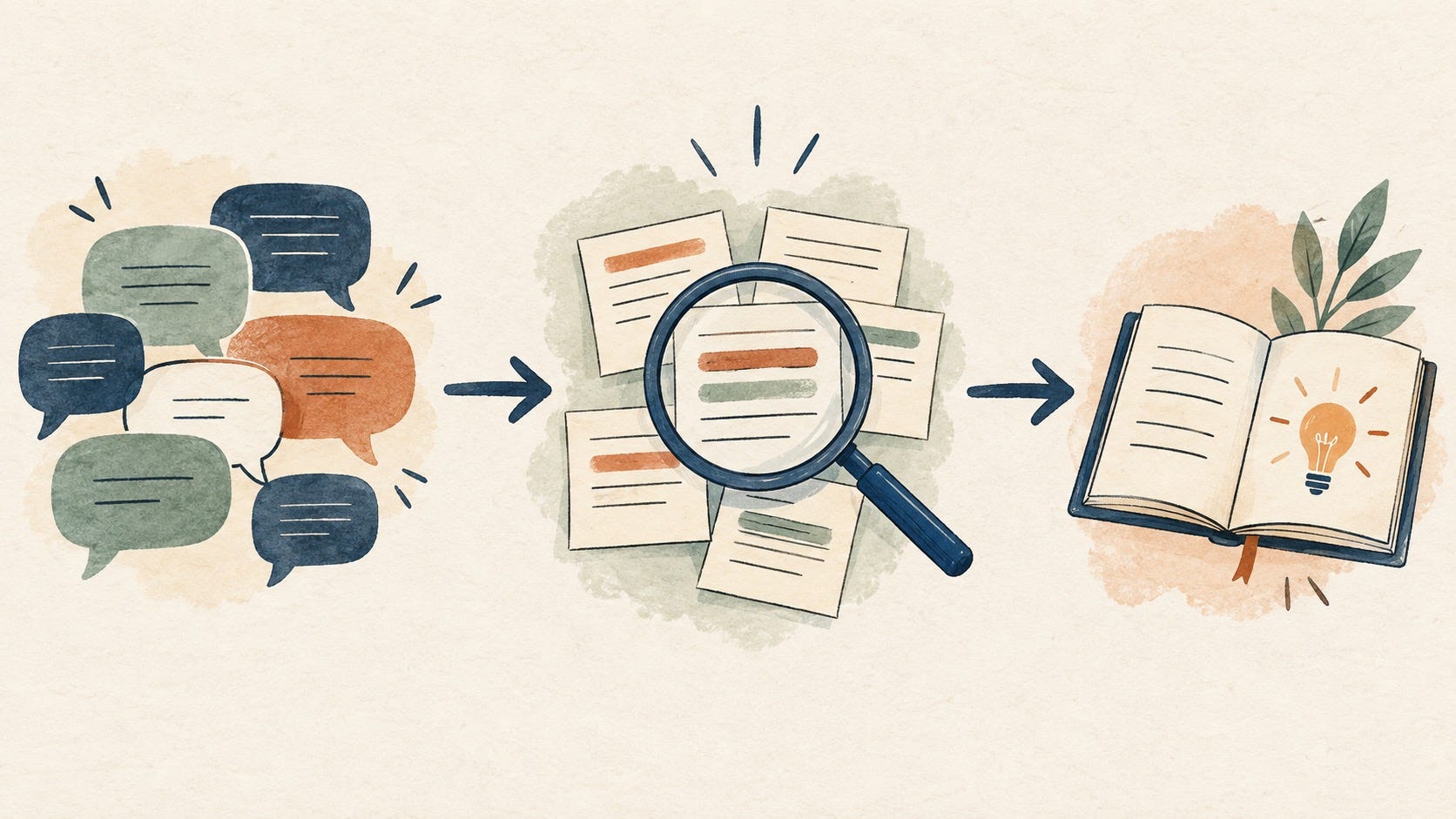
Listen first, then look for patterns, then teach. Reversing that order is how public content becomes generic.
Let AI sort patterns, not invent the lesson
AI is remarkably good at the boring middle: grouping notes, identifying repeated language, suggesting competing explanations, and flagging details that could expose a source. It is weak at knowing whether a pattern is real, representative, ethical to share, or useful in the world. That judgment remains yours.
Create a sanitized source packet. Remove names, organizations, deal size, timing, and details that could identify a client. Keep only the five-signal notes and any approved public references. Then use a prompt like this:
You are an editorial research assistant. Analyze only the de-identified notes below.
1. Group repeated questions, tensions, and trade-offs.
2. Separate direct evidence from your inferences.
3. Flag any detail that could identify a person or organization.
4. Propose three teaching ideas, each with: the audience problem, a precise claim I can support, and what evidence would still be needed.
5. Do not invent statistics, quotes, customer outcomes, or examples.
NOTES:
[paste sanitized five-signal notes]
Ask a second question before you publish: “What would make this advice false, incomplete, or risky in another context?” That prompt is more valuable than “make it punchier.” It forces a public idea to carry its limits, not just its confidence.
For example, imagine five founders say some version of, “We keep buying tools, but nobody knows who owns the final decision.” The weak post is: “Stop buying AI tools.” The useful public lesson is: “Before adopting a new tool, name the person who approves the use case, validates the output, and owns the outcome. Tool choice is downstream of accountability.” The first is a hot take. The second gives someone a next step.
Turn one pattern into a small proof system
Do not squeeze every conversation into a post. One strong pattern can become several formats, each with a different job. This is how customer research builds a personal brand rather than a short burst of engagement.
A concise LinkedIn post names the pattern, explains the overlooked trade-off, and offers one practical decision rule.
A newsletter issue tells the longer story: what you kept hearing, why the obvious answer fails, and what changed in your own approach.
An answer page or FAQ captures the repeated question in plain language for people who arrive later through search or a referral.
A talk or workshop module turns the insight into an exercise, framework, or diagnostic people can use in a room.
A source-bound case note can be created only when the facts, permission, and confidentiality are all clear.
The consistency comes from the underlying pattern, not from forcing identical wording onto every channel. This is different from content repurposing for its own sake. You are preserving the same hard-won insight while giving each reader an appropriate depth of answer.
Build a 45-minute weekly research-to-brand ritual
A credible personal brand does not require you to turn every working day into a performance. It needs a small system that catches what you are already learning before it disappears into the next meeting.
Reserve 15 minutes to review your conversations and write five-signal notes. Spend 15 minutes grouping them with your sanitized AI packet. Use the final 15 to choose one pattern and draft a single useful asset. That could be a post, a paragraph for your website, a question to ask in your next workshop, or a private note that needs more evidence.
Keep a simple “not yet” list. Some observations are interesting but thin. Some are true only for a narrow kind of customer. Some would be irresponsible to publish. A visible not-yet list is a mark of good judgment. It means your public identity is being shaped by evidence, not by the pressure to always have an opinion.
Protect the boundary between insight and extraction
There is a temptation to treat customer proximity as content access. Resist it. The people who trust you with a problem are not raw material for your brand. The long-term asset is the reputation that you can learn from someone without turning them into an example.
That means you should never let AI turn a few notes into invented testimonials, precise results, or a composite customer who sounds like a real person. It means you should make claims proportionate to the evidence: “I have heard this pattern in recent conversations” is not the same as “every leader is facing this.” And it means you should correct or remove a public observation if a person reasonably tells you it exposes them.

Strong personal branding keeps private context private while making the transferable lesson easier for others to use.
Google’s guidance on AI-created material lands in the same place: helpful content should be original, high quality, and people-first, whatever tools helped produce it. The tool is not the source of trust. Experience, specificity, and accountability are.
The next time you think you have no content ideas, do not ask AI to generate ten. Review the last five conversations where your work made a difference. Find the question underneath the question. Remove the private details. Teach the useful part with enough care that the person who inspired it would recognize their dignity in the result.
Frequently asked questions
What is customer research for personal branding?
It is the practice of using real audience and customer conversations to understand recurring questions, language, trade-offs, and misconceptions—then turning de-identified patterns into useful public teaching. It is not a license to share private client details.
Can I use AI to analyze customer interviews for content ideas?
Yes, if you first follow your privacy, confidentiality, and employer rules. Remove identifying details, use an approved tool when required, and ask AI to group evidence rather than invent quotes, outcomes, or customer stories. You remain responsible for every conclusion you publish.
How many customer conversations do I need before I publish an insight?
There is no magic number. One conversation can inspire a clearly labeled personal observation; a broad claim needs stronger evidence across several interactions and sources. When evidence is thin, publish a question, a lesson learned, or a boundary—not a sweeping trend.
How do I avoid violating an NDA in personal-brand content?
Do not use names, timelines, distinctive facts, internal metrics, screenshots, or details that let a reader infer the organization. Share only generalized patterns that remain useful without the case, or ask for written approval for a specific, accurate case study.
What should I do with a customer insight that is too sensitive to post?
Keep it in a private learning log. It may improve your discovery questions, service design, workshop material, or judgment even if it never becomes public content. Not every valuable lesson belongs in your public brand.
Does customer research replace personal stories in thought leadership?
No. Personal stories show your perspective; customer research helps you make that perspective relevant to another person’s reality. The best work combines both: a real observation, your considered interpretation, and a practical way for the reader to act.
Further reading: LinkedIn’s guidance for AI-assisted content, Google’s people-first content guidance, and research on trust-building through useful conversations.