


A strong CSM brand is not a parade of customer wins. It is evidence that you can notice a recurring obstacle, make a sound judgment, and teach something useful without borrowing a client’s story.

The work is private; the judgment can still become visible. Customer success managers live unusually close to the truth. You hear where adoption stalls, which handoffs make customers uneasy, why an executive sponsor stops showing up, and what a team needs before it can get value from a product. That proximity is valuable. It is also sensitive.
So when ordinary personal-branding advice says “share your customer wins,” many CSMs face a bad choice: publish vague motivational posts or reveal more than they should. AI makes that temptation worse. A model can turn a call summary into a polished post in seconds, but polish does not make a private story safe, and it does not turn a one-off observation into a trustworthy lesson.
The better approach is to build a customer-friction-to-public-proof system. You collect recurring patterns privately, strip away the account and the drama, test the idea against public evidence and your own judgment, then publish a useful principle. The result is a credible customer success manager personal brand: one that can help with a promotion, career move, advisory conversation, or peer referral without treating a customer’s trust as content fuel.
Your public brand should make people think, “They understand how customers reach value,” not “They have access to customer secrets.”
Why generic CSM content fails to build authority
Customer success content often gets trapped between two weak formats. The first is the polished win: “We saved an at-risk account.” It can sound impressive, but it may expose timing, business context, commercial pressure, or a customer relationship that was never yours to narrate. The second is the generic lesson: “Always listen to your customers.” Nobody disagrees, and nobody remembers who said it.
Authority lives in the middle. It comes from naming a specific decision pattern that another practitioner can use. Instead of describing an account, teach the moment where a success plan becomes a status report. Instead of retelling a renewal, explain the early signal you use to distinguish an adoption problem from an executive-alignment problem. Instead of claiming that “relationships matter,” show the question that changes a QBR from a reporting ritual into a decision meeting.
This is also a better use of AI. AI can suggest structures, surface counterarguments, and turn a verified lesson into channel-specific drafts. It cannot decide whether a pattern is representative, whether a customer could recognize themselves, or whether an observation should become public. Those are reputation decisions. Keep them human.
Build a private customer-friction ledger
Start with a small private ledger. It is not a CRM export, an account diary, or a repository for call transcripts. It is a personal learning record that captures the shape of a recurring problem with no customer identifiers. After a meaningful work moment, write five short fields:
The friction: What did customers repeatedly struggle to understand, do, decide, or own?
The context class: Was this onboarding, adoption, stakeholder change, value realization, renewal readiness, expansion, or escalation?
The signal: What did you observe that changed your interpretation? Keep it abstract: “usage discussion stayed tactical,” not a private metric or quotation.
The decision: What did you change in your approach, and why?
The boundary: What must never leave the private record—names, dates, screenshots, pricing, roadmap, distinctive circumstances, or reported outcomes?
Over a few weeks, look for a pattern that appears in more than one setting. The goal is not to prove a universal law. The goal is to earn the right to say, “Here is a repeatable question I use.” That wording is more honest and more useful than turning a single customer moment into an industry proclamation.
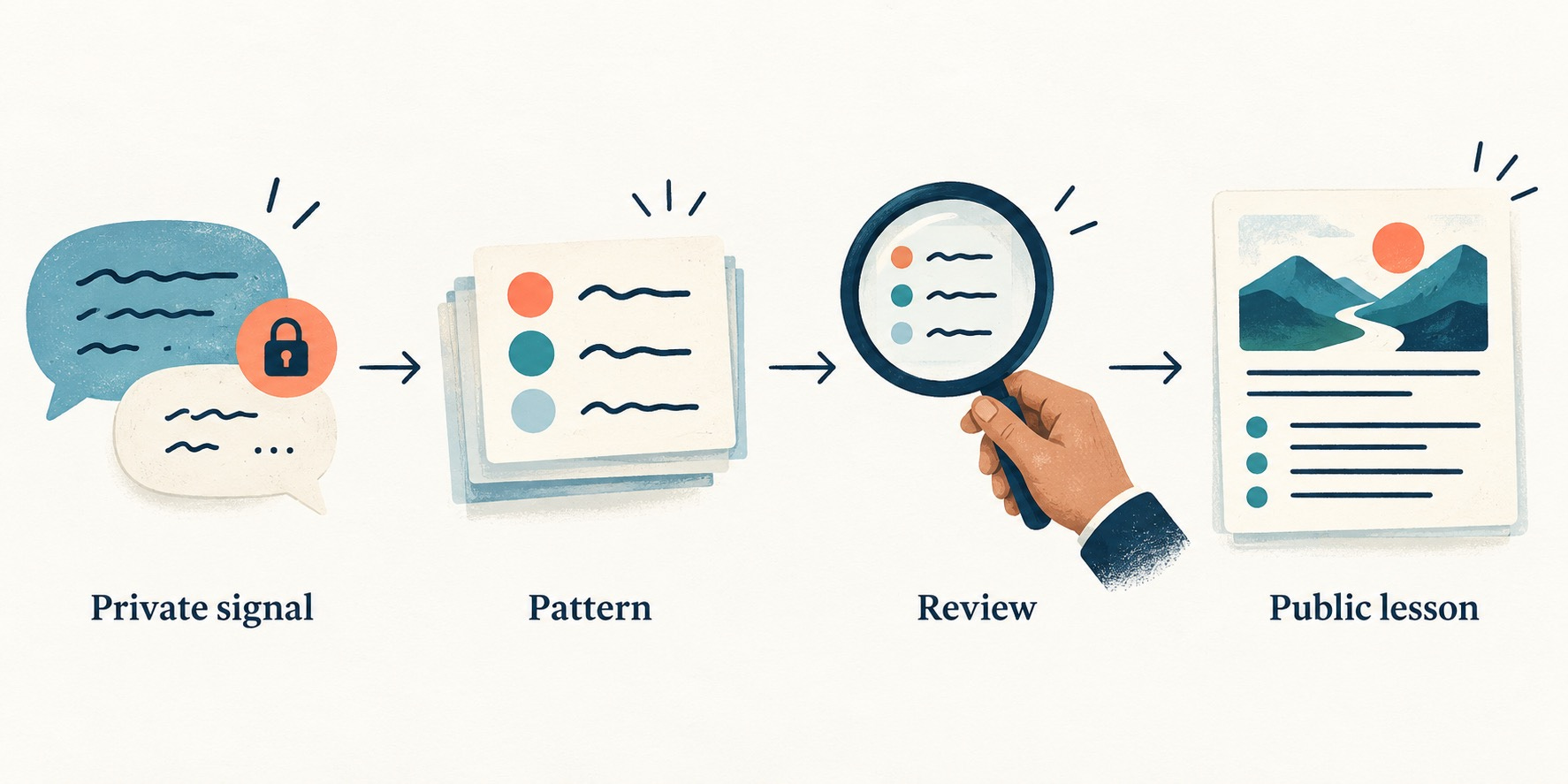
Capture a pattern, not a case study: private signal → pattern → human review → public lesson.
Use the pattern, not the customer story
Suppose several onboarding conversations reveal the same issue: a new champion can follow the setup steps but cannot explain why the first workflow matters to their leader. That is a useful pattern. The public lesson is not “How we rescued a new customer.” It is “The executive-translation question I ask before calling onboarding complete.”
The public version might teach a simple sequence: ask the champion to describe the next business decision the workflow will inform; identify who needs to trust that decision; and schedule the first review around that decision rather than around product activity. You can use a fictional scenario to make it concrete. You do not need an account name, a logo, a call recording, or a percentage improvement to make the lesson real.
Run every potential post through a recognizability test. Could the customer, a colleague, or a competitor identify the situation from the combination of industry, timing, role, product behavior, and outcome? If the answer is even “maybe,” generalize further or do not publish. Removing a name is not the same as removing context.
A useful rule: If the public lesson needs the customer’s dramatic details to be interesting, it is not yet a strong lesson. Find the decision inside the story and teach that instead.
Give AI a bounded editorial job
Do not paste customer emails, call notes, screenshots, recordings, health scores, renewal details, product roadmaps, or support transcripts into a general AI tool unless you have clear organizational permission and the tool is approved for that data. Even then, personal branding is a poor reason to move sensitive material around.
Start from your sanitized ledger entry. Ask AI to help with angles, reader objections, outline choices, or a clarity pass. Require it to flag facts it cannot verify. Then make the final claim yours. The most valuable part of a CSM’s public voice is calibrated judgment: knowing where a pattern applies, where it does not, and what you still need to learn.
I am a customer success manager creating a public teaching piece from a sanitized recurring pattern. Do not invent client facts, metrics, outcomes, or quotations.
Pattern: [describe a recurring customer friction without names, dates, product details, or identifiable context]
Decision I made: [describe the change in approach]
Audience: [CSMs / CS leaders / founders / product teams]
Give me three useful article or LinkedIn-post angles. For each, include: the reader problem, one safe fictional illustration, a limitation, and one question I must answer from my own experience before publishing.
Notice what this prompt refuses to outsource. The model may help you see the idea; it does not supply the evidence. If it produces a sharp sentence that feels true but that you cannot support from your own practice or a public source, remove it.
Choose a position people can repeat
“Customer success professional” is a role, not yet a memorable position. Your position emerges from the recurring friction you are unusually good at resolving. You might become known for helping new champions create internal momentum, making value reviews useful to executives, designing calmer escalations, translating customer language for product teams, or protecting adoption through messy stakeholder changes.
Test a position with a plain-language sentence: “I help [specific people] navigate [recurring customer problem] by [distinct method].” For example: “I help B2B teams turn early adoption signals into better executive conversations by separating activity from decision readiness.” It is not a slogan. It is a working hypothesis you can improve as you gather proof.
Put that sentence where people meet you: the beginning of your LinkedIn About section, a speaker introduction, a short bio, or the opening of your newsletter. Support it with a few public artifacts: a practical checklist, a careful post, a sourced explanation of a relevant concept, and a thoughtful comment that adds a question rather than applause. You do not need to publish every day. You need enough coherent evidence that a colleague can describe what you are useful for when you are not in the room.
Make your content helpful to customers and peers
A CSM brand becomes stronger when it is not secretly a pipeline machine. Create work that helps the people around the customer relationship: new CSMs, CS leaders, product partners, enablement teams, and thoughtful buyers. That restraint matters. It shifts the content from “Look at me” to “Here is a decision tool you can use.”
Build a modest three-part rhythm. First, publish a friction explainer: a concise breakdown of a moment that routinely slows value. Next, share a decision tool: a question set, review agenda, or diagnostic that helps someone act. Finally, write a cross-functional translation: what customer language can teach product, sales, or leadership without exposing a customer. Rotate those formats and let real peer questions guide the next piece.

Credibility grows when public teaching has clear permission and privacy boundaries.
A 30-day start that does not turn you into an influencer
In week one, start the private ledger and record three recurring friction patterns. In week two, choose the one that is broadest, safest, and most useful to a peer. Write the lesson in a fictional scenario, then apply the recognizability test. In week three, use AI only on the sanitized version to generate three angles and challenge the clarity of your draft. Ask a trusted colleague or manager about internal policy if the boundary is unclear. In week four, publish one useful artifact and update your profile with the position it supports.
Measure better signals than likes. Did a peer save the checklist? Did a product partner recognize a customer pattern? Did a recruiter, leader, or colleague describe your specialty more clearly? Did the article create a thoughtful conversation without putting a customer on display? Those are signs that your reputation is compounding in the right direction.
The authority that lasts
The best customer success manager personal branding does not make the CSM the hero of the customer story. It makes their judgment legible. Over time, a body of safe, specific public teaching shows that you can listen carefully, distinguish signal from noise, protect confidence, and move a group toward value.
AI can make the drafting faster. It cannot make the lesson earned. Keep the customer relationship private, keep the verification human, and let your public work show the quality of thinking that customers and colleagues already rely on.
Frequently asked questions
How can a customer success manager build a personal brand without sharing customer stories?
Teach repeatable decision patterns rather than account narratives. Keep a private, de-identified friction ledger; look for recurring problems; use fictional examples; and publish the question, framework, or review method that follows from the pattern.
Can customer success managers use AI for personal branding?
Yes, as a bounded editorial helper. Give it only sanitized patterns, ask it to surface assumptions and alternative angles, and verify every claim yourself. Do not use unapproved AI tools for customer data, call notes, screenshots, or confidential product information.
What should a customer success manager post on LinkedIn?
Post practical lessons on adoption, stakeholder alignment, value realization, handoffs, escalation judgment, and customer-language translation. Make each post specific enough to be useful but broad enough that no customer is identifiable.
How do I write a customer success personal-brand statement?
Use a simple structure: “I help [specific people] navigate [recurring problem] by [distinct method].” Anchor it in work you can demonstrate through safe public teaching, not through a grand claim about being the best.
Should a CSM share retention or renewal metrics publicly?
Only with clear permission and a real reason to do so. Metrics can reveal account scale, timing, commercial sensitivity, or a recognizable customer situation. A decision tool or carefully generalized lesson is often more durable and safer.
How often should a customer success manager publish content?
One useful, reviewed artifact every few weeks is enough to begin. The goal is a credible body of work, not a daily content quota. Publish when you have a real pattern, a safe example, and a clear benefit for the reader.
Useful context: the Planhat discussion on personal branding in customer success illustrates the career relevance of visibility, while LinkedIn’s social-selling guide emphasizes helpful participation over pitches. This article adds a confidentiality-safe, AI-bounded workflow; it does not replace your employer’s data, communications, or legal policies.