


A visibility system for security professionals who want their judgment to be known-without turning their profile, employer, or network into an attacker’s research dossier.

Most personal-brand advice gives security professionals the wrong assignment: post more, sound more certain, and turn every milestone into a victory lap. That advice ignores the uncomfortable fact that your public identity can be useful to recruiters, peers, customers, and attackers at the same time.
The better question is not, “How do I become more visible?” It is, “What can I make visible that proves how I think without making my work, employer, colleagues, or routines easier to exploit?”
That question is timely. The latest SANS security-awareness research still puts social engineering at the top of human risks, with AI close behind. A public profile is not inherently dangerous. An unexamined one is. The same AI that helps you organize a lesson or improve an explanation can help an attacker make a more convincing imitation.
This is not a case for disappearing. It is a case for building a security-minded personal brand: one based on useful teaching, bounded evidence, and a small repeatable review process. You do not need daily posts, confidential case studies, or a giant following. You need a reputation for helping the right people understand a problem better.
The core shift: Do not publish a stream of facts about your life and work. Publish a carefully designed trail of judgment, principles, and safe-to-share artifacts.
Why cybersecurity personal branding has a different risk model
A designer can share process shots. A sales leader can celebrate a deal. A security professional has to ask a different set of questions: Does this reveal a customer, vendor, toolset, access pattern, physical location, team change, release window, travel plan, or useful fragment of an internal architecture?
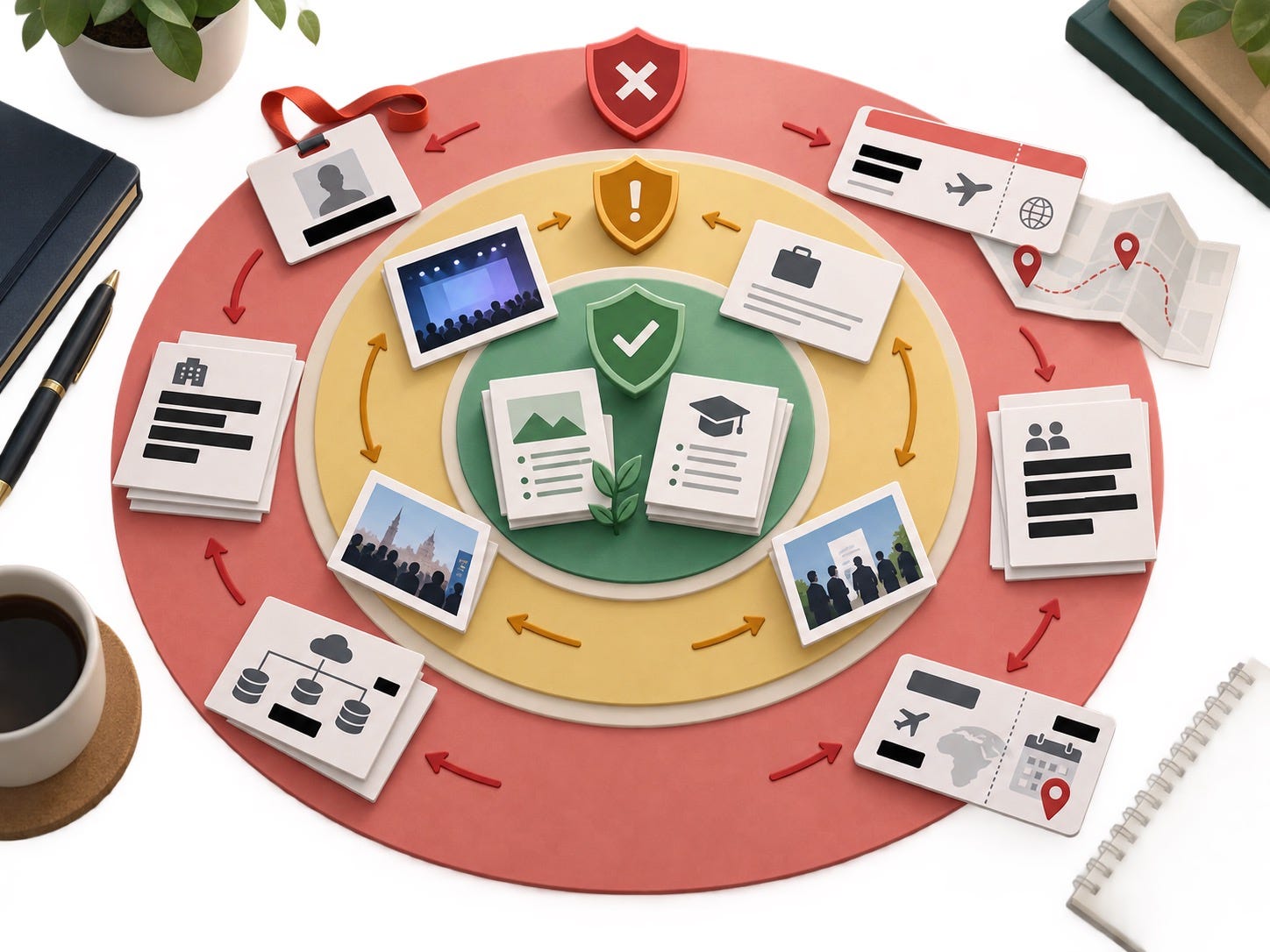
Even harmless-seeming details become more powerful in combination. A conference photo can confirm where you are. A job-anniversary post can narrow tenure. A proud tool-stack post can enrich an attacker’s reconnaissance. A well-meaning “what I learned from an incident” thread can reveal the shape of controls that failed.
That does not mean your public presence must be vague. Vague is not safe; it is merely unhelpful. Instead, trade operational detail for transferable judgment. Teach how you evaluated a trade-off, what question changed your mind, how you designed a safer process, or which misconception your audience should avoid. That is more durable than a screenshot of a dashboard anyway.
Visibility has three jobs
Findability: the right people can understand your area of work and the problems you care about.
Believability: they can see evidence of your reasoning, not only a list of tools and certifications.
Resilience: the public picture does not hand unnecessary context to someone with bad intent.
If a post improves only the first job, it is incomplete. A strong cybersecurity personal brand holds all three together.
Start with a personal-brand threat model
Before you rewrite a headline or ask AI for content ideas, run a light threat model. This takes 30 minutes and prevents the common mistake of adding information because a profile field exists.
1. Name the audience you actually want
Choose two or three audiences, not “everyone in cyber.” For example: security leaders hiring for governance work, founders who need practical cloud-risk advice, or early-career analysts learning detection engineering. A narrower audience makes your message clearer and reduces the temptation to disclose everything in order to look impressive.
2. List the proof you can safely own
Make three columns: public already, publishable after review, and never public. Your first column might include a talk title, open-source contribution, training material, public certification, de-identified framework, or a lesson from a lab. The second might include a pattern from a past engagement after approval and abstraction. The final column should include client names, internal names, current controls, live incident details, access information, routine locations, and anyone else’s data.
3. Consider the mosaic, not just the post
Ask what a stranger could combine from your LinkedIn, social accounts, conference agenda, personal site, and colleagues’ posts. A post can be safe by itself but unsafe beside a public travel schedule and an employer announcement. Review the collection once a quarter.
4. Decide your escalation path before you need it
Know who reviews a gray-area post: your manager, communications lead, legal team, client contact, or no one because the answer is simply “do not publish.” Also decide what you will do if someone impersonates you, misquotes a post, or sends a suspicious connection request. A public identity needs an incident path just like any other asset.
Build authority from safe proof, not confidential stories
The most credible security content rarely starts with “Here is what happened at my company.” It starts with a useful, bounded observation. You can share judgment without pretending to disclose the most dramatic thing you have ever seen.
Try these safe proof formats:
The decision note: explain a general security trade-off you have seen repeatedly, the options, and the question that should decide it.
The misconception correction: take one common claim—such as “more security awareness is always the answer”—and add the missing context.
The redacted pattern: replace names, dates, counts, platforms, and identifying specifics with a generalized scenario, then state what remains true across settings.
The teaching artifact: publish a checklist, small glossary, mock tabletop prompt, or decision tree that someone can use immediately.
The public synthesis: connect two already-public reports and explain the practical implication for a specific audience.
Notice the standard: a reader should learn something they can act on, while a stranger should not gain a useful map of your current environment. That is a much higher bar than “Was this technically accurate?”
Use AI as a reviewer, not a reputation autopilot
AI is particularly useful for cybersecurity personal branding when it helps you reduce risk and improve teaching. It becomes risky when it writes plausible-sounding claims you cannot verify, turns sensitive notes into a polished leak, or invents a confident “thought leader” voice that peers immediately distrust.
A good workflow keeps the professional in charge of source material, boundaries, and final judgment:
Write five rough bullets from a real lesson, question, or public source. Do not paste confidential tickets, reports, transcripts, or client data into a general AI tool.
Remove names, dates, company references, identifiers, exact metrics, and implementation detail before prompting.
Ask AI to surface the teaching principle, reader questions, and possible overclaims—not to manufacture expertise.
Compare the draft with your intended audience and your threat-model list.
Add the human part: what you believe, where the advice does not apply, and what evidence supports the claim.
A safer AI review prompt
I am preparing a public educational post for [audience]. Based only on the sanitized notes below, identify: (1) the transferable lesson, (2) claims that need evidence or qualification, (3) details that may reveal operational context, and (4) three specific questions a skeptical practitioner would ask. Do not invent examples, statistics, tools, incidents, or results. Keep the tone practical, modest, and precise.
Sanitized notes: [paste only material approved for this tool]
This prompt turns AI into a red-team-minded editor. It is much more valuable than “write a viral LinkedIn post about zero trust.” The latter may produce tidy sentences. It cannot supply your accountability.

Make your profile clear without making it a reconnaissance sheet
Your profile should help an informed person answer three questions quickly: What kind of security problems do you help solve? What evidence suggests you can do it? What is the appropriate way to contact or follow your work?
That does not require a current-project inventory. Replace internal nouns with problem categories and outcomes. “Security engineer responsible for the company’s proprietary fraud stack” is more revealing than necessary. “Security engineer focused on identity abuse, detection quality, and practical response workflows” is clearer about your direction and more respectful of your employer.
Likewise, list certifications as evidence, not as a personality. Link to public talks or writing only when you can stand behind them later. Keep job descriptions about the scope of your contribution rather than the sensitive mechanics of the environment. If you use a personal site, treat it like production: keep the software current, limit unnecessary analytics and forms, and use a contact method that does not expose more than needed.
Choose a sustainable publishing rhythm
Security professionals often reject personal branding because they picture a feed full of daily hot takes. That is a false choice. A useful reputation can be built with one thoughtful artifact a month and a few genuinely helpful conversations in between.
Try this one-hour monthly cycle:
10 minutes: capture one question you answered, trade-off you observed, or public report that changed your thinking.
15 minutes: decide the principle and remove sensitive context.
15 minutes: use AI for an overclaim, clarity, and exposure review.
15 minutes: write the final artifact and add a source, limitation, or next question.
5 minutes: consider what the post adds to your public mosaic.
Over time, these artifacts become a body of work. A recruiter sees your direction. A peer sees the quality of your reasoning. A potential client sees the kind of questions you ask. And none of them need a stream of hype to reach that conclusion.
Measure trust, not noise
Follower counts and impressions are weak signals for a security reputation. Better evidence includes invitations to contribute to a panel, a thoughtful question from the right practitioner, a warm introduction, a relevant interview, a citation of your public explainer, or a recurring community conversation.
Keep a private log of these signals. Note which topics generated real peer discussion, which formats were safe and easy to repeat, and where someone misunderstood your claim. That feedback should shape your next teaching artifact. It should not pressure you to publish more personal information.
The goal is not to become a cybersecurity influencer. It is to become easier for the right people to understand, verify, and recommend. In an AI-saturated professional feed, that quiet kind of specificity travels farther than generic confidence.
Frequently asked questions
Is personal branding safe for cybersecurity professionals?
It can be, if you design it around safe proof and review. Do not treat a public profile as a complete work history. Share transferable judgment, public artifacts, and de-identified lessons; withhold details that increase risk to you, your employer, customers, or colleagues.
What should a cybersecurity professional post on LinkedIn?
Post useful explanations, public-source syntheses, learning notes, carefully generalized decision frameworks, and teaching artifacts. Avoid live incidents, exact customer context, credentials, badge photos, real-time travel, and detailed descriptions of active technology or controls.
Can I use AI to write cybersecurity content?
Yes, but use it for structure, clarity, skeptical questions, and exposure checks. Never paste confidential material into an unapproved tool, and do not publish claims or examples that you cannot verify yourself.
How often should security professionals publish?
Consistency matters more than volume. One useful, carefully reviewed artifact a month can compound into a credible body of work. Add thoughtful comments when you have something specific to contribute; do not manufacture activity.
Should I list my employer and exact job title on my profile?
It depends on your organization, role, contracts, and personal threat model. Use the minimum detail that helps your intended audience understand your direction. If you are unsure, seek the appropriate internal guidance before publishing.
How do I avoid sounding like a cybersecurity influencer?
Teach from real questions, disclose limitations, cite public sources when relevant, and avoid inflated titles or universal claims. Let your reputation be a consequence of useful work and generous participation, not a performance of expertise.