


A pipeline that runs once proves you can follow a tutorial. A calm, well-documented response to a broken schema shows the judgment people trust with real decisions.

Most data engineering portfolio projects have a familiar shape: pull public data, load it into a warehouse, transform it, put a dashboard on top, and list every tool used. It is a useful way to learn. It is also easy to make look impressive without showing whether you understand the risk that matters most: a small upstream change can quietly make a confident downstream number wrong.
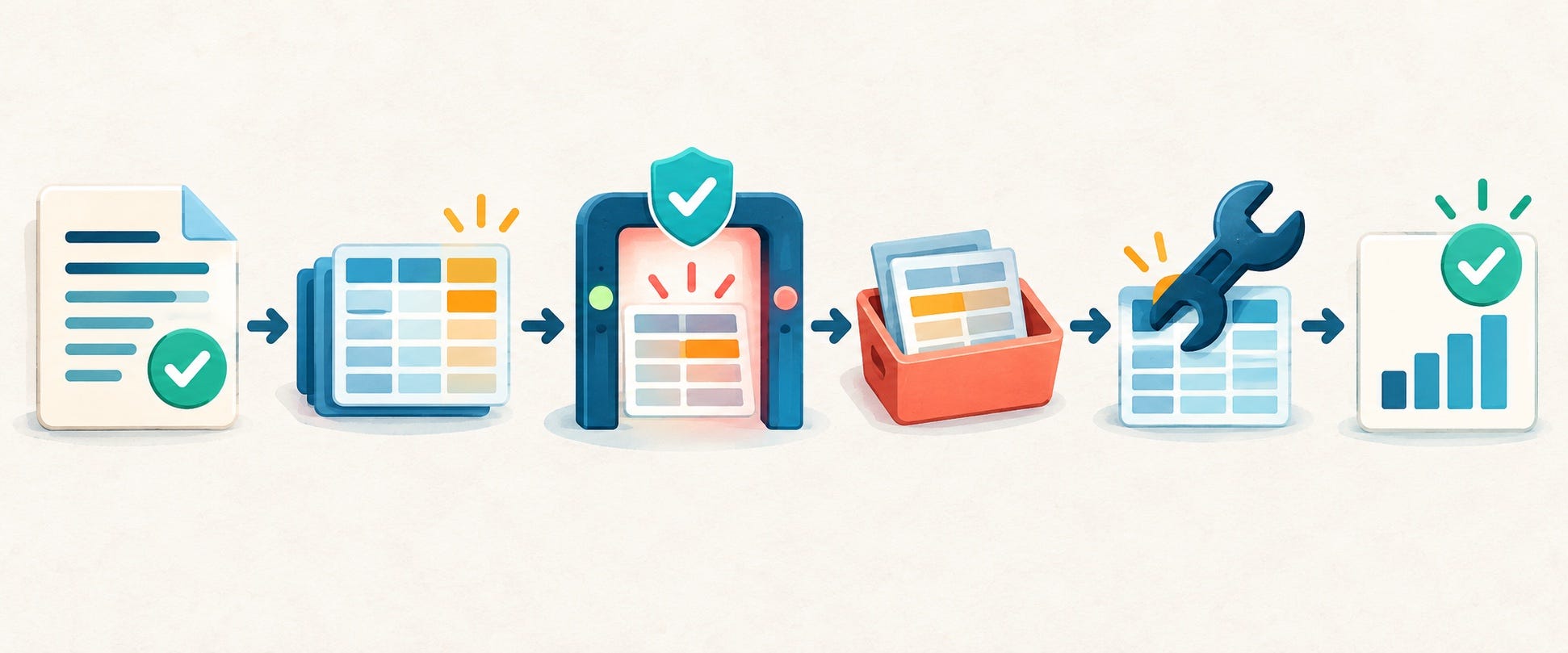
That is where a stronger data engineering portfolio project begins. Instead of presenting only the happy path, build one controlled change event. A source changes amount from a number to a string. A required identifier disappears. A new status value arrives. A supplier sends a duplicate file. Then show how your system notices, what you inspect, what you prevent from reaching a consumer, and how you recover.
You are not staging a fake production incident. You are creating a small, honest case study about data trust. It gives a hiring manager, collaborator, or future client something much more useful than a logo wall: a chance to see how you think when data stops behaving.
Your portfolio does not need to say, “I know every modern data tool.” It needs to make it easy to believe, “I know when a dataset should not be trusted yet.”
Why the happy-path pipeline is no longer enough
“Ingest, transform, visualize” is the default portfolio storyline because it is clean. Real systems are messier. Producers change without warning. Business meanings drift. A field can remain technically valid while no longer meaning the same thing. A dashboard can refresh on schedule while leading someone to a bad decision.
That does not mean you need an expensive cloud environment or a complicated streaming platform. It means your project should contain one decision that a tool cannot make for you. For example: should a batch be blocked because one optional field changed? Should the system quarantine only bad records? Should a compatible additive change proceed while a downstream model waits for review? What evidence would let you say the repair worked?
Those questions create a story. They also separate the technology from the judgment. A reviewer may not use your exact warehouse, orchestrator, or transformation framework. They will still recognize careful scoping, explicit assumptions, failure containment, and a clear explanation of trade-offs.
Start with an honest boundary. Say: “This is a controlled educational project using public or synthetic data. I introduced a documented compatibility break to test validation and recovery. I am not claiming a production incident, customer impact, or enterprise-scale reliability.” That sentence increases trust because it tells the reader what the work does—and does not—prove.
Build a contract-change case study
A data contract is simply a useful way to make expectations visible. It can describe fields, types, required values, identifiers, freshness expectations, and quality rules. You do not need to adopt a specific platform to learn from the idea. A versioned YAML or JSON file, a validation script, and a readable README can be enough for a portfolio exercise.
Pick a small domain with a real downstream question. Public transit arrivals, city permits, open retail data, weather records, or a synthetic subscription service can work. Create one source dataset, one transformed model, and one consumer-facing output. Then choose a break that would matter to that output.
1. State the promise in plain language
Begin with a sentence a non-engineer can understand: “This daily feed helps operations decide which locations need restocking.” Then define the technical promise beneath it: each record has a stable location identifier, an event timestamp, a non-negative quantity, and a source version. Naming the human decision first stops the project from becoming a generic exercise in moving rows around.
2. Make one expectation executable
Choose a handful of checks rather than a giant checklist. Check that a key exists and is unique. Check that a timestamp parses. Check that a required status belongs to a documented set. Check a reasonable row-count or freshness boundary. Version the expectations alongside the pipeline so a reviewer can see what changed and why.
Tools can help here. The Data Contract CLI documentation, for example, shows how schema properties such as required fields and keys can become checks. But do not let the tool become the story. The story is why this particular check protects a downstream decision.
3. Introduce one meaningful break
Use a controlled fixture, never a borrowed employer dataset. Rename store_id to location_id, send quantity as "unknown", or add a new status that your dashboard would otherwise categorize incorrectly. Record the before and after versions in your repository. A good break is specific enough to explain in one sentence and connected to a visible consequence.
4. Choose a containment action
This is the part most portfolios skip. Your choice might be to stop the batch, quarantine the invalid rows, retain the last known good output with a visible freshness warning, or accept a backward-compatible addition while logging it for review. No answer is universally correct. Explain what you optimized for: accuracy, availability, cost, or investigation speed.
5. Repair, retest, and name the limit
Update the mapping or contract only when you can explain the producer’s intent. Re-run the original checks. Compare the consumer-facing output before and after. Then publish the remaining limitation: perhaps your project does not notify an owner automatically, handles only batch files, or cannot infer a semantic change from a type-valid field. Limits are not embarrassment. They tell a reviewer that you can distinguish a working demo from a complete operating system.
Show the consumer impact, not only the failed test
A red test screenshot is evidence, but it is not the whole case study. Trace the break to the person or process that would consume the data. If a duplicate file would double a weekly total, show the comparison that reveals it. If a missing identifier would create an orphaned record, show why the dashboard should wait. If a new category would be misclassified, explain how that would distort the business question.
This is where your personal brand becomes clearer. You are not claiming to be the person who can write the most validation rules. You are showing that you understand why data quality exists: to protect decisions. A concise diagram, a small test fixture, and a decision note are usually more persuasive than an oversized architecture picture.
Use AI to speed up the work without outsourcing the judgment
AI can be genuinely useful in a data-quality project. Ask it to propose edge cases from a written contract, turn terse logs into candidate investigation questions, draft a first-pass README outline, or generate test-data variations that you then inspect. It can also act as a skeptical reviewer: paste your case-study outline and ask, “Which claim would be hard to verify?”
Keep the important decisions yours. Do not publish a generated explanation of a schema migration you cannot defend. Do not let an assistant invent an impact statement. Do not present synthetic test results as observed production behavior. The strongest use of AI is to create more time for the human tasks: defining the boundary, choosing the trade-off, verifying the result, and writing what you learned.

Package the case study so someone can verify it quickly
Think of the repository as a guided review, not a storage closet. The opening README should answer five questions in under five minutes: What decision does the pipeline support? What data does it expect? What controlled change did you introduce? How did the system respond? What does the project not prove?
Then add a short evidence trail. Link to a simple architecture diagram, the contract or expectation file, a small input fixture, the validation output, a decision record, and the retest. Keep secrets out. Use public or synthetic data. If a file is too large, include a representative sample and explain how a reviewer can reproduce the run.
You can reuse this case study across your professional presence without repeating yourself. A GitHub README contains the reproducible details. A LinkedIn post can focus on the trade-off: why you quarantined a batch instead of fixing it silently. A short newsletter post can share the lesson about semantic changes. A portfolio page can show a one-page visual summary. Each item points back to real work instead of multiplying generic content.
Before you publish, check:
Can a reader name the decision the dataset supports?
Did I label public, synthetic, and simulated data clearly?
Is the break connected to a real consumer consequence?
Did I explain why I blocked, quarantined, or accepted the data?
Can someone reproduce the test without private credentials?
Did I state one important limit instead of implying production readiness?
A practical two-week build plan
Days 1–2: Pick a small public or synthetic source and write the human decision it supports. Define three to five expectations that protect that decision. Days 3–4: Build the smallest ingestion and transformation path. Save a known-good input fixture and output.
Days 5–6: Add executable checks and a clear failure message. Write down what each check cannot detect. Days 7–8: Introduce one controlled schema or quality break. Capture the failure and trace the downstream risk.
Days 9–10: Pick and implement a containment rule. It can be simple: fail the batch, isolate records, and preserve the last known good output. Days 11–12: Repair the scenario, rerun the checks, and record what changed.
Days 13–14: Write the case study for a skeptical reviewer. Ask one data engineer: “Where would you distrust this evidence?” Their answer may reveal a better next iteration than another layer of tooling would.
The lasting personal-brand signal is not that you assembled an impressive stack. Tools will change. The durable signal is that you can define an expectation, notice when reality violates it, protect a decision from bad data, and explain the trade-off without drama. That is what turns a project into credible public proof.
Frequently asked questions
What makes a good data engineering portfolio project?
A good project makes engineering judgment visible. Include a useful data question, reproducible inputs, explicit expectations, a controlled failure or edge case, a containment decision, a retest, and honest limits. One complete case study is usually more persuasive than several disconnected demos.
Do I need a cloud warehouse for a data engineering portfolio?
No. Use the smallest stack that lets you demonstrate the decision you want to show. Local tools, public datasets, and a clear run path can be enough. Add cloud services only when they help explain an engineering choice you can defend.
How do I show data quality in a portfolio project?
Connect checks to a downstream use. Show the expected data, introduce a safe failure, capture what the validation detects, explain the containment action, and prove the retest. Avoid claiming that a few checks make a project production-ready.
What is a data contract project?
It is a project that makes data expectations explicit and testable. A contract can cover structure, required values, keys, quality rules, and service expectations. For a portfolio, the most valuable part is showing how you handle a change when the data no longer meets those expectations.
Should I include schema evolution in a data engineering project?
Yes, if you can keep it bounded. One additive or breaking change is enough to show how you think. Explain whether the change is compatible, who is affected, what gets blocked or quarantined, and how the repair is verified.
Can I use AI to build my data engineering portfolio?
Yes—use it to brainstorm test cases, organize documentation, improve clarity, and question weak assumptions. Verify every implementation and keep the scenario, trade-offs, and conclusions grounded in work you actually understand and performed.