


A strong personal brand in hiring does not require daily posting, a huge audience, or a polished influencer persona. It requires a believable online trail that makes a recruiter think: this person is real, current, credible, and easy to trust.

Many job seekers still treat their online presence like a side issue. They update a resume, tweak LinkedIn, maybe swap in a cleaner headshot, and hope that is enough. But hiring has changed. Recruiters are under pressure to move faster, AI is now involved somewhere in many screening workflows, and identity trust matters more because fake profiles, AI-assisted applications, and polished but empty candidates are harder to spot at a glance.
That changes the meaning of your digital footprint. It is no longer just a privacy concern. It is part of your professional evidence. When someone searches your name, they are not only looking for red flags. They are trying to answer a quieter question: does this person feel consistent, legitimate, and current?
The good news is that you do not need to become a content creator to solve that problem. You need a minimum viable professional footprint. You need enough visible proof to support the story your resume and interviews are telling. That is the real personal branding job for most job seekers now.
Why this matters more in AI-era hiring
Two trends are colliding at the same time. First, online vetting is normal. Recruiters and hiring managers have been Googling candidates for years, and research on cybervetting shows this is not a fringe behavior. Second, AI has made it easier to manufacture surface-level professionalism. A candidate can now generate a polished bio, a clean headshot, a tidy resume, and a confident cover letter in a single afternoon.
That means polished language alone no longer proves much. Employers increasingly look for consistency across surfaces: LinkedIn, search results, portfolio artifacts, speaker pages, GitHub, personal websites, bylines, public comments, community involvement, or proof-of-work samples. Not everyone needs all of those. But almost everyone benefits from some combination of them.
In practical terms, a digital footprint is your trust layer. It helps other people verify that your experience is real, your interests are current, and your professional identity is not stitched together five minutes before the interview.
This is especially important for career switchers, new graduates, remote candidates, consultants moving back into full-time roles, and anyone applying into crowded white-collar markets. If your resume makes a strong claim but the web returns almost no supporting context, the burden of belief shifts back onto you.
What employers actually want from your online presence
Most employers are not performing a forensic investigation. They are doing quick pattern matching. They want to know four things.
Are you who you say you are?
Does your public identity broadly match your resume and interview story?
Do you show any signs of current engagement with your field?
Is there anything unusually risky, hostile, or inconsistent?
That means the ideal outcome is not “the internet loves me.” The ideal outcome is “nothing feels off, and something useful supports my credibility.”
This is where a lot of people make the wrong tradeoff. They either overshare in the hope of looking active, or they disappear completely in the hope of staying safe. Both extremes can work against you. Oversharing creates noise. Total invisibility can create doubt. A better target is selective visibility.
The minimum viable digital footprint
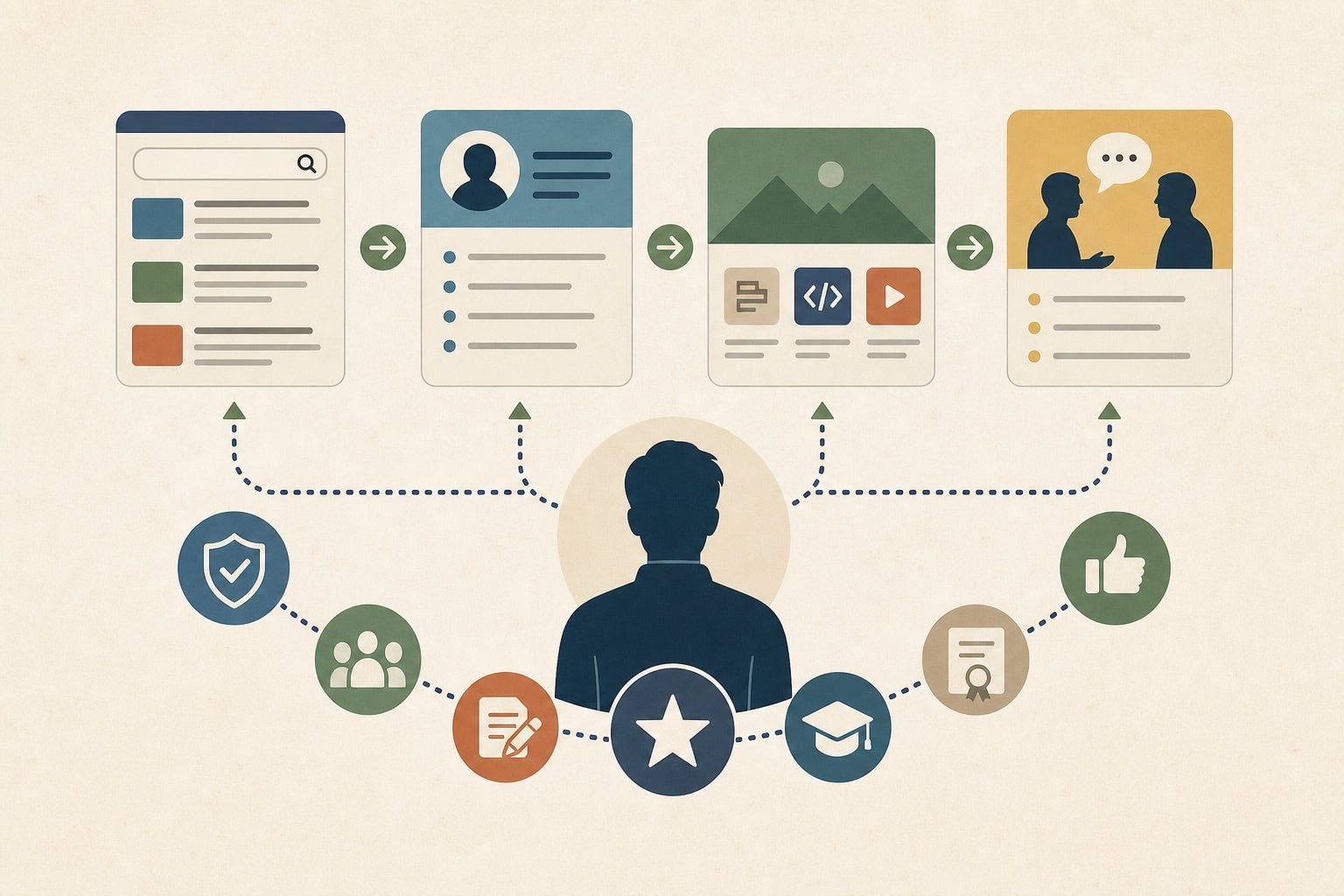
If you are not trying to build a public audience, your goal is not to dominate search. Your goal is to make the first page of signals coherent. For most professionals, that means building four layers.
1. A clean identity layer
Your name, headshot, location context if appropriate, and core professional positioning should be broadly consistent across public surfaces. That does not mean identical wording everywhere. It means the same person is clearly visible across them.
2. A credibility layer
This includes LinkedIn recommendations, project samples, a simple portfolio page, case-study bullets, public contributions, certifications, talks, articles, or community appearances. You need visible proof that your expertise exists outside your own claims.
3. A freshness layer
One of the most underrated hiring signals is recency. A dormant profile from three years ago feels stale. A recently updated headline, current role description, recent project, or thoughtful public comment tells employers you are active now.
4. A judgment layer
Your public footprint should signal maturity. The question is not whether you have opinions. It is whether your online behavior suggests reliable judgment. Even in expressive industries, employers are often screening for volatility, hostility, confusion, or oversharing.

The five surfaces that matter most
You do not need to win everywhere. Start with the surfaces that produce the highest trust per hour invested.
LinkedIn
This is still the default professional identity layer. Your photo, headline, About section, experience entries, featured items, and recommendations do a large share of the work. The key is specificity. “Passionate leader driving innovation” says nothing. “Product designer focused on B2B onboarding and retention” says something real.
Search results for your name
Google yourself in an incognito window. Search your full name, then your name plus city, company, role, and specialty. You are looking for gaps, not perfection. Does a recruiter find your LinkedIn quickly? Do irrelevant old profiles outrank your current identity? Is there any proof-of-work visible at all?
A simple owned page
This can be a personal site, Notion page, Carrd, portfolio, GitHub profile, or one-page “work with me / about me / selected work” page. The point is control. Owned pages let you tell a clear story in your own order. For job seekers who are changing fields, this is often more useful than posting more on social media.
Proof-of-work assets
These are the strongest personal-branding signals because they move you out of self-description and into evidence. Examples include a case study, writing sample, project demo, code repository, design walkthrough, strategy memo, audit summary, presentation clip, podcast appearance, or public notebook showing how you think.
Public micro-signals
You do not need a big audience to benefit from small visible activity. A few thoughtful LinkedIn comments, a short post explaining a project lesson, a conference recap, or a niche community contribution can all help. These work because they show live thinking without requiring creator-scale output.
How to use AI without making your footprint look fake
AI is useful here, but only if you use it around your reputation, not instead of it. The fastest way to weaken trust is to let AI manufacture a polished identity that has no texture.
Use AI for cleanup, synthesis, and structure. Do not use it to invent substance. Good uses include:
Turning messy work history notes into sharper bullet points
Summarizing common themes across recommendations or testimonials
Rewriting an About section for clarity while preserving your actual language
Generating headline variations based on your real role and specialty
Organizing portfolio material into clear sections
Bad uses include writing generic leadership language, exaggerating your expertise, generating fake authority markers, or producing content you could not defend in an interview. If AI helps you sound cleaner but less specific, it is hurting you.
A useful test: if a recruiter clicked from your polished profile into your actual work, would the same person still be there?
A practical 7-day footprint rebuild
If your online presence feels weak, do not try to fix everything at once. Build a compact system.
Day 1: Search yourself like a recruiter
Use incognito. Search your name, role, city, and past company. Save screenshots. Notice what appears first, what is outdated, and what is missing.
Day 2: Tighten LinkedIn
Rewrite your headline and About section for specificity. Add measurable context to your last two roles. Remove vague filler. Add a featured item if you have one.
Day 3: Publish one owned page
Create a simple page with your positioning, selected work, and contact path. If you do not have a portfolio, use a clean one-pager with a short bio and three proof points.
Day 4: Add proof-of-work
Choose one artifact that demonstrates thinking. A strong page explaining a project decision is usually more useful than another motivational post.
Day 5: Create one current public signal
Write a short post, leave two thoughtful comments, or publish a project reflection. Your goal is not reach. Your goal is recency and relevance.
Day 6: Clean up contradictions
Check job titles, dates, usernames, profile photos, and bios for inconsistency. Small contradictions create unnecessary friction in trust.
Day 7: Build a maintenance loop
Once per month, update one line, one asset, and one public signal. Personal branding becomes manageable when it is treated like light maintenance instead of a giant reinvention project.
What not to do
Do not build a fake expert identity because you think the market expects one. Recruiters do not need perfection. They need coherence.
Do not post daily generic AI content just to look active.
Do not create a personal site full of vague claims and no evidence.
Do not use AI headshots or bios that make you look more polished than believable.
Do not confuse privacy with invisibility. You can stay selective without disappearing.
Do not let old abandoned profiles outrank your current professional identity.
The strongest job-seeker personal brands are rarely loud. They are legible. When someone searches, the story holds together. That is what trust looks like online.
The bigger shift
The old career model assumed your resume carried the burden of proof. The new one assumes your resume starts the claim and your digital footprint helps verify it. That does not mean the system is always fair. It is not. Online vetting raises real privacy and bias concerns, especially when employers use public signals carelessly. But pretending the behavior does not exist will not protect you.
A smarter response is to build a footprint that is true, calm, and strategically useful. If you are serious about personal branding, this is one of the most practical places to start. Not because you want attention. Because you want your credibility to survive first contact.
If you remember only one thing, make it this: your goal is not to look famous online. Your goal is to look easy to trust.
FAQ
Do job seekers really need a personal brand now?
Most job seekers do not need a big public brand, but they do need a visible professional identity. In practice, that means a digital footprint that supports credibility when employers search your name.
What if I do not want to post on LinkedIn all the time?
That is fine. A strong footprint does not require constant posting. A clear profile, an owned page, one or two proof-of-work assets, and occasional thoughtful public activity are often enough.
Can AI help me improve my online presence for a job search?
Yes, if it is used for editing, structuring, and clarifying your real experience. It becomes risky when it starts generating generic authority language or fabricating expertise you cannot defend.
What matters more: cleaning up bad results or creating good ones?
Usually both, but creating better current signals is often the higher-leverage move. A strong LinkedIn profile, a simple personal page, and proof-of-work assets can push older weak signals out of importance over time.
Is having no online presence always a problem?
No. Some roles care less than others. But in knowledge work, remote hiring, client-facing jobs, leadership tracks, and career transitions, having no visible professional footprint can create avoidable doubt.
What should I create first if I am starting from zero?
Start with LinkedIn, then add one owned page and one proof-of-work asset. That combination gives you identity, control, and evidence without forcing you into full-time content creation.