



You do not need to become a public performer to become known. You do need a system that makes your expertise, judgment, and proof visible.
There is a quiet pressure on professionals right now: be visible, post often, show your face, tell your story, and do it before the algorithm forgets you exist.
That advice works for some people. It also burns out founders, consultants, engineers, students, freelancers, and executives who do not want their face turned into a content asset. The sharper question is, “Can I build trust without becoming the face of everything?”
Yes, but the bar is higher than it used to be.
A faceless personal brand cannot rely on charm, presence, or parasocial familiarity. It has to earn trust through proof, clarity, repetition, useful thinking, and responsible AI use. That matters more now because platforms are becoming suspicious of low-effort synthetic content. Substack now offers readers a way to scan posts and notes for AI-assisted text, TikTok is testing systems to detect AI-generated spam, and Pangram found heavy AI saturation in longform professional content.
AI is not off limits. But if you use AI to hide, people will feel it. If you use it to organize your thinking, sharpen your voice, and show better evidence, it can make your brand more credible.
What a faceless personal brand actually is
A faceless personal brand is not an anonymous spam account. It is a public reputation built around a recognizable point of view, body of work, and contribution style without making your face the main trust signal.
You may still use your real name. You may use initials, an illustrated portrait, hand shots, product screenshots, code samples, slide excerpts, voice notes, or written essays. The core idea: your work becomes more visible than your appearance.
This is useful for founders, technical professionals, consultants, students, job seekers, creators, and people in sensitive roles who need visibility with boundaries.
The trap is assuming that “faceless” means “effortless.” If people cannot see your facial expressions or hear your natural delivery, they need other cues that you are real, competent, and accountable.
A faceless brand wins when the reader can still answer three questions: Who is behind this? Why should I trust them? What proof do they keep showing?
The trust equation for a faceless brand
When your face is not the anchor, trust has to come from five signals.
1. Specific expertise
Do not brand yourself as a “growth thinker,” “AI strategist,” or “future of work voice” unless you can make those words concrete. A faceless brand needs a narrow field of recognition.
Better examples:
“I help seed-stage B2B founders turn customer calls into sharper positioning.”
“I explain applied AI workflows for solo consultants who do not have a content team.”
“I document how data analysts can build public proof without becoming creators.”
“I review developer portfolios from the hiring manager’s point of view.”
Specificity lets strangers place you and gives AI tools clearer source material when summarizing your identity.
2. Visible proof
Proof replaces face time. A faceless brand should publish evidence more often than opinions.
Evidence can include teardowns, project lessons, annotated screenshots, public experiments, decision logs, templates, mini case studies, customer questions, diagrams, repos, reading notes, or data roundups. You do not need to reveal confidential details. You do need to show how you think.
3. Recognizable voice
Faceless does not mean voiceless. Your writing has to be recognizable without a headshot.
AI can help if you give it source material: voice notes, emails, comments, call transcripts, and rough drafts. Ask it to extract sentence patterns, recurring opinions, phrases to avoid, and your natural level of directness.
Then use AI as an editor, not a substitute speaker. The goal is to sound consistently like yourself.
4. Clear boundaries
People trust boundaries when they are honest. If you do not show your face for privacy, safety, cultural, legal, employment, or personal reasons, a short public note can be enough.
For example: “I keep my visual identity private, but every guide here is based on real work, research, and experiments. When AI helps with editing or structure, I say so.”
That reduces suspicion because you are not pretending to be more visible than you are.
5. Accountability
Trust grows when people can challenge, contact, cite, or verify you. A faceless brand should still have an email, profile page, author note, citations, and a connected body of work.
If you use a pseudonym, keep it stable. If you publish claims, link sources. If you make a mistake, correct it visibly.
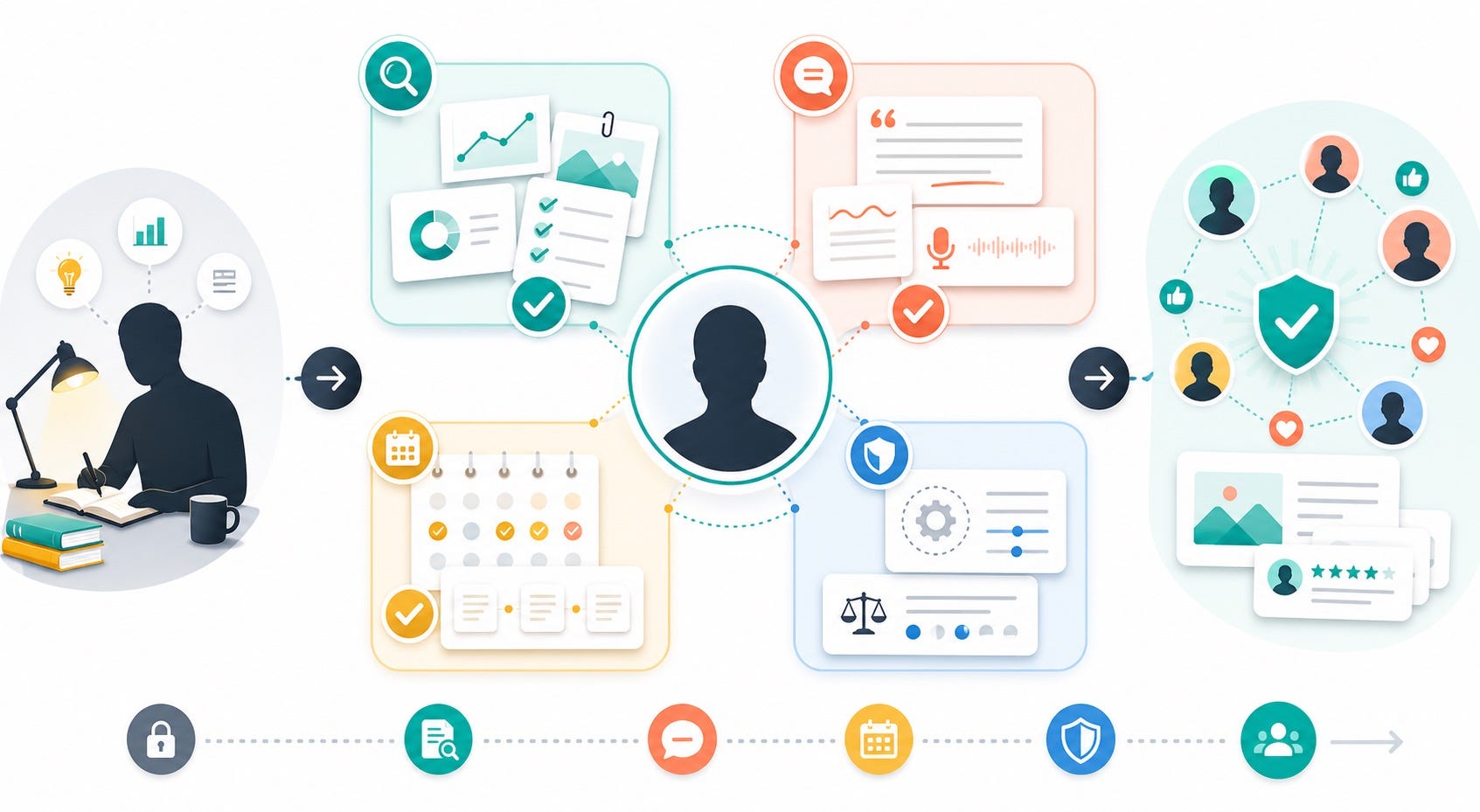
The AI workflow for building a faceless personal brand
The best AI workflow is not “write posts for me.” It turns private expertise into public assets while preserving judgment and boundaries.
Step 1: Build a personal brand source folder
Create one folder that AI can help you work from. Include:
Five examples of your best writing.
Ten opinions you are willing to defend.
Ten client, project, class, or work problems you understand deeply.
Five stories you can share without violating privacy.
Three topics you will not discuss publicly.
Three kinds of proof you can publish regularly.
This folder becomes your anti-generic system. Without it, AI reaches for the same phrases everyone else uses. With it, AI has your real constraints.
Step 2: Ask AI for a positioning map, not a bio
Most people ask AI to write a bio too early. A bio is packaging. Positioning is strategy.
Prompt: “Act as a personal brand strategist. Using the notes below, identify three positioning lanes. For each lane, define the audience, urgent problem, credibility proof, expected content, trust risk, and tradeoffs. Do not write slogans.”
The trust-risk part matters. A faceless expert in finance, hiring, law, or AI implementation needs more disclosure and sourcing than someone sharing productivity notes.
Step 3: Turn proof into repeatable content formats
Lean on formats that make substance visible:
Teardowns: “I reviewed three onboarding flows and found the same trust problem.”
Decision notes: “Here is why I chose the boring automation over the impressive one.”
Field notes: “Five patterns I noticed after auditing twenty profiles.”
Templates: “A one-page checklist for making an AI-assisted article sound human.”
Annotated examples: “The weak version, the stronger version, and the reason.”
Office-hours answers: “A reader asked how to build credibility without posting daily.”
These work because they require judgment, not a face.
Step 4: Use AI as a private editor
Once you have a rough post, ask AI to improve it through constraints rather than invention.
Prompt: “Edit this draft for clarity and rhythm. Preserve my claims, examples, and directness. Remove generic AI phrasing. Flag sentences that sound inflated, unverifiable, or too polished. Suggest three stronger openings.”
This keeps the human contribution visible. AI improves the transmission; it does not replace the signal.
Step 5: Add a disclosure layer
Disclosure does not need to be dramatic. It needs to match the risk.
If AI helped with grammar, you probably do not need a headline confession. If AI created a synthetic voice, avatar, case example, image, or expert quote, be clearer. If your advice affects money, careers, health, safety, or legal decisions, cite sources and define limits.
Substack’s AI-scanning feature and TikTok’s AI-literacy push point to the same shift: audiences want to know when a human is accountable. A faceless brand should make that easier.
How to set up your faceless brand profile
Your profile has to answer the questions your face would normally answer: Is this real? Are they serious? What do they know?
Profile photo or avatar
Use something stable and professional: initials, a clean symbol, a back-facing photo, a workspace image, an illustrated portrait, or a consistent avatar. Avoid hyper-polished AI portraits that imply a false identity.
Headline
Make the promise concrete. A good headline combines topic, audience, and outcome.
For example: “AI workflows for consultants who want sharper content without sounding automated” is stronger than “AI strategist and creator.”
About section
Open with your operating premise, not your life story. Then add proof, boundaries, and what people can expect.
Template: “I write about [topic] for [audience] who need [outcome]. My work is based on [proof base]. I keep [boundary] private, so I focus on [evidence format]. Expect [content types]. Contact me for [clear reason].”
Featured proof
Pin three assets: a practical guide, a proof artifact, and a point-of-view piece that shows how you think differently.
What to post when you do not want to be the face
Faceless content works best when it feels like a useful desk, not a stage. Let readers see the workbench.
Try these formats for thirty days:
Monday: One practical teardown of something in your field.
Tuesday: One short lesson from a real project, anonymized if needed.
Wednesday: One useful framework or checklist.
Thursday: One reply to a common audience question.
Friday: One proof post showing what changed, what failed, or what you learned.
You do not need to post everywhere. Pick one primary platform and one durable home. For many professionals, that means LinkedIn for discovery and Substack or a personal website for depth. Technical people may prefer GitHub plus a blog.
The platform matters less than the pattern: same topic, same audience, same proof style.
When AI avatars help and when they hurt
AI avatars can help when they are framed honestly. They can summarize a guide, narrate a tutorial, localize content, or make a static idea easier to understand. They hurt trust when they pretend to be spontaneous human presence.
Use this rule: an avatar is acceptable when it is a presentation layer, not a false relationship layer.
Good use: “Here is an AI-narrated walkthrough of my checklist.”
Risky use: “Here is a synthetic version of me acting as if I personally recorded a message for you.”
Bad use: fake testimonials, fake client conversations, fake event footage, fake credentials, fake founder presence, or synthetic comments that simulate a community.
If you value privacy, do not trade it for fake intimacy. You can be private and still be honest.

The mistakes that make faceless brands look fake
The first mistake is over-automation. If every post has the same structure, dramatic hook, and empty lesson, readers will assume nobody is home.
The second mistake is vague authority. “I help people grow” is not enough. What people? Grow what? Based on what proof?
The third mistake is hiding all context. You can protect your face and still share methods, sources, limits, and examples.
The fourth mistake is using AI visuals that imply a false person. A stylized avatar is fine. A fake photorealistic executive headshot is a trust problem.
The fifth mistake is never interacting. A faceless brand becomes more believable when it replies thoughtfully, updates old posts, admits nuance, and participates in public conversations.
A simple 30-day build plan
If you are starting from zero, build a small trust loop.
Days 1 to 3: Define the lane
Write your audience, problem, proof base, boundaries, and three content pillars. Ask AI to pressure-test whether the lane is too broad or too similar to everyone else.
Days 4 to 7: Create the profile
Set up a clean photo or avatar, a concrete headline, an about section, and one contact path. Add a privacy note if needed.
Days 8 to 14: Publish proof
Publish three practical posts and one deeper article. Each should include a real example, clear opinion, or useful artifact. Chase recognizability first.
Days 15 to 21: Join conversations
Leave ten thoughtful replies under people your audience already reads. Do not pitch. Add context, examples, or a useful disagreement.
Days 22 to 30: Build the durable asset
Turn the best-performing idea into a guide, checklist, public note, or resource page. A faceless brand needs durable assets because it cannot rely on recognition from selfies or personality clips.
The point is not to hide. It is to be known for the right thing.
A faceless personal brand is not weaker by default. It is weaker only when it removes human signals and replaces them with generic AI output.
The strongest version says: you do not need constant exposure to be trusted. You need visible judgment, proof that compounds, a voice shaped by lived work, and boundaries people can understand. If you use AI, use it to make your expertise clearer, not more suspicious.
In an internet full of synthetic confidence, a thoughtful faceless brand can feel surprisingly human because people can see your standards.
FAQ
Can you build a personal brand without showing your face?
Yes. Replace visual familiarity with proof, useful thinking, consistent voice, clear boundaries, and visible accountability.
What is the best platform for a faceless personal brand?
It depends on your proof style. LinkedIn works for discovery, Substack for deeper essays, GitHub for technical proof, X for commentary, and a personal website for durable assets.
Should I use an AI avatar for my faceless brand?
Yes, if it is clearly a presentation layer. Use it for explainers or walkthroughs. Avoid fake intimacy, testimonials, credentials, or synthetic personal interactions.
How do I make a faceless brand feel authentic?
Share specific opinions, constraints, anonymized examples, decision notes, failures, sources, and updates. Authenticity requires evidence of real judgment, not oversharing.
Can AI write content for a faceless personal brand?
AI can help with research, structure, editing, summarizing, and repurposing. Draft from real experience first, then use AI to clarify and tighten.
How often should a faceless personal brand post?
Start with three to five useful touchpoints per week if sustainable. One strong teardown, checklist, or proof-based post beats five generic AI updates.