



The best founders are not asking, “Should I build my personal brand or the company brand?” They are asking a sharper question: which part of trust should live with me, which part should live with the business, and which part should be proven by the work itself?
A founder brand can make a young company feel human before the market knows the logo. A company brand can make that trust scalable before every opportunity depends on one person’s face, calendar, and mood. The mistake is treating these as rivals.
Founders usually swing too far in one direction. Some hide behind the company page and wonder why nobody trusts a vague product from a silent team. Others turn the founder into the whole brand, then create a business that cannot sell, hire, or recover unless the founder keeps performing in public.
AI makes the decision more urgent. It is now easy to generate founder posts, company updates, polished bios, social replies, newsletters, and profile copy. That abundance does not automatically create trust. When everything sounds smooth, readers look for a person, a point of view, a receipt, or a specific piece of proof.
The useful path is not more content. It is better trust placement.
The Real Difference Between Founder Brand and Company Brand
Your founder brand answers: “Do I trust the person behind this judgment?”
Your company brand answers: “Do I trust this business to keep delivering when one person is not in the room?”
Those are different promises. A founder brand is strongest when the market needs context, conviction, taste, expertise, and visible decision-making. A company brand is strongest when the market needs reliability, repeatability, service quality, team depth, and product proof.
Early on, the founder often has more credibility because the company has not had enough time to build a record. Later, the company must absorb more of that credibility or growth becomes fragile.
This is especially true in AI-saturated markets. Substack recently added an AI text scanning feature for posts, notes, comments, and replies published after July 21, 2026, using Pangram estimates to show readers how much text appears human-written or AI-assisted. It is a signal that audiences are becoming more sensitive to who made the thing, how it was made, and whether the voice deserves trust.
At the same time, AI use is normalizing. Kit’s creator survey found that 57.3% of creators use AI every day, and 89.2% always review and edit AI output before using it. The winning behavior is not pretending AI is absent. It is keeping human judgment visible.
The founder should carry judgment. The company should carry delivery. Proof should carry belief.
Use the Trust Placement Test
Before you decide where to post, write, record, or publish, run your idea through three questions.
1. Is the value in the judgment or the proof?
If the value is judgment, the founder should probably lead. This includes lessons learned, market interpretation, taste, predictions, strategic trade-offs, hiring philosophy, founder mistakes, and why you are choosing one path over another.
If the value is proof, the company should probably lead. This includes product updates, customer results, process reliability, case studies, security practices, service guarantees, integration details, support documentation, and pricing clarity.
For example, “Why we rejected a popular growth tactic” is founder-led. “How our onboarding process prevents that tactic from hurting customers” is company-led. The first builds belief in the founder’s judgment. The second builds belief in the company’s operating system.
2. Would this trust still matter if the founder took a month off?
If the answer is no, the founder brand is carrying too much. A founder can open doors, but the company needs assets that keep working when the founder is busy, offline, sick, fundraising, building, hiring, or simply tired.
Look at your current public presence. If every useful explanation, strong opinion, customer insight, and credibility marker exists only as founder posts, you have visibility but not infrastructure. Turn the best founder material into company assets: an FAQ, a comparison page, an onboarding doc, a principles page, a customer story, a product explainer, or a clear public methodology.
3. Who takes the reputational risk if this message is wrong?
Some messages belong to the founder because they are bets. Others belong to the company because they are commitments. A founder can say, “Here is what I believe will change in our category.” A company should say, “Here is what we support, provide, measure, and stand behind.”
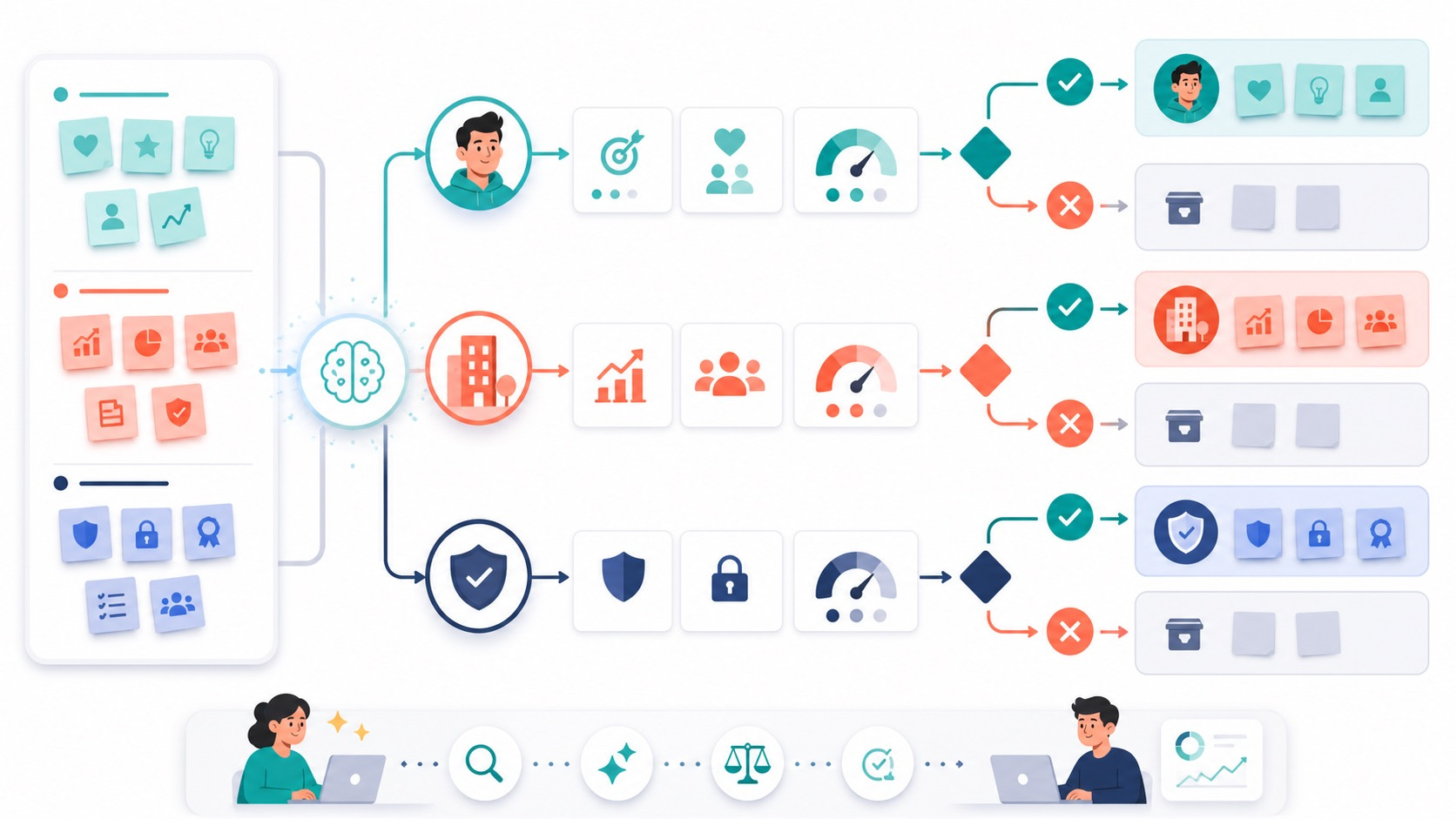
A useful personal branding system routes each message to the place where it builds the most durable trust.
An AI Workflow for Deciding What Goes Where
You can use AI as a decision partner without letting it become the public voice. The workflow is simple: collect raw material, classify trust type, assign the right channel, then turn the message into evidence.
Step 1: Build a raw trust inventory
Open a document and dump the messy material most founders leave scattered across calls, Slack, email, notes, and memory. Include customer questions, objections, founder beliefs, product decisions, lessons from mistakes, testimonials, sales-call language, support patterns, case-study details, investor questions, hiring conversations, and recurring myths in your market.
“Classify the following notes into founder judgment, company proof, customer evidence, team expertise, operational reliability, and audience education. Do not rewrite them yet. Identify which notes are strongest, which are vague, and which need evidence before they should be published.”
This keeps AI in the analyst role. It is helping you sort the trust you already have.
Step 2: Assign each item to a trust home
Use these rules:
Founder profile: beliefs, lessons, decision logic, lived experience, taste, and category interpretation.
Company website: repeatable processes, product facts, customer outcomes, policies, security, pricing, and proof that should not depend on one person.
Company social account: launches, customer education, team expertise, ecosystem participation, product teaching, and public support.
Founder social account: market commentary, stories, principled disagreements, behind-the-scenes decisions, and conversations that need a human point of view.
Owned newsletter or blog: deeper arguments, frameworks, original thinking, and proof-backed teaching that deserves more context than a social post.
If you are a solo consultant, this still applies. You are both the founder and the company. The distinction is not about headcount. It is about whether a message proves your judgment or proves your delivery.
Step 3: Turn founder insight into company evidence
The best founder brands do not just create attention. They create assets the company can reuse. A founder post about a painful customer misconception can become a company FAQ. A founder thread about why your process is different can become an onboarding checklist. A founder story about a mistake can become a public principle.
“Turn this founder insight into three company-grade assets: a customer FAQ answer, a website section, and a support-doc explanation. Keep the factual claims conservative. Mark any claim that needs proof before publication.”
That last sentence matters. AI should not launder founder enthusiasm into unsupported company claims.
When the Founder Brand Should Lead
The founder brand should lead when trust depends on motive, judgment, or category clarity.
That includes early-stage markets where buyers are still learning the problem, expert-led services where clients are buying taste and decision quality, technical products that need category education, and moments like fundraising, hiring, partnerships, or community building.
Founder-led content works best when it is specific enough to be costly. A generic post about “building in public” does little. A post explaining the trade-off you made, what you refused to optimize for, what you learned from a failed experiment, or why a popular industry belief is incomplete gives people something real to evaluate.
Use the founder brand for:
Point-of-view essays that explain how you see the market.
Founder notes that reveal decision quality without oversharing drama.
Lessons from sales calls, customer work, product choices, or hiring mistakes.
Public answers to questions your audience is too polite to ask directly.
Trust-building context before launches, fundraising, partnerships, or category education.
The founder should sound like a person with consequences, not a content calendar.
When the Company Brand Should Lead
The company brand should lead when trust depends on consistency, operations, and proof that survives the founder’s absence.
This is where many founder-led companies underinvest. They get attention, but the company website stays vague. They post smart takes, but the product page cannot explain who it is for. They earn comments, but a buyer looking for proof finds scattered screenshots and recycled claims.
Company brand assets should answer the questions a serious buyer, candidate, partner, journalist, or investor would ask after the founder gets their attention.
Use the company brand for:
Clear positioning: what the company does, for whom, and why it is different.
Proof assets: customer stories, examples, numbers, screenshots, workflows, and before-and-after evidence.
Trust pages: methodology, values in practice, security, responsible AI use, pricing logic, and support expectations.
Team credibility: who else contributes judgment, craft, service, and reliability.
Durable education: explainers that help the market understand the problem without needing the founder to repeat the same points forever.
Edelman’s Trust Barometer has framed trust as a business and leadership issue for years, and its latest research describes a world narrowing into smaller circles of trust. For founders, that means a faceless company page often starts at a disadvantage. But it also means a founder-only brand can become too narrow if the business never earns institutional confidence.
The Founder-Company Flywheel
The right system is a flywheel, not a rivalry.
The founder sees and interprets the market. The company turns the best interpretation into repeatable proof. Customers respond with questions, objections, outcomes, and stories. The founder uses those signals to sharpen judgment. The company packages the strongest proof into assets that reduce future trust friction.

AI can support the flywheel:
Summarize sales-call objections into recurring trust gaps.
Turn founder voice notes into draft posts, then force a human edit.
Convert strong founder posts into website FAQs, customer education, and team documentation.
Compare company claims against proof assets and flag unsupported language.
Scan public profiles for contradictions between founder positioning and company messaging.
The guardrail is simple: AI may draft, sort, compare, and challenge. It should not decide what you believe, invent proof, fake customer language, or smooth away the tension that makes your perspective worth reading.
A Practical Weekly System
If this feels abstract, run the system once a week for 45 minutes.
Minute 1 to 10: Collect raw trust signals. Pull three customer questions, one founder decision, one objection, one proof point, and one market observation.
Minute 11 to 20: Ask AI to classify each item as founder judgment, company proof, shared trust asset, or not ready. Ask it to explain why.
Minute 21 to 30: Pick one founder-led idea and one company-led asset. The founder-led idea might be a short post about a decision. The company-led asset might be a FAQ answer or website section that makes the decision useful to buyers.
Minute 31 to 40: Draft with AI, then edit for specificity. Replace generic phrases with real examples, constraints, customer language, or named trade-offs. If you cannot add evidence, weaken the claim.
Minute 41 to 45: Save the best line, question, objection, and proof point in your personal brand knowledge base. Next week starts faster.
Do this for eight weeks and you will have more than posts. You will have a clearer founder voice, a stronger company explanation, and a better sense of which trust gaps keep repeating.
Common Mistakes to Avoid
Mistake one: making the founder brand a prettier company page. If every founder post says “we launched,” “we are excited,” and “our team is proud,” people learn nothing about the founder’s judgment.
Mistake two: letting AI flatten both voices. If the founder and company sound identical, trust becomes harder to place. Founder voice can be more candid and interpretive. Company voice should be clearer, more precise, and more accountable.
Mistake three: building audience without proof. Visibility without evidence creates suspicion. Every few founder posts should point toward a company asset that proves something real.
The Best Answer Is Usually Both
Founder brand versus company brand is a false choice when the real goal is trust design.
Use the founder brand to make judgment visible. Use the company brand to make delivery believable. Use proof assets to make both harder to dismiss. Use AI to sort, pressure-test, repurpose, and maintain the system, but keep the final judgment human.
The founder does not need to become an influencer. The company does not need to become faceless. The useful middle is a public identity where people can see who thinks, what the business can repeat, and why the proof deserves attention.
That is where trust should live: not in one account, but in a system people can inspect.
FAQ
Is founder brand more important than company brand?
Founder brand is often more powerful early because people trust visible humans faster than unfamiliar logos. Company brand becomes more important as the business needs repeatability, team credibility, and trust that does not depend on the founder always being present.
Should every founder post on LinkedIn?
No. A founder should post when they have useful judgment, credible experience, or market context to share. If posting becomes a generic visibility chore, it can weaken trust. A quieter founder can still build credibility through essays, interviews, product notes, customer education, or a strong personal website.
How can AI help with founder branding without making it fake?
Use AI for sorting notes, finding patterns, drafting options, repurposing founder insights, and checking claims against proof. Do not use AI to invent opinions, fake stories, manufacture expertise, or publish without human review. The founder’s real judgment is the asset.
What should live on the company brand instead of the founder brand?
Company pages should carry product facts, customer proof, methodology, support expectations, pricing logic, security practices, team expertise, and durable educational assets. Anything that needs to remain useful when the founder is offline should eventually become a company asset.
How do I know if my founder brand is becoming a bottleneck?
Look for signs like every sales conversation requiring the founder, every strong explanation living only in founder posts, team members being invisible, buyers lacking proof after they discover you, or the company website feeling weaker than the founder profile. Those are signs that trust needs to move into company assets.
What is the best first step for a founder with no personal brand?
Start with one weekly founder note about a real decision, customer insight, or market belief. Then turn that note into one company asset such as an FAQ answer, product explainer, or proof page. This builds both visibility and infrastructure from the same effort.