


If your LinkedIn profile still reads like a static resume while everyone else is flooding the feed with generic AI polish, you have an opening. The winning profile in 2026 is not louder. It is clearer, more specific, and easier to trust.

LinkedIn changed the conversation for founders on May 12, 2026. The company announced new business tools and explicitly framed Premium Business profiles as a way to move from a resume-focused profile to a founder-led one. That language matters because it confirms what many professionals already feel: a job-history page is no longer enough if you want your public identity to create trust, inbound interest, or market authority.
At the same time, the platform has a credibility problem. Reddit threads from founders, B2B marketers, and LinkedIn users keep repeating the same complaints: too many templated posts, too many suspicious comments, too many profiles that look optimized but not believable. Tech coverage this week added another layer, reporting that LinkedIn is tightening its stance against low-value AI slop in posts and comments. In other words, the platform is telling you two things at once: build your presence, but do not outsource your brain.
That tension creates a real opportunity for founders, consultants, creators, and operators. Most people are using AI to increase output. Very few are using it to increase clarity. A founder-led LinkedIn profile wins when it helps a stranger answer five questions fast:
What do you actually do?
Who do you help?
Why should anyone trust you?
What have you seen firsthand?
What should someone do next if they want to learn more?
This article is a practical system for building that kind of profile without sounding like another AI-assisted clone.
Why this topic matters now
Two trend lines collided this month. First, LinkedIn said founder growth in the United States is up roughly 70% year over year. Second, more founders are trying to use AI to scale their personal brand faster. The result is predictable: more competition for attention and more sameness in the way people describe themselves.
The next moat in personal branding is not volume. It is recognizability. If someone removed your name from your profile summary, would the writing still sound like you?
That question sits at the center of the content gap I found while researching this piece. There is plenty of content about “founder-led marketing” and plenty of content about “using AI on LinkedIn.” There is much less practical guidance on turning a founder profile into a credible public asset while avoiding the exact signals that now make readers tune out: generic hooks, inflated claims, polished emptiness, and outsourced opinions.
Reddit discussions also reveal a sharper intent than most blog posts address. People are not only asking how to get more reach. They are asking:
How do I generate leads on LinkedIn without looking like a spammer?
How much time should a founder really spend on LinkedIn?
How do I make my profile feel credible if I am early-stage or unknown?
How do I use AI without making my content and comments look fake?
Those are better questions. They point toward trust, not vanity. So that is the frame to use.
What a founder-led LinkedIn profile actually is
A founder-led LinkedIn profile is not just a founder profile with more posts. It is a public credibility system built around your judgment. Your profile should make it obvious how you think, what problem you are close to, and where your authority comes from.
That means a strong founder-led profile does three jobs at once:
It converts profile visits into trust.
It turns your experience into visible proof of work.
It gives your future posts, comments, interviews, and DMs a stronger landing page.
Most weak profiles fail because they are trying to sound impressive instead of reducing uncertainty. They say things like “building the future,” “helping businesses scale,” or “passionate about innovation.” None of that helps a high-intent visitor understand whether you are relevant to their problem.
A better standard is this: after 15 seconds on your profile, a useful stranger should be able to repeat your niche, your edge, and your evidence in one sentence.
The 7-part founder profile system
1. Rewrite the headline like a positioning statement
Your headline is not the place for vague ambition. It is the place for precise context. A good founder headline usually includes your role, who you help, and the category or outcome you are known for.
Weak: “Founder | Builder | AI | Growth”
Stronger: “Founder helping B2B SaaS teams turn technical expertise into founder-led pipeline on LinkedIn”
If you use AI here, use it for compression, not invention. Ask it to generate five clearer versions of your existing positioning, then choose the line that sounds most like something you would actually say out loud.
2. Turn the About section into a credibility narrative
Your About section should not read like a corporate bio. It should answer three things in order: what you are working on, what experience shaped your perspective, and what problem you care enough to keep discussing publicly.
Think in this structure:
Present: what you are building or solving now
Backstory: the pattern or frustration that made you care
Proof: results, clients, research, shipped work, or category insight
Invitation: what kinds of people or conversations you want more of
This is where founders often overuse AI and flatten their story. The safer workflow is to voice-note your real origin story first, transcribe it, and then use AI to cut repetition, surface stronger verbs, and remove filler. Keep the raw observations. Delete the buzzwords.
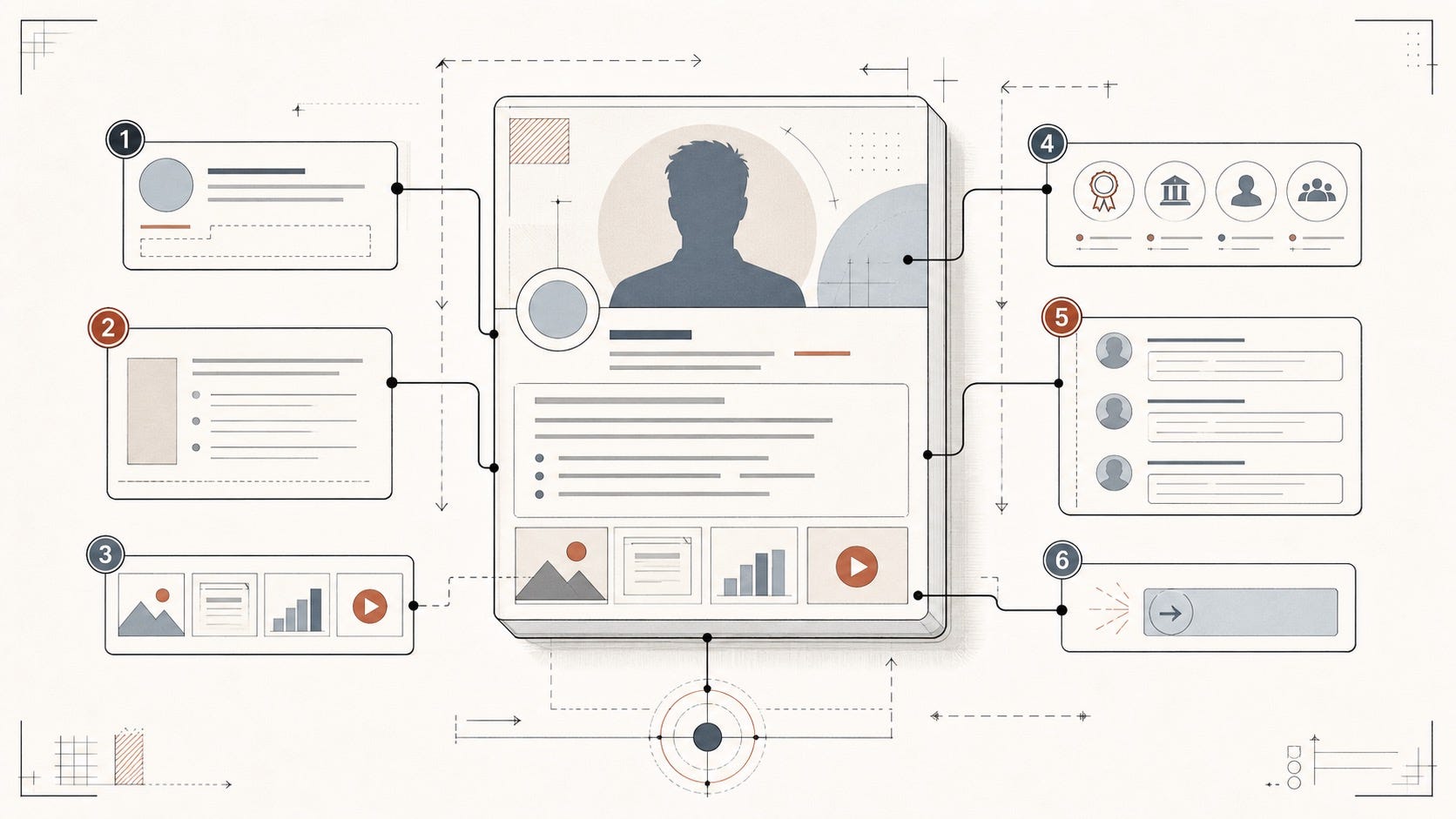
3. Use the Featured section as a proof shelf
This is where a founder-led profile stops being theoretical. Do not fill the Featured section with random reposts or generic company links. Feature assets that show the way you think or the results you can point to.
Good Featured items include:
A useful article with a clear point of view
A teardown, framework, or case study
A product demo, interview, or founder note
A talk, podcast, or workshop clip
A customer result, operator memo, or industry analysis
If you are early-stage and feel like you have “nothing to show,” feature thoughtful process, not fake certainty. A market map, a niche breakdown, a pattern you are noticing, or a short lesson from real conversations can still act as proof of seriousness.
4. Add trust signals that reduce guesswork
Visitors should not have to hunt for legitimacy. Make the trust signals easy to find: specific outcomes, named domains you understand, relevant communities, speaking history, certifications only if they matter, and work samples that show taste or technical depth.
AI can help you inventory these faster. Paste your old bios, proposals, notes, and posts into a model and ask it to extract every concrete credibility signal you have already mentioned. Then pick the strongest ones. The point is not to inflate your story. The point is to stop hiding your evidence in scattered places.
5. Make your profile usable for conversation, not just browsing
A profile that gets visited but does not start conversations is unfinished. Your call to action should fit your real business stage. If you sell consulting, you may want a direct invitation to talk. If you are an early founder, you may want to invite peer conversations, pilots, or operator feedback. If you are a creator, you may want readers to follow a specific series or subscribe to a newsletter.
The mistake is forcing every profile into a hard pitch. The better move is to make the next step obvious and low-friction.
6. Build a comments strategy, not just a posting strategy
One of the clearest signals from Reddit was that thoughtful comments and non-pitch DMs still feel more human than polished posts. That matters because profile strength and comment quality reinforce each other. A sharp comment gets someone curious. A clear profile converts that curiosity into trust.
For many founders, this is the highest-return workflow:
Two strong public posts per week
Five to ten thoughtful comments on relevant conversations
One hour each week updating proof assets, examples, and featured links
That is enough to build visible presence without becoming a full-time content machine.
7. Use AI as an editor, not a ventriloquist
The fastest way to weaken a founder-led profile is to let AI generate your identity from scratch. The better use case is narrower and more valuable. Use AI to:
Find repeated phrases and trim them
Turn long explanations into punchier versions
Extract proof points from messy notes
Offer alternative headlines and calls to action
Pressure-test whether your profile is too broad or too vague
Do not use AI to manufacture opinions you have not earned. Readers can feel the difference. Increasingly, platforms can too.
A practical AI workflow that keeps your voice intact
If you want a clean repeatable process, use this one:
Step 1: Record a five-minute voice note answering what you do, who you help, what you have learned, and what frustrates you about your market.
Step 2: Transcribe it and highlight the lines that sound unmistakably like you.
Step 3: Feed the transcript to AI and ask for a tighter headline, About section, and proof-point list using your exact ideas only.
Step 4: Remove anything you would never say in a real conversation.
Step 5: Add one or two specific examples that only you could provide.
Step 6: Ask a friend, colleague, or customer which line sounds most true and which line sounds generic.
This workflow matters because it starts with lived material. AI is better when it edits raw signal than when it fills an empty page.
The biggest mistakes founders are making right now
The first mistake is confusing professional polish with credibility. Plenty of profiles look expensive and still feel anonymous.
The second mistake is treating the profile like a static page while spending all energy on post templates. If your posts create curiosity but your profile does not resolve it, you lose the trust you just earned.
The third mistake is over-automating comments and engagement. LinkedIn has already published guidance around authentic conversations and automated comments. Even when automation “works,” it can quietly make your identity feel rented instead of real.
The fourth mistake is hiding behind company language. Founder-led does not mean self-centered. It means the reader can tell a real person is accountable for the perspective on the page.

How to know your profile is working
Do not judge success only by follower count. A founder-led profile is working when better conversations start happening around it.
Look for signals like these:
People mention a specific idea from your profile or featured work
DMs get more relevant and less random
Prospects or partners describe your niche in the same language you use
Podcast, speaking, hiring, or collaboration requests become more aligned
Your posts attract fewer empty compliments and more detailed replies
That is the real goal. Not attention at any cost. Recognition with the right people.
FAQ
Should founders use AI to write their LinkedIn profile?
Yes, but only as an editor or structuring tool. Start from your own voice notes, stories, and examples. Use AI to tighten wording, organize proof, and test clarity, not to invent a personality for you.
What is the difference between a founder-led LinkedIn profile and a normal LinkedIn profile?
A normal profile often reads like a work history. A founder-led LinkedIn profile is built to communicate market point of view, public credibility, and a clear invitation for conversation. It acts more like a trust page than a resume page.
How often should a founder post on LinkedIn in 2026?
For most people, two strong posts per week plus regular thoughtful comments is enough. The better benchmark is whether your activity creates real conversations and profile visits from the right audience, not whether you post daily.
How do I make my LinkedIn profile look less AI-generated?
Use more specifics, fewer slogans, and more proof. Replace vague claims with examples, observations, numbers, lessons, or visible work. Read every section out loud. If it sounds like anyone in your category could have written it, keep editing.
What should founders feature on LinkedIn if they do not have big wins yet?
Feature useful thinking. Share process breakdowns, category notes, customer patterns, operator lessons, or product reasoning. Early-stage credibility comes from clarity and seriousness, not from pretending you already have scale.
Can a founder-led LinkedIn profile help with leads even before posting a lot?
Yes. A stronger profile improves the quality of every profile visit that comes from comments, DMs, referrals, podcasts, events, or search. It does not replace outreach, but it makes your outreach easier to trust.
If the AI era is making every profile sound smoother, your edge is not to sound smoother too. It is to sound more legible, more specific, and more accountable. Build a profile that feels like a real person with a real point of view, and the right audience will notice the difference faster than any growth trick can manufacture it.