


The fastest-growing problem in the fractional market is not visibility. It is trust. Here is how real operators can use AI to sharpen their positioning, package proof, and stand out from title inflation.
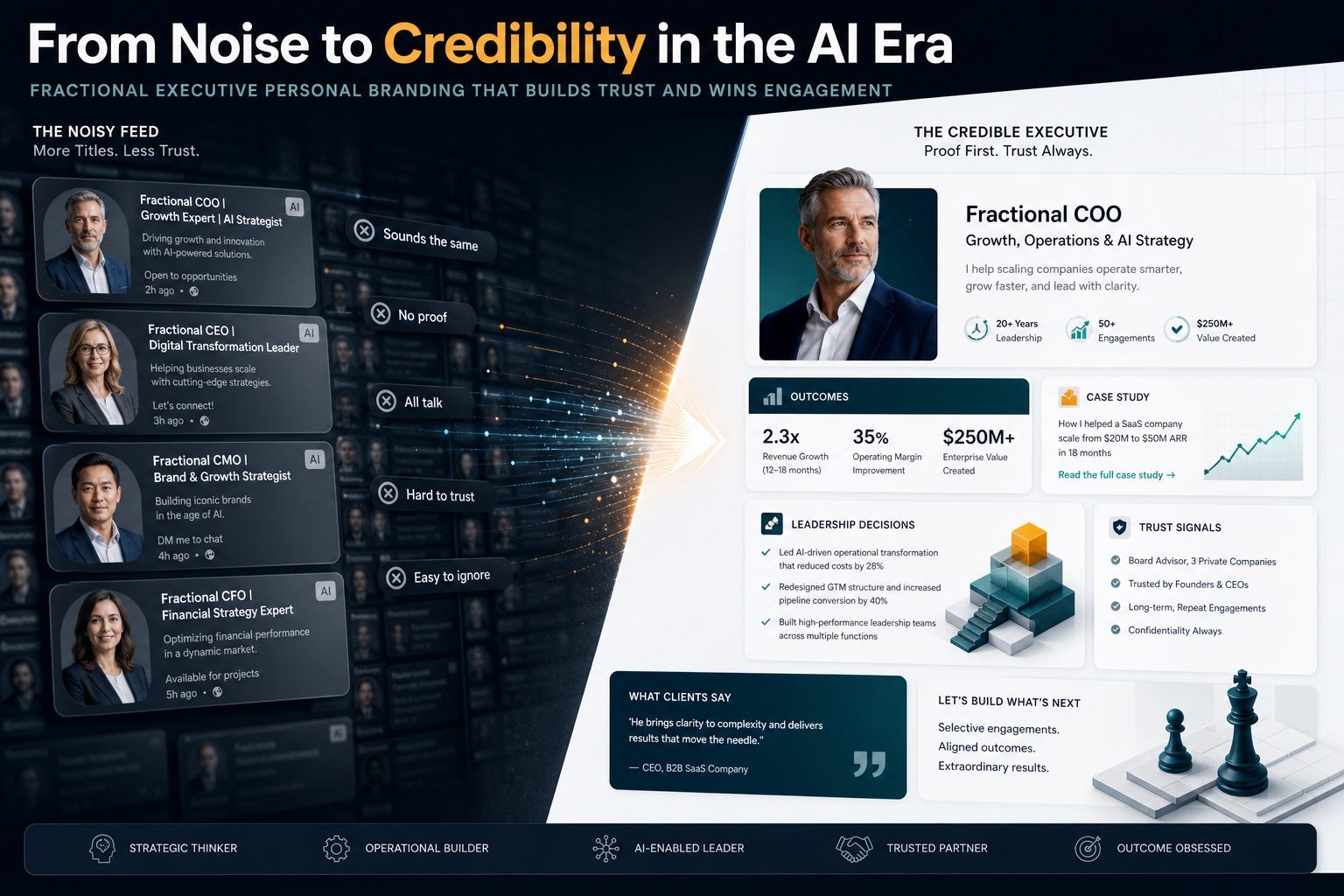
In a crowded fractional market, better claims do not win. Better proof does.
There are now plenty of people calling themselves a fractional COO, fractional CMO, or fractional chief of staff. Some are excellent. Some are repackaged consultants with a new title. Some are smart operators using AI to clarify their message. Others are using AI to inflate it.
That is the real search intent behind fractional executive personal branding now. Founders are not asking, “How do I look more polished?” They are asking, “How do I tell who is real?” If you work in this space, that means your personal brand cannot rely on title-first positioning anymore. It has to become evidence-first.
The opportunity is good news for serious operators. When the market gets noisy, credibility compounds. A founder who sees ten vague profiles and one precise, proof-backed profile will remember the precise one. A recruiter, investor, or portfolio CEO comparing several candidates will trust the person whose brand makes decisions, outcomes, and operating style visible.
This is where AI becomes useful. Not as a machine for manufacturing authority, but as a tool for extracting what is already true, organizing it, and adapting it across platforms without making you sound like everyone else.
Why the Fractional Executive Market Suddenly Feels Harder
Fractional work is attractive for obvious reasons. Companies want senior leadership without the cost or commitment of a full-time executive. Experienced operators want a more flexible portfolio career. That creates demand, but it also creates skepticism.
Look at the current search landscape and community discussions around fractional roles and you see the same pattern: lots of advice on networking, lots of general LinkedIn tips, and not enough guidance on how to prove you are more than a headline. That gap matters because founders do not hire a fractional executive for inspiration. They hire for judgment, execution, and speed.
If your online presence looks interchangeable, the buyer fills in the blanks with risk. Risk that you are a generalist. Risk that your wins were team wins you cannot repeat. Risk that you know the language of leadership better than the work of leadership.
In crowded expertise markets, vague branding reads as self-protection. Specific branding reads as competence.
That is why the best fractional executive personal branding does three things at once:
It narrows your lane so the right buyer can identify fit fast.
It makes outcomes visible instead of implied.
It uses AI to scale consistency, not to fake depth.
Start With a Smaller Claim, Not a Bigger One
The weakest personal brands in the fractional market usually begin with broad ambition. “I help companies grow.” “I drive transformation.” “I unlock scale with AI.” None of these statements are false, but none of them help a buyer make a decision.
A stronger move is to claim less and prove more. Instead of leading with a generic fractional title, lead with the narrow operating problem you solve in a repeated context.
Examples of stronger positioning:
Fractional COO for founder-led SaaS teams stuck between $2M and $10M ARR.
Fractional CMO for B2B firms that have pipeline but weak category positioning.
Fractional chief of staff for CEOs managing post-fundraise operating chaos.
This is not niche theater. It is trust acceleration. Specificity tells the buyer you have pattern recognition. It also makes your AI workflow better, because AI can only help you sharpen a message that already has boundaries.
A simple prompt that works well here is: “Based on these five engagements, what repeatable operating problem do I solve better than most peers, and what proof is strongest for it?” Feed the model your own notes, not generic templates. You want language extracted from real work, not invented positioning.
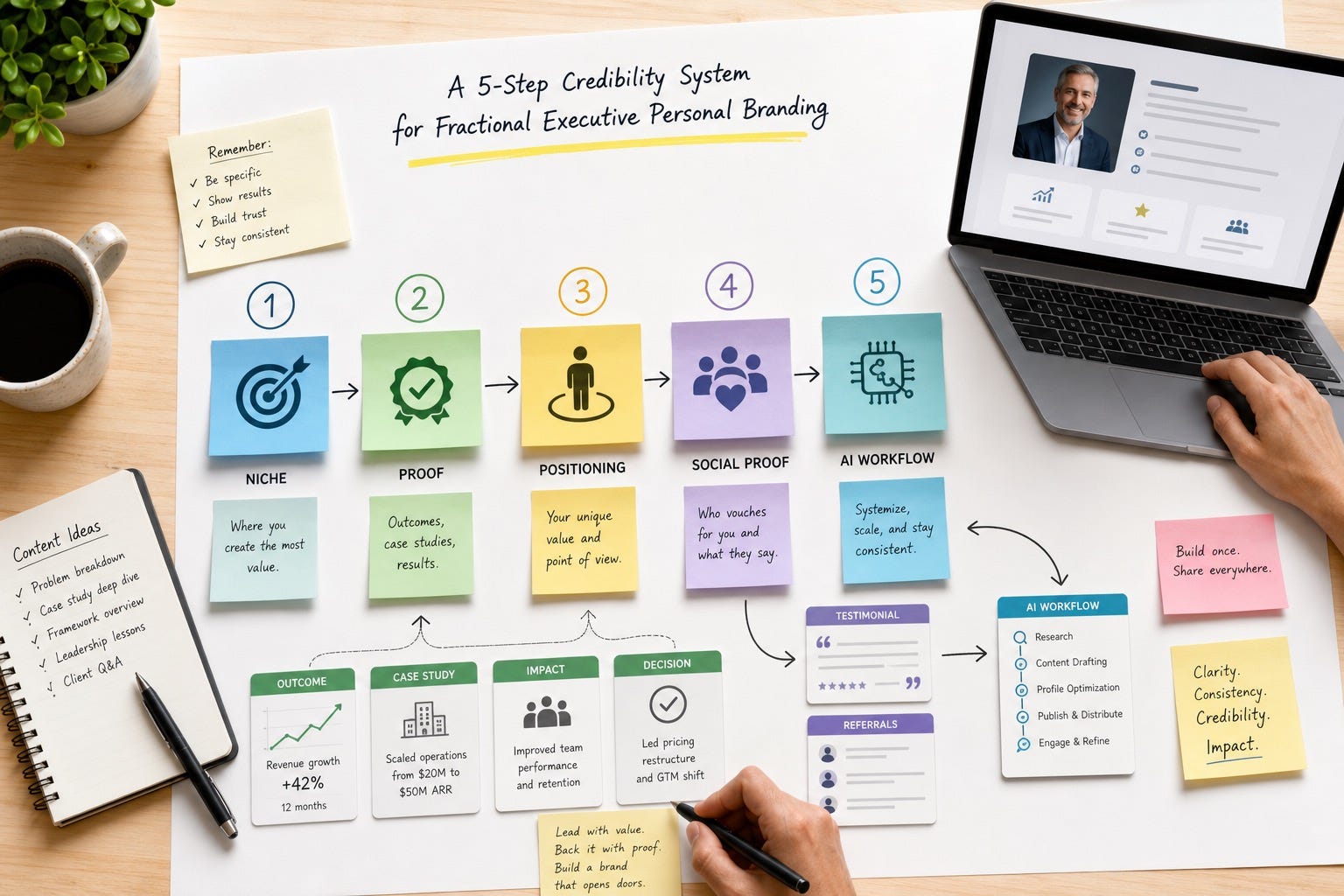
A credible fractional brand is usually built in the same sequence: niche, proof, positioning, social proof, then AI-supported consistency.
Build a Proof Stack That Makes Your Title Believable
Your title is only a hook. Your proof stack is the case.
For a fractional executive, the minimum proof stack should answer five buyer questions:
What kind of company have you helped?
What changed because you were there?
What decisions did you personally drive?
Who can vouch for your judgment?
How do you work when information is incomplete?
Most people have enough material for this already. They just have it trapped in private decks, Slack messages, old board notes, and memory. AI is useful because it can help you extract the raw evidence and turn it into portable brand assets.
For example, a messy set of weekly updates can become a concise case-study block. An old board memo can become a “decision I led” paragraph. A client thank-you note can become a testimonial that shows how you operate under pressure. When buyers can see the chain from problem to decision to result, they stop evaluating whether your title sounds impressive and start evaluating whether your judgment feels dependable.
Your proof stack might include:
A one-line outcome bank with quantified wins.
Three short case studies focused on decisions and constraints.
A testimonial set that highlights judgment, not personality alone.
A “how I work” note covering cadence, scope, and leadership style.
A short list of repeatable scenarios where you create disproportionate value.
Notice what is missing: motivational slogans, inflated mission language, and vague strategy talk. Founders hire fractional leaders to reduce ambiguity. Your brand should do the same.
Use LinkedIn Like an Evidence Page, Not a Billboard
LinkedIn is still the first place many buyers will check, but the common mistake is treating it like a digital business card. For fractional executive personal branding, it works better as an evidence page with a clear operating thesis.
Your headline should combine role, lane, and context. Your About section should explain the business situation you enter, the decisions you typically make, and the outcomes you usually influence. Your Featured section should act like a credibility menu, not a dumping ground.
A practical structure looks like this:
Headline: role plus specific scenario.
About: what breaks, what you fix, how you work, what proof exists.
Featured: one case study, one insight post, one proof asset, one speaking or interview clip if relevant.
Experience: fewer generic bullets, more decisions and outcomes.
AI can help you tailor each section, but only after you define the source material. Ask it to reduce repetition, surface stronger verbs, and preserve your own language patterns. Do not ask it to “make me sound more executive.” That request usually produces the exact sameness you are trying to escape.
Turn AI Into a Credibility Editor, Not a Reputation Costume
This is the line that matters. AI should edit for clarity, structure, and adaptation. It should not manufacture conviction you do not have.
A trustworthy AI workflow for personal branding usually has four stages:
Capture raw material from voice notes, meeting reflections, case-study notes, and client feedback.
Extract patterns, outcomes, phrases, and decision logic.
Adapt the material for LinkedIn, email intros, bios, proposals, and articles.
Review every output for specificity, tone, and truthfulness.
The fastest self-check is simple. If a sentence could fit almost any ambitious consultant on LinkedIn, cut it. If it reveals a judgment call, a tradeoff, a number, or a repeatable situation, keep it.
A useful editing prompt:
“Tighten this profile copy for a founder evaluating a fractional executive. Remove cliches, surface evidence, keep my tone direct, and flag any sentence that sounds inflated or generic.”
This is also where ethics matter. If you use AI to draft, disclose when disclosure is relevant. If you use AI avatars or synthetic media, make sure the rest of your brand contains enough real proof that trust does not depend on production polish. A convincing style without visible substance creates the wrong kind of curiosity.

A strong personal brand gives buyers a sequence of trust checkpoints, not one polished impression.
Create a Cross-Platform Credibility Loop
The best personal brands for fractional executives do not rely on constant posting. They rely on repeatable credibility loops.
One client engagement can produce multiple trust assets:
A private debrief becomes a short lesson post.
A before-and-after operating story becomes a case study.
A repeated founder question becomes a FAQ answer.
A decision framework becomes a carousel, memo, or short article.
A client quote becomes a contextual testimonial, not just praise.
AI helps by making repurposing faster, but the credibility loop only works if every output points back to the same core identity. That identity should stay stable across LinkedIn, your website, guest appearances, email intro, and newsletter bio.
This is where many strong operators undersell themselves. They think consistency is vanity. It is not. Consistency is how the market learns what to remember you for.
A Weekly Operating System for Fractional Executive Personal Branding
You do not need to become a full-time creator. You need a lightweight system that captures signal while your work is still fresh.
Try this weekly rhythm:
Monday: write down one operating problem you saw clearly last week.
Tuesday: ask AI to extract the decision, the tradeoff, and the lesson.
Wednesday: turn that into one post, one case-study note, or one FAQ answer.
Thursday: update one proof asset on LinkedIn or your site.
Friday: save one client phrase, result, or objection into your proof library.
Over time, this creates a compounding asset base. You stop trying to “look credible” from scratch. You start documenting credibility as a byproduct of real work.
That also changes how buyers experience you. Instead of seeing an executive title and wondering what is behind it, they see a consistent pattern of problems solved, decisions made, and outcomes delivered.
The Real Goal Is Legibility
The highest-performing personal brands are not always the loudest ones. They are the most legible.
A founder should be able to land on your profile and understand, within seconds, who you help, what changes under your leadership, and why your judgment is credible. If AI helps you make that clearer, use it. If AI makes you more abstract, more polished, or more interchangeable, it is hurting you.
That is why fractional executive personal branding is not really about optics. It is about reducing uncertainty. In a market full of inflated positioning, the person who makes truth easiest to verify usually wins.
FAQ
What is fractional executive personal branding?
It is the way a fractional COO, CMO, CFO, chief of staff, or other part-time leader presents expertise, proof, and trust signals across LinkedIn, websites, bios, and content so buyers can evaluate credibility quickly.
How can AI help a fractional executive build a personal brand?
AI is best used to extract patterns from past work, tighten messaging, repurpose proof across platforms, and remove generic phrasing. It should support clarity and consistency, not invent authority.
What should a fractional executive put on LinkedIn?
Focus on role clarity, a narrow operating lane, quantified outcomes, short case studies, testimonials tied to judgment, and a Featured section that shows how you think and what results you create.
How do fractional executives avoid sounding generic?
Use fewer broad claims and more specifics. Name the company stage, the recurring problem, the decisions you make, and the measurable changes you influenced. Generic language is usually a sign that proof has not been packaged yet.
Do fractional executives need to post constantly to build credibility?
No. Consistency matters more than volume. A small system that turns real operating work into reusable proof assets is usually more effective than frequent opinion posts with no evidence behind them.
What is the biggest mistake in AI personal branding for executives?
The biggest mistake is using AI to sound more impressive instead of more understandable. When AI makes your message feel inflated or interchangeable, trust drops even if the writing looks polished.
Search intent: informational, trust-focused, and buyer-evaluation oriented. Primary keyword: fractional executive personal branding.