



The real win is not chasing a vanity box in Google. It is building such a clear public identity that search engines and AI tools stop guessing who you are.
Most personal branding advice still assumes your biggest problem is visibility. Post more. Publish more. Be louder. Build a content machine. That advice breaks down fast when Google, ChatGPT, LinkedIn, and AI search systems are trying to assemble your reputation from dozens of scattered signals at once.
The problem is not only that people do not know you. The problem is that machines do not understand you. If your website says one thing, your LinkedIn says another, your podcast bio uses a third version, and your best proof lives in random corners of the web, you do not look like one expert identity. You look like fragments.
That is why the Google Knowledge Panel question matters. Not because everyone needs a panel tomorrow, and not because Google guarantees one if you follow a checklist. It matters because a panel is one of the clearest signs that the web is beginning to agree on who you are, what you do, and why your name belongs to a specific body of work.
Useful framing: a knowledge panel is not the product. It is the byproduct of clear identity, aligned proof, and repeated corroboration across trusted surfaces.
Why This Matters More In The AI Search Era
On May 19, 2026, Google used I/O to push Search further toward AI-native experiences. That shift matters for personal branding because AI search does not evaluate your presence like a human browsing ten blue links. It tries to synthesize who you are from multiple signals, then present a coherent answer.
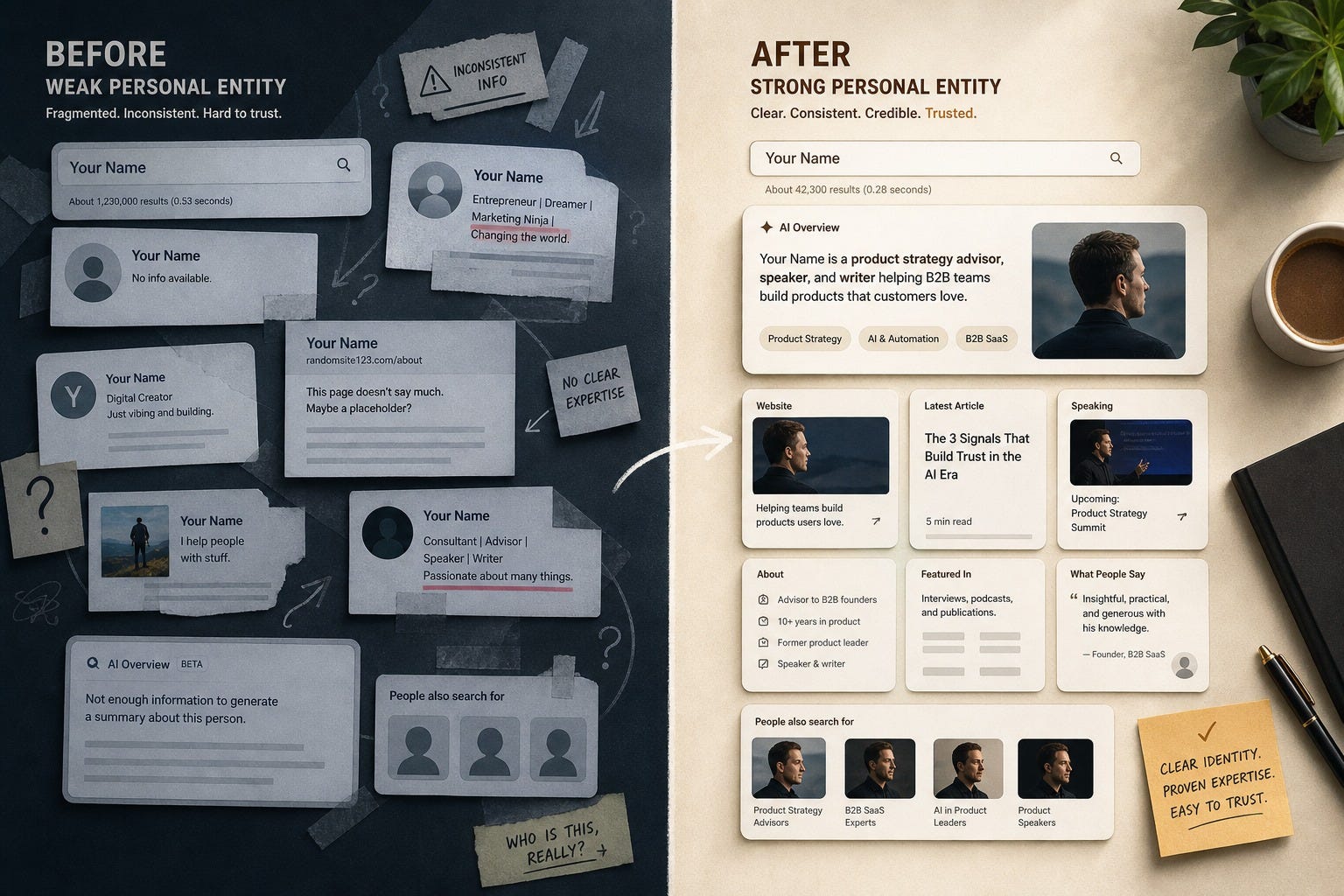
If those signals are weak, inconsistent, or shallow, your personal brand becomes hard to trust. You may still rank for your name, but the search experience feels random. A LinkedIn page here. A stale speaker bio there. Maybe an old conference listing. Maybe a podcast page that explains you better than your own site.
Strong personal branding in AI search is not just about discoverability. It is about machine-readable credibility. The cleaner your public identity becomes, the easier it is for Google and other AI systems to connect your name, expertise, proof, and relevant work into something usable.
What A Knowledge Panel Actually Signals
People often treat the Google Knowledge Panel as a celebrity feature. That misses the point. For a professional personal brand, it signals four deeper things:
Your name is connected to a distinct entity, not just a generic string of text.
Multiple public sources support a consistent description of who you are.
Your work is legible enough for machines to connect profiles, websites, publications, and mentions.
Your authority is grounded in visible proof, not only self-description.
Google’s own documentation is blunt about this. Knowledge panel information is generated automatically from public information on the web. Claiming a panel does not force Google to create one. It mainly helps verified representatives suggest edits and corrections if a panel already exists.
That detail is useful because it keeps you focused on the right job: building a coherent entity footprint, not hunting for a shortcut.
Why Most Personal Brands Never Get Close
Most professionals do not fail because they lack talent. They fail because their public identity is too messy for both humans and machines to interpret quickly.
Here are the common problems:
Inconsistent naming: different versions of your name across social profiles, bylines, speaker pages, and domains.
Inconsistent positioning: strategist in one place, operator in another, creator somewhere else, with no unifying theme.
Weak proof: lots of claims, not enough visible work, outcomes, case studies, citations, or third-party mentions.
Broken entity connections: no clear links between your site, social profiles, authored content, and public appearances.
Overreliance on AI-generated blur: polished words that say almost nothing specific.
This is also why generic AI personal branding often backfires. It can make everything look cleaner while making nothing more believable.
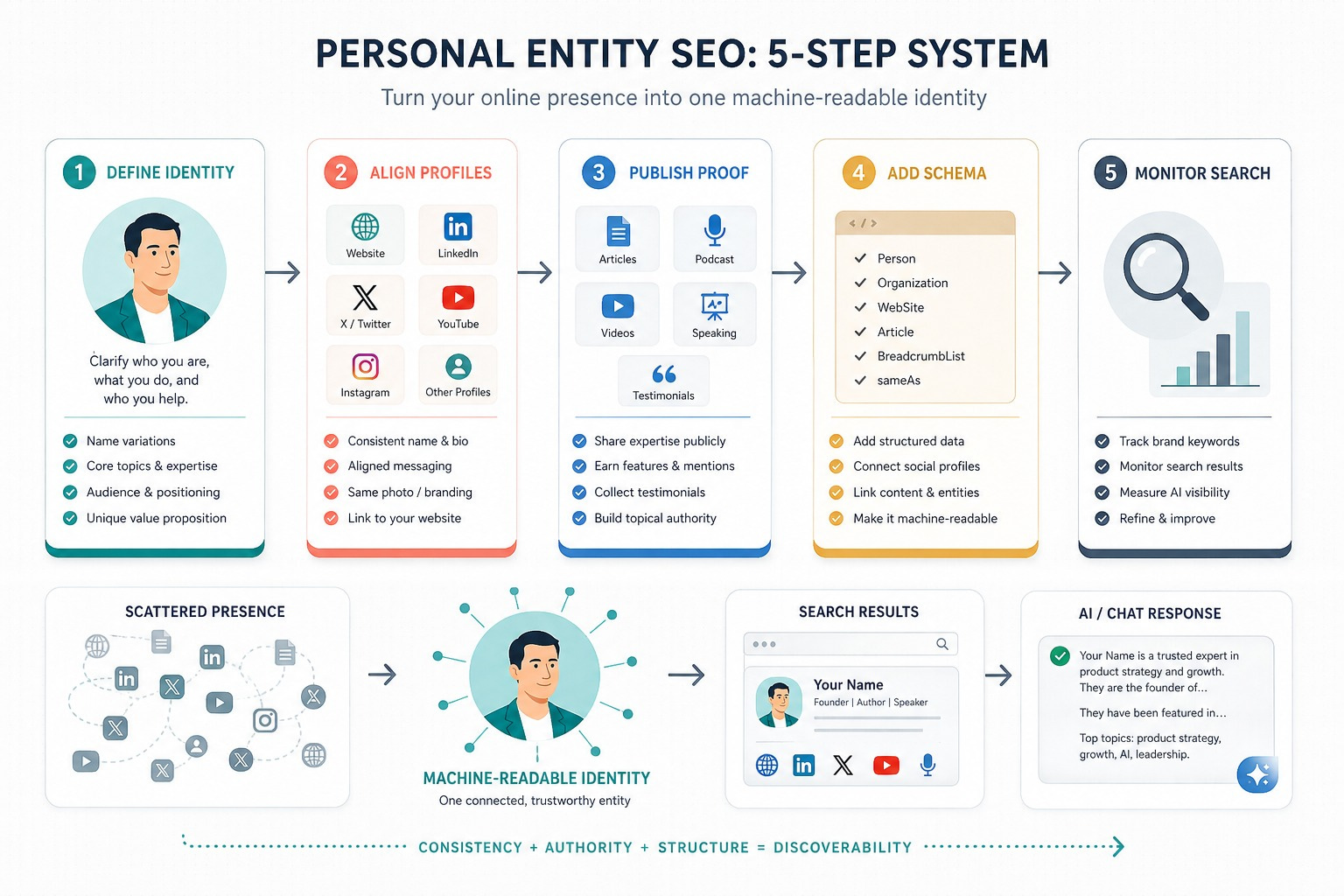
The Five-Layer Personal Entity SEO System
If you want a stronger Google presence around your name, think like an entity architect. Your goal is to reduce ambiguity and increase corroboration.
1. Define One Clear Identity Sentence
Before you optimize any profile, write one plain sentence that answers three questions: who are you, what do you help with, and what body of work proves it? This becomes the anchor for your website, LinkedIn, speaker bios, guest intros, and press responses.
A weak version sounds like this: “I’m passionate about innovation and helping people succeed.” A strong version sounds like this: “I help B2B founders turn complex AI products into clear market narratives, backed by product launches, keynote talks, and advisory work.”
Use AI here as a sharpening tool, not an author. Feed it your projects, wins, themes, and audience. Ask it to find recurring nouns, verbs, and proof patterns. Then rewrite the output until it sounds like you.
2. Align Every Major Profile Around That Identity
Your LinkedIn headline, website About page, speaker bio, author bio, and guest podcast intro should not be identical, but they should agree. Search systems do not need perfect repetition. They need consistent interpretation.
That means:
the same name format
the same core expertise themes
the same recognizable profile image family
clean links back to your main site or central profile
If you want an AI workflow, export the copy from your key profiles into one document and ask AI to flag contradictions, vague terms, and category drift. Then standardize the foundations before you chase more exposure.
3. Publish Proof, Not Just Positioning
Google cannot trust a personal brand that only self-describes. You need public artifacts that support the identity you claim. That may include authored articles, podcast appearances, keynote pages, research breakdowns, open-source work, case studies, testimonials, or interviews.
Proof is what turns “I do strategy” into visible evidence that you have actually done strategy. This is where many founders and consultants should publish less but publish better. One excellent article with a real framework can do more for entity clarity than twenty generic posts.
Ask yourself: if someone searched my name today, what three pages would make my expertise obvious in under thirty seconds? If you do not like the answer, that is the next asset queue.
4. Add Machine-Readable Structure
This is where structured data matters, but only as part of a larger system. Google Search Central explicitly says structured data helps Google understand page content and that some markup can help Search understand profile pages and the people or organizations they represent. It also says structured data does not guarantee a particular search feature.
That is the right mindset. Add structure because it reduces ambiguity, not because it is a magic switch.
At a minimum, your core website should make it easy to connect:
your real name
your core role and expertise
your website profile page
your key social profiles
your authored work or featured appearances
If you have a website, use AI to audit your page structure and markup gaps, then validate whatever gets added with Google’s own testing tools. Clean markup will not create authority, but messy markup can make a clear identity harder to parse.
5. Earn Corroboration From Other Trusted Sources
A personal brand becomes more legible when others describe you in ways that match your own positioning. This is why podcast guest pages, conference bios, industry directories, media quotes, bylines, and reputable mentions matter. They do not have to be huge publications. They have to reinforce the same expert identity.
The key is not volume. It is consistency. Ten mismatched mentions create noise. Three aligned mentions on relevant surfaces create signal.
A Simple AI Workflow To Build This Faster
Here is a practical workflow you can run in one focused weekend and then maintain monthly.
Search your name in Google, LinkedIn, and your AI tool of choice. Save the top results and note where the story feels inconsistent.
Collect your bios, headlines, About page copy, speaker intros, and author blurbs in one document.
Ask AI to extract repeated expertise themes, contradictions, vague phrases, and unsupported claims.
Rewrite your identity sentence, then update your top five public surfaces.
List your best proof assets and decide what is missing: one flagship article, one case study, one interview page, one testimonial block, one profile page.
Use AI to turn raw notes, transcripts, and client language into first drafts, but keep your final judgment visible.
Review monthly for drift. If new profiles or bios start describing you differently, fix them early.
Important: if a knowledge panel eventually appears, treat it as feedback that your public identity is becoming coherent. If it does not appear yet, the work still pays off because your search results, AI summaries, referrals, and audience trust all get better.
What To Avoid
Do not manufacture fake authority signals. Do not stuff keywords into bios. Do not invent credentials. Do not let AI write five different identities for five different platforms. And do not confuse “claim this knowledge panel” with “create my panel.” Google’s own help center makes clear that panels are generated automatically and that verified feedback mainly helps with accuracy once a panel exists.
The highest-leverage move is almost always the least flashy one: make the web tell the same truthful story about you again and again.
The Real Goal
If you build your personal brand well, the result is bigger than one search feature. Your website gets clearer. Your LinkedIn gets sharper. Your guest bios get stronger. Your speaking page becomes easier to trust. AI tools quote you more accurately. Search results stop feeling accidental.
That is what strong personal branding looks like now. Not more noise. More coherence.
FAQ
Can I create a Google Knowledge Panel for myself on demand?
No. Google says knowledge panels are generated automatically from public information on the web. You can claim and help manage a panel if one exists, but you cannot manually request that Google create one as a guaranteed feature.
Does claiming a knowledge panel improve my personal brand?
Claiming can help you suggest corrections, add certain profile information, and manage feedback if a panel already exists. It does not replace the deeper work of identity alignment, proof publishing, and authority building.
What is the difference between personal brand schema and a knowledge panel?
Schema is structured information you add to your site to help machines understand content and entities. A knowledge panel is a search surface Google may generate when its systems have enough confidence in the entity and supporting information. Schema can help reduce ambiguity, but it does not guarantee the panel.
What are the best proof assets for founders and consultants?
The best assets are public pages that make your expertise obvious fast: strong About pages, case studies, authored articles, podcast guest pages, keynote pages, media mentions, and testimonials tied to real outcomes.
Can AI help with Google Knowledge Panel personal branding without making me sound generic?
Yes, if you use AI for analysis, extraction, outlining, and consistency checks rather than letting it invent your positioning. The safest workflow is to feed AI your real work, wins, transcripts, and client language, then keep the final phrasing under human control.
How long does it take for Google to understand a stronger personal entity?
There is no fixed timeline. Google’s systems need to crawl, connect, and trust the signals they find. In practice, improvements to branded search clarity can show up before any formal panel does, especially once your core pages and profiles stop contradicting each other.