



The next career advantage is not posting more online. It is building a clear reputation inside the rooms where opportunities are decided.
You can do excellent work and still be misread.
Your manager may remember the crisis you handled, but forget the pattern behind it. A senior leader may see the final dashboard, but not the messy judgment that made it useful. A promotion committee may hear that you are “reliable,” but not understand that reliability saved the team three weeks, protected a client relationship, or made a risky launch calmer.
This is why personal branding at work matters. Not the performative version. Not the version where every meeting becomes a stage and every LinkedIn update sounds like a press release. The useful version is simpler: become known, by the right people, for the work you want more responsibility to do.
AI changes the workflow because it can help you capture scattered evidence, translate work into clearer impact, prepare better updates, and notice reputation gaps before they become career problems. But AI should not invent your brand. It should help you see the real one more clearly.
The Problem: Good Work Is Often Too Quiet
People rarely make career decisions from a complete record. They make them from memory, recent examples, repeated signals, and what trusted people say when you are not in the room. That is uncomfortable, but it is also practical. No manager has perfect visibility into every decision, tradeoff, fix, customer save, analysis, mentoring moment, or piece of operational judgment you produce.
Reddit career threads show the tension clearly. Professionals ask whether regular employees really need personal branding, whether visibility rewards self-packaging over skill, and how to get promoted without looking political. In one recent r/careerguidance discussion, the poster framed the exact fear: personal branding can feel like “bragging” or “a distraction from actual work,” while quiet employees may end up overlooked. In another promotion thread, people traded stories about what actually got them promoted: reliability, visible impact, manager trust, and work that influential people could remember.
The search results tell the same story. Guides from the Center for Creative Leadership, Harvard Business School Online, and career publishers explain that self-promotion can be professional when it makes contributions visible instead of obnoxious. The gap is not “should you talk about your work?” The gap is how to do it in a way that feels accurate, ethical, and repeatable in an AI-shaped workplace.
Internal personal branding is the discipline of making your real contribution easier to notice, understand, remember, and repeat.
Why AI Makes Internal Personal Branding More Important
AI is moving into the everyday mechanics of work. Tools are summarizing meetings, scanning documents, generating status reports, drafting performance reviews, recommending candidates, and turning messy collaboration into searchable records. Axios recently reported that Meta is expanding AI tools for creators and small businesses, including prompts that analyze what content worked and produce recurring reports. That same pattern is coming to internal work: more activity will be summarized, filtered, and interpreted by software before a human sees it.
That creates an opportunity and a risk. The opportunity is that you can use AI to keep a better private record of your work and communicate with more clarity. The risk is that lazy AI makes everyone sound the same. If your updates become generic, your reputation becomes generic too.
There is also a privacy issue. The more AI tools connect to email, calendars, documents, and workplace systems, the more carefully you need to decide what belongs in an AI workflow. For internal personal branding, the rule is simple: use AI to organize your own thinking, not to expose confidential company information or automate relationship-building.
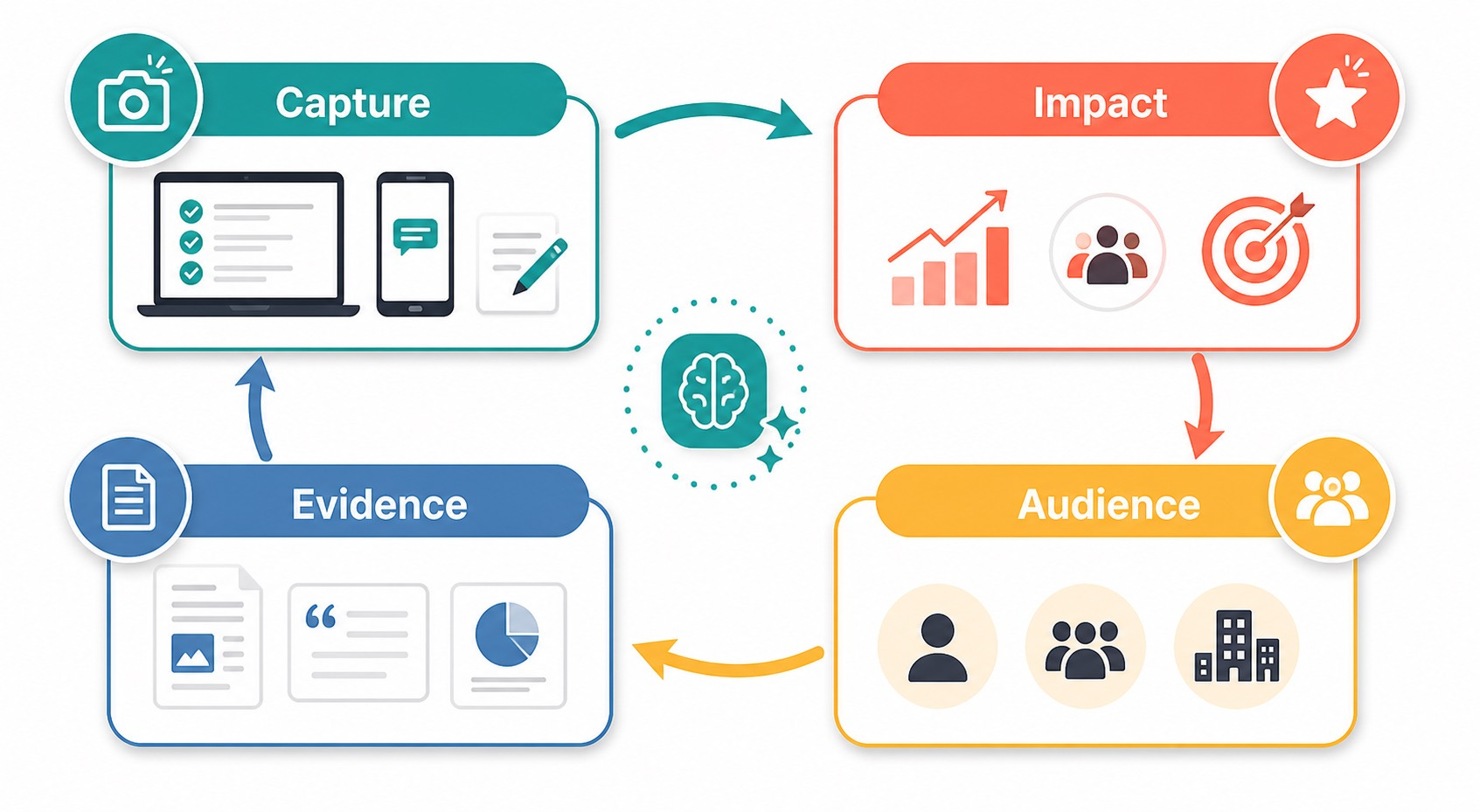
The Four-Part AI Workflow for Personal Branding at Work
A useful internal brand system has four parts: capture, impact, audience, and evidence. You can run it once a week in 20 minutes, then use the output in 1:1s, performance reviews, promotion packets, internal presentations, project retrospectives, and external career materials later.

1. Capture the Work While It Is Fresh
Most people wait until performance review season to remember what they did. By then, the best details are gone. Start a private weekly log instead. It can live in a notes app, a document, or a spreadsheet. The format matters less than the habit.
Capture five types of evidence:
Decisions you made when the answer was not obvious.
Problems you prevented, not just problems you solved.
People you helped move faster.
Systems, templates, documents, or workflows you improved.
Positive feedback, especially when it names a specific behavior.
Then use AI to clean the notes. A good prompt is:
“Review these weekly work notes. Extract concrete accomplishments, decisions, risks reduced, people helped, and measurable outcomes. Do not exaggerate. Flag anything that needs more evidence before I share it with my manager.”
This is not a content prompt. It is a memory prompt. You are asking AI to help you keep a more honest record.
2. Translate Tasks Into Impact
Internal reputation rarely forms around tasks. It forms around the meaning of those tasks. “Built a dashboard” is a task. “Gave the sales team a daily view of stalled accounts so managers could intervene earlier” is impact. “Handled support tickets” is a task. “Reduced repeat questions by turning unclear onboarding steps into a reusable guide” is impact.
AI is useful here because it can challenge vague wording. Feed it your weekly log and ask:
“Rewrite each accomplishment in three versions: one for my manager, one for a cross-functional leader, and one for a promotion review. Keep the tone factual. Include the business result, the audience helped, and the judgment required.”
The important move is audience translation. Your manager may care about reliability and priorities. A senior leader may care about risk, revenue, retention, speed, quality, or strategic clarity. A promotion committee may care about scope and independence. The same work needs different context for each audience.
3. Choose the Room Before You Choose the Message
A common self-promotion mistake is broadcasting every win everywhere. That creates noise. Internal personal branding works better when you match proof to the room where it matters.
For example, a detailed technical fix may belong in a team retrospective. A repeated customer objection may belong in a cross-functional product meeting. A pattern of mentoring may belong in your manager 1:1. A strategic insight may belong in a concise memo to the leader deciding next quarter’s priorities.
The Guardian’s promotion advice highlights this theme from another angle: career progression depends on early conversations, manager alignment, and a supportive network, not just a last-minute ask. AI can help you prepare for those conversations, but it cannot replace the relationships.
4. Share Evidence, Not Self-Praise
The best internal updates sound useful, not thirsty. They help other people make decisions. They reduce ambiguity. They give your manager language they can reuse accurately.
Compare these two updates:
“I did a great job improving the onboarding process and taking ownership.”
“I noticed new hires were asking the same setup questions in week one, so I turned the answers into a checklist and asked two recent hires to test it. The next cohort finished setup with fewer back-and-forth messages. I’m going to keep improving it as new questions appear.”
The second version works because it shows the situation, action, evidence, and next step. It lets the listener conclude that you are thoughtful. You do not have to announce it.
A Weekly AI Routine for Workplace Visibility
Here is a simple routine that works for employees, managers, consultants embedded with clients, technical professionals, and founders who need stronger executive presence inside their own company.
Friday: Capture the Raw Material
Spend ten minutes listing what happened. Do not polish. Include rough notes, links to documents, meeting outcomes, customer issues, blockers, decisions, and feedback. If you use AI meeting summaries, treat them as input, not truth. Add your own judgment about what mattered.
Monday: Pick One Signal to Share
Ask AI to identify the strongest reputation signal from the prior week. Was it ownership? Calm under pressure? cross-functional clarity? technical depth? customer empathy? commercial thinking? Then choose one place to share it: a 1:1, a project channel, a retrospective, a short memo, or a stakeholder update.
Monthly: Build Your Evidence Bank
Once a month, turn the best examples into a private evidence bank. Group them by skill: leadership, execution, communication, judgment, customer impact, revenue support, quality, collaboration, and learning. This becomes your source material for reviews, raises, internal interviews, external interviews, bios, and public content if you choose to create any.
Quarterly: Audit the Reputation Gap
Ask yourself: “What do I want to be trusted with next?” Then compare that to the evidence you have actually shown. If you want to be seen as strategic but all your visible proof is execution, you need to share more context about decisions and tradeoffs. If you want to lead people but only show individual output, you need visible examples of helping others succeed. If you want a more senior role but only report activity, you need to communicate scope, risk, judgment, and business effect.
What Not to Automate
AI can help you write clearer. It should not make you less accountable. Avoid these mistakes:
Do not paste confidential meeting notes, private feedback, customer data, legal issues, or sensitive strategy into tools that are not approved for that use.
Do not use AI to inflate your role in a project. If the work was shared, name the shared work.
Do not automate praise messages, networking notes, or internal comments that pretend to be personal.
Do not turn every accomplishment into a public post. Some proof is more powerful when shared with the right person privately.
Do not let AI remove the rough edges that make your judgment visible.
This matters because AI-era trust is getting more fragile. TechRadar recently argued that organizations need to verify information, identity, intent, and provenance more continuously as AI-generated content spreads. That idea applies to personal brands too. The more synthetic communication becomes, the more valuable traceable, specific, human evidence becomes.
Examples by Role
For a Technical Professional
Do not just say you “improved reliability.” Show the pattern: you noticed repeat failures, identified the common cause, proposed a fix, explained the tradeoff, and helped the team avoid future incidents. Use AI to turn incident notes into a concise postmortem summary, then share the lesson in an engineering meeting.
For a Consultant or Freelancer Inside a Client Team
Your internal brand is not only what the client sponsor thinks. It is what the broader team experiences. Use AI to summarize weekly client-facing outcomes into plain language: what changed, who benefited, what is still risky, and what decision is needed next. The goal is to be remembered as clear, useful, and low-drama.
For a Manager
Your brand should not be “I am busy.” It should be “my team moves through complexity with clarity.” Capture moments where you removed blockers, improved decision quality, protected focus, coached someone into stronger work, or made a tradeoff visible before it became political.
For a Job Seeker Still Employed
Internal personal branding also protects your external future. A well-kept evidence bank helps you update your LinkedIn, portfolio, interview stories, and references without scrambling. It also keeps you honest. You will know which claims you can support because the proof is already there.
The Quiet Rule: Be Easy to Advocate For
The real goal of personal branding at work is not to impress everyone. It is to make it easier for credible people to advocate for you accurately.
Your manager should be able to say, “She makes ambiguous projects clearer.” Your cross-functional partners should be able to say, “He turns messy feedback into decisions.” Your team should be able to say, “They raise the quality of the room.” Your public profiles, if someone checks them, should support the same story instead of telling a totally different one.
That is the difference between reputation and noise. Noise demands attention. Reputation earns recall.
FAQ
What is personal branding at work?
Personal branding at work is the process of becoming known internally for specific strengths, behaviors, and results. It is not about creating a fake persona. It is about making your real contribution easier for managers, peers, and leaders to understand and remember.
How can AI help with internal personal branding?
AI can help you summarize accomplishments, translate tasks into impact, prepare clearer 1:1 updates, organize feedback, and identify gaps between how you want to be seen and what your evidence actually shows. It should support your judgment, not replace your voice.
How do I promote myself at work without bragging?
Focus on evidence and usefulness. Share the problem, the action you took, the result, and what others can learn from it. Mention collaborators. Avoid vague claims like “I crushed it” or “I showed leadership.” Let the facts carry the credibility.
Should I post on LinkedIn to build my internal brand?
Not necessarily. LinkedIn can help with external visibility, but internal reputation is built through meetings, project updates, documentation, stakeholder trust, manager conversations, and consistent follow-through. Public posting is optional. Clear internal evidence is not.
What should I track for my personal brand at work?
Track decisions, outcomes, feedback, problems prevented, people helped, risks reduced, systems improved, and examples of judgment under uncertainty. Over time, these notes become your evidence bank for reviews, promotions, interviews, bios, and public profiles.
What is the biggest mistake people make with AI personal branding?
The biggest mistake is using AI to sound polished instead of using it to become more precise. Generic polish weakens trust. Specific evidence, honest context, and human judgment make your reputation stronger.