


Your LinkedIn headline gets the click. Your About section decides whether that click turns into trust.

If you build a personal brand on LinkedIn, the About section is one of the few places where you can still sound like a real person. No boxed-in job titles. No forced date ranges. No tiny one-line skill labels. Just a block of space where someone can decide, in a minute or less, whether you sound credible, useful, and worth contacting.
That matters more now because AI made it easier for everyone to publish polished profile copy. It also made it easier to sound interchangeable. LinkedIn said on June 4, 2026 that it is dialing back generic AI content and looking for real perspective, context, and expertise. That warning was aimed at posts and comments, but the principle applies to profiles too. If your About section sounds like a wordy machine-generated pitch, it works against your personal brand instead of strengthening it.
The good news is that AI is still useful here. The mistake is asking AI to invent who you are. The better move is to use AI as an editor, compressor, and clarity engine for material that is already yours: your proof, your projects, your working style, your perspective, and the outcomes you are known for.
The core rule: do not ask AI to write your identity from scratch. Give it raw material that could only belong to you, then use it to sharpen what is already true.
Why the LinkedIn About section matters more than most people think
LinkedIn’s own profile guidance says the About section should become your story, not just a list of skills or job titles. That is the difference between a searchable profile and a memorable one. Search gets you surfaced. Story gets you remembered.
For personal branding, the About section has to do three jobs at once:
Help the right people understand what you do fast.
Prove you have real substance behind the claim.
Create enough curiosity and trust for the next click, message, or introduction.
Most weak About sections fail because they only do one of those jobs. Some are all keywords and no personality. Some are all personality and no proof. Some read like a biography written by a stranger. Some are stuffed with soft adjectives like strategic, passionate, innovative, and visionary, which are easy to say and hard to trust.
The stronger your personal brand goals, the less room you have for vague copy. Founders need investor and customer trust. Consultants need authority and fit. Job seekers need recruiter clarity. Technical professionals need proof that they are not just repeating tools they saw trending online. In every case, the About section is where your positioning gets translated into human language.
What makes an About section feel generic
If you want to avoid AI slop, learn to spot the smell of it. Generic LinkedIn summaries usually have the same symptoms:
They open with abstract adjectives instead of a concrete role, audience, or problem.
They claim broad excellence without naming proof, numbers, artifacts, or outcomes.
They use polished filler like “passionate about driving innovation” that could fit ten thousand profiles.
They sound finished before they sound specific.
They mention AI because it is fashionable, not because it changed the way the person works.
Reddit discussions around LinkedIn profiles and AI writing keep circling the same frustration: people want help writing about themselves, but they do not want to sound fake, arrogant, or robotic. The most useful advice is surprisingly consistent. Start messy. Brain-dump first. Then edit. The best AI LinkedIn About section is usually built from rough notes, voice transcripts, client language, project outcomes, and direct examples of how you work.
If your About section could be swapped onto someone else’s profile with only two words changed, it is not personal branding. It is filler.
A trust-first structure for the LinkedIn About section
You do not need a clever literary masterpiece. You need a structure that makes you easy to place, easy to trust, and easy to remember. This five-part framework works well for founders, consultants, executives, creators, technical professionals, and job seekers alike.
1. Open with your real positioning
The first two lines matter most because many profile visitors will skim them before deciding whether to expand. Start with who you help, what problem you solve, or what kind of work you are known for. Not a slogan. Not your entire life story. Just positioning.
Example: “I help B2B software teams turn messy product launches into clear stories that customers, sales teams, and investors can actually follow.”
2. Add proof early
Once you make a claim, support it fast. Mention results, environments, projects, or operating range. LinkedIn’s product direction keeps moving toward proof and verification. That makes unsupported language weaker than it used to be.
Proof can be numbers, but it can also be scope, complexity, public artifacts, repeat clients, shipped systems, cross-functional leadership, published work, or recognized expertise.
3. Show how you work
This is where personality becomes useful. Explain your method, lens, or standards. Do you simplify technical complexity for non-technical buyers? Build calm systems in chaotic environments? Translate founder intuition into content that sounds human? This part helps people imagine working with you.
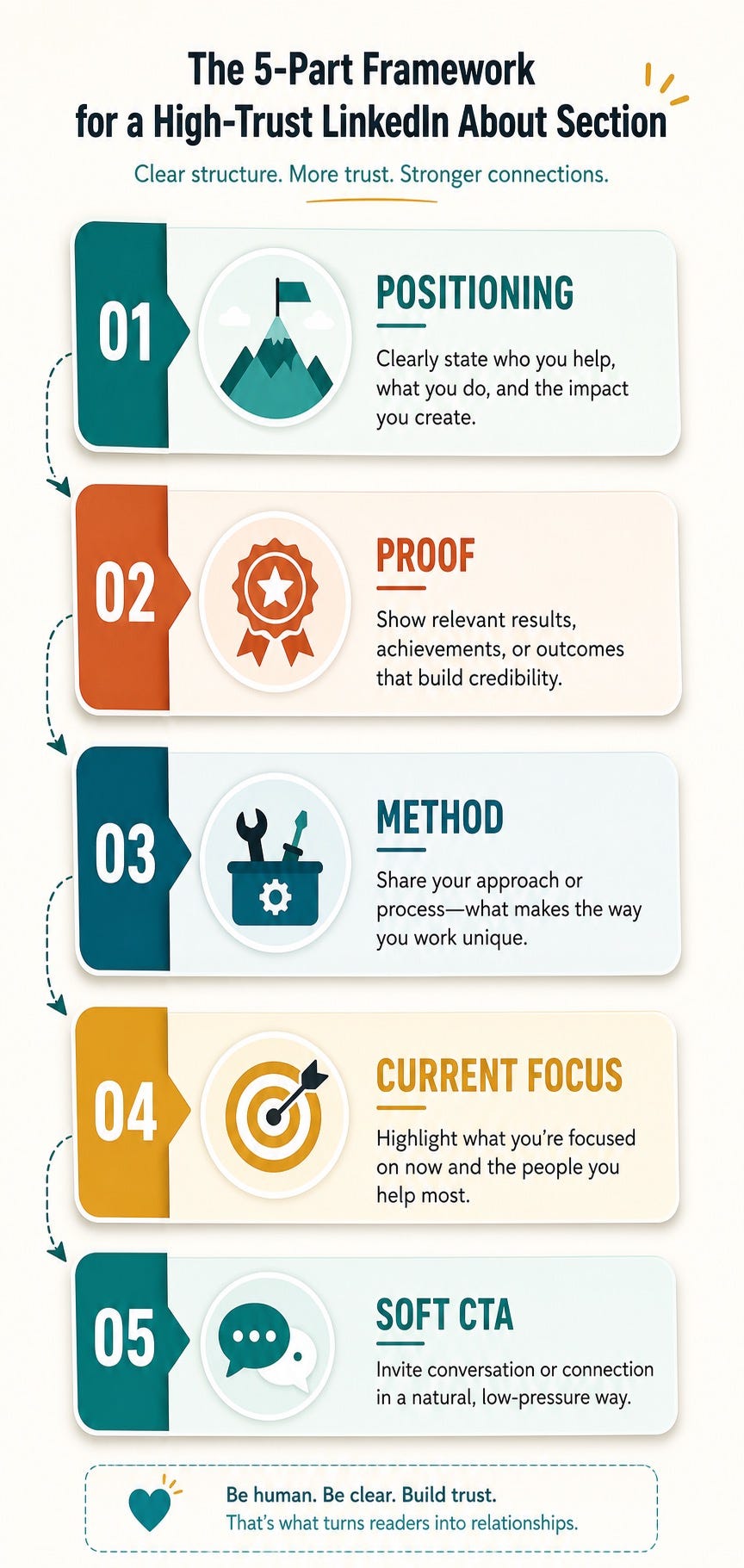
4. Clarify your current focus
Tell readers what kinds of opportunities, problems, or collaborations are relevant now. This keeps the section useful instead of merely descriptive. It also helps recruiters, founders, clients, and peers self-sort.
If you are a job seeker, this is where you can signal target roles. If you are a consultant, it is where you narrow by client type or problem. If you are a founder, it is where you explain the kind of conversations you want to attract.
5. End with a soft next step
You do not need a hard sales CTA. A simple invitation is enough: connect if you are building in a certain area, hiring for a certain capability, or thinking through a certain problem. The goal is not to close the reader. It is to lower the friction for a relevant conversation.
How to use AI without losing your real voice
The cleanest workflow is not “write my LinkedIn About section.” It is “help me organize and sharpen the evidence I already have.” Here is the process I recommend.
Record a rough voice note or write a blunt brain dump about what you do, who you help, and what people thank you for.
List five to ten proof points: shipped projects, measurable outcomes, recognizable environments, testimonials, public artifacts, or repeated responsibilities.
Paste both into AI and ask it to find patterns, not write copy yet.
Choose one positioning angle based on the opportunities you want now.
Only then ask AI to draft two or three versions in first person.
Edit hard for specificity, rhythm, and honesty.
Use prompts that force compression and proof. Avoid prompts that reward style without evidence.
I am rewriting my LinkedIn About section for personal branding. Use the notes below to identify: 1. the clearest positioning angle 2. the strongest proof points 3. the phrases that sound most like me 4. any vague language that weakens trust Then draft three first-person About section options. Rules: - Keep each version under 1,200 characters - Use plain English - Make the first two lines highly specific - Include at least three concrete proof points - Do not use generic adjectives unless they are backed by evidence - Do not invent achievements - Keep my tone direct, calm, and credible Raw notes: [paste voice transcript, bullets, and proof here]
A second prompt is useful for cleanup:
Score this LinkedIn About section out of 10 for: - clarity - credibility - uniqueness - keyword relevance - skimmability Then rewrite only the weakest lines. Flag anything that sounds AI-generated, overclaimed, or interchangeable.
Role-specific ways to shape the section
The structure stays stable, but the emphasis changes by audience.
For founders
Lead with the market problem you are obsessed with, not just your title. Show why you are credible to solve it. Mention customer proximity, category insight, shipped work, or unusual domain knowledge.
For consultants and freelancers
Be explicit about the type of client and problem you solve best. Your About section should screen for fit, not try to impress everyone. Specificity makes you easier to hire.
For job seekers
Do not turn the section into a plea for work. Translate your strongest experience into future-facing value. Make it easy for recruiters to understand what roles fit you, what tools you actually use, and what kind of environments bring out your best work.
For technical professionals and AI builders
Name real systems, workflows, tools, or shipped artifacts. LinkedIn’s recent emphasis on verified skills reflects a bigger reality: people want evidence. If you use AI, explain how. Not “I leverage AI.” Say what you automate, accelerate, or validate with it.

A 30-minute rewrite routine you can use today
If your current About section is weak, do this in one focused session.
Read your current version and delete any sentence that could describe thousands of people.
Write one sentence answering: who do I help, what do I help them do, and in what context?
Pull in three proof points that show range, depth, or results.
Add two sentences that describe how you work or what people trust you for.
Add one sentence on your current focus.
End with a low-friction invitation to connect.
Run the draft through AI for trimming, keyword alignment, and AI-slop detection.
Then read it out loud. That last step matters. If the section feels unnatural in your mouth, it will feel unnatural on the screen.
The real goal of the About section
A good LinkedIn About section does not try to be impressive in a vacuum. It helps the right person form the right conclusion quickly: this person is clear, real, and credible. In a feed full of generic AI polish, that is a serious advantage.
So use AI, but use it late. Start with the scraps only you have: the voice note after a client call, the project you are proud of, the phrasing people use when they recommend you, the weirdly specific problem you are known for solving. That is where personal branding actually begins.
FAQ
Should my LinkedIn About section be first person or third person?
First person is usually better for personal branding because it sounds more natural and less performative. Third person can work for formal executive bios, but on LinkedIn it often feels distant.
How long should a LinkedIn About section be?
Long enough to make your positioning, proof, and focus clear. Many strong versions land between 700 and 1,200 characters. Use more space only if every extra line adds evidence or clarity.
Can I use AI to write my LinkedIn About section?
Yes, but use AI to organize, trim, and improve your language. Do not let it invent your story. The best results come from feeding it voice notes, real proof points, and specific examples from your work.
What keywords should I include in a LinkedIn About section for personal branding?
Use the terms that describe your role, domain, tools, and audience accurately. The right keywords are the ones a recruiter, client, partner, or podcast host would genuinely use to find someone like you.
What is the biggest mistake people make in the LinkedIn About section?
The biggest mistake is sounding polished before sounding specific. Vague confidence, generic AI language, and unsupported claims weaken trust fast. Proof and clarity should come before style.