


Most people will look at LinkedIn Advice Sessions and think, finally, an easier way to charge for calls.
That is true, but it is not the real opportunity.
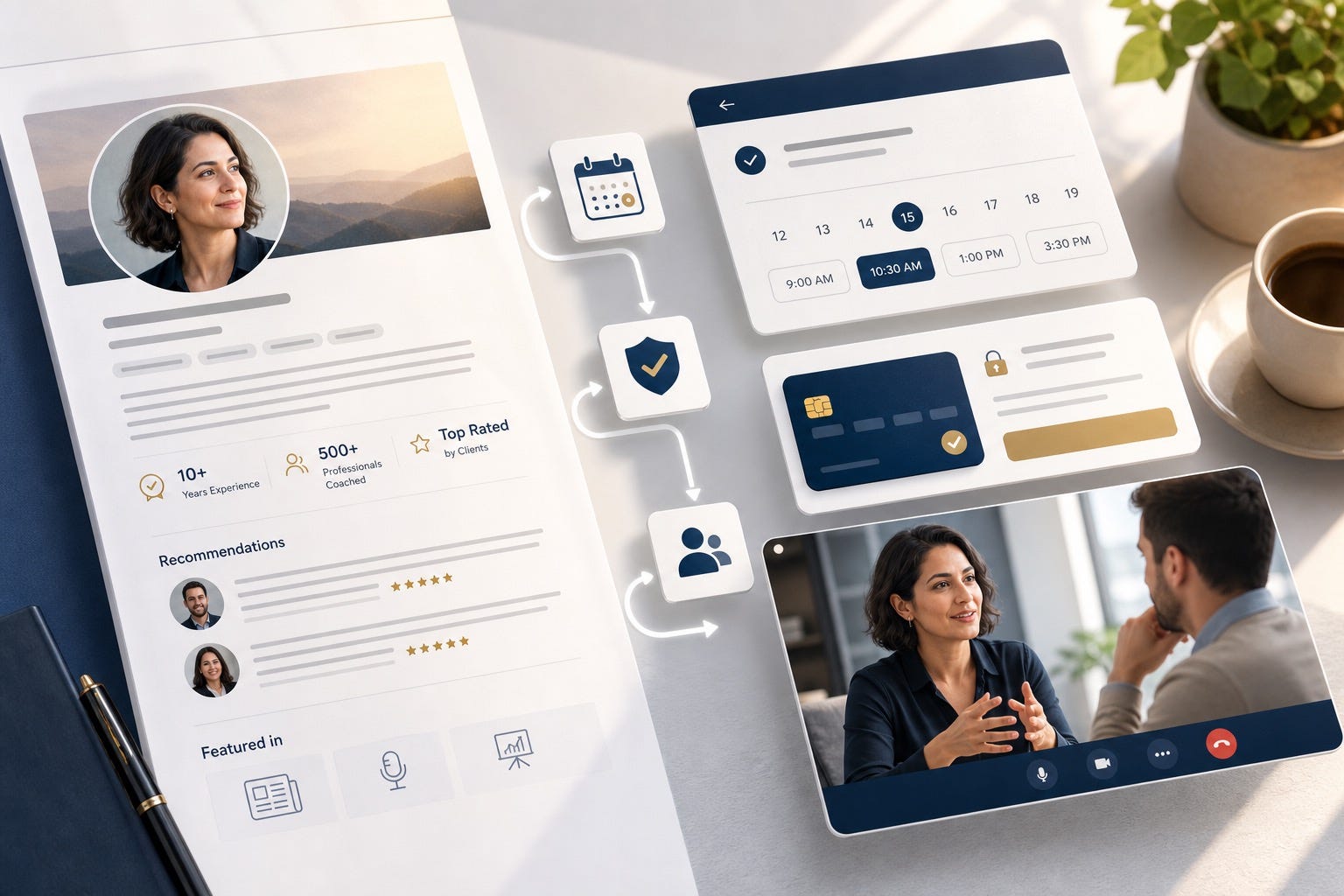
The real opportunity is that LinkedIn has turned a piece of your personal brand into a public buying decision. On May 12, 2026, LinkedIn announced that Advice Sessions would let eligible Premium Business users offer paid one-to-one consultations directly from their profile, with booking, payment, and video built into the platform. Around the same time, LinkedIn said early Premium All-in-One users were seeing a 57% rise in followers and a 40% increase in profile views. More profile attention means more people deciding, very quickly, whether you feel worth their time and money.
That is why this feature matters even if you do not plan to become a coach, creator, or full-time consultant. It reveals whether your positioning is clear, whether your proof is visible, and whether your digital identity feels trustworthy enough to buy from.
Advice Sessions are not just a monetization feature. They are a credibility test sitting in public.
If your profile is vague, inflated, or stuffed with AI-smoothed filler, the feature will not save you. It will expose the weakness faster. But if your profile already creates confidence, Advice Sessions can become a compact trust engine: a way to turn attention into qualified conversations without sending people through five extra links and a fragile follow-up sequence.
This article shows how to use LinkedIn Advice Sessions for personal branding, how AI can help behind the scenes, and what to fix before you switch the feature on.
Why This Feature Changes the Personal Branding Game
For years, LinkedIn personal branding has had an awkward middle step. Someone reads your post, checks your profile, thinks you seem smart, and then has to figure out what to do next. They might send a vague direct message. They might click away. They might promise themselves they will come back later and never do.
Advice Sessions shrink that gap. LinkedIn Help says hosts set their own rate and availability, and bookers can pay and schedule inside LinkedIn itself. In the limited U.S. rollout, bookers also need a verified profile. That matters because the platform is trying to reduce friction and raise trust at the same time.
In practical terms, this means your brand now has a more direct conversion path. But it also means your positioning has to answer five questions fast:
Who are you actually useful for?
What problem are you qualified to help with?
Why should someone trust your judgment?
What outcome will they get from a paid session?
Why book you now instead of reading free posts?
If your profile cannot answer those questions, the feature becomes decorative. If it can, the feature becomes a serious authority asset.
What to Fix Before You Turn Advice Sessions On
Too many professionals treat monetization as a button. It is really an architecture problem. Before you offer paid time, tighten the parts of your personal brand that create confidence.
1. Make your headline do more than describe your job
Your headline should make the right person feel recognized. Not impressed. Recognized. A good consulting headline signals audience, problem, and angle. It gives the reader a reason to believe the session will be specific.
Bad example: “Founder | Advisor | Speaker | Helping Businesses Scale.”
Better example: “Go-to-market advisor for B2B SaaS founders who need clearer messaging before they hire sales.”
2. Replace broad claims with visible proof
If someone is about to pay for your time, they need evidence. Use your Featured section, About section, and recent posts to show artifacts: frameworks, case studies, teardown posts, podcasts, talks, screenshots of outcomes, or short lessons from real work. Proof beats polish every time.
3. Define a session promise
Do not sell “pick my brain.” Sell a narrow outcome. People pay faster when they understand what gets solved in the session.
“Clarify your founder positioning before you rewrite your profile”
“Audit your LinkedIn presence for trust leaks and messaging confusion”
“Turn your rough expertise into a clean thought-leadership content system”
4. Show boundaries, not endless availability
Strong personal brands are not infinitely open. They are clear. State what you do help with, what you do not help with, and who the session is for. Boundaries make expertise feel more real.
5. Clean up the profile language AI often ruins
If your profile sounds like it was passed through three generic prompts, paid sessions will feel risky. Remove bloated claims, filler abstractions, and phrases like “passionate about driving innovation” unless you can prove them. People are not buying sentence quality. They are buying judgment.
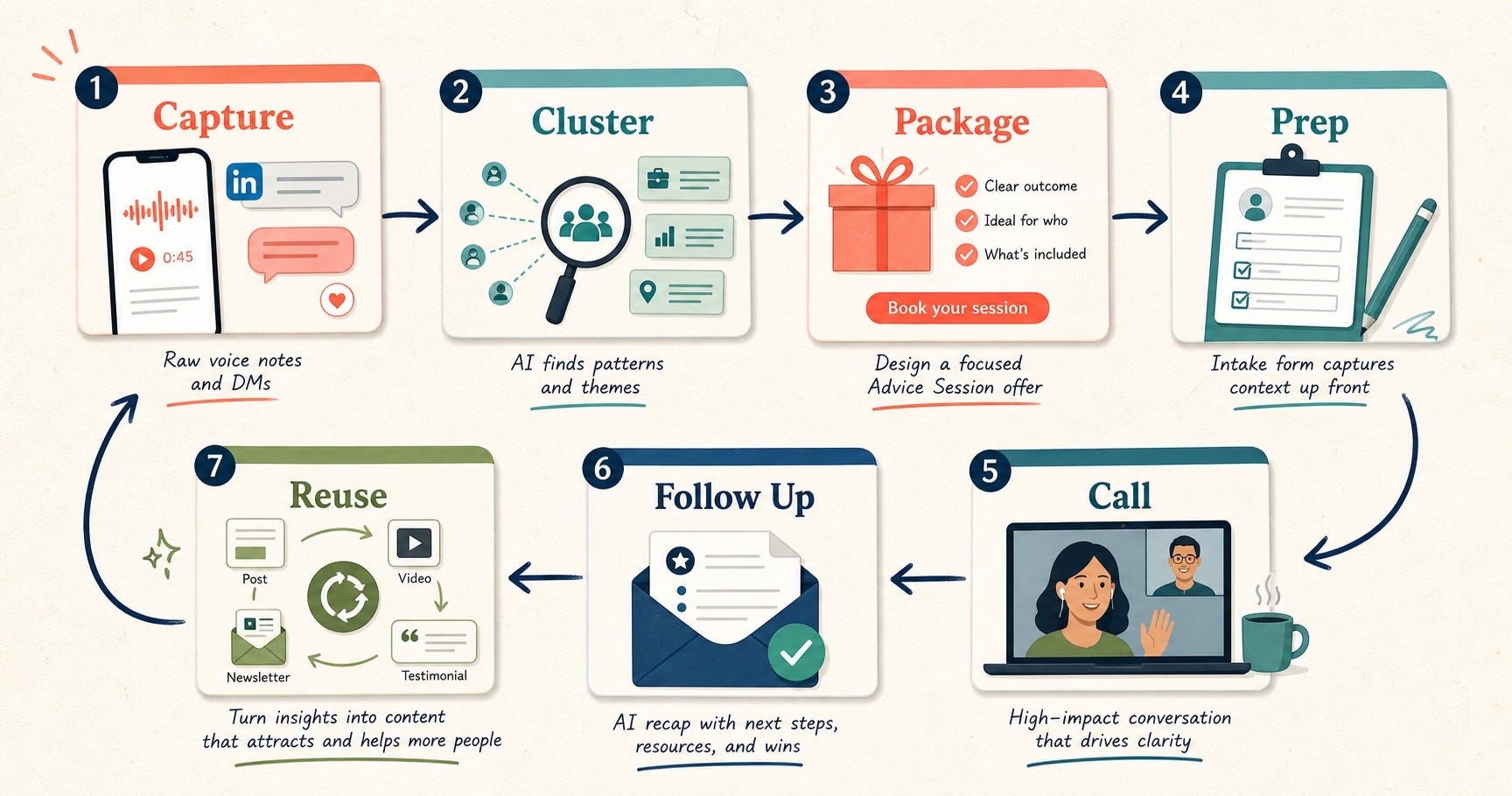
The Best AI Workflow for Advice Sessions
The wrong way to use AI here is to ask for “a LinkedIn Advice Session strategy” and paste whatever comes back. That produces the same problem as generic AI content everywhere else: smooth copy with no lived experience inside it.
The right way is to use AI as an organizer, editor, and compression layer for raw human material.
Simple rule: your expertise should come from experience; AI should help you package it faster.
Step 1: Capture the raw material
Start with inputs that are difficult to fake:
voice notes explaining the problems people bring you
old client emails with recurring questions
direct messages asking for help
call notes from discovery conversations
posts that got strong replies because they hit a real pain point
That source material is where your real language lives.
Step 2: Ask AI to find patterns, not invent authority
Feed those notes into AI and ask for clusters. Which problems repeat? Which phrases show urgency? Which buyers are asking beginner questions versus advanced ones? This is where AI becomes a research assistant for your personal brand.
A useful prompt is: “Analyze these notes and group them into the 3 highest-frequency problems people ask me to solve. Pull out the exact phrases they use, what outcome they want, and which problems sound urgent enough for a paid session.”
Step 3: Package one session around one problem
AI can now help you draft session titles, descriptions, and outcome bullets. Ask for multiple versions at different levels of specificity, then edit manually. The goal is not fancy language. The goal is buyer clarity.
Good session packaging feels like this:
specific audience
specific problem
specific outcome
clear fit and non-fit
Step 4: Build pre-call intelligence
One of the strongest uses of AI is a pre-session intake system. Before the call, ask bookers for context: their profile URL, current goal, biggest block, and what a useful outcome would look like. Then use AI to summarize the intake into a prep brief.
That lets you enter the call with sharper questions, better examples, and less wasted time. It also makes the experience feel premium without adding more manual admin.
Step 5: Turn each session into a trust asset
After the call, use AI to convert your notes into:
a recap email
a personalized action list
a reusable anonymized lesson for future content
a new FAQ you can answer on LinkedIn later
This is the compounding move. Every paid conversation can improve the next version of your brand, your content, and your profile clarity.
How to Make Your Profile Feel Worth Paying For
A paid advice feature works best when the rest of the profile acts like pre-sold trust. Think of the session button as the last step, not the first one.
Your About section should sound like a guide, not a brochure
Use it to explain how you think, what patterns you notice, and what kinds of people you help. Skip grand claims. Include one or two real examples of the situations you solve. Readers should hear your judgment, not your adjective list.
Your Featured section should carry proof of method
Add one framework, one case-style example, and one artifact that shows your process. If someone books you, they are often buying the confidence that you have done this before. Make that obvious.
Your recent content should preview the session quality
Do your posts show how you analyze a problem? Do they reveal tradeoffs? Do they help smart people think better? If not, the session offer may feel disconnected from the rest of your profile.
Pricing and Packaging Without Looking Salesy
One reason personal brands lose trust is that they jump from “here are free ideas” to “book a premium advisory session” with no middle logic. Advice Sessions work better when the offer feels like a natural next step.
Start with one offer, not five. Pick the question people already ask you most often. Then price according to clarity, not ego.
A lower-ticket session works well for audits, feedback, and positioning review.
A mid-tier session works well for strategy mapping, messaging breakdowns, and roadmaps.
A higher-ticket session only works when your authority, niche, and outcomes are already obvious.
Do not make the first paid offer overly broad. A narrow offer converts better and protects your reputation because it is easier to deliver well.
The safest way to monetize a personal brand is to charge for a defined outcome, not for access to your thoughts.
Mistakes That Make Advice Sessions Hurt Your Brand
Turning it on before your profile has proof.
Using AI-written session copy that sounds like every other consultant online.
Offering vague brainstorming instead of a defined result.
Trying to serve everyone from job seekers to enterprise founders with one session.
Hiding important boundaries until after booking.
Forgetting that buyers are evaluating your judgment before they evaluate your knowledge.
The biggest mistake is assuming the tool creates demand. It does not. It simply shortens the path for demand you have already earned.

A Practical 7-Day Setup Sprint
If you want to move fast without looking rushed, use this sequence.
Day 1: collect the top 20 questions people already ask you in DMs, calls, and emails.
Day 2: use AI to cluster those questions into one high-fit session offer.
Day 3: rewrite your headline, About section, and Featured section around that offer.
Day 4: draft your session description, fit criteria, and pre-call intake questions.
Day 5: prepare a reusable call outline and a post-call recap template.
Day 6: publish one or two posts that preview the problem your session solves.
Day 7: turn the feature on only after the profile and follow-up system feel coherent.
What This Means for AI Personal Branding
The larger lesson is not just about one feature. It is about where professional identity is going. Platforms are rewarding people who can package expertise clearly, show proof publicly, and convert trust without forcing the audience through extra friction. AI can accelerate that work, but it cannot manufacture the reputation layer underneath it.
That is why the best AI personal branding systems feel a little less magical than people expect. They are built from real notes, real questions, real experience, and real boundaries. The AI part is mostly operational. It helps you analyze, compress, structure, and follow up. The credibility part is still human.
If you treat LinkedIn Advice Sessions as a shortcut, it will probably underperform. If you treat it as a visible trust layer for a well-defined personal brand, it can become one of the cleanest ways to turn reputation into revenue without sounding like a full-time marketer.
FAQ
What are LinkedIn Advice Sessions?
They are LinkedIn’s built-in paid one-to-one consultation feature for eligible Premium Business users. LinkedIn handles booking, payment, and the video session inside the platform, which reduces the number of steps between profile discovery and a paid conversation.
Who should use LinkedIn Advice Sessions for personal branding?
They fit consultants, founders, operators, coaches, creators, and niche experts who already have a clear area of expertise and want a direct trust-to-conversion path. They are less useful for people whose profile is still vague or who do not yet have visible proof of work.
How can AI help without making the offer sound generic?
Use AI to analyze recurring client questions, draft multiple offer versions, summarize intake forms, and prepare recap notes. Do not use it to invent your authority or write polished-but-empty copy from scratch. Your experience should supply the substance.
Should I charge for a first conversation on LinkedIn?
Charge when the call has a defined purpose and a real outcome. If the session is still vague, overly broad, or exploratory, keep refining the offer first. Paid sessions work best when buyers know exactly what they are getting.
What makes a LinkedIn profile convert into paid advice calls?
Clarity, proof, and fit. The strongest profiles explain who they help, what problem they solve, how they think, and why their advice is credible. Good content helps, but proof of judgment matters more than volume.
Is LinkedIn Advice Sessions better than using Calendly and Stripe separately?
For some professionals, yes, because it reduces friction and keeps the booking flow inside the place where trust is already being evaluated. But it only works well if your profile itself is strong. External tools still make sense if you need more control, broader geography, or a more complex service flow.
Sources referenced for context: LinkedIn newsroom announcement on Advice Sessions, LinkedIn Premium All-in-One launch data, and LinkedIn Help documentation for Advice Sessions.