


LinkedIn is shifting from rigid keyword matching toward plain-language discovery. That changes how a strong personal brand gets found, judged, and trusted.

Most people still optimize LinkedIn like it is 2018. They obsess over stuffing keywords into a headline, adding every buzzword to the skills section, and hoping the algorithm will do the rest.
That approach is getting weaker.
LinkedIn’s own help documentation now describes AI-assisted search that interprets plain-language prompts and translates them into structured signals like skills, location, and job titles. Recruiters can type a request like “find me marketing managers in Dublin with sales enablement experience,” and LinkedIn builds the search for them. LinkedIn’s jobs experience also encourages users to search in their own words. At the same time, the platform is filling up with more AI-generated content, which means discoverability is no longer enough. You also have to look credible when someone clicks.
That is the real shift: discovery is becoming more natural-language driven, while trust is becoming more human-proof driven.
If you are a founder, consultant, executive, creator, student, or job seeker, your profile now has to do two jobs at once:
Make it easy for AI-assisted systems to understand what you actually do.
Make it easy for humans to believe you are the real thing.
This article is a practical playbook for both.
Why This Matters Now
Recent LinkedIn product changes are pushing the platform toward simpler inputs and smarter interpretation. LinkedIn Recruiter’s AI-assisted search explicitly turns plain-language requests into structured filters. LinkedIn also says search ranking depends on relevance to the searcher, profile completeness, and ongoing algorithm changes. In other words, the platform is not rewarding raw keyword density alone. It is rewarding clearer relevance.
Your profile is no longer just a page. It is a machine-readable explanation of who you help, how you help, and why anyone should trust you.
There is also a social reason this topic is heating up. In the last week, Business Insider reported new estimates suggesting a large share of LinkedIn posts now appear AI-generated. Whether every estimate is perfect is almost beside the point. Professionals feel the change. Buyers, recruiters, and peers are scanning faster for signs of sameness. If your profile reads like it was assembled by a prompt template, you may show up more, but convert less.
That is why the winning move is not “more AI.” It is better structure, sharper proof, and more visible judgment.
What AI-Assisted Search Actually Changes
Old-school LinkedIn optimization assumed a human searcher would manually combine filters or type a few exact keywords. AI-assisted search changes the input layer. The searcher can describe intent in a fuller, more natural way. That means your profile has to map to concepts, not just isolated terms.
Before
A recruiter searched: “B2B SaaS copywriter.”
Now
A recruiter or buyer can describe a need like: “Find someone who can turn technical product launches into clear thought leadership for enterprise buyers.”
That second query depends on more than a job title. It depends on whether your profile contains enough evidence for LinkedIn to connect you with that outcome.
This is why generic profiles fail. “Helping brands scale with innovative synergies” gives the machine very little. It also gives the human nothing to trust.
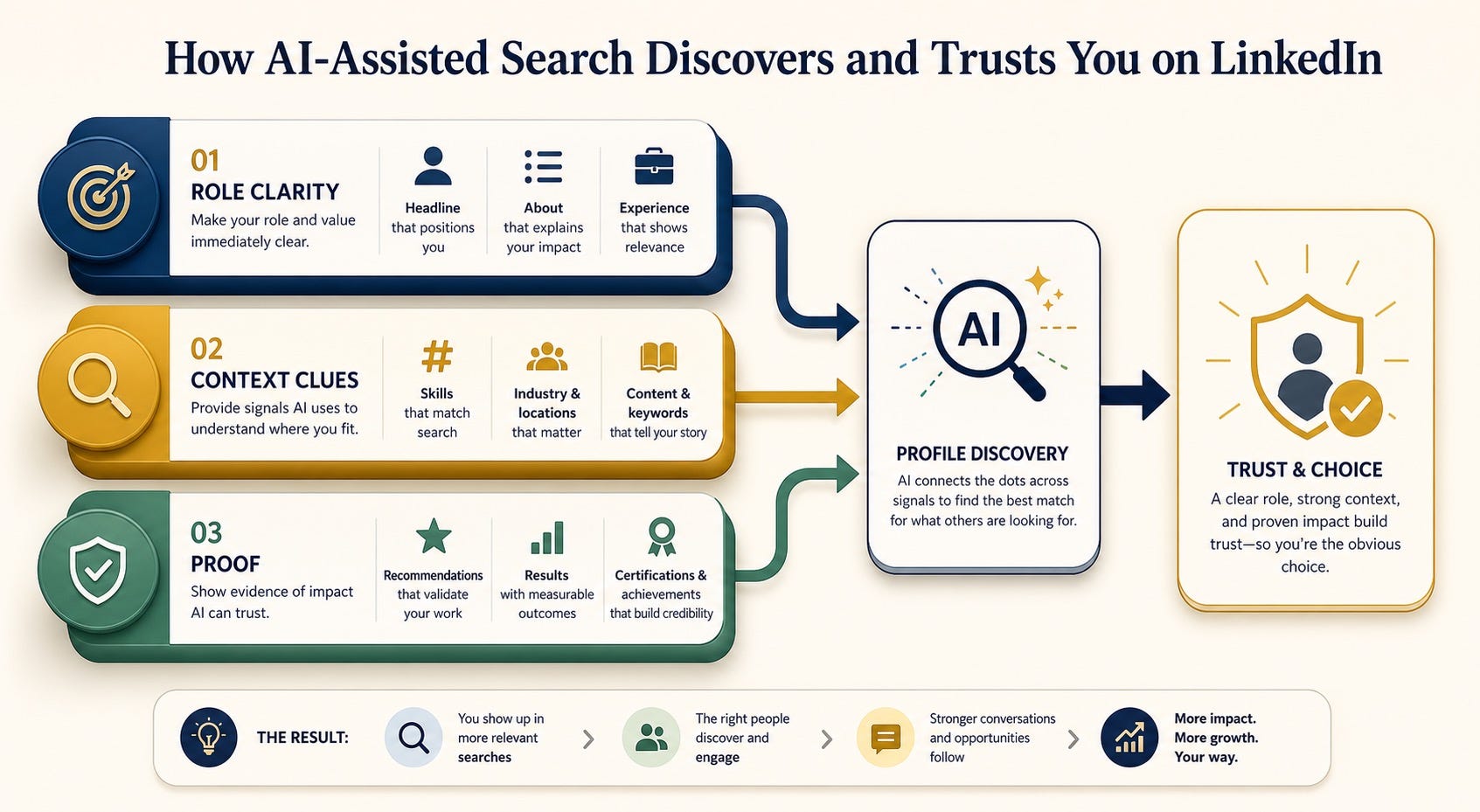
The Three Layers of a Discoverable Personal Brand
1. Role clarity
You need explicit language around your actual function. Not vague positioning. Not identity theater. Clear nouns and verbs.
Bad: “Growth-minded strategist building meaningful impact.”
Better: “B2B demand gen consultant helping SaaS teams improve demo conversion and pipeline quality.”
2. Context clues
AI-assisted discovery improves when your profile explains industries, audiences, problems, tools, and outcomes across multiple sections. Think beyond the headline:
About section
Current role description
Featured links
Skills
Recommendations
Creator or publication activity
3. Proof
Proof is the difference between appearing in results and earning replies. AI can infer relevance. Humans still inspect evidence.
Proof can include:
Specific wins
Named projects
Before-and-after outcomes
Public artifacts
Client language from testimonials
Recommendations that describe your working style
How to Optimize Your Profile for AI-Assisted Discovery
Write for tasks, not labels
Many professionals only write identity labels: founder, strategist, advisor, creator, consultant. That is not enough. You need to describe the work people need from you.
Add phrases that answer these prompts:
What problem do I solve?
For whom?
In what setting?
With what method?
Toward what outcome?
For example, instead of “AI consultant,” write “AI workflow consultant for agencies that need faster client reporting, proposal drafting, and knowledge reuse.”
Use natural language in the About section
Your About section is where semantic relevance gets stronger. Write in complete sentences that mirror how buyers, recruiters, and collaborators describe needs out loud.
A simple formula:
Who you help.
What you help them do.
What makes your approach different.
What proof supports that claim.
Example:
I help cybersecurity founders turn technical expertise into founder-led content, analyst-ready messaging, and sales-enabling thought leadership. My work usually starts when a team knows the product is strong but the market still does not understand why it matters.
Make your experience section do real work
Too many profiles treat job descriptions like a resume archive. That misses a major discoverability layer. Rewrite each current or recent role so it includes:
The audience you served
The problems you owned
The outputs you created
The outcomes you influenced
This helps both machines and humans build the right picture fast.
Turn your Featured section into evidence
If AI-assisted search gets someone to your profile, your Featured section should close the credibility gap. Use it to show:
A strong article or essay
A case study or teardown
A media mention
A live project
A talk, framework, or notebook that proves depth
Do not feature filler. Feature signal.
How to Use AI Without Making Your Profile Worse
AI is useful for compression, comparison, and consistency. It is dangerous when it becomes the author of your identity.
Use AI for:
Extracting recurring themes from your projects, testimonials, and bios
Finding missing proof points
Rewriting dense language into clearer language
Creating multiple versions of the same claim for different sections
Do not use AI for:
Inventing authority you have not earned
Flattening your voice into platform jargon
Replacing examples with adjectives
Hiding uncertainty behind polished nonsense
A useful prompt is not “write my LinkedIn profile.” A useful prompt is:
Analyze these raw notes, projects, testimonials, and past bios. Extract repeated themes, concrete outcomes, audience language, and proof points. Then draft three profile versions: one for recruiter discovery, one for founder credibility, and one for consulting leads. Keep the language plain, specific, and human.
That prompt keeps AI in the role of analyst and editor, not identity puppeteer.
What This Looks Like for Different Audiences
The exact wording should change based on who needs to find you. The structure stays the same, but the emphasis shifts.
For founders
Founders should optimize around market clarity, category language, and trust. Your profile should make it obvious what company problem you are solving, what type of buyer you understand, and why you are a credible guide in the space. Good founder profiles often connect product insight, operator experience, and a point of view about the market.
Instead of writing “building the future of finance,” a stronger line might be “Building compliance software for fintech teams that need faster vendor onboarding without adding more manual review.”
For consultants and freelancers
Consultants need searchability plus conversion. That means your profile should clearly name your service, your buyer, and the transformation you create. People should not have to guess whether you do strategy, implementation, advisory work, or execution support.
A consultant who writes “fractional marketing leader for B2B SaaS teams preparing for category expansion” is much easier to place than someone who writes “brand and growth advisor for ambitious companies.”
For executives
Executives need visible authority without sounding inflated. AI-assisted discovery will likely connect you to leadership, functional, and industry terms, but the human click still depends on composure and substance. Executives should highlight scope, cross-functional decisions, culture impact, and what kind of high-stakes problems they can lead through.
If you led through a turnaround, integration, major launch, or regulatory shift, say so directly. That is stronger than a paragraph of leadership adjectives.
For job seekers and students
You do not need a famous personal brand. You need a coherent professional signal. If you are earlier in your career, translate class projects, internships, side projects, research, volunteer work, and portfolio assets into skill-and-outcome language. Show what you can do, not just what you studied.
This matters because many searchers are not only looking for past titles. They are looking for evidence of capability, communication, and seriousness.
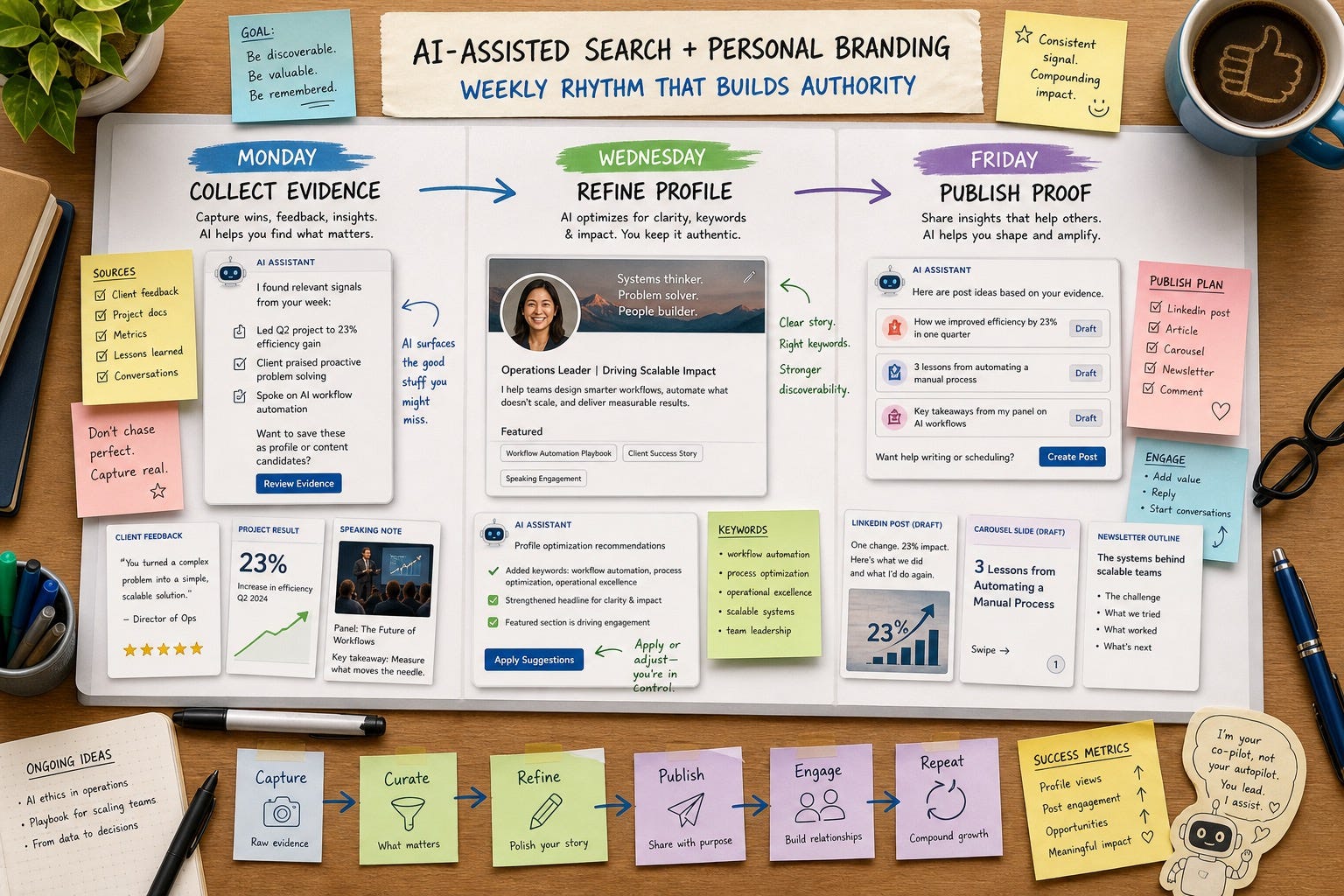
A Practical Weekly Workflow
If you want this to compound, do not treat profile optimization as a one-time edit. Treat it like a visibility system.
Monday: collect evidence
Save client feedback, shipped work, screenshots, comments, wins, and language people use to describe your value.
Wednesday: refine one section
Update one part of your profile using the freshest language from real work. One better paragraph every week beats one giant rewrite every six months.
Friday: publish one proof artifact
Share a short insight, a mini-case study, a teardown, a framework, or a useful observation from the week. This creates language and evidence that reinforce your profile over time.
This is especially useful for quiet professionals who do not want to “build a brand” in the loud sense. You do not need to become an influencer. You need to leave enough structured evidence that the right people can understand you.
Common Mistakes That Kill Discoverability
Keyword stuffing without narrative
A profile full of disconnected terms may help you match weakly, but it rarely creates conviction.
Beautiful positioning with no proof
If your profile sounds expensive but says nothing concrete, AI may surface you and humans may still bounce.
AI-polished sameness
The most dangerous personal-brand risk right now is not being invisible. It is being forgettable in the exact same way as everyone else.
Outdated experience language
Your best work may be recent, but your profile may still be written around a role from two years ago. That creates discovery lag.
Zero outcome language
What changed because of your work? More trust, better demos, faster hiring, clearer messaging, stronger activation, better investor understanding? Name the result.
The Real Goal: Better Matches, Not More Impressions
Personal branding in the AI era is not about tricking search systems. It is about becoming easier to understand.
The strongest profiles do not win because they are packed with hacks. They win because they reduce ambiguity.
When someone finds you through AI-assisted search, they should be able to answer five questions in under thirty seconds:
Who is this person for?
What do they actually do?
What kind of problems can they handle?
What proof do they have?
Do they sound like a real person I would trust?
If your profile answers those questions cleanly, you are already ahead of most of the platform.
LinkedIn’s discovery layer is becoming more AI-assisted. Your job is not to become more robotic in response. Your job is to become more legible, more specific, and more evidentially human.
FAQ
What is LinkedIn AI-assisted search?
LinkedIn AI-assisted search is a feature in Recruiter that interprets plain-language queries and turns them into structured search filters such as skills, titles, and locations. It reflects a broader shift toward natural-language discovery on the platform.
How do I optimize my LinkedIn profile for AI-assisted search?
Use clear role language, describe real tasks and outcomes, add context across your About and Experience sections, and feature proof assets that support your claims. Focus on relevance and evidence, not keyword stuffing.
Does LinkedIn still care about keywords?
Yes, but keywords work best when they appear inside useful, natural language. Exact terms still matter, especially for titles, skills, and industries, but meaning and context matter more than a pile of disconnected buzzwords.
Can AI write my LinkedIn profile for me?
AI can help analyze your work, organize proof, and improve clarity. It should not fully invent your positioning or voice. The best results come when AI edits reality instead of replacing it.
What sections of LinkedIn matter most for discoverability?
Your headline, About section, current role description, skills, Featured section, and recommendations matter most because they help LinkedIn understand your relevance and help humans evaluate your credibility.
How often should I update my LinkedIn profile?
Review it weekly in small passes and refresh core sections whenever your audience, service, outcomes, or best proof changes. A live profile compounds better than a polished profile that never evolves.