


Most professionals still judge LinkedIn content by impressions and likes. That is how you mistake attention for authority. If you want a stronger personal brand, you need to read the quieter signals that show whether people trust your ideas enough to keep them, share them, and look you up after they read.

The right post is not always the loudest one. Sometimes it is the one people save for later or quietly send to a colleague.
A lot of smart people are doing sincere work on LinkedIn and still feel blind. They publish thoughtful posts, get a handful of likes, maybe a nice comment or two, and then wonder whether any of it is building reputation in a meaningful way. That confusion gets worse in an AI-heavy feed, because surface engagement is easier than ever to fake, inflate, or misunderstand.
LinkedIn’s newer analytics signals help if you know how to read them. Saves tell you whether a post was useful enough to keep. Sends tell you whether it was worth sharing privately. Reach split tells you whether the post is mostly circulating among people who already know you or actually introducing you to new people. Together, these metrics tell a much more useful story than likes alone.
This matters for founders, consultants, executives, job seekers, creators, and technical professionals for the same reason: personal branding is not about looking active. It is about making your expertise easier to trust. The best analytics question is not, “Did this post perform?” It is, “Did this post move me toward being remembered for the right thing?”
Why vanity metrics keep leading personal brands in the wrong direction
Likes are fast. They are public. They feel emotionally satisfying. They are also easy to misread. A post can get a respectable pile of reactions because it is agreeable, funny, dramatic, or familiar. None of that guarantees it strengthened your professional positioning.
A trust-building post often behaves differently. It may attract fewer reactions but more saves because the content solves a real problem. It may get more sends because someone thinks, “I should pass this to a colleague.” It may trigger profile visits because a reader wants to figure out whether you actually know what you are talking about. Those actions signal intent, not just attention.
The post that flatters your ego is not always the post that compounds your reputation.
If you build your content strategy around likes, you start optimizing for broad approval. If you build it around trust signals, you start optimizing for usefulness, specificity, proof, and professional relevance. That usually leads to a stronger brand, even if it produces fewer vanity spikes.
The three LinkedIn metrics personal brands should care about most
1. Saves: the signal of lasting utility
A save usually means the reader believes your post will still be useful later. That is powerful. People do not save generic inspiration very often. They save checklists, frameworks, sharp examples, prompts, templates, and nuanced explanations they expect to revisit.
For personal branding, saves usually mean your content is becoming a reference point. That is a stronger position than being briefly entertaining. If your posts about hiring, AI workflows, founder lessons, or product strategy are being saved, your audience is telling you what they want to remember you for.
2. Sends: the signal of private endorsement
A send is different from a repost. Reposts are public theater. Sends are private recommendation behavior. When someone sends your post to a friend, teammate, client, or founder group, they are putting a little bit of their own credibility behind it. That often makes sends one of the cleanest trust signals on the platform.
If a post gets strong sends, ask why. Was it specific? Did it name a pain people recognized instantly? Did it give language a reader could borrow in their own conversation? Content that gets privately shared often becomes authority content later.
3. Reach split: the signal of discovery quality
Reach without context is noisy. Reach split gives it context. If a post is mostly in-network, it may be deepening trust with people already familiar with you. If it is getting strong out-of-network reach, it may be doing discovery work and putting your name in front of the right strangers.
Neither result is automatically better. A consultant trying to convert warm reputation into referrals may want deep in-network engagement. A founder entering a new category may care more about qualified out-of-network reach. The important thing is to stop treating all impressions as equal.
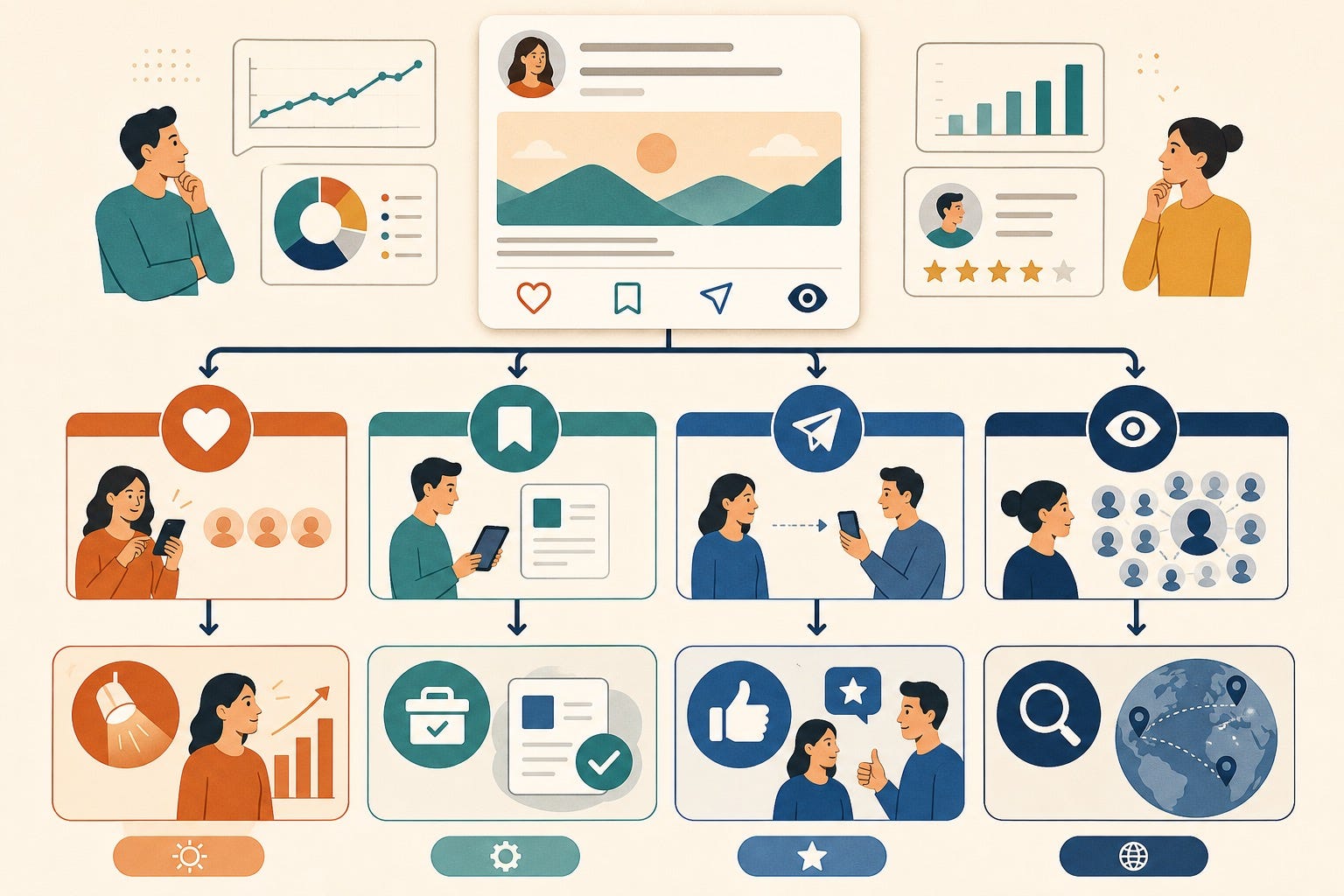
A simple rule: likes signal reaction, saves signal value, sends signal endorsement, and reach split signals whether the right people are finding you.
How to translate these metrics into a stronger brand strategy
The point of analytics is not better reporting. The point is better judgment. Here is a practical way to read your posts.
High saves, low likes
This usually means your post was useful, but not designed for public applause. That is often a good sign. Think frameworks, tactical breakdowns, niche observations, or strong process posts. You probably found a topic worth turning into a repeatable content pillar.
High sends, medium saves
This often means the post was highly relatable or highly relevant to a live conversation. It may have named a common problem clearly enough that people wanted to forward it. These posts are strong candidates for turning into a carousel, short article, FAQ answer, or email issue.
High out-of-network reach, weak saves and sends
This can mean the hook worked, but the substance did not convert attention into trust. Your opening may be strong while your body stays too generic. That is a content quality issue, not a visibility issue.
Modest reach, strong profile actions
This is often underrated. If a smaller, more specific post gets the right people to click your profile, read your about section, or message you, it may be doing better brand work than a much bigger post. Personal branding is about qualified response, not applause density.
Working rule: If a post earns attention, study the hook. If it earns saves, study the structure. If it earns sends, study the framing. If it earns profile interest, study the positioning match.
An AI workflow for reading your LinkedIn analytics without losing your voice
This is where AI becomes useful. Not as your ghostwriter, but as your pattern spotter.
Once a week, export or manually log your last 10 to 20 posts in a simple sheet. Add columns for topic, format, hook style, proof type, saves, sends, comments, reach split, profile visits, and any real outcome such as DMs, interviews, intros, or leads. Then use AI to help classify the patterns.
A simple prompt to use
You can paste your rows into ChatGPT or another model and ask:
Analyze these LinkedIn posts for personal-brand signal quality. Group them by what seems to drive saves, sends, out-of-network reach, and profile interest. Identify which topics build trust, which hooks attract curiosity but weak depth, and which post structures I should repeat.
Then ask a second question:
Based on these patterns, give me three content experiments for next week that preserve my voice, increase usefulness, and strengthen authority with my target audience.
The value is not in accepting the output blindly. The value is that AI can sort faster than you can. You still apply judgment. You still decide whether the model is confusing broad engagement with the kind of credibility you actually want.
What high-trust LinkedIn posts usually have in common
Across industries, posts that earn strong saves and sends often share four traits.
Specificity. They solve a problem for a real audience instead of addressing everyone.
Transferable value. They contain language, examples, checklists, or frameworks people can reuse.
Proof. They refer to work done, mistakes made, decisions taken, or outcomes observed.
Clear identity. They sound like they came from a person with a recognizable angle, not a generic AI assistant.
If your goal is founder visibility, your best posts may be short case-study fragments about decisions, tradeoffs, and operating lessons. If your goal is consultant credibility, your best posts may be practical frameworks that readers can act on immediately. If your goal is executive presence, your best posts may be calm, high-signal interpretations of changes happening in your industry.
The metric does not tell you who to be. It helps reveal which version of your expertise people actually trust enough to keep.

The mature move is not posting more. It is learning what kind of signal your best content leaves behind.
A weekly scorecard you can use in 20 minutes
If you want one practical system, use this every Friday:
List your last five posts.
Mark each one as mainly built for utility, opinion, story, proof, or conversation.
Compare likes versus saves versus sends.
Note whether reach was mostly in-network or out-of-network.
Record any profile visits, DMs, newsletter subscribers, meeting requests, or opportunity signals.
Ask AI to summarize what pattern appears.
Choose one thing to repeat and one thing to stop.
That is enough. You do not need a giant dashboard. You need a repeatable habit of connecting signal to strategy.
The mistake to avoid when AI enters your content loop
The danger is obvious: once analytics tells you what works, AI makes it tempting to mass-produce a cleaner, flatter, more generic version of it. That is how people accidentally sand away the very texture that made the post trustworthy in the first place.
Use AI to compress research, summarize comments, cluster patterns, and stress-test ideas. Do not use it to replace your observations, your examples, your contrarian details, or your lived language. The more the feed fills with polished sameness, the more valuable your own rough edges become.
In practice, that means keeping a library of real stories, mistakes, screenshots, notes, objections, client questions, and hard-earned phrases. Let AI help you organize the library. Do not let it become the library.
What this means for the future of personal branding
LinkedIn is becoming easier to publish on and harder to trust. That shifts the job of personal branding. Winning is no longer about showing up at industrial scale. It is about creating content that leaves a stronger residue: remembered frameworks, privately shared insight, and a clearer sense of who you are good for.
If you start reading analytics this way, you stop asking, “How do I get more engagement?” and start asking, “What kind of content makes the right people trust me faster?” That is a better question. It leads to better posts, better positioning, and usually better outcomes beyond the feed.
Attention is cheap. Saved insight is rarer. Private sharing is rarer still. Build for those signals and your personal brand gets quieter in the right way: less performative, more referable, more durable.
FAQ
What is the most important LinkedIn metric for personal branding?
There is no single universal metric, but saves and sends are usually stronger trust signals than likes because they indicate usefulness and private endorsement. Reach split adds context by showing whether you are deepening trust with your network or reaching relevant new people.
Do likes matter for LinkedIn personal branding?
Yes, but less than many people think. Likes can show quick resonance, but they do not reliably tell you whether your post built authority, taught something memorable, or made someone more likely to trust your expertise.
How often should I review LinkedIn analytics?
Weekly is enough for most professionals. A short review every Friday works better than obsessing over each post in real time. The goal is to spot patterns across multiple posts, not to overreact to one spike or one quiet day.
How can AI help with LinkedIn analytics for personal branding?
AI is best used to classify post themes, compare hooks, identify recurring high-save topics, and suggest experiments. It should support your interpretation, not replace it. You still need human judgment to decide what aligns with your reputation and goals.
What does out-of-network reach mean on LinkedIn?
Out-of-network reach shows how much of your content is being seen by people who are not already in your immediate LinkedIn network. It helps you judge whether a post is doing discovery work or mainly reinforcing trust with people who already know you.
Why do some posts with fewer likes still help my personal brand more?
Because some posts are more useful than publicly exciting. A niche framework, a practical checklist, or a sharp lesson from real work may attract fewer reactions while generating more saves, sends, profile visits, and better-fit opportunities.