


A new LinkedIn feature is arriving at the exact moment professional audiences are getting tired of polished solo posts that feel machine-made. Shared bylines can help, but only if you use them as a trust signal instead of a reach trick.

Most people will talk about LinkedIn collaborative posts as a distribution feature. That is too shallow.
The real value is reputational. In a feed where AI makes it easy to publish smooth, generic opinions at scale, a shared byline answers a more important question than “How far did this travel?” It answers, “Who is publicly willing to stand next to this idea?”
That matters now because professional audiences are getting better at sensing content that sounds competent but feels empty. Recent reporting on a Pangram study found that a large share of LinkedIn posts now appear AI-generated. At the same time, LinkedIn is gradually rolling out collaborative posts, letting members and Pages co-publish public posts together. Those two shifts point in the same direction: trust is becoming visible in the structure of the content, not just the wording.
If you are a founder, consultant, executive, creator, freelancer, student, or technical expert, this creates a useful opening. You do not need to out-post everyone. You need to become easier to believe. Collaborative posts can help you do that if you use them to show real working relationships, real proof, and real judgment.
What LinkedIn Collaborative Posts Actually Change
LinkedIn’s help documentation says the feature is rolling out gradually, supports multiple post types, and allows up to five collaborators on a public post. On the surface, that looks like a product update. In practice, it changes the social meaning of a post.
A solo post says, “Here is what I think.” A collaborative post says, “More than one credible person or organization is willing to attach their name to this.” That is a stronger signal, especially in B2B and professional contexts where buyers, employers, media, and peers all check who your ideas are associated with.
This is why the best use cases are not random partnerships. They are moments where shared credit makes the idea more believable:
A founder and a customer sharing what actually changed after a project.
A consultant and a client summarizing a lesson they both learned.
An executive and a team member explaining how a process really works.
A creator and a technical expert combining audience clarity with substance.
A student and a mentor reflecting on a real build, project, or internship outcome.
In the AI slop era, collaboration is not just a growth tactic. It is a credibility format.
Why Shared Bylines Feel More Trustworthy
Trust grows when content carries friction. Friction means someone had to review it, approve it, add nuance, or protect their own reputation before it went live. Collaborative posts naturally introduce that friction.
When two or more names appear at the top of a professional post, readers infer a few things right away:
The idea survived another person’s judgment.
The story probably came from real work, not just solo commentary.
The post may connect audiences, roles, or perspectives that rarely overlap.
The author is less likely to overstate results when another party is visible.
That is why collaborative posts can outperform standard personal-brand content even if the writing is simpler. They reduce skepticism. For service businesses, leadership brands, and independent professionals, that is often more valuable than raw reach.
This also fits a broader market mood. Gartner reported in March 2026 that half of U.S. consumers prefer brands that avoid generative AI in consumer-facing content. Whether or not your LinkedIn audience would phrase it that way, the underlying point is the same: people are not rejecting efficiency; they are rejecting distance. They want clearer evidence that a real person means what they are saying.
Who Should Use This Format First
Not everyone should rush into collaborative posting. Start where shared authorship adds clarity, not noise.
Founders
Use collaborative posts with customers, operators, product leaders, or partners when you want to show that your company message is grounded in real execution. This is stronger than another solo “hard-won lesson” post.
Consultants and Freelancers
Use them with clients, former colleagues, or specialist collaborators when you want to turn private trust into visible market proof. If a client is willing to publish with you, that is stronger than a testimonial screenshot.
Executives
Use them with team leads or subject-matter experts to avoid the common executive-brand mistake of sounding distant from the real work. Shared authorship can make leadership content feel less ghostwritten and more grounded.
Creators and Experts
Use them when combining reach and substance. A creator who brings distribution and an expert who brings proof can produce content that feels smarter than either side publishing alone.
Job Seekers and Students
Use them sparingly, but strategically. A collaborative post with a professor, mentor, project lead, or internship manager can validate your work in a way self-description cannot.
The Rule That Keeps This From Looking Like a Growth Hack
Only collaborate when the other name changes the meaning of the post.
That is the simplest rule in this whole article. If the collaborator does not add proof, perspective, access, or accountability, skip it. People can smell decorative partnerships fast. A shared byline without a real shared stake makes your brand look more performative, not more credible.
Quick test: If your collaborator vanished from the post, would the reader lose something important? If the answer is no, the collaboration is probably cosmetic.
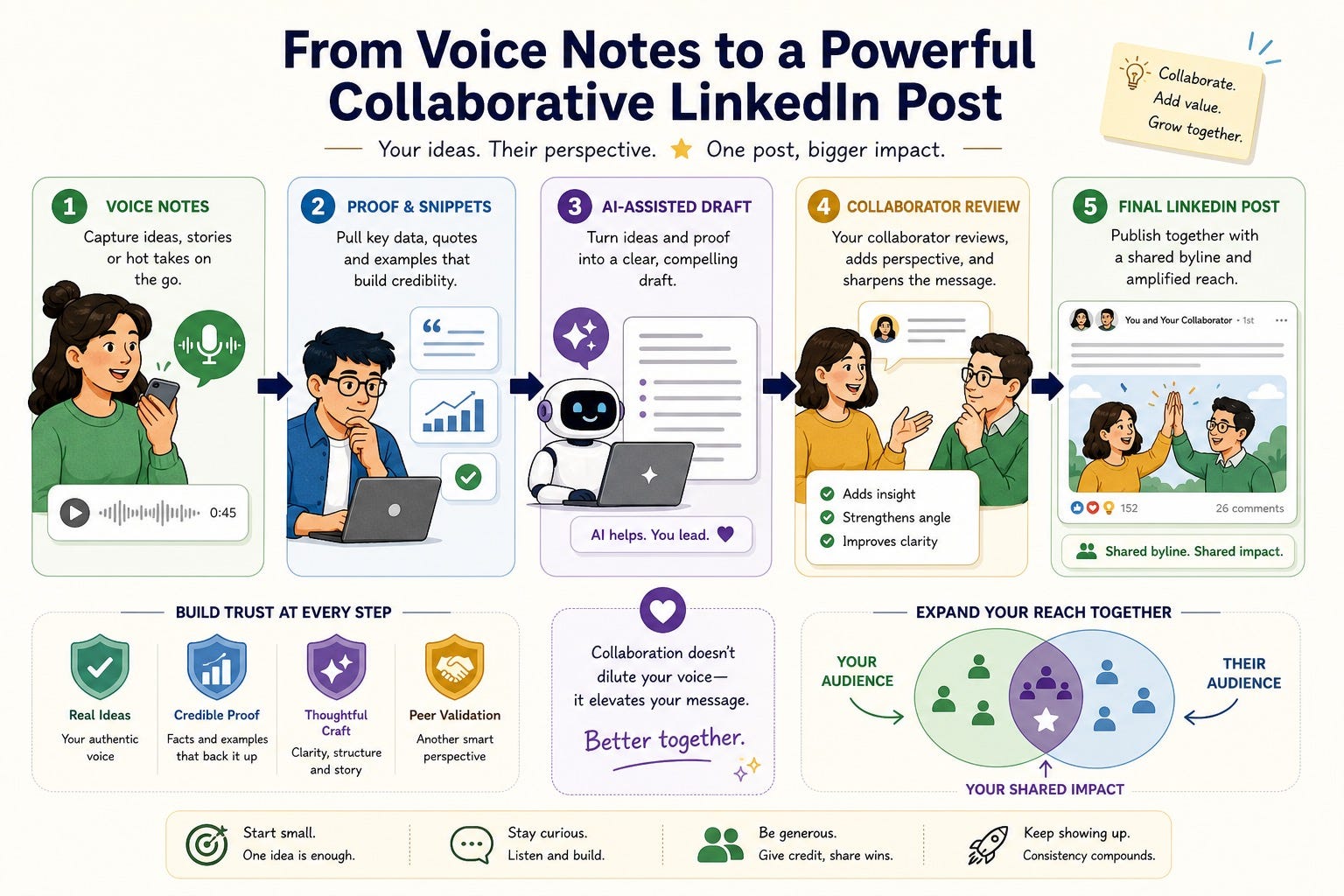
An AI Workflow That Helps Without Taking Over
This is a good place for AI, but only behind the scenes. Let AI support the preparation, not impersonate the relationship.
Ask each collaborator for raw input first. Use voice notes, bullet points, screenshots, lesson lists, or Slack-style fragments.
Have AI cluster the material into themes: problem, method, result, disagreement, surprise, and takeaway.
Draft a skeleton with clear roles. Which line sounds like the founder? Which point belongs to the operator? Which proof belongs to the client?
Use AI to compress, not invent. Ask it to tighten repetition, surface stronger verbs, and remove jargon.
Run a “human residue” pass. Add lived details, uncertainty, tradeoffs, and phrasing each collaborator actually uses.
Ask each collaborator to approve not just the facts, but the tone. That is where trust is won.
A useful prompt is: “Organize these notes into one LinkedIn post that preserves each person’s perspective, keeps the voice conversational, highlights proof before opinion, and avoids generic inspiration language.”
Then edit hard. Delete lines that could have been written by anyone. Keep lines that sound like this project could only have happened with these people.
Five Collaborative Post Formats That Work for Personal Branding
1. The Shared Lesson
Two people explain what they learned from the same project from different angles. This works well for founder-client, consultant-client, and manager-operator pairings.
2. The Before-and-After
One collaborator frames the original problem. The other explains what changed. This format is ideal for consultants, coaches, recruiters, and technical experts with proof.
3. The Build Narrative
Use this when launching a product, system, or public resource. One person gives the strategic why. Another gives the practical how. Together, the post feels more complete and less promotional.
4. The Contrasting Perspective
One collaborator brings creative or market insight. The other brings operational or technical reality. These posts often perform well because they do not read like consensus theater.
5. The Public Thank-You With Substance
Most thank-you posts are forgettable. But a collaborative version can become memorable if it teaches something specific about process, leadership, or customer success instead of just celebrating the relationship.

How to Structure the Post So It Feels Real
The best collaborative posts are usually simpler than solo thought-leadership posts. Use a structure like this:
Start with the situation. What were you trying to solve or learn?
Name why the collaboration matters. Why are both of you here?
Share one to three concrete observations, each tied to someone visible in the byline.
Include proof. Numbers, decisions, constraints, mistakes, or changed behavior.
End with a useful takeaway, not a vague moral.
If you want a reliable test, read the draft aloud and ask: “Does this sound like two real humans who did something together, or one content system trying to simulate chemistry?”
Mistakes That Quietly Damage the Brand
Choosing collaborators only for audience size. Reach without relevance looks opportunistic.
Publishing generic praise with no proof. This feels like networking theater.
Letting AI flatten both voices into the same tone. Different people should sound different.
Using the collaboration to hide weak positioning. A shared post cannot fix an unclear brand.
Overusing the format. If every post is a collaboration, none of them feel special.
A Simple 45-Minute System
If you want to test this without overcomplicating it, use this workflow:
List three people whose public association would genuinely strengthen your credibility.
Pick one shared topic tied to real work from the last 90 days.
Collect five bullet points from each person.
Use AI to group the notes into one angle and one draft.
Edit for specificity, proof, and voice.
Publish only if both people would still stand behind the post six months from now.
That last line matters. Strong personal branding is not about squeezing every new feature for exposure. It is about building a searchable, believable trail of public evidence. Collaborative posts can become part of that trail if they show the kinds of people who trust you enough to share the microphone.
The Bigger Personal Branding Shift
The old internet rewarded the loudest self-publisher. The current one rewards the clearest trust stack.
That trust stack includes proof of work, visible relationships, consistent voice, searchability, and a public identity that still feels human when AI is everywhere. LinkedIn collaborative posts are useful because they strengthen one part of that stack: public relational proof.
If you use them well, people do not just see your opinion. They see who validates your judgment, who builds with you, who learns with you, and who is willing to appear next to your name. That is a stronger personal brand than polished solo posting alone can usually create.
FAQ
What are LinkedIn collaborative posts?
They are public LinkedIn posts that can include multiple collaborators, such as members or Pages, so the content appears with shared authorship instead of a single byline. LinkedIn says the feature is rolling out gradually.
Do LinkedIn collaborative posts help personal branding?
Yes, when the collaboration reflects a real working relationship or a real shared perspective. They can strengthen trust faster than solo posts because another credible person is visibly attached to the idea.
Who should I collaborate with on LinkedIn?
Choose people whose presence adds proof, perspective, or accountability. Good collaborators include clients, partners, subject-matter experts, team leads, mentors, or creators with a complementary role. Avoid purely decorative pairings.
Can I use AI to write collaborative LinkedIn posts?
Use AI to organize notes, compress repetition, and suggest structure. Do not use it to invent the relationship, flatten both voices into one, or generate fake proof. AI should support the process, not replace the human judgment behind it.
How often should I post collaborative content on LinkedIn?
Use it selectively. Collaborative posts work best when they mark something meaningful: a project, launch, insight, lesson, or proof point. If you use them too often, they start to look tactical instead of credible.
What is the biggest mistake with LinkedIn collaborative posts?
The biggest mistake is using them as a reach hack with no real shared stake. If the other person’s name does not materially improve the idea, the post will feel forced and can weaken your brand.