


AI is raising the bar for knowledge work at the same moment LinkedIn is rewarding richer, more human content. That combination is not a threat if you build your professional visibility like a system instead of a posting habit.
Two signals landed within days of each other, and together they say more about career growth in 2026 than another round of generic AI advice ever could.
On April 30, 2026, LinkedIn said paid video was growing nearly 30 percent year over year while original posts rose 14 percent. Then on May 5, 2026, Reuters reported that Freshworks would cut 11 percent of its workforce, with the CEO saying AI and automation were removing routine work across the business. One story is about distribution. The other is about labor pressure. Put them together and the message is blunt: professionals now have to show their thinking, not just list their experience.
The market is becoming less forgiving of invisible expertise. If your work is good but hard to see, explain, or trust quickly, AI will not just compete with you. It will compress the value of what you do.
That is why a serious LinkedIn content strategy in 2026 is no longer a side project for creators. It is a career asset for founders, consultants, operators, engineers, recruiters, and anyone whose next opportunity depends on being understood before they are interviewed.
The mistake many people make is assuming this means posting more. It does not. The right response is to build a proof-based personal branding system that makes your expertise easy to notice, easy to remember, and easy to trust.
What actually changed in 2026
Most summaries of the LinkedIn algorithm stop at the usual points: write a stronger hook, ask better questions, avoid links too early, and show up consistently. That advice is fine, but it misses the more important shift.
LinkedIn is moving toward content that behaves more like a knowledge graph and less like a popularity contest. Reach is still influenced by engagement, but the quality of engagement matters more than vanity reactions. The platform is trying to connect ideas to the right professionals, not merely amplify whoever games the feed first.
The new advantage belongs to professionals who can package insight, evidence, and personality into a format the feed can understand quickly.
That matters because AI has flooded the market with acceptable writing. Average text is now abundant. Clear thinking with lived context is not. In practice, that means three things are rising in value:
Specific points of view tied to real work
Proof assets such as walkthroughs, examples, demos, and before-and-after thinking
Formats that communicate trust faster than text alone, especially native video and visual explanation
If you are still posting broad lessons with no evidence, the problem is not that the algorithm is unfair. The problem is that your content is now indistinguishable from everyone else using AI to sound polished.
The new job of personal branding
In 2023 and 2024, personal branding was often treated like online visibility theater. People optimized for impressions, follower counts, and performative consistency. In 2026, the job is different. Your personal brand is now a translation layer between what you know and how quickly the market can trust it.
Think of it like product packaging. A great product in a blank box gets ignored. A mediocre product in a shiny box gets one chance. But the professional who wins over time is the one whose packaging makes the substance obvious. That is the goal.
For AI professionals especially, this matters more than ever. If you work in product, operations, growth, engineering, sales, recruiting, or consulting, employers and clients are asking a new question: can this person use AI to create leverage, not just opinions?
Your content should answer that question before anyone asks it directly.
The 2026 personal branding system
1. Anchor your brand to a business problem
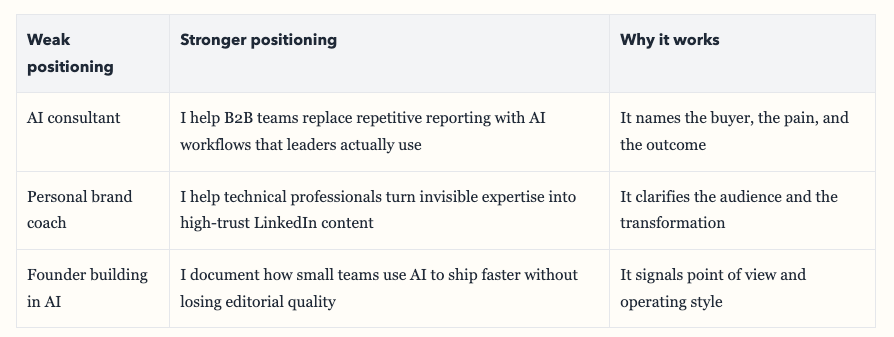
Too many smart professionals brand themselves around vague identities such as AI strategist, builder, creator, future-of-work thinker, or growth expert. Those labels are easy to write and hard to trust. Instead, anchor your positioning to a business problem you repeatedly solve.
2. Publish in layers, not one-off posts
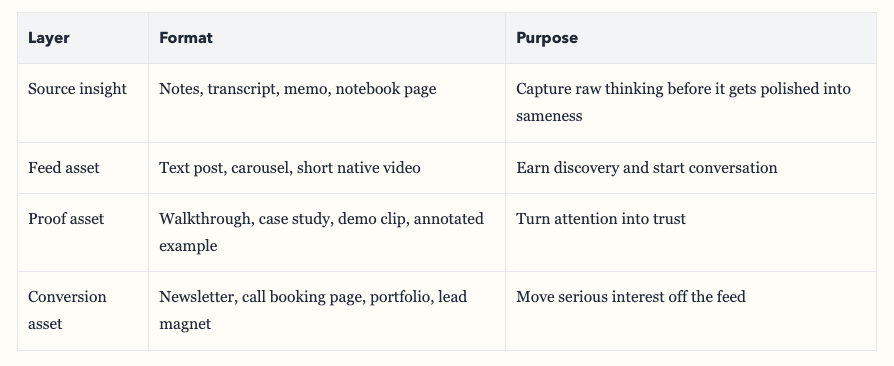
Professionals burn out on LinkedIn because they treat every post like a new invention. That is the wrong mental model. Strong creators work from a source asset and repurpose it into layers.
One customer call, one meeting recap, one failed experiment, one product demo, or one internal memo can become a week of useful content if you structure it correctly.
3. Use AI as a production layer, not a personality substitute
The fastest way to become forgettable is to let AI smooth every edge off your thinking. Use it for compression, organization, and first-draft acceleration. Do not use it to replace judgment. If your content sounds like it was generated by a committee of polite robots, your professional signal drops immediately.
A better rule is this: AI can help you shape the package, but it cannot be the source of the story. Your experience, examples, and opinions still need to carry the weight.
A practical content operating system for busy professionals
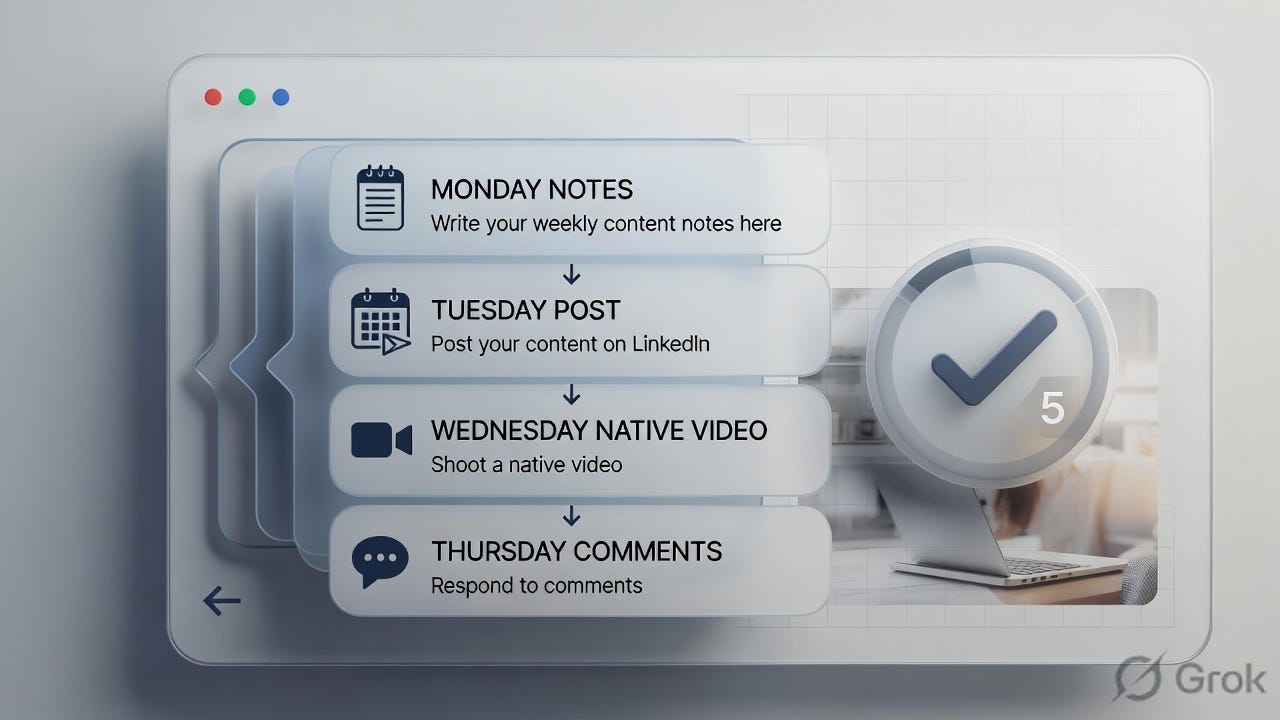
You do not need a media company. You need a repeatable weekly rhythm. Here is a simple five-day operating cadence that works well for founders and technical professionals.
Monday: Capture one idea from real work. Write what happened, what surprised you, and what changed your mind.
Tuesday: Turn that idea into one sharp text post with a clear professional lesson.
Wednesday: Expand the same idea into a proof asset such as a short video, annotated screenshot, or mini case study.
Thursday: Engage with comments, collect objections, and note which phrases people repeat back to you.
Friday: Package the week’s best insight into an owned asset such as a newsletter issue, portfolio entry, or short resource.
This is where many professionals should rethink video. A short native explainer built from an existing insight can do the work of three text posts because it carries tone, confidence, and proof at the same time. If you do not want to record yourself every week, a lightweight workflow using an avatar-based explainer on portfoliovideo.com can turn a written insight into a reusable proof asset without creating a full production burden.
The point is not to become a video creator. The point is to reduce friction between expertise and trust.
A simple workflow template
weekly_brand_system:
  source_event: “customer call, team retro, experiment, hiring lesson”
  core_question: “what changed how I think?”
  text_post:
    hook: “name the tension in one sentence”
    body: “show the lesson with one concrete example”
    close: “invite a specific kind of response”
  proof_asset:
    format: “native video or annotated walkthrough”
    length: “45 to 90 seconds”
    purpose: “make the insight easier to trust”
  owned_asset:
    format: “newsletter issue or portfolio entry”
    purpose: “capture demand beyond the feed”
What to post when everyone else sounds the same
If the feed feels crowded, that is because it is. The answer is not louder content. It is better evidence. When in doubt, post from one of these four angles.
Share decision-making, not just conclusions
People trust a mind they can follow. Break down why you chose one tool, one hire, one go-to-market bet, or one product tradeoff over another. That makes your thinking legible.
Show work in motion
Early drafts, workflow maps, customer patterns, and revised assumptions often outperform polished summaries because they reveal how you operate. The audience is not only buying your answer. They are evaluating your process.
Document pattern recognition
Anyone can repost headlines about AI. Fewer professionals can explain what those headlines mean inside a team, a pipeline, a budget, or a hiring plan. If you want authority, become a translator of change.
Teach from friction
The most useful insights often come from what failed, broke, stalled, or surprised you. Friction is memorable because it contains stakes. A clean success story is nice. A lesson earned under pressure is believable.

Mistakes that now cost you reach and trust
Posting broad inspiration with no real operating detail
Using AI to make every sentence polished but emotionally flat
Sending people off-platform before the value is clear
Treating video like a vanity format instead of a proof format
Optimizing for likes when your real goal is qualified conversations
The fourth point matters more than most people realize. Video is not automatically better than text. It becomes powerful when it reduces ambiguity. A useful video says, this is how I think, this is how I explain, and this is what it is like to work with me. That is why it compounds trust faster than a polished paragraph ever will.
The metrics worth caring about in 2026
Impressions still matter, but only as a diagnostic. The better questions are:
Are the right people commenting, not just more people?
Are profile views rising after your best posts?
Are more conversations moving into direct messages, calls, or email?
Are people referencing your ideas back to you in meetings?
Are you building assets that still work when a single post stops performing?
A personal brand is healthy when your best ideas keep attracting trust after the post itself fades. That is why owned assets matter. Feed reach is rented land. Your deeper explanations, archives, newsletters, and proof pages are not.
What this means for the next six months
The professionals who win the second half of 2026 will not necessarily be the loudest or the most polished. They will be the ones who build a small, durable media system around real expertise.
That system will probably look less glamorous than influencer culture suggests. It will involve notes, examples, short explanations, better questions, and consistent proof. But it will work, because it is aligned with how trust is actually built in an AI-heavy market.
If AI is shrinking the value of routine output, your advantage has to move up the stack. Your judgment. Your framing. Your taste. Your ability to explain. Your ability to connect abstract change to real business action. LinkedIn is still one of the best distribution surfaces for that, especially when you use it to move people from awareness to evidence.
So do not ask whether you should post more in 2026. Ask whether your expertise has a system around it. If it does not, build one now. The market is moving too quickly to stay brilliant and invisible.