


LinkedIn’s new Creator Marketplace is not just a creator-economy story. It is a signal that professional reputation, visible expertise, and public trust are becoming searchable business assets.

Most people will read the launch of LinkedIn Creator Marketplace as social-platform news. More monetization. More creators. More sponsored content. That reading is too shallow.
The real shift is bigger: LinkedIn is turning professional credibility into an indexed discovery layer. If brands can search by topic expertise, audience fit, and content quality, your personal brand is no longer just a reputation signal. It becomes inventory. Not in a cynical way. In a market-structure way.
That matters for founders, consultants, operators, executives, and niche experts who do not want to become internet celebrities. You do not need to post twenty times a week. You do need to become easier to understand, easier to trust, and easier to evaluate.
LinkedIn’s own recent research points in the same direction. The company says trusted networks outrank AI and search as a professional advice source, and that marketers are increasing investment in creators and expert voices. In other words: buyers and brands are looking for humans they can believe.
This creates a useful question for personal branding: if someone discovered your profile, your posts, and your public body of work today, would they quickly understand what you know, who you help, and why your perspective is worth paying attention to?
If the answer is no, Creator Marketplace is not a monetization problem for you yet. It is a packaging problem.
Why This Matters Even If You Never Call Yourself a Creator
Many professionals reject the word creator because it sounds performative. Fair enough. But LinkedIn is defining creators in a business-native way: people with visible expertise, consistent points of view, and content that influences decisions.
That means the future winner is not the loudest person in the feed. It is the clearest one.
The important mental shift: stop asking, “How do I look more active?” Start asking, “How do I become easier to classify, trust, and recommend?”
In practice, brands do not need more generic thought leadership. They need experts whose content reduces risk. A founder who explains hard tradeoffs clearly. A consultant who turns messy change into plain language. A technical leader who makes complex systems legible. A category expert whose commentary sounds lived, not assembled.
This is why personal branding is moving away from broad visibility and toward structured credibility. LinkedIn’s Creator Marketplace simply makes that shift easier to see.
What Brands Are Likely Filtering For
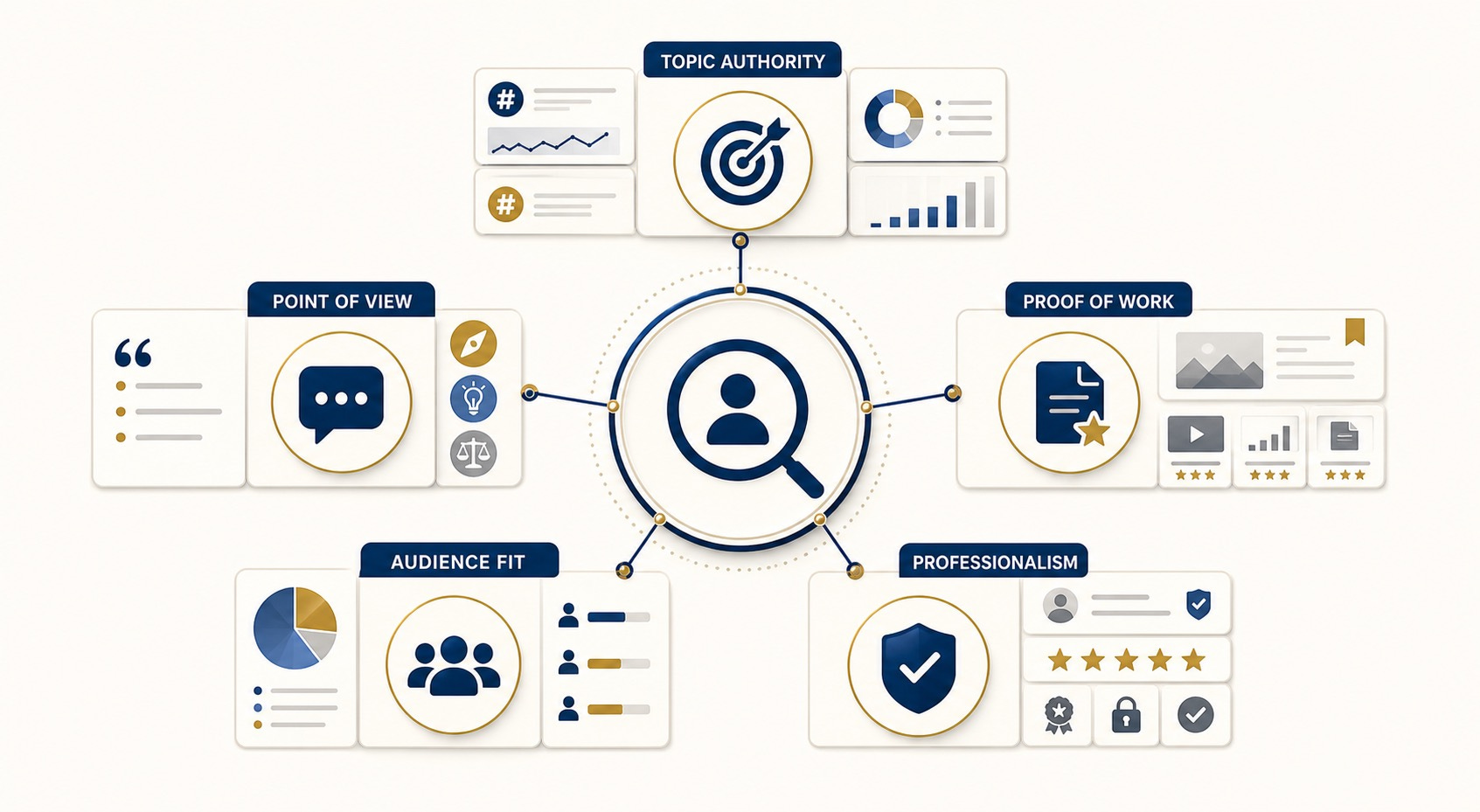
LinkedIn says brands can search for creators by topic and assess audience, performance, and fit. That sounds simple, but it has deep implications. The platform is telling you what signals matter.
1. Clear topic authority
If your posts swing between product takes, fitness updates, vague motivation, and random reposts, you may look active but hard to place. Discoverability starts with category coherence. A viewer should be able to skim ten recent posts and name your territory in one sentence.
2. Recognizable point of view
Authority is not just subject matter. It is pattern recognition plus judgment. Two people can cover the same AI or startup topic, but the more memorable voice has a distinct way of framing tradeoffs, risks, and priorities.
3. Public proof
Proof beats polish. Screenshots of process, teardown threads, field notes, before-and-after examples, mini case studies, workshop clips, hiring insights, and lessons from real projects all signal substance faster than generic advice posts.
4. Audience relevance
Brands care less about raw follower count than whether the right people pay attention. A consultant with five thousand relevant operators can be more valuable than a broad audience that does not map to buying decisions.
5. Low-friction professionalism
If your profile photo, headline, About section, featured links, post quality, and reply behavior feel inconsistent, a brand or buyer has to work too hard to trust you. Friction kills momentum.
The Personal Brand Stack That Makes You Opportunity-Ready
You do not need a massive content engine. You need a clean system. Here is the stack I would build for any expert preparing for Creator Marketplace-style discovery.
Positioning layer
Write one sentence that answers three things: who you help, what problem you are known for, and what lens makes your view different. This should show up in your headline, About section, featured content, and recurring post themes.
Weak positioning says, “I help companies grow.” Strong positioning says, “I help B2B founders turn complex product stories into trusted demand signals.”
Proof layer
Collect ten pieces of visible evidence: a client result, framework, annotated screenshot, conference insight, product teardown, industry memo, public lesson, media quote, process checklist, or opinion backed by real work. These are your raw materials.
Editorial layer
Create three recurring content lanes. For example: field notes from work, opinionated takes on industry shifts, and breakdowns of how you solve one narrow problem. Repetition is not boring when it deepens recognition.
Interaction layer
Most professionals underestimate replies. Your comments are often the fastest proof that you can think in public. If your posts are sharp but your comments are empty, your brand feels managed. If your comments add clarity, your brand feels real.
Asset layer
Make sure your featured section and top posts act like a starter kit. When someone lands on your profile, they should immediately find your best explainer, strongest proof, and clearest invitation to work with you.
How to Use AI Without Turning Your Voice Into Wallpaper
This is where many personal brands break. AI makes consistency easier, but it also makes sameness cheap. If you use it lazily, your profile becomes fluent and forgettable.
The better use of AI is not autoposting. It is editorial compression.
Use AI for these jobs:
Pull recurring themes from your last 20 posts, comments, calls, or notes
Extract your strongest phrases and repeated beliefs so your voice stays recognizable
Turn raw transcripts, Slack notes, voice memos, and workshop fragments into outlines
Pressure-test whether a post is too broad, too safe, or too generic
Generate alternate hooks for different audience segments without changing the core insight
Do not use AI to invent experience you do not have. Do not use it to fake certainty. And do not let it smooth away your edges. The sentence that feels slightly too specific is usually the one people remember.
A useful workflow is simple:
Capture one real observation from work.
Ask AI to organize it into three angles: lesson, warning, and practical takeaway.
Choose the angle that sounds most like you.
Rewrite the first paragraph manually.
Add one concrete example and one sentence you would actually say out loud.
That last step matters. Authenticity is not mystical. It is often just spoken-language texture plus real stakes.
A Simple 30-Day Creator Marketplace Readiness Plan
If you want a practical starting point, spend the next 30 days making your personal brand easier to evaluate.
Week 1: Clarify your category
Rewrite your headline and About section around one expertise lane. Remove vague language. Pin three pieces of content that represent your best thinking.
Week 2: Publish proof, not motivation
Post three pieces of evidence-based content: one teardown, one field note, one practical framework. Show how you think, not just what you believe.
Week 3: Improve discoverability
Review your last 15 posts. Are the right keywords and topic signals repeated naturally? Could an outsider tell what you are known for? If not, tighten the language and examples.
Week 4: Build your best-work shelf
Create a mini library of reusable assets: a short bio, collaboration topics, speaking themes, best posts, short case studies, and a clean contact path. Even before Creator Marketplace access expands, this makes you easier to book, cite, and refer.

The Biggest Mistakes to Avoid
The first mistake is optimizing for creator aesthetics instead of professional clarity. Fancy hooks, dramatic formatting, and synthetic vulnerability are not substitutes for expertise.
The second mistake is treating every post like a broad audience play. Creator Marketplace logic rewards relevance. A narrower, more useful body of work often outperforms generic appeal.
The third mistake is sounding too clean. Ghostwritten polish can help with structure, but over-processed content removes human judgment. In a trust market, frictionless language can read as low-trust language.
The fourth mistake is ignoring replies, DMs, and follow-up behavior. Your brand is not only your publishing style. It is also your participation style. People notice whether your public voice survives conversation.
How to Tell If Your Personal Brand Is Marketplace-Ready
A simple test is to imagine a brand strategist, podcast host, or event organizer landing on your profile with only ninety seconds to decide whether you are worth shortlisting. Could they answer five questions fast: what do you know, who do you help, what proof backs it up, what topics you are safe to associate with, and what kind of audience already trusts you?
If any of those answers are fuzzy, your next move is not more posting. It is better packaging. Tighten your topic lane. Replace vague inspiration with evidence. Make your featured section more useful. Turn your best comments and recurring audience questions into future content assets. The goal is not to look busier. The goal is to reduce evaluation time for the right people.
The Real Opportunity
The best part of this shift is that it rewards professionals who are useful, not just entertaining. LinkedIn’s Creator Marketplace is early, and access may stay limited for a while. That is fine. The deeper opportunity starts now.
When platforms build discovery systems around expertise, they force a healthier question: what evidence does your public identity give other people?
If your current answer is mostly activity, likes, and vague thought leadership, you are still easy to ignore. If your answer becomes category clarity, proof, viewpoint, and visible trust, you become much easier to find and much harder to replace.
That is the real personal-brand upgrade here. Not more content. Better legibility.
FAQ
What is LinkedIn Creator Marketplace?
It is LinkedIn’s new system inside Campaign Manager that helps brands discover and evaluate creators by topic expertise, audience fit, and content signals, then reach out for partnerships.
How does LinkedIn Creator Marketplace affect personal branding?
It raises the value of a clear, trust-first public identity. Your profile, posts, and proof of expertise become easier for brands and buyers to scan, compare, and act on.
Do I need a huge audience to benefit from LinkedIn Creator Marketplace?
No. For many B2B experts, relevance matters more than scale. A smaller audience with the right decision-makers can be more useful than a larger but mismatched following.
Can I use AI for LinkedIn personal branding without sounding fake?
Yes, if AI is used to organize your ideas, extract patterns, and improve structure rather than generate generic opinions or borrowed experience. The raw insight still needs to be yours.
What should I fix first if I want to become more discoverable?
Start with positioning. If someone cannot tell what you are known for in a few seconds, everything else is harder. Then improve proof, featured assets, and topic consistency.
Is LinkedIn Creator Marketplace only for full-time creators?
No. It is especially relevant for founders, consultants, executives, operators, and niche experts whose professional credibility can influence buying decisions, partnerships, or speaking opportunities.