


Your LinkedIn headline is not a label. It is the line that decides whether a recruiter, client, collaborator, investor, or podcast host clicks to learn more. In an AI-saturated feed, that makes it one of the highest-leverage pieces of personal branding you own.
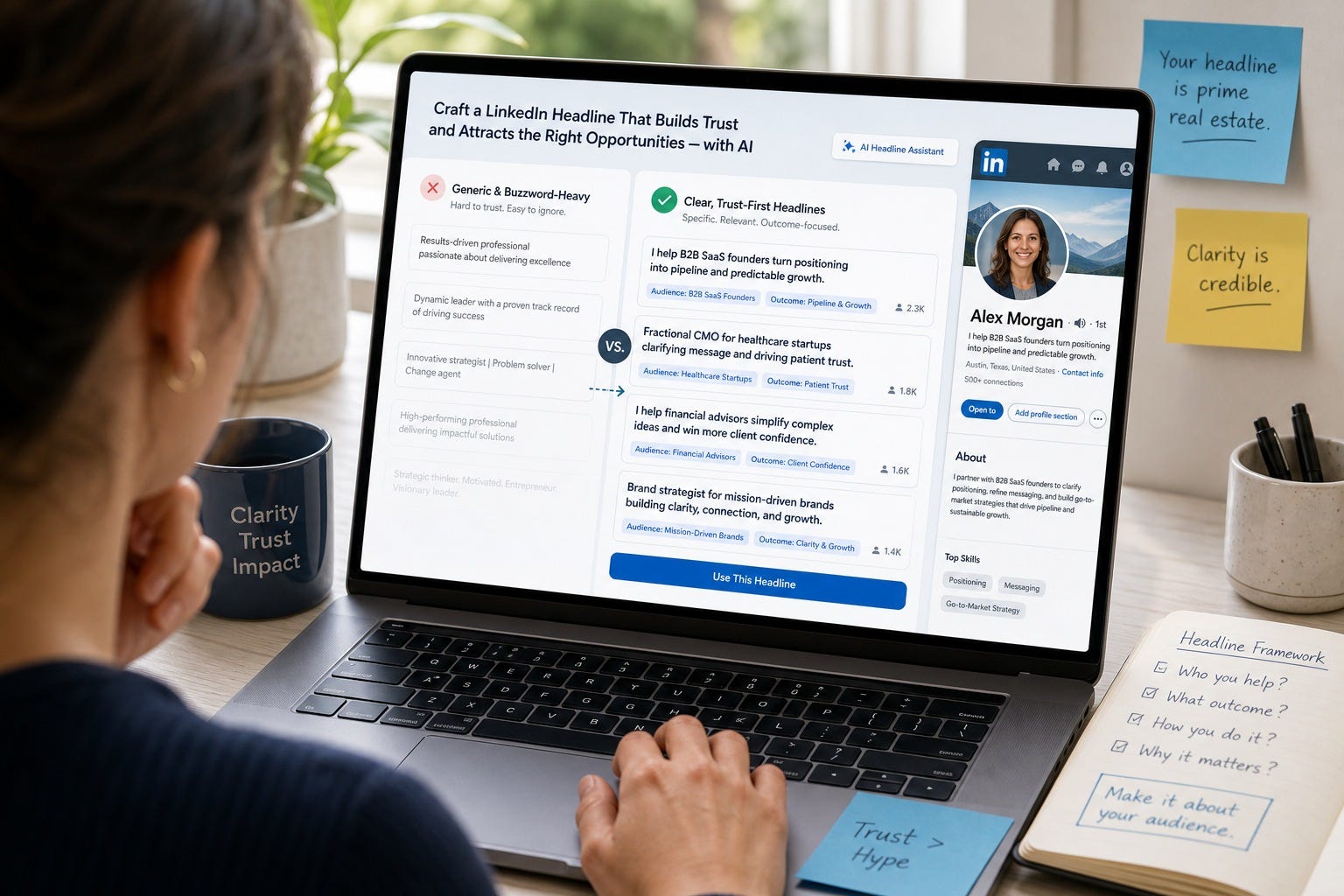
A strong headline does not try to say everything. It makes the right person want the next click.
Most professionals still use their LinkedIn headline like a name tag. They paste in a job title, add a few buzzwords, maybe stack some vertical bars, and hope it feels polished enough. The problem is that LinkedIn rarely shows your full story first. It shows your headline in search results, comments, connection requests, profile previews, and feed interactions. People often see that line before they see your About section, your Featured links, or your actual work.
That means the headline has a different job than most people think. It does not need to summarize your whole career. It needs to create immediate clarity, signal relevance, and earn curiosity from the right audience. If you use AI to help, it needs to sharpen that clarity without flattening your voice into another generic professional slogan.
The best LinkedIn headlines are not written for everyone. They are written for the few people you actually want to attract.
This is where personal branding gets practical. A better headline can help you look more coherent, more searchable, and more trustworthy. It can make your profile feel less like a static resume and more like a sharp landing page for your reputation. And because LinkedIn is dialing back generic AI-style content that lacks clear perspective, bland headline formulas are becoming even less useful.
Why the headline matters more now
Three shifts make the headline more important than it used to be.
AI has made polished wording cheap. Almost anyone can sound competent for one sentence. That means specificity matters more than smoothness.
Search and recommendation systems need clearer signals. LinkedIn keeps moving toward skills, proof, and visible relevance, not just static credentials.
People scan faster than ever. Your headline often gets judged in seconds, sometimes without a single click.
Think about how your profile is discovered. Maybe someone sees you in a comment thread. Maybe your name shows up in recruiter search. Maybe a founder lands on your profile after hearing your name on a podcast. In every case, your headline helps answer the first silent question: “Why should I care about this person right now?”
If the answer is vague, you lose the click. If the answer is overloaded with empty jargon, you also lose the click. Personal branding works when the headline bridges identity and usefulness. It should tell people what kind of professional you are, who you help or influence, and what you are known for in a way that feels credible.
What a strong LinkedIn headline actually needs
Good headlines vary by role, but most strong ones contain four layers.
1. A clear professional identity
This is the easiest part to get right. You need a recognizable role, specialty, or category. For some people that is a title. For others it is a functional identity, like product marketer, AI consultant, founder, or technical writer.
2. Audience or context
Who is the work for? What world are you operating in? A headline becomes more memorable when it places you in a useful context: B2B SaaS, early-stage founders, healthcare teams, job seekers, developer tools, and so on.
3. Outcome or value
What changes because of your work? This is where many headlines improve fast. Outcomes beat adjectives. “Trusted advisor” is weak. “Helps compliance teams explain complex regulation clearly” is stronger. One sounds self-congratulatory. The other sounds useful.
4. Proof or signal of seriousness
You do not always need this, but it helps. Proof can be a product category, a known capability, a visible specialization, or a real body of work. It is often better to imply credibility through specificity than to claim it directly.
Simple test: if your headline could belong to 500 other people in your industry, it is probably too generic to support strong personal branding.
The trust-first formula
Here is the formula I recommend when using AI to draft headline options:
Identity + audience/context + outcome + optional proof signal
That does not mean every headline needs all four parts spelled out. It means your options should be generated from those four ingredients. Once you do that, you can compress the sentence until it feels natural.
For example:
Founder: B2B SaaS Founder | Helping RevOps teams reduce pipeline waste with cleaner attribution
Consultant: Pricing Consultant for Agencies | I help service firms raise margins without wrecking sales conversations
Job seeker: Product Analyst | Turning messy user data into clearer product decisions | Open to analytics roles
Executive: Operations Leader | Scaling systems, teams, and accountability across multi-site healthcare
Creator or expert: Cybersecurity Educator | Making AI security risks easier for non-technical leaders to act on
Notice what these examples do not do. They do not say “passionate,” “visionary,” “results-driven,” or “thought leader.” Those words are weak because they cost nothing to claim. A better headline uses language that feels harder to fake.
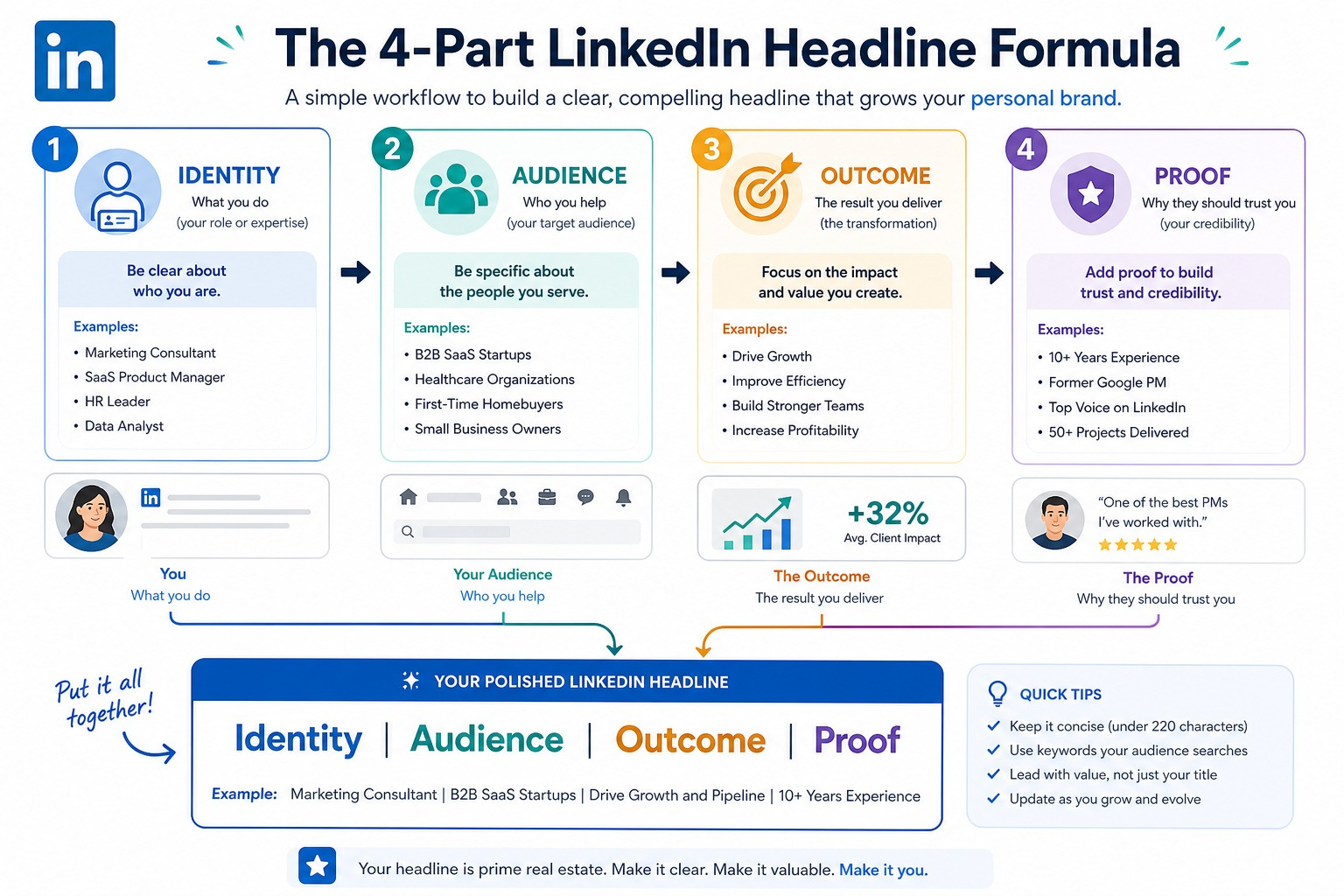
The formula matters less than the discipline: clarity first, credibility second, style third.
How to use AI without sounding AI-written
AI is useful here, but only if you give it real constraints. Most bad AI headlines happen because the prompt is too broad. People ask for “ten professional LinkedIn headlines” and get ten polished copies of the same empty sentence.
Use AI like an interviewer and compressor, not a magician. Start by feeding it raw inputs:
what you do
who you help
what problems you solve
what proof you can honestly imply
what tone you want to avoid
Then use a prompt like this:
Write 15 LinkedIn headline options for personal branding. Use my real role, audience, and outcomes. Avoid buzzwords, self-congratulatory language, and generic AI phrasing. Make each option specific, human, and credible. Prioritize clarity over cleverness. Give me five conservative options, five authority-building options, and five options optimized for recruiter or client search.
After that, do not pick the smoothest line. Pick the line that makes the right reader understand you fastest. Then revise by hand. Add your vocabulary. Remove any phrase you would never say out loud. If it sounds like a personal branding consultant wrote it for a stranger, it is not ready.
Headline examples by audience
For founders
Founders often make the same mistake: they use the headline to name the company but not the relevance. If you are an early-stage founder, the stronger move is to connect the company to the problem you solve.
Weak: Founder at Acme Labs
Stronger: Founder at Acme Labs | Building AI workflow tools for finance teams that are done with spreadsheet chaos
For consultants and freelancers
Your headline should make fit obvious. That means niche, problem, and outcome usually outperform broad authority claims.
Weak: Brand Consultant | Helping businesses grow
Stronger: Personal Branding Consultant for Technical Founders | Turning complex expertise into clearer market trust
For job seekers
You do not need to sound desperate or vague. A strong job-seeker headline can frame you around target role, strengths, and direction.
Weak: Seeking new opportunities
Stronger: UX Researcher | Mixed-methods insights for fintech products | Open to user research roles
For executives
Executive headlines work best when they communicate scope and decision impact. Avoid inflated leadership theater.
Weak: Visionary executive driving transformation
Stronger: CFO | Helping growth-stage companies build cleaner forecasting, pricing discipline, and investor confidence
For creators and experts
If your personal brand depends on ideas, education, or public credibility, your headline should show what kind of knowledge you translate and for whom.
Weak: Creator | Speaker | Thought Leader
Stronger: AI Education Writer | Helping non-technical teams understand what new AI tools change at work
Five mistakes that quietly weaken your headline
Using only your job title. It may be accurate, but it often says too little to earn curiosity.
Stuffing keywords without a message. Searchability matters, but a headline still has to feel readable to humans.
Claiming status instead of showing relevance. “Expert” and “thought leader” usually weaken trust unless the surrounding proof is obvious.
Trying to serve every audience. When a headline tries to attract recruiters, clients, investors, and peers equally, it usually becomes forgettable.
Letting AI over-polish the line. If the sentence feels too smooth, it often feels less believable.
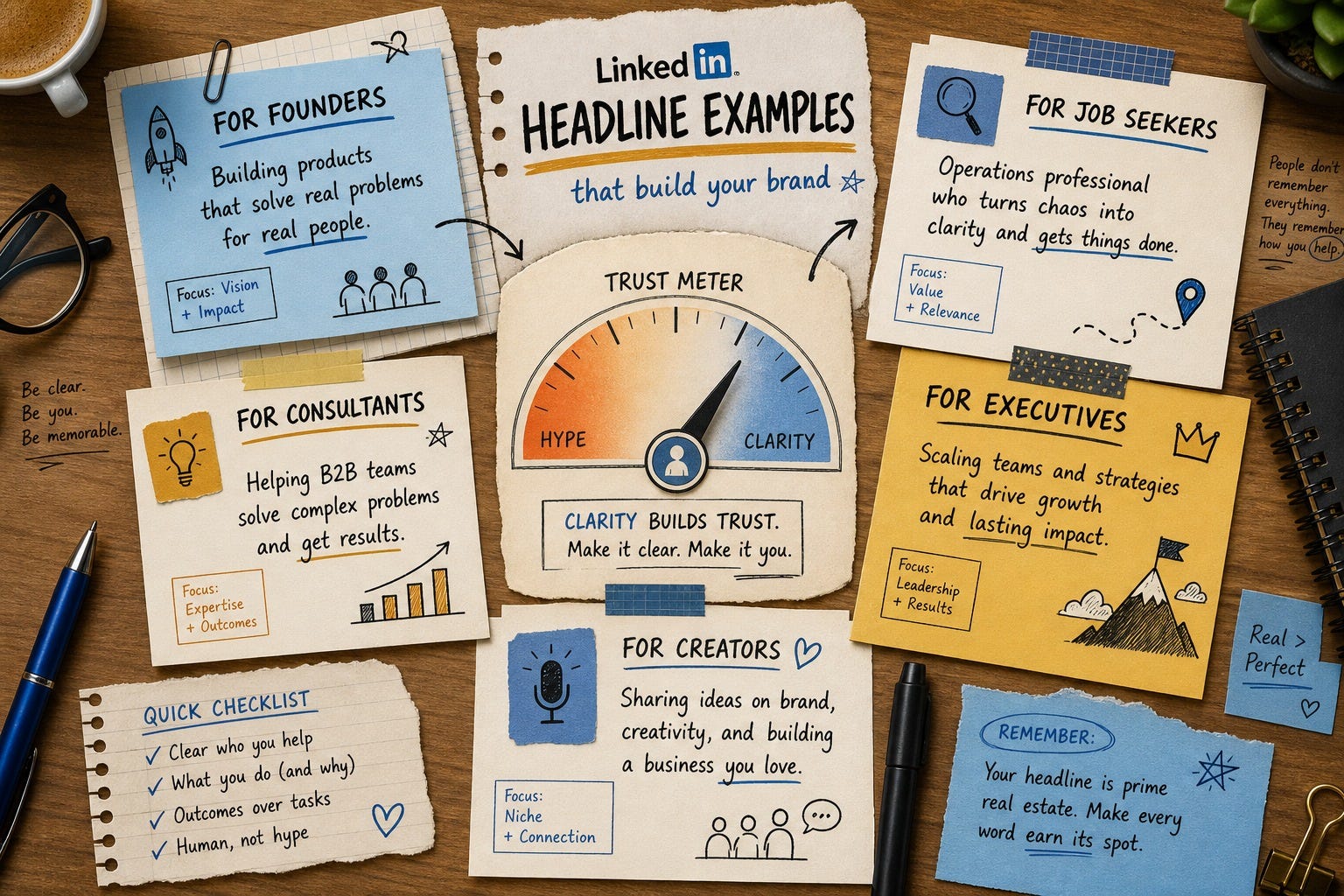
Different roles need different headline tradeoffs, but every strong version earns clarity before it tries to sound impressive.
A 20-minute rewrite sprint you can run today
If you want a fast system, use this.
Minute 1-5: Write down your real role, who you want to attract, and the outcomes you help create.
Minute 6-10: Ask AI for 15 options using those inputs and clear anti-buzzword constraints.
Minute 11-15: Delete every option that sounds interchangeable or over-optimized.
Minute 16-20: Hand-edit the best two and pick the one that a specific recruiter, client, or collaborator would understand fastest.
Then test it in context. Look at how it appears in comments, profile previews, and search. A headline that reads well in isolation may feel cluttered once it sits under your name and next to your profile image. Good personal branding is not just wording. It is wording in context.
The deeper point is this: your LinkedIn headline is not supposed to be clever branding theater. It is supposed to reduce friction. The right person should land on your profile and think, “I understand what this person does, who they matter to, and why I should keep reading.” If your headline creates that reaction, it is doing its job.
Final thought
In a market full of polished AI language, the headline that wins is usually the one that feels most grounded in real work. Use AI to generate options, not identity. Let it help you compress. Let it help you compare. But keep the final line close to the way you actually think, speak, and deliver value.
Your personal brand does not need a more dramatic headline. It needs a more precise one.
FAQ
What is the best LinkedIn headline for personal branding?
The best LinkedIn headline for personal branding clearly states your professional identity, who you help or influence, and the value or outcome you create. It should feel specific and credible, not stuffed with vague buzzwords.
Should my LinkedIn headline include keywords?
Yes, but only useful ones. Include role, specialty, industry, or audience terms that help the right people find you. Do not force a long keyword list if it makes the line unnatural.
Can I use AI to write my LinkedIn headline?
Yes. AI works well for generating options and testing angles. The important part is giving it real context and then editing the output so the final headline sounds like you, not like a template.
How long should a LinkedIn headline be?
Keep it as short as possible while still making the right idea clear. You want enough detail to feel useful, but not so much that the line becomes hard to scan in previews or search results.
Should job seekers write a different LinkedIn headline than founders or consultants?
Usually, yes. Job seekers often benefit from target role plus strengths plus openness to work. Founders and consultants usually benefit more from audience and outcome language that clarifies the problem they solve.
What makes a LinkedIn headline sound generic?
Overused claims like “results-driven,” “visionary,” or “thought leader” often feel generic because they are easy to copy. A headline sounds stronger when it names real context, audience, and outcomes.