


Most people try to grow on LinkedIn by posting more. The smarter move is often simpler: make your profile easier to find, easier to understand, and easier to trust when the right person searches.

LinkedIn is no longer just a digital business card. It is becoming a searchable authority layer for your name, niche, and proof of work.
If you are a founder, consultant, executive, freelancer, creator, student, or job seeker, LinkedIn is one of the few places where your positioning, reputation, and proof can sit in public together. That matters more now because people do not discover experts in one tidy path anymore. A client might search inside LinkedIn. A recruiter might search on Google and land on your profile. A podcast host might skim your headline, About section, Featured links, and recommendations in under two minutes before deciding whether to reply.
The problem is that most personal brands are optimized for self-expression, not discovery. They sound impressive to the person who wrote them, but vague to the person searching. They say “helping businesses scale” instead of naming the actual work. They hide proof in PDFs, old posts, and private decks. They use AI to polish language, but not to clarify what they should be found for.
That is where LinkedIn SEO for personal branding becomes useful. Not SEO in the old agency sense. SEO in the practical sense: what words you use, what proof you attach to them, what surfaces reinforce your expertise, and how clearly your profile answers the question, “Why should I trust this person for this specific thing?”
The key shift: if your profile is readable but not findable, you stay invisible. If it is findable but generic, you get ignored. Strong LinkedIn SEO for personal branding sits in the middle: searchable, specific, and human.
Why LinkedIn SEO matters more now
LinkedIn has become more creator-friendly, more public, and more searchable. That changes the job of a profile. It is not only there to summarize your career. It now acts as a filter for opportunity. The people who win are not always the loudest. They are often the clearest.
Think about how discovery actually works in high-value opportunities:
A founder wants a fractional CMO for B2B SaaS and types that phrase into LinkedIn search.
A hiring manager searches your name after seeing your application and wants a fast credibility signal.
An event organizer looks for “AI product marketing speaker” and skims the first page of profiles.
A client hears your name on a podcast, searches you, and expects your LinkedIn profile to confirm what you do in plain language.
If your profile headline, About section, Experience, Featured links, and recommendations do not line up around a clear expertise cluster, LinkedIn has less context and humans have less confidence. That is the real SEO issue.
Most professionals do not have a visibility problem. They have a translation problem. Their real expertise exists, but their profile does not translate it into searchable language.
What most LinkedIn SEO advice misses
Most guides stop at “put keywords in your headline.” That advice is not wrong. It is just incomplete.
A keyword only works when it is reinforced by proof. If your headline says “AI consultant for B2B growth,” but your Featured section shows no case study, your recommendations never mention AI, and your Experience section is written like a vague resume, then the keyword feels aspirational rather than earned.
Strong LinkedIn SEO for personal branding has four layers:
Search language: the phrases people actually use when looking for your type of expertise.
Context: enough detail for LinkedIn, Google, and humans to understand what those phrases mean in your case.
Proof: examples, assets, outcomes, and third-party validation that make the positioning believable.
Consistency: the same story repeated across headline, About, Experience, Featured, skills, recommendations, posts, and external links.
AI can help with all four layers, but only if you use it as a sorting and clarification tool. If you use it like a headline vending machine, it will push you toward the same generic language everyone else already uses.
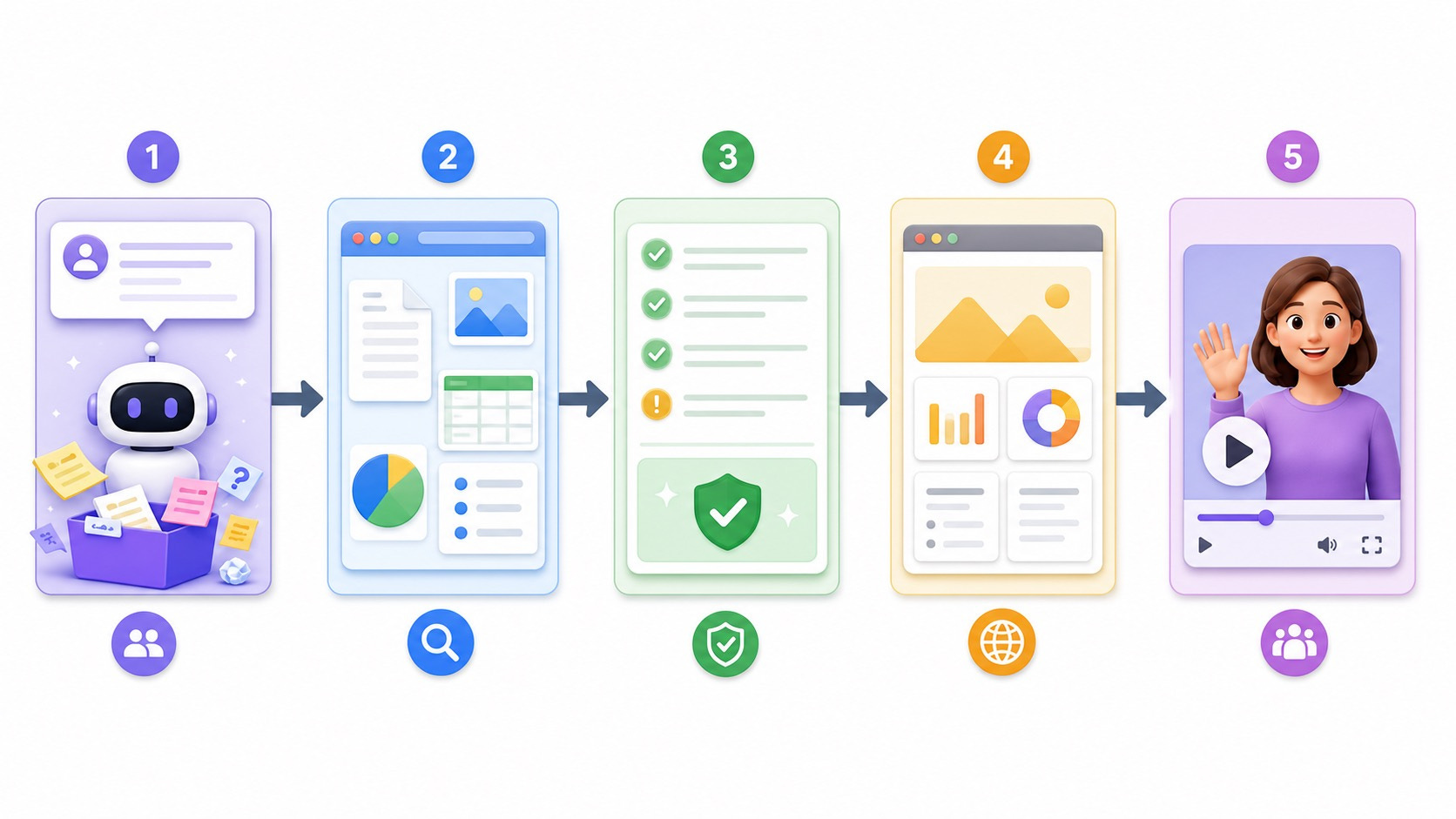
The right AI workflow does not invent a brand. It organizes the evidence you already have into searchable language.
The AI workflow I recommend for LinkedIn SEO
Start with raw material, not prompts. Open a blank doc and dump the following:
Your last 10 meaningful projects or wins
The problems people hire you to solve
The words clients or coworkers already use to describe you
The job titles, niches, and outcomes you want more of
Any proof assets you already have: case studies, screenshots, talks, articles, press mentions, demos, or testimonials
Then use AI for three tasks.
1. Build a keyword stack
Ask AI to group your raw notes into three buckets:
Core identity keywords: what you are
Problem keywords: what you solve
Proof keywords: what outcomes, assets, or methods back it up
For example, a consultant might end up with a stack like this:
Core identity: B2B SaaS positioning consultant, product marketing advisor, fractional strategist
Problem keywords: messaging clarity, go-to-market narrative, category positioning, launch adoption
Proof keywords: case studies, customer research, homepage rewrites, launch strategy, cross-functional alignment
This is more useful than asking AI for “a better LinkedIn headline” because it gives you a system, not a sentence.
2. Translate expertise into search-friendly language
Next, ask AI to rewrite your jargon into phrases a buyer, recruiter, or host would actually search. This matters because insiders often describe themselves in language that outsiders never type.
“Narrative systems thinker” might be true, but “B2B SaaS positioning consultant” is easier to find. “Operator helping brands scale” sounds polished, but “fractional CMO for health-tech startups” gives a searcher something concrete.
3. Match each keyword to visible proof
For every major keyword, ask one question: what visible asset proves this? If you claim expertise in executive messaging, can someone see a talk, article, before-and-after rewrite, testimonial, or framework? If not, the keyword is weak. AI can help identify those gaps and suggest where each proof asset belongs on the profile.
How to optimize each profile section
Headline
Your headline should not try to sound profound. It should help the right person self-select. A strong formula is:
What you do + who it is for + optional proof or angle.
Example: “B2B SaaS Positioning Consultant for Technical Founders | Messaging, Category Narrative, and Launch Clarity.”
That is not glamorous. It is useful. Useful gets searched. Useful gets clicked.
About section
Your About section should expand the headline, not repeat it. Start with the audience and problem. Then explain your approach. Then show proof. Then clarify what kind of conversations you want.
A good About section answers five questions fast:
Who do you help?
What problem do you solve?
How do you think or work differently?
What evidence supports that claim?
What should the right person do next?
Experience
Most Experience sections are underused. People list responsibilities when they should be reinforcing searchable expertise. Rewrite each role around outcomes, categories, and recognized methods. If you want to be found for AI adoption strategy, founder positioning, GTM storytelling, or creator partnerships, your Experience section should say so explicitly.
Featured section
This is where SEO becomes trust. Your Featured section should show the proof behind your keywords. Put your strongest assets first: a sharp case study, a useful article, a talk, a press mention, a framework, a portfolio page, or a short demo. If your profile says one thing and your Featured section proves another, the proof wins. Make sure they align.
Skills, recommendations, and creator proof
Skills still matter because they reinforce topic associations. Recommendations matter because they turn your claims into third-party language. Ask a few trusted people to mention the exact type of work you want more of. Not in a fake keyword-stuffed way. In a precise way that mirrors reality.
What to do if you do not want to post every day
You do not need a high-volume content strategy to improve discoverability. You do need enough public signals that your profile feels active, current, and credible.
A low-maintenance system looks like this:
Refresh your headline and About section once per quarter
Add one new Featured asset each month
Publish one thoughtful post or article when you actually have something useful to say
Leave a few high-quality comments each week on conversations connected to your niche
Update old job descriptions when your positioning changes
This works because discoverability compounds when the profile, proof, and public behavior all point in the same direction.

Search visibility gets the click. Proof assets get the trust. You need both.
The biggest mistakes that kill LinkedIn search visibility
Writing for peers instead of searchers. If only insiders understand your wording, you narrow discovery.
Using broad ambition words. “Growth,” “strategy,” “innovation,” and “leadership” mean almost nothing alone.
Letting AI flatten your voice. Clean writing helps. Generic writing harms.
Separating positioning from proof. If your profile makes claims your assets cannot support, trust drops fast.
Ignoring the Featured section. This is one of the fastest ways to turn attention into belief.
Optimizing once and disappearing. Search relevance needs small maintenance, not constant reinvention.
A 30-minute LinkedIn SEO sprint you can do this week
Write down the three phrases you most want to be found for.
Check whether those phrases appear naturally in your headline, About section, and Experience.
Pick one proof asset for each phrase and place the strongest one in Featured.
Ask AI to spot vague language and replace it with clearer audience, problem, and outcome wording.
Review the whole profile once as a stranger. Could someone understand what you do in 20 seconds?
If the answer is yes, you are already ahead of most profiles.
Final thought
Personal branding on LinkedIn is not just about looking polished. It is about being legible. The right people should be able to find you, understand you, and trust you without needing a long explanation.
That is why LinkedIn SEO matters. It is not a trick. It is the discipline of making your expertise easy to discover and hard to misunderstand. AI can speed that up, but it cannot do the thinking for you. Your job is to decide what you want to be known for. Then build a profile where the language, evidence, and public signals all reinforce that choice.
FAQ
What is LinkedIn SEO for personal branding?
It is the practice of making your LinkedIn profile easier to discover and easier to trust by using clear keywords, audience language, proof assets, and consistent positioning across every section of the profile.
Can LinkedIn profiles rank in Google search?
Yes. For many professionals, LinkedIn profiles are among the most visible pages connected to their name and expertise. That is why headline wording, About copy, and Featured assets matter beyond the platform itself.
How do I use AI for LinkedIn SEO without sounding generic?
Use AI to organize raw experience, identify keyword clusters, translate jargon into searchable language, and spot proof gaps. Do not use it to produce a finished personality in one click.
Which LinkedIn section matters most for search visibility?
Your headline usually has the fastest impact because it shapes first impressions and keyword clarity, but the best results come when headline, About, Experience, Featured, skills, and recommendations all reinforce the same expertise.
Do I need to post often to improve LinkedIn discoverability?
No. Consistent posting can help, but it is not mandatory. Many professionals can improve visibility more by clarifying positioning, upgrading proof assets, and staying lightly active with occasional posts and thoughtful comments.
What keywords should I use on my LinkedIn profile?
Use the phrases your ideal recruiter, client, collaborator, or audience would actually search for. Focus on what you do, who you do it for, the problems you solve, and the proof that backs up your claims.