


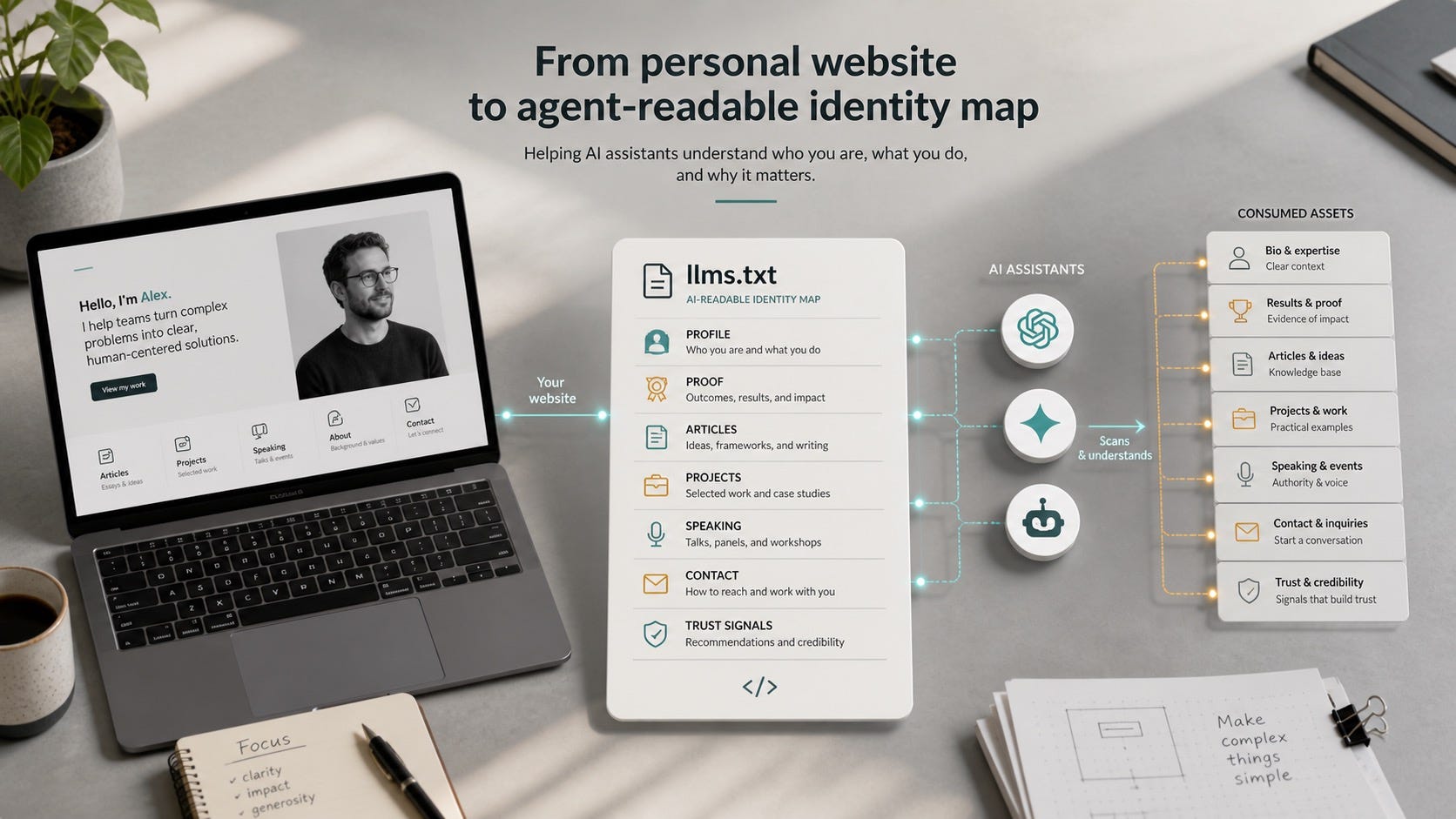
Your personal brand is no longer read only by people. It is also interpreted by search systems, browser agents, AI assistants, and hiring or buying workflows that summarize you before anyone clicks your profile.
Most professionals still optimize for the old first impression: a human lands on LinkedIn, scans a headline, reads a few posts, and decides whether they seem credible. That still matters. But a second first impression is becoming more common. Someone asks an AI tool, “Who is this person?”, “Is this consultant credible?”, “What has this founder actually built?”, or “Which expert should I follow on this topic?”
If your public identity is messy, generic, or buried inside pages that are hard to parse, the answer can become thin or wrong. That is where llms.txt enters the personal branding conversation.
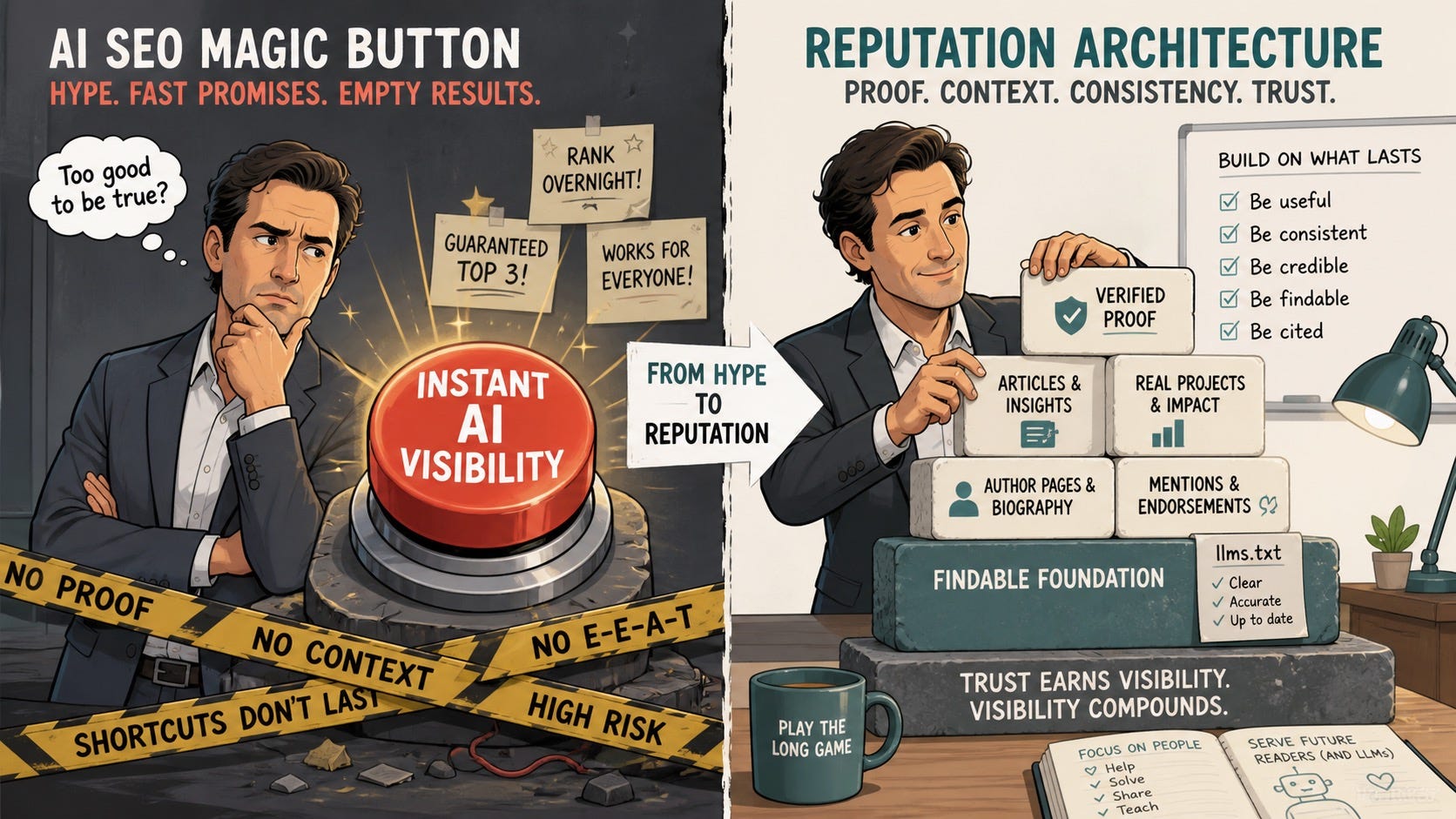
Not as a magic AI SEO button. Not as a guaranteed way to get cited by ChatGPT. Not as a replacement for good work, useful writing, clear positioning, or real proof. Think of llms.txt for personal branding as a machine-readable map of who you are, what you do, what you have proven, and where your strongest public evidence lives.
What llms.txt Actually Is
llms.txt is an emerging convention for adding a Markdown file to a website, usually at /llms.txt, that gives AI agents and large language models a concise guide to the most important information on the site. The public llms.txt proposal describes it as a way to help agents use a website by giving them clean, expert-level information in one accessible location.
For a company, that file might point to documentation, product pages, pricing, policies, case studies, and API references. For a personal brand, the same idea becomes more identity-focused. Your file can point to your best bio, strongest proof, most useful articles, public talks, portfolio pages, contact page, and verification signals.
That sounds technical, but it is not complicated. It is a plain text file written in Markdown. You need clear judgment about what a future reader or AI assistant should treat as the best source material about you.
The important word is “source.” Your llms.txt file should not invent authority. It should point to authority that already exists.
The Trust Problem This Solves
AI personal branding has created a strange problem. It is easier than ever to publish, but harder than ever to know who is real.
Anyone can generate a polished bio, daily LinkedIn posts, an expensive-looking headshot, or a model-written thought-leader voice. The result is a feed full of confident claims and weak evidence.
Professionals who actually have substance need a better system. They need their public identity to answer three questions quickly:
Who are you and what should people associate with your name?
What have you done that proves your expertise?
Where can a human or AI system verify the claim?
A strong llms.txt file supports those questions because it forces you to create a hierarchy. You have to decide what belongs in the top layer of your reputation.
The branding value of llms.txt is not the file itself. The value is the editorial decision behind the file: “These are the pages that best explain why I am credible.”
Do Not Treat llms.txt Like an AI Ranking Hack
This is where the advice needs to stay honest. Google has said in its official guide to optimizing for generative AI features on Google Search that you do not need special AI text files or Markdown files to appear in Google Search or its generative AI capabilities. Google also says maintaining those files will neither help nor harm Google Search visibility because Google Search ignores them.
Chrome’s Lighthouse documentation, meanwhile, describes llms.txt as an emerging convention for giving AI agents a machine-readable summary of a website. A missing file is optional, not a failure.
That distinction matters. For personal branding, llms.txt is not a proven shortcut to ranking. It is a lightweight agent-readiness and identity-clarity layer.
The data is also sobering. SE Ranking analyzed nearly 300,000 domains and found that only 10.13% had an llms.txt file. Their analysis found no correlation between the file and how often a domain was cited by LLMs.
That is why the personal-brand version should be calm and useful. If it helps clarify your digital identity, it may be worth doing. If you use it to avoid publishing better proof, it is a distraction.
Who Should Create a Personal-Brand llms.txt File?
You probably do not need this if you have no personal website, no durable public content, and no reason for AI agents to interpret your work outside social platforms. Start with a clearer profile, a better About page, and one or two proof assets.
But llms.txt becomes more useful if you are one of these people:
A founder whose reputation is tied to trust in the company.
A consultant or freelancer whose name is the business.
An executive who appears in podcasts, events, panels, or company announcements.
A creator, analyst, or researcher with a growing body of public work.
A developer, AI builder, designer, or technical expert with projects spread across GitHub, blogs, talks, and social profiles.
A job seeker or career changer who wants their public proof to be easier to understand.
The more fragmented your public presence is, the more valuable a curated map becomes. You are not trying to make an AI system admire you. You are reducing ambiguity.
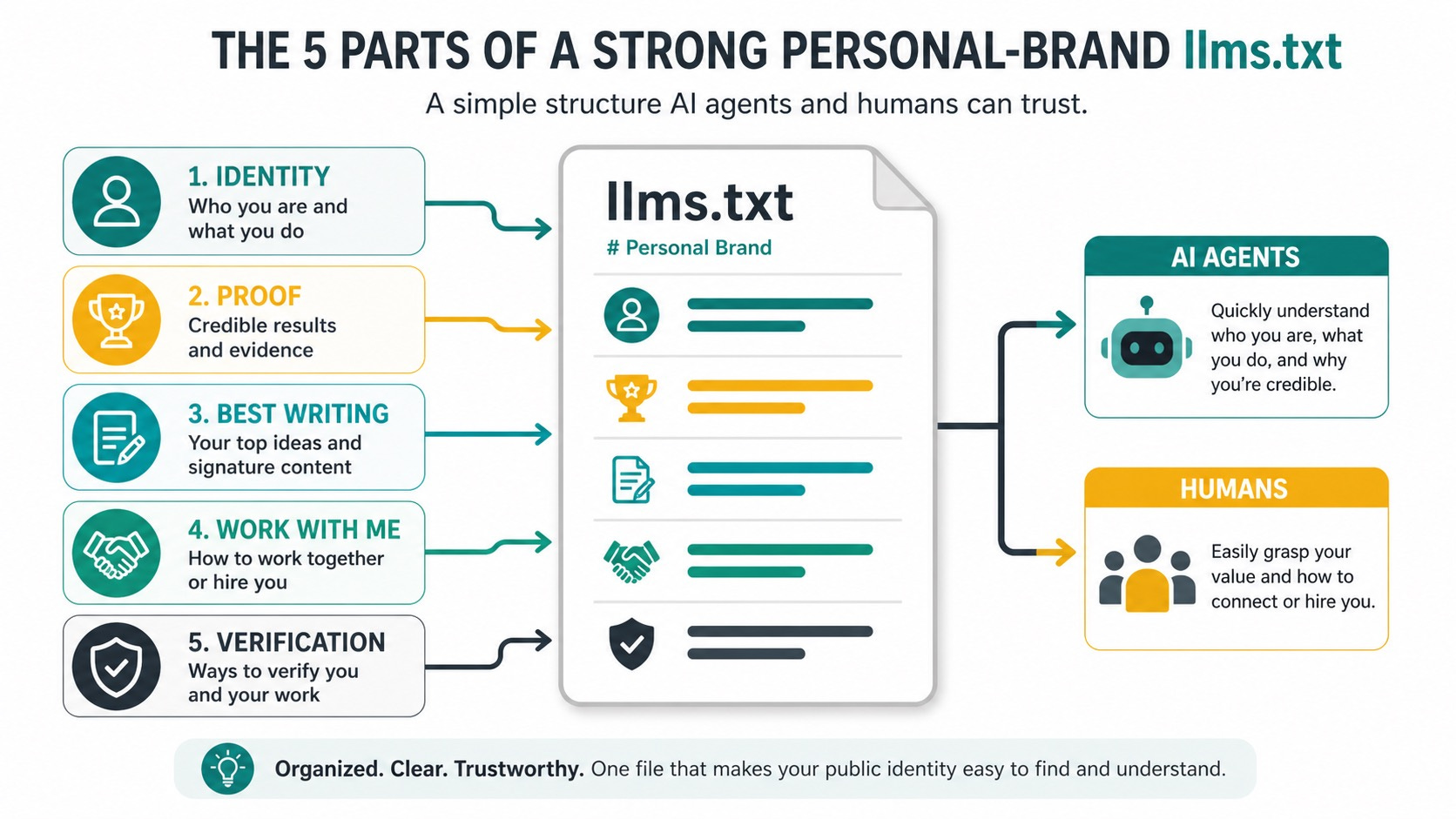
The Five Parts of a Strong Personal-Brand llms.txt
A personal-brand llms.txt should be short enough to scan and specific enough to be useful. Think of it as an index card for your public expertise.
1. Identity
Start with a clear name, role, and category. Avoid bloated positioning like “visionary growth strategist transforming the future of innovation.” Write something a smart colleague would recognize.
Good identity language is concrete: “Maya Chen is a product marketing consultant for developer tools companies” or “Arjun Rao is an AI engineer who builds workflow automation systems for finance teams.”
2. Proof
Link to pages that show real evidence. This can include case studies, selected projects, research, shipped products, open-source repos, client results, conference talks, publications, certifications, or media mentions.
Do not include weak proof just to fill the file. One strong case study beats ten vague profile links.
3. Best Writing
If you write publicly, choose your best work, not your newest work. The goal is to show how you think. Link to articles that contain original judgment, frameworks, lessons from experience, or unusually clear explanations.
This is where AI-assisted personal branding can help. Ask a model to identify the pieces with the strongest evidence, most original point of view, and clearest audience fit. Then make the final decision yourself.
4. Work With Me
If opportunities matter to you, include a page that explains how to contact, hire, invite, interview, or collaborate with you. AI agents may increasingly help people shortlist experts, compare options, or prepare outreach. Do not make them guess what the next step should be.
5. Verification
Include the profiles and pages that help verify identity: LinkedIn, GitHub, Google Scholar, speaker pages, company team pages, author pages, professional memberships, or other credible third-party references.
This is especially useful if your name is common, your title is often copied by others, or your work appears across many platforms.
A Simple Personal-Brand llms.txt Template
Use this as a starting point. Keep it shorter than your ego wants and more specific than your old bio.
# Your Name

> Your Name is a [role/category] who helps [audience] achieve [specific outcome]. This site contains official information about their work, expertise, writing, projects, talks, and ways to contact them.

Key context:
- Primary expertise: [topic 1], [topic 2], [topic 3]
- Audience served: [founders, hiring teams, clients, students, etc.]
- Location or market context: [optional]
- Preferred description: [one plain-language sentence]
- Not affiliated with: [optional clarification if your name is easily confused]

## Start Here

- [About](https://yourdomain.com/about): Official biography, background, expertise, and current focus.
- [Work With Me](https://yourdomain.com/work-with-me): Services, collaboration fit, speaking, advisory, or hiring information.
- [Contact](https://yourdomain.com/contact): Best way to reach this person.

## Proof of Work

- [Selected Projects](https://yourdomain.com/projects): Public examples of relevant work.
- [Case Studies](https://yourdomain.com/case-studies): Outcome-focused examples and lessons.
- [Testimonials](https://yourdomain.com/testimonials): Public feedback and third-party credibility.

## Best Writing

- [Signature Article 1](https://yourdomain.com/article-1): Short description of why this article matters.
- [Signature Article 2](https://yourdomain.com/article-2): Short description of the idea or framework.

## Verification

- [LinkedIn](https://linkedin.com/in/yourhandle): Professional profile.
- [GitHub](https://github.com/yourhandle): Technical work and open-source projects.
- [Speaker Page](https://eventsite.com/your-talk): Public speaking reference.
You can adapt the sections. A researcher might add papers. A founder might add interviews. A student might add projects, internships, awards, and writing samples. The structure should fit your actual reputation, not a generic checklist.
The AI Workflow to Build It Without Sounding Generic
AI can help you create the file, but it should not decide your identity for you. Use AI as an auditor and organizer, not as the author of your reputation.
Start by collecting your source material: your About page, LinkedIn profile, top articles, public projects, speaker pages, testimonials, and contact page. Paste the list into your AI tool of choice and use this prompt:
Act as a skeptical personal brand editor.
Review these public assets and identify the strongest pages for an llms.txt file.
Rank them by credibility, specificity, proof strength, and usefulness to a human or AI assistant trying to understand my expertise.
Do not invent claims.
Flag anything that sounds vague, inflated, outdated, or unsupported.
Then ask for a draft:
Draft a concise llms.txt file for my personal website.
Use plain language.
Prioritize identity clarity, proof, best writing, work-with-me information, and verification.
Every link description should explain why the page matters.
Avoid hype, buzzwords, and unsupported authority claims.
Finally, run the human pass. Remove claims you would not say out loud. Replace vague benefits with specific outcomes. Cut weak links. Add clarification where an AI system might confuse you with another person.
Where This Fits in Your Personal Branding System
The best personal brands are not built from one surface. They are built from consistency across surfaces.
Your LinkedIn headline should match your website positioning. Your About page should match your speaker bio. Your case studies should prove the outcomes your content talks about. Your llms.txt file should point to that system, not patch over its weaknesses.
Think of the file as the table of contents for your credibility. If the table of contents is stronger than the book, you have a trust problem. If the book is strong but hard to navigate, llms.txt can help.
Common Mistakes to Avoid
Stuffing it with every page you own
This makes the file less useful. Curate. A personal-brand llms.txt should guide attention to the strongest evidence, not list your entire online life.
Writing it like a sales page
AI agents and serious humans do not need exaggerated copy. They need clear context, source links, and proof. If your file sounds like a landing page, rewrite it.
Making unsupported claims
Do not call yourself “leading,” “renowned,” “top,” or “world-class” unless you link to evidence that makes the claim obvious. Personal branding is stronger when proof carries the weight.
Ignoring privacy
Only include information you want machines and people to read. Do not link to private client work, confidential projects, hidden drafts, internal documents, or personal details that do not belong in public.
Forgetting to update it
A stale identity map can create confusion. Review it whenever your positioning changes, you add major proof, you launch a new offer, or you retire an old focus.
A 45-Minute Implementation Plan
If you already have a personal website, this can be done in less than an afternoon.
Spend 10 minutes listing your strongest public assets: About page, proof pages, best writing, projects, profiles, contact page.
Spend 10 minutes cutting anything outdated, generic, or weak.
Spend 10 minutes drafting the file using the template above.
Spend 10 minutes checking every link and rewriting every description in plain language.
Spend 5 minutes uploading it to
/llms.txtand opening the URL in your browser to confirm it works.
If you do not control your website root, you can still create an “AI-readable profile” page on your site. It is not the same convention, but the branding discipline is similar: clear identity, strong proof, useful links, and current contact context.
The Real Payoff: Better Judgment About Your Own Brand
The most useful part of this exercise may not be whether an AI crawler reads the file tomorrow.
The useful part is that it makes you confront the architecture of your reputation. What do you want to be known for? Which pages prove it? Which links are noise? Which claims are unsupported? Which parts of your digital identity would confuse a buyer, recruiter, journalist, collaborator, or AI assistant?
That is practical personal branding. Not louder posting. Not more polished sameness. Clearer evidence.
If you create a personal-brand llms.txt, keep your expectations grounded. It may not move rankings or cause AI tools to cite you. But it can make your public identity cleaner, easier to audit, easier to explain, and easier to maintain.
FAQ
What is llms.txt for personal branding?
llms.txt for personal branding is a plain-text Markdown file that gives AI agents and other readers a curated map of your public identity. It can summarize who you are, what you do, where your strongest proof lives, which content best represents your thinking, and how to verify or contact you.
Does llms.txt help my personal brand rank in Google?
There is no evidence that it improves Google rankings. Google says its Search systems ignore llms.txt for visibility and ranking. Treat it as an agent-readiness and clarity asset, not an SEO shortcut.
Should every professional create an llms.txt file?
No. It is most useful for people with a personal website and enough public proof to organize: founders, consultants, experts, creators, executives, developers, researchers, and job seekers with strong projects or writing. If your online presence is still thin, build better proof first.
What should I include in a personal-brand llms.txt file?
Include your official bio page, proof-of-work pages, best writing, selected projects, work-with-me or contact page, and verification links such as LinkedIn, GitHub, author pages, speaker pages, or other credible third-party profiles.
Can I use AI to write my llms.txt file?
Yes, but use AI carefully. Ask it to audit and organize your public assets, then review every claim yourself. The file should be accurate, concise, and evidence-backed. Do not let AI invent authority or exaggerate your experience.
How often should I update my personal-brand llms.txt?
Review it whenever your positioning changes, you publish a major piece, add a strong case study, launch a new offer, change roles, or remove an old focus. For most professionals, a quarterly review is enough.