


Anybody can draw a pipeline. The stronger signal is showing what you noticed when it drifted, how you chose a response, and what you learned when the first fix was not enough.

If your MLOps portfolio project ends at “deployed successfully,” it describes a launch, not the work people need you for after launch. A trained model can be served in an afternoon. Keeping its decisions understandable when input changes, costs rise, latency spikes, or a metric quietly degrades is the part that reveals engineering judgment.
That distinction matters for your personal brand. Recruiters and technical reviewers see plenty of repositories with Docker, a registry, a cloud service, and a dashboard. Those are useful building blocks, but they do not tell a reader whether you can decide what to monitor, recognize an ambiguous signal, or avoid a reckless retrain.
Build one MLOps portfolio project around a controlled reliability story instead. Create a small system with synthetic or public data, introduce one safe failure condition, document your response, and let someone inspect the evidence. You are not trying to imitate a production incident. You are making your reasoning reviewable.
Your public proof is not “I used every MLOps tool.” It is “I could explain what changed, what I checked, what I chose, and what I would do differently.”
Why the standard MLOps project feels generic
A familiar recipe dominates portfolio advice: train a classifier, put it behind an API, containerize it, add CI, draw an architecture diagram, and call it production-ready. That sequence teaches useful mechanics. It also lets an AI assistant generate a plausible README full of impressive nouns without forcing its author to make a meaningful trade-off.
The gap becomes obvious when a reviewer asks five short questions: What would tell you the system is becoming less useful? Which signal would change your decision? When would you leave the current model alone? How would you roll back safely? What evidence says the recovery worked?
A polished answer does not require a giant Kubernetes cluster or a paid cloud account. It requires a bounded scenario and honest constraints. In fact, a deliberately small project is easier to understand, cheaper to reproduce, and harder to pad with performative complexity.
Start with an honest boundary: “This is a controlled educational system using public or synthetic data. I simulated a shift to test the monitoring and release process; I am not claiming production traffic, customer impact, or real-world model performance.” That sentence makes the rest of your work more credible, not less.
Choose a scenario where a decision is required
A good portfolio scenario has an operational question, not merely a technical feature. Consider a simple demand forecast, support-ticket routing model, document classifier, or retrieval pipeline with public data. Then define one change that makes the old behavior less trustworthy: a new input mix, missing fields, a latency budget breach, a drop in human-review agreement, or a cost spike.
Do not inject random noise and declare “drift detected.” State why the shift matters. A support-routing model might see a new product category that makes a previously reliable keyword feature less informative. A document workflow might receive a new template that increases extraction failures. The simulated condition should connect to a user-facing risk.
Then write a decision rule before running the experiment. For example: if a monitored quality proxy falls below a clearly labeled threshold and the candidate model does not beat the current model on a held-out slice, keep the current release and route uncertain cases to review. The exact threshold is less important than explaining why you selected it and where you would revisit it.
Build an evidence loop, not a feature list
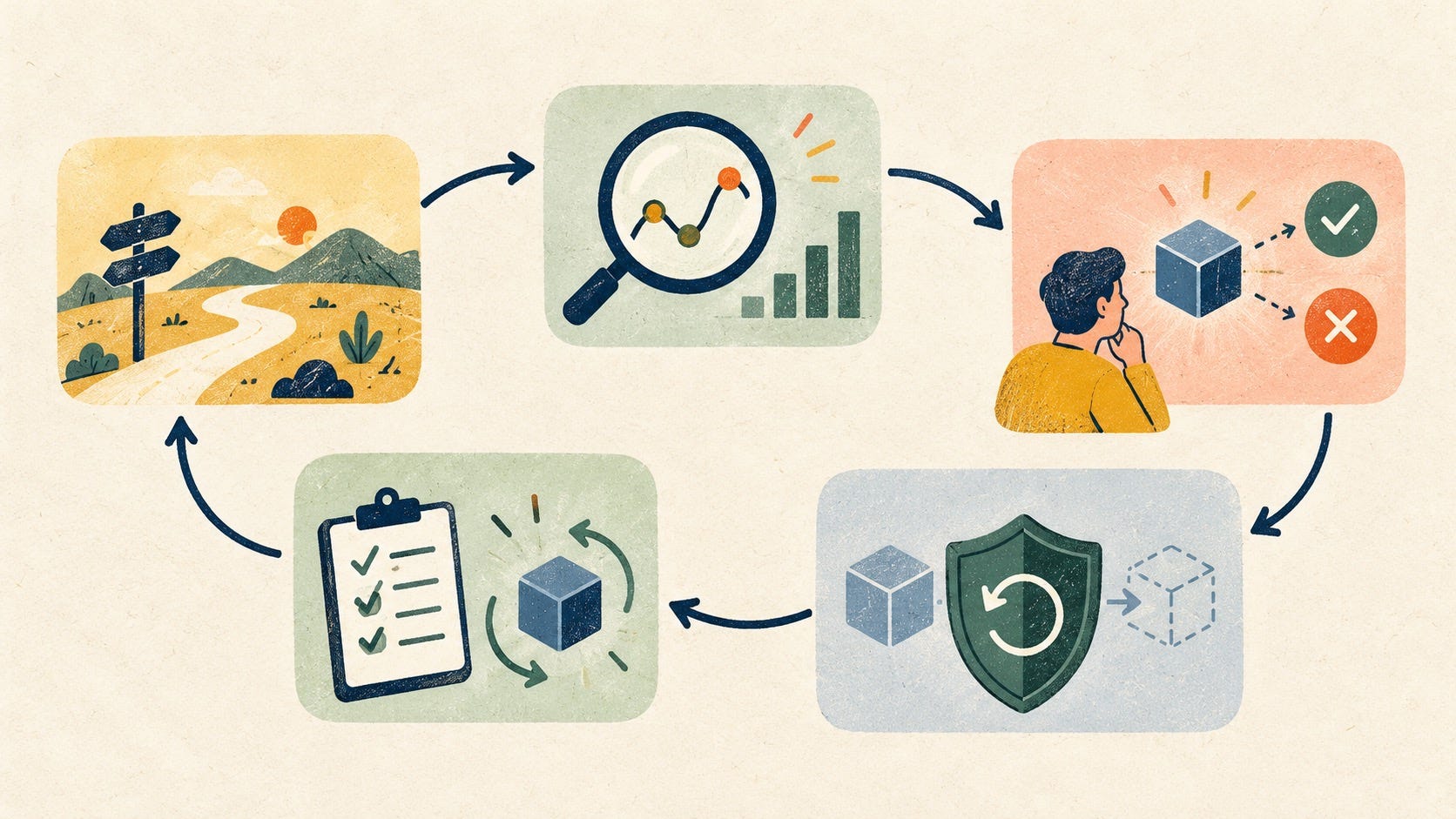
Your case study can follow six compact stages. This is also a useful outline for a project page, GitHub README, LinkedIn featured item, or technical post.
1. State the job and the boundary
In two or three sentences, name the model’s purpose, the user it serves, the data source, and what the project does not prove. Avoid “production-ready” as a status label. Say what is genuinely implemented: “a local service with versioned test data and a simulated drift scenario,” for example.
2. Draw the decision path
Show only the components that affect trust: input, validation, model or retrieval step, output, monitoring, human-review path, and rollback option. Add one sentence under each arrow explaining the failure it prevents or reveals. A reviewer should understand the risk without decoding a vendor logo mural.
3. Define a signal with a limitation
Pick two or three signals that match the scenario: input-schema failures, latency, cost per request, a distribution check, task-specific quality on labeled replay data, or reviewer agreement. Crucially, name what each signal cannot tell you. A feature distribution shift does not prove customer harm. A stable latency chart does not prove correct outputs. Limits are a personal-brand asset because they show you can distinguish telemetry from truth.
4. Record the decision, not only the alert
Write a short decision log: what fired, what you inspected next, the alternatives you considered, the action you chose, and why. Maybe the right move is a rollback. Maybe it is a rate limit, a fallback model, a temporary human queue, or no change because the signal was not enough. Good MLOps is not automatic change; it is appropriate change.
5. Make recovery safe and reversible
For a portfolio, “rollback” can simply mean returning to a previous versioned artifact and rerunning a known test suite. The point is to demonstrate a path, not to stage disaster theater. Keep data and credentials synthetic, redact traces that do not need to be public, and never imply that a local simulation is a customer incident.
6. Retest and publish the uncomfortable lesson
Run the original checks after the response. Did the recovery restore the chosen metric? Did it create a new limitation? Perhaps a fallback improved accuracy but violated the latency budget, or a monitoring threshold created too many false alarms. That is the material that makes a case study feel human. It shows you learned something your first architecture diagram could not show.
What to show when you have no production incident
Most early-career builders do not have permission to publish a real outage, and they should not try to manufacture one. A safe exercise can still show the same habits. Make the premise fictional, say exactly how you created the condition, and focus the case study on the decision process rather than on simulated drama.
For example, replay a labeled public dataset through two versions of a model after changing the input mix. Save the baseline results, introduce the shift, and compare the outcome against your decision rule. If you add a fallback, report its cost: perhaps it sends more cases to human review, increases latency, or covers only one input category. That trade-off is useful evidence. It tells the reader that resilience has a price and that you noticed it.
Keep a tiny appendix with the run command, environment version, data-provenance note, artifact identifiers, and the exact checks you reran. This is not busywork. Reproducibility lets a reviewer tell the difference between a thoughtful experiment and a dashboard staged for a screenshot. You do not need a perfect public demo; you need enough context for an informed person to trust your process.
Use AI to sharpen the work, not invent the judgment
AI is useful here. Ask it to turn raw notes into a candidate test matrix, suggest plain-language captions for a diagram, generate questions a skeptical reviewer might ask, or flag gaps in your README. It can help you create a clean first pass much faster.
But keep three items human-owned: the scenario, the decision rule, and the interpretation. If you cannot explain why a threshold exists, do not publish it. If an LLM wrote a trade-off you do not understand, remove it. An impressive stack built from generated snippets can make a reviewer more cautious, not less.

Turn the project into a personal-brand asset
Do not publish a repository and hope someone infers your expertise. Package the same work in a few review-friendly forms. Your main project page should answer the reliability story in five minutes. A short post can focus on one decision: why you did not retrain automatically, why a simple fallback beat a more complex option, or why your metric was only a proxy. A one-page diagram can live in your profile’s featured section.
Use precise language. “I built a controlled model-monitoring exercise” is stronger than “I engineered enterprise-grade AI infrastructure” when the former is what happened. Technical credibility compounds when claims are easy to verify.
Before publishing, check:
Can a reader name the user-facing risk in one sentence?
Did I label simulated data, scenarios, and limits clearly?
Does every impressive tool in the project support a real decision?
Can someone follow the path from signal to action to retest?
Did I show one trade-off or thing that did not work?
Have I removed private data, secrets, and unsupported performance claims?
A practical two-week build plan
Days 1–2: Choose a small, useful task and public or synthetic data. Write the boundary and the user-facing risk. Days 3–4: Build the smallest baseline service and save a versioned test set. Days 5–6: Select two or three signals and document what they miss.
Days 7–8: Create one controlled shift or failure condition. Decide in advance what action each outcome would justify. Days 9–10: Implement a reversible response and record the decision. Days 11–12: Retest, capture concise evidence, and write the limitation that remains.
Days 13–14: Turn the evidence into one calm project page, a diagram, and a short reflection. Ask an MLOps practitioner or software engineer one question: “Where would you distrust this evidence?” Their response will improve your next project more than adding another tool.
The personal brand you want is not “person who knows the current MLOps stack.” Tools change. The durable signal is a person who can make a model-serving system legible, notice when confidence should fall, choose a proportionate response, and communicate the limit without drama. That is what people remember after they close the tab.
Frequently asked questions
What makes a good MLOps portfolio project?
A good project makes a real operational decision visible. Include a bounded use case, reproducible data or inputs, monitoring signals, a response path, a retest, and clear limits. One complete reliability story is usually stronger than several disconnected deployments.
Do I need Kubernetes for an MLOps portfolio?
No. Use the smallest stack that lets you demonstrate the decision you want to show. A local containerized service with versioned artifacts and an honest monitoring exercise can communicate more than complex infrastructure you cannot explain or maintain.
How can I simulate model drift ethically?
Use public or synthetic data, describe the scenario as simulated, and tie it to a plausible input or task change. Never present a synthetic event as a customer incident or claim real-world performance you did not measure.
Should an MLOps project automatically retrain after drift?
Not by default. Drift is a signal to investigate, not an automatic instruction to replace a model. Show the checks you would require before promoting a candidate and the conditions where a fallback or human review is safer.
How do I explain MLOps work on LinkedIn without oversharing code?
Share the problem, the observable signal, the decision you made, the result of the retest, and the lesson. A simple diagram and a short written case study can show judgment without revealing proprietary code, data, or credentials.
Can AI help me write my MLOps portfolio case study?
Yes—use it to organize notes, improve clarity, generate reviewer questions, and identify missing documentation. Verify every claim yourself and keep the scenario, trade-offs, and interpretation grounded in work you actually did.