


A trust-first personal branding system for leaders who want AI speed, human judgment, and a public presence that still feels like a real person is behind it.

Online executive presence is no longer just profile polish. It is editorial judgment made visible.
Most executive visibility advice is still built for a quieter internet. Update your profile. Post more often. Share leadership lessons. Be authentic. None of that is wrong. It is just incomplete.
In July 2026, Pangram Labs published feed-level research based on more than one million scanned posts and found that one in four longform social posts were flagged as fully AI-generated. LinkedIn stood out the most: more than 40% of long posts were flagged as fully AI-written, and the platform accounted for nearly 62% of all flagged AI content in the dataset. Detection studies are not perfect, but the signal is hard to ignore. Your audience is reading in an environment where polished content increasingly feels synthetic.
That changes the job of personal branding for leaders. You are not just competing for attention. You are competing for belief. When people check your profile, skim your posts, read a comment, or hear you on a podcast, they are asking a simple question: does this person think for themselves?
That is what online executive presence means now. Not louder posting. Not more tools. Not becoming a creator caricature. It means building a visible leadership identity that still carries signal after AI has made content cheap.
The real shift: AI did not remove the need for executive presence. It raised the standard for it. If everyone can publish polished language, the advantage moves to specificity, conviction, proof, and consistency.
Why leaders get punished faster for generic AI content
Junior professionals can sometimes get away with vague AI-assisted writing because expectations are lower. Executives cannot. The more senior you are, the more people expect real stakes, real judgment, and real pattern recognition.
Generic founder or executive content usually breaks in five visible ways:
It sounds clean but says nothing a peer would remember an hour later.
It makes observations without naming tradeoffs, constraints, or consequences.
It claims leadership values without attaching them to actual decisions.
It over-optimizes polish and under-delivers proof.
It is consistent in tone but inconsistent in point of view.
That last point matters most. A recent Reddit discussion about personal branding and AI captured the problem well: strong brands are not getting bigger, they are getting more coherent. Every post, interview, talk, comment, and bio reinforces the same underlying idea. AI helps only after that architecture exists.
Your online executive presence should make people feel they met the same mind in five different places.
The new model: executive presence as a visible trust stack
LinkedIn’s own guidance on online executive presence still centers on three fundamentals: polish your profiles, create valuable content, and engage with your network. That remains the base layer. But in an AI-saturated feed, those basics are no longer enough on their own.
A stronger model is to think of executive presence as a five-layer trust stack.
1. Positioning layer
This is what you want to be known for. Not your job title. Not a vague niche. A sharp sentence that links the problems you solve, the lens you use, and the audience you serve.
Example: “I help B2B software teams turn messy customer feedback into clearer product and GTM decisions.”
2. Proof layer
This is where most executive brands are weaker than they look. Authority is not built by adjectives. It is built by artifacts: decisions, frameworks, examples, metrics, commentary on real situations, recorded interviews, screenshots, memos, slides, and case narratives.
3. Voice layer
Your voice is not just your writing style. It is your pattern of judgment. The phrases you repeat. The tradeoffs you care about. The kinds of bad advice you reject. The level of precision you naturally use.
4. Interaction layer
People trust leaders partly through how they respond. Comments, replies, short notes, and interviews often feel more human than polished flagship posts. Pangram’s data found that top-level posts are more AI-saturated than replies. That means thoughtful interaction is now a competitive advantage.
5. Consistency layer
Your profile, website bio, speaker intro, podcast guest sheet, pinned posts, and comment style should all feel related. Not identical. Related. Consistency is what makes AI work for you instead of fragmenting your identity into six slightly different versions.
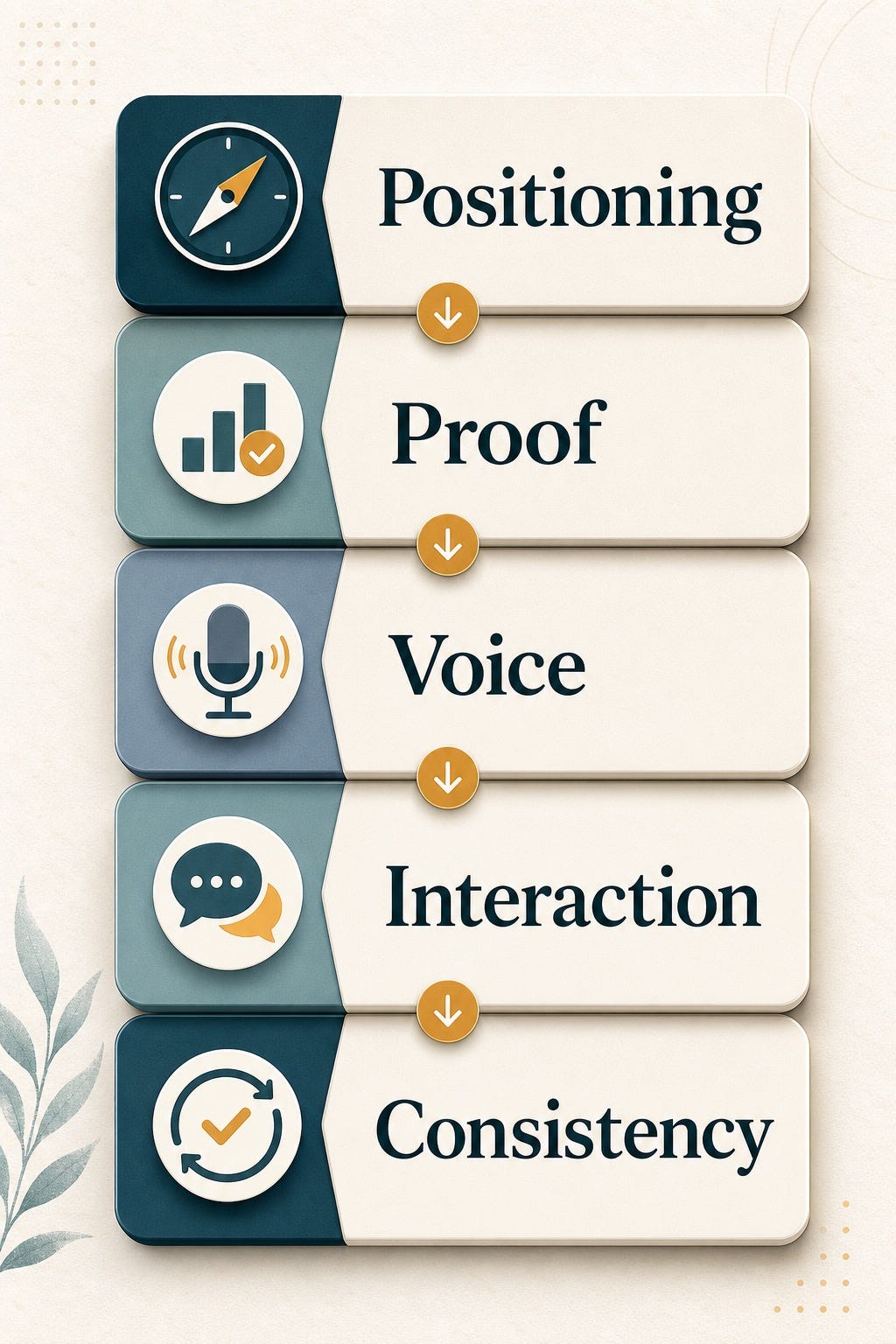
When AI lowers the cost of content, the winning signal comes from a stronger trust stack.
The practical AI workflow that keeps leaders sounding real
The best use of AI for executive presence is not “write my personal brand.” It is “help me extract, organize, sharpen, and reuse the thinking I already have.” That distinction is everything.
Here is the workflow I recommend for founders, executives, consultants, and domain experts.
Step 1: Build a leadership source file
Create one working document that captures the raw material AI should learn from. This is your private operating document, not public copy.
Include:
Three to five problems you want your name associated with
Your strongest contrarian or non-obvious beliefs
Ten examples of decisions you made and why
Stories that explain how you work under pressure
Phrases you naturally use and phrases you never want published under your name
Proof assets: metrics, case studies, wins, failures, screenshots, talks, interviews, comments, notes
If this file is weak, AI will fill the gap with generic language. If this file is strong, AI becomes an amplifier instead of an impersonator.
Step 2: Capture spoken thinking before written thinking
Executives usually sound smarter in speech than in first-draft prose. Use that. Record five-minute voice notes after meetings, customer calls, board prep, hiring interviews, or product reviews. Speak in fragments. Explain what happened, what mattered, what surprised you, and what you would do again.
Then use AI to turn those notes into angle banks, post ideas, newsletter intros, or talking points. This preserves cadence, skepticism, and verbal texture that pure prompt-writing often loses.
Prompt:
You are my editorial strategist. Use the voice note transcript below.
Extract:
1. the strongest point of view
2. the hidden leadership lesson
3. one short LinkedIn post
4. one comment I could leave on someone else's related post
5. one sentence that sounds generic and should be cut

Keep my language concrete. Do not add inspiration-speak. Do not use em dashes. Do not end with a broad motivational takeaway.
Step 3: Draft from proof, not from themes
Bad AI workflows start with themes like “leadership,” “innovation,” or “future of work.” Good ones start with proof. A client objection. A hiring mistake. A pricing tradeoff. A lesson from a failed launch. A question from a board member. A weird pattern in customer calls.
The more your draft begins with something observable, the less it sounds interchangeable.
Step 4: Run the authority filter before publishing
Before anything goes live, pass it through five questions:
Could this have been posted by almost anyone in my role?
Does it include one real constraint, decision, or example?
Is there an actual point of view, not just a pleasant opinion?
Would a peer learn something specific from it?
Does it sound like how I speak when I am slightly under time pressure?
If you answer “yes” to the first question, the draft is too generic. If you answer “no” to any of the next four, it is still not ready.
Step 5: Split your output into flagship and ambient presence
Not every piece of executive content should be a polished essay.
Flagship presence is your high-signal content: a core post, article, keynote clip, guest essay, interview, or framework.
Ambient presence is everything that makes you feel alive online: thoughtful comments, short notes, replies, reframes, link annotations, and smart questions.
Many leaders only invest in flagship content. That creates a polished but oddly distant brand. Ambient presence is often what makes executive visibility feel believable.
What to automate and what never to automate
Leaders usually ask the wrong question here. They ask, “How much of my personal brand can AI do?” The better question is, “Which parts benefit from speed, and which parts require identity?”
Good things to automate
Turning transcripts into drafts, summaries, and content angles
Repurposing one idea across LinkedIn, Substack, speaking notes, and internal memos
Organizing proof assets and examples by topic
Generating alternate hooks and stronger structure
Cleaning up sentence length, repetition, and weak transitions
Bad things to automate blindly
Your final point of view
Your personal stories
Your response to public tension or controversy
Your comments on customers, employees, hiring, leadership, or strategy
Your entire cadence of engagement
If AI is deciding what you believe, your executive presence is already hollow. Use the machine to compress labor, not to outsource identity.

The gap is not human versus AI. It is generic versus evidence-backed.
A weekly system for staying visible without turning into a content machine
Most executives do not need daily posting. They need a repeatable system that turns lived work into visible trust.
Try this weekly cadence:
Monday: Record one voice note after your highest-signal meeting.
Tuesday: Ask AI to extract three angles and one short post.
Wednesday: Publish one flagship insight or a compact framework.
Thursday: Leave five smart comments on relevant posts in your field.
Friday: Update your source file with one new proof asset, one lesson, and one phrase you want to reuse.
This system works because it ties visibility to actual work. You are not inventing a public persona. You are packaging pattern recognition that already exists inside your week.
The fastest way to sound more senior online
Stop trying to sound impressive. Start sounding accountable.
Senior presence comes through when readers can feel that your words came from tradeoffs, not from trend summaries. Replace broad abstractions with phrases like:
“The mistake we made was…”
“The metric that changed our mind was…”
“The tradeoff most teams underestimate is…”
“What I would not delegate here is…”
“This worked for us because the constraint was…”
AI can help surface these lines from transcripts and notes. But it cannot invent the lived judgment behind them. That is still your moat.
Prompt:
Take this draft and make it sound more senior, not more polished.
Add:
- one clear tradeoff
- one real decision
- one line that shows accountability

Remove:
- empty inspiration
- vague future-of-work language
- anything that could apply to every executive on LinkedIn
Final thought
The market does not need more executive content. It needs more recognizable executive thinking.
That is the opportunity hiding inside the AI slop era. Because content is easier to produce, genuine judgment becomes easier to notice. Leaders who use AI as an editorial partner rather than a personality replacement will compound trust faster than leaders who simply publish more.
Build the source file. Capture voice notes. Draft from proof. Show your work in public. Let AI help with structure and reuse, but keep the signal human.
That is what online executive presence looks like now.
FAQ
What is online executive presence?
Online executive presence is how leaders shape trust, authority, and credibility across digital channels such as LinkedIn, personal websites, podcasts, newsletters, interviews, and public comments. It is the digital version of how people assess your leadership judgment before they ever meet you.
How is executive presence different from personal branding?
Personal branding is the broader system of how you are known. Executive presence is a higher-trust expression of that system for leadership contexts. It emphasizes judgment, credibility, composure, and decision-making visibility rather than just awareness or content volume.
Can executives use AI for LinkedIn without sounding fake?
Yes, if AI is used to organize and sharpen original thinking rather than generate identity from scratch. The safest inputs are voice notes, transcripts, real examples, and proof assets. The riskiest input is a blank prompt asking AI to “write thought leadership” with no source material.
What kind of content builds executive presence fastest?
Content that reveals pattern recognition and accountability usually compounds trust fastest. That includes decision breakdowns, client or customer lessons, operator frameworks, hiring reflections, strategic tradeoffs, annotated examples, and thoughtful comments on industry shifts.
Do executives need to post every day to build a strong personal brand?
No. Most leaders benefit more from one strong flagship insight each week plus consistent ambient engagement through comments and replies. Reliability matters more than volume, especially when the market is already flooded with overproduced AI content.
What is the biggest mistake leaders make with AI personal branding?
The biggest mistake is using AI to replace judgment instead of documenting it. When the tool invents your tone, your beliefs, and your conclusions, your content may look polished but it stops building trust. AI should reduce friction, not erase authorship.