


Most professionals treat the About page like background filler. In practice, it is often the page that decides whether a founder, consultant, executive, or creator feels credible enough to trust, contact, recommend, or remember.

There is a strange gap in modern personal branding. People spend hours polishing LinkedIn headlines, generating AI headshots, testing content hooks, and posting thought leadership. Then a curious stranger clicks their website, opens the About page, and finds a stiff mini-resume written like a committee approved it. That page quietly destroys trust.
It does not answer the questions serious people actually ask. Who is this person, really? What do they want to be known for? Why this niche? Why should I trust their judgment instead of the next person making the same claim? If I quote them, hire them, invite them to speak, or recommend them, what am I betting on?
This matters even more now because your audience is not only human. Search engines, AI assistants, recruiters, podcast hosts, journalists, clients, investors, and collaborators all need a clean source of truth. Recent creator-platform moves on LinkedIn are pushing harder toward expert credibility over broad influencer reach, while AI answer engines increasingly pull from public profile and website language to decide who sounds authoritative. In that environment, a vague About page is not neutral. It creates ambiguity.
A personal brand about page fixes that. It gives your reputation a home base and makes your digital identity easier to understand across search, social, and AI systems.
Your About page is not a biography page. It is the page that reduces the cost of believing you.
Why the personal brand about page matters more than most people think
When someone lands on your About page, they are rarely browsing by accident. They already felt enough interest to investigate. That makes the page high leverage.
Reddit threads about founder visibility, personal websites, and online authority show the same pattern again and again. People know they need some form of public trust layer, but they get stuck on the most basic questions: what should the About page say, should it sound personal or professional, how honest should they be about being a solo operator, and how much story is too much? The problem is not lack of effort. The problem is that most templates teach design blocks, not trust logic.
A useful About page does three jobs at once:
It gives a new visitor a fast answer to who you are and what you do.
It gives a skeptical visitor enough proof to keep moving.
It gives AI systems a stable, reusable description of your expertise and identity.
That last part is easy to underestimate. In personal brand SEO circles, people increasingly talk about the About page as an entity home: the clearest page you control that states who you are, what you are known for, and where the rest of your digital footprint connects back. You do not need to obsess over the jargon to benefit from the principle. The principle is simple. If every surface describes you differently, machines get confused and humans feel friction. If one page clearly anchors the story, everything else becomes easier.
What readers want from your About page
Most About pages fail because they answer the wrong question. They answer, “How can I summarize my background?” But the reader is asking, “Why should I care, and why should I trust you?”
For personal branding, that means your page needs to answer a compact set of trust questions:
What exactly do you want to be known for?
Who do you help, serve, advise, or speak to?
What shaped your point of view?
What proof should I look at first?
How do you work or think differently?
What should I do next if I want to go deeper?
Notice what is missing. Nobody urgently needs your life story in chronological order. Nobody needs a paragraph full of soft adjectives like passionate, innovative, results-driven, and mission-oriented. Nobody needs an AI-generated paragraph that could belong to six thousand consultants.
Trust rule: the more generic your self-description, the more the reader assumes your expertise is generic too.
The best personal brand about pages feel specific, calm, and easy to verify. They do not scream authority. They make authority legible.
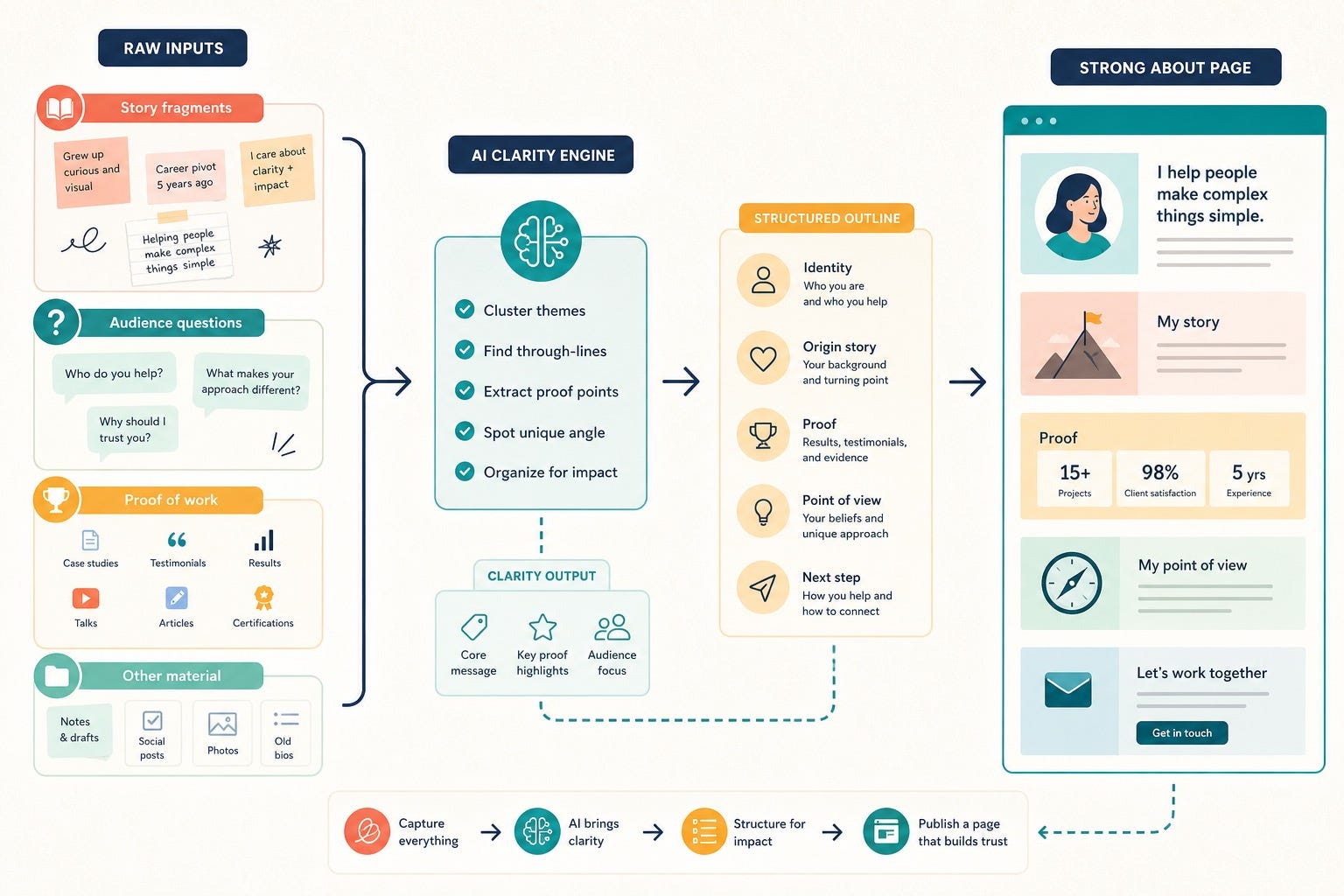
The seven building blocks of a strong personal brand about page
You do not need a fancy framework. You need a page structure that mirrors how trust gets built.
1. A one-line identity statement
Open with a sentence that says who you are, what you do, and who it matters to. This is the core sentence that should stay consistent across your website, LinkedIn, speaker bios, guest profiles, and AI-assisted brand materials.
Weak version: “I help businesses grow through strategic innovation.”
Stronger version: “I help B2B founders turn deep product knowledge into clear public authority through writing, speaking, and trust-first content systems.”
2. A short origin story with a useful point
Your story matters, but only if it explains why your perspective exists. Tell the reader what you noticed, what frustrated you, what changed your direction, or what problem made you care enough to build expertise around it.
A founder might explain why generic brand marketing felt disconnected from trust in complex B2B sales. A job seeker might explain how AI-shaped hiring changed what credibility looks like online. A consultant might explain the repeated pattern they saw across clients that now defines their point of view.
The key is relevance. Your story should make the reader understand why your approach is not random.
3. A visible audience fit
Readers trust specialists faster than broad claims. Say who the page is for. Founders? Creators? Technical experts? Consultants? Executives? Job seekers? Early-stage operators? A strong About page makes the right person feel seen.
This is also where many personal brand website pages become more useful for AI search. Specific audience and topic language creates clearer context. It tells a machine, and a human, what bucket your expertise belongs in.
4. A point of view you can defend
Memorable personal brands are not only descriptive. They are interpretive. They hold a view.
Maybe you believe founder visibility works better when it is built around proof of work rather than hot takes. Maybe you believe AI should compress research and editing time, not replace lived perspective. Maybe you believe most experts do not need more content; they need better trust architecture. Put that belief on the page.
A clear point of view does two useful things. It attracts the right people and filters out the wrong ones. Both are good outcomes.
5. Proof that is easy to scan
Trust rises when claims meet evidence. Use concrete proof instead of decorative credibility. That can include client names, measurable outcomes, notable projects, speaking appearances, case studies, publications, product launches, interviews, research, open-source work, or public artifacts.
Do not hide your proof at the bottom of your site. Put it where the About page naturally needs reinforcement, right after the reader starts asking, “Can this person really do what they say?”
6. A sentence about how you use AI
This is one of the easiest modern trust upgrades. If AI plays a role in your work, state the role clearly. For example: “I use AI for research clustering, draft compression, and workflow speed, but my strategy, judgment, and final words stay human.” That sentence does more than disclose a tool. It communicates standards.
In AI personal branding, the issue is rarely whether you use AI. The issue is whether your audience can still detect your judgment. Your About page is a good place to make that explicit.
7. A routing-style next step
Do not end with “feel free to reach out.” Tell the reader what kind of next step fits. Read selected essays. Book a call. Explore case studies. Invite you to speak. Listen to interviews. Email for advisory work. A routing CTA lowers friction because it gives intent-specific paths instead of one vague gesture.
How to use AI to write your About page without sounding AI-generated
AI is useful here, but only in the right part of the process. If you ask a model to “write an About page for my personal brand,” you will usually get polished mush. It will sound complete. It will also sound replaceable.
Start by collecting raw material:
Your best introductions from emails, podcasts, and bios
Three to five projects that prove your work
Audience questions you get repeatedly
Moments that changed your point of view
Words clients, colleagues, or readers use to describe you
Then feed the model raw input and make it do synthesis, not invention.
Prompt:
You are helping me write a personal brand about page.
Use the raw material below to produce:
1. one crisp identity statement
2. a short origin story grounded in real events
3. three proof bullets
4. one clear point of view
5. one sentence explaining how I use AI without sounding defensive
6. a closing CTA with three possible next steps
Rules:
- do not invent achievements
- do not use buzzwords like passionate, innovative, visionary, or results-driven
- write in first person
- make the language specific enough that a recruiter, client, or journalist could quickly place my expertise
- keep the tone human, calm, and credible
[Paste your notes, proof, project links, audience, and positioning here]
After AI gives you a draft, your real work starts. Read every sentence and ask three questions:
Would I actually say this out loud?
Can I prove this claim?
Does this sentence help the reader trust me faster?
If the answer is no, cut it. Most strong About pages get better by subtraction.
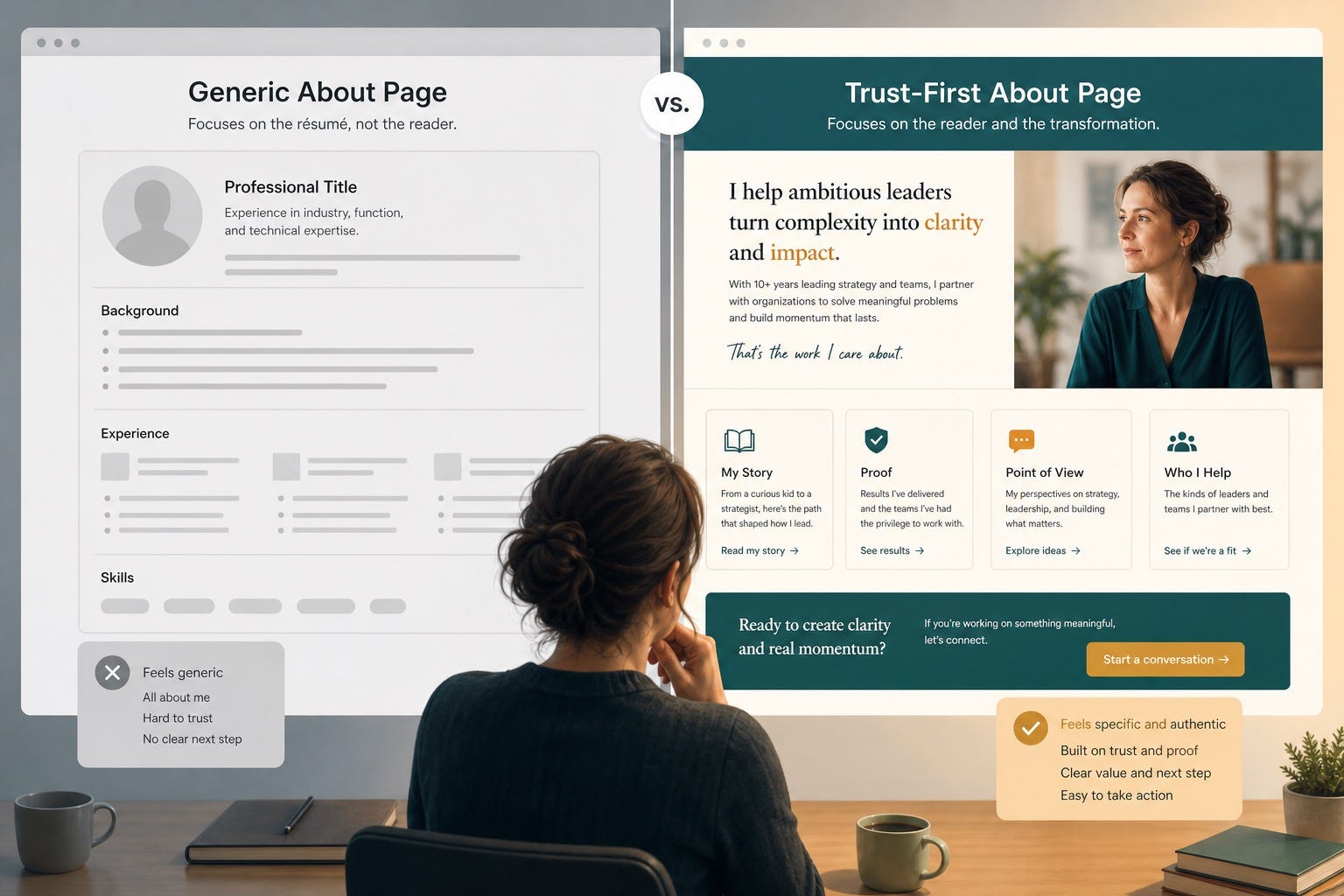
Common About page mistakes that weaken personal branding
Writing a resume in paragraph form
Your resume is optimized for chronology and role history. Your About page is optimized for trust, clarity, and relevance. Those are different jobs. Do not confuse them.
Trying to sound like a larger company
Many solo founders and consultants still hide behind vague plural language. Sometimes that weakens trust more than honest specificity would. If you are a focused expert, say so in a way that signals standards, not scarcity.
Using AI to blur your real voice
AI tends to average your language unless you force it to work from your examples, vocabulary, and proof. If your page sounds like generic leadership content, readers assume your thinking may be generic too.
Making proof hard to find
If a reader has to hunt for evidence, many will not bother. Put your strongest public proof close to the claims it supports.
Forgetting the machine-readable layer
This does not mean you need to become a technical SEO person. It means your page should use consistent naming, clear descriptions, updated links, and obvious alignment with your LinkedIn, website bio, and other public profiles. Consistency is a trust signal.
A 45-minute personal brand about page sprint
If your current page is blank, outdated, or embarrassing, do not wait for the perfect brand strategy document. Use this quick workflow.
Spend 10 minutes listing the five things you most want to be known for.
Spend 10 minutes pulling links, examples, or outcomes that prove those claims.
Spend 10 minutes writing the story of why you care about this niche in plain language.
Spend 10 minutes using AI to compress that material into a draft structure.
Spend 5 minutes deleting anything vague, inflated, or unprovable.
You do not need a masterpiece on day one. You need a page that is true, specific, and easy to understand. Then you can refine it as your body of work grows. A good About page is not static. As your expertise sharpens, your proof expands, and your public identity becomes more defined, the page should evolve too.
Why this page compounds over time
A smart personal brand is built from assets that keep making other assets stronger. That is why the About page matters so much. A clear About page improves your speaker bio, your podcast pitch, your guest author line, your website copy, your LinkedIn summary, your AI prompt inputs, and the way others describe you when you are not in the room. It also helps you stay consistent when AI tools enter more of your workflow. If you give a model a strong source document, you get better bios, cleaner summaries, sharper social drafts, and more accurate positioning help. If you give a model a messy identity, you get polished confusion back.
That is the deeper reason to treat this page seriously. It is not only for website visitors. It is for every future system, human or machine, that needs to understand your reputation quickly.
In personal branding, clarity is not cosmetic. Clarity is leverage.
FAQ
What is a personal brand about page?
A personal brand about page is the website page that explains who you are, what you are known for, who you help, and why people should trust your perspective. It should do more than list your background. It should make your expertise easy to understand and verify.
How is a personal brand about page different from a resume?
A resume is built for formal hiring review and chronological experience. A personal brand about page is built for trust, positioning, and quick comprehension across clients, collaborators, media, recruiters, and AI systems. It should feel more like a clear introduction than a job history document.
Can I use AI to write my about me page for my website?
Yes, but use AI for structure and editing rather than for inventing your identity. Give it real proof, real stories, real audience language, and clear constraints. Then edit the output hard so the final page sounds like you and only claims what you can support.
What should every founder about page include?
At minimum, include a clear identity statement, a short why-now story, the audience you serve, your point of view, proof of work, and a next step. If AI is part of your workflow or company narrative, a sentence explaining how you use it can also strengthen trust.
How long should a personal website about page be?
Long enough to answer the core trust questions, short enough to stay readable. For most professionals, 500 to 1,200 words is enough. If your audience is making high-trust decisions, slightly longer can work if every section earns its place.
Why does an about page matter for AI search and digital identity?
AI systems and search engines work better when they can find one consistent, well-structured source describing who you are, what you do, and where your authority comes from. A clear About page helps anchor that understanding and reduces contradiction across your public profiles.