


Most AI personal-branding advice starts too late. It tells you how to prompt better after your content already sounds generic. The real fix is simpler: give AI one page that explains who you are, who you serve, what proof you have, and how you actually sound.

If you have used AI to draft a LinkedIn post, website bio, newsletter, or speaker intro, you have probably felt the same problem. The draft is not wrong. It is just strangely ownerless. It sounds like a competent person on the internet, not like you.
That is happening because most professionals ask AI to produce public-facing copy before they give it a source of truth. The model has no idea what your judgment sounds like, what kind of work you actually want more of, which phrases feel natural in your mouth, or which claims you refuse to make. So it fills the gap with default internet language.
Recent Reddit discussions about AI-written LinkedIn posts keep circling the same complaint: the outputs are fast, readable, and flat. Search results for this problem are also surprisingly weak. You can find scattered templates, newsletters, and social posts about personal brand voice, but there is still a gap around the actual asset that solves the issue: a personal brand brief built for AI-assisted writing.
That is the angle that matters now. In an AI-saturated feed, the professionals who win are not the ones who ban AI. They are the ones who feed it better identity inputs.
A personal brand brief is not a fancy branding exercise. It is the operating document that keeps AI from inventing a version of you that sounds more polished and less trustworthy than the real one.
What Is a Personal Brand Brief?
A personal brand brief is a one-page document that tells AI how to represent you in public. Think of it as the bridge between your actual professional identity and the drafts AI produces on your behalf.
It is not a logo guide. It is not a moodboard. It is not a vague list of values like integrity, innovation, and impact. A useful personal brand brief is concrete enough that an AI model can use it to draft a LinkedIn About section, a short founder bio, a newsletter introduction, a podcast pitch, or a thought-leadership post without sliding into generic language.
The reason this matters for SEO and discoverability is simple. Searchable personal-brand assets are multiplying: LinkedIn profiles, founder bios, website about pages, FAQ pages, speaker pages, Substack intros, and AI answer-engine summaries. If every surface says something slightly different, your identity gets blurry. A personal brand brief reduces that drift.
Why AI Content Sounds Generic Without One
AI does not know your standards unless you write them down. When there is no source document, most models fall back on patterns from public business writing: broad claims, smooth transitions, empty confidence, and clichés about passion, innovation, and empowering others.
That default style creates three personal-branding problems fast.
Your content becomes interchangeable with hundreds of other founders, consultants, creators, and job seekers using the same tools.
Your audience stops learning what you really believe because the writing removes the texture of your judgment.
Your own workflow gets slower because you spend more time deleting fluff than building stronger ideas.
This is why a personal brand brief is more useful than another mega-prompt. Prompts tell AI what to do for one task. A brief tells AI who it is writing for across many tasks.
Simple test: if your AI draft could be pasted under another consultant’s name with only a few edits, your system has a source-document problem, not a prompting problem.
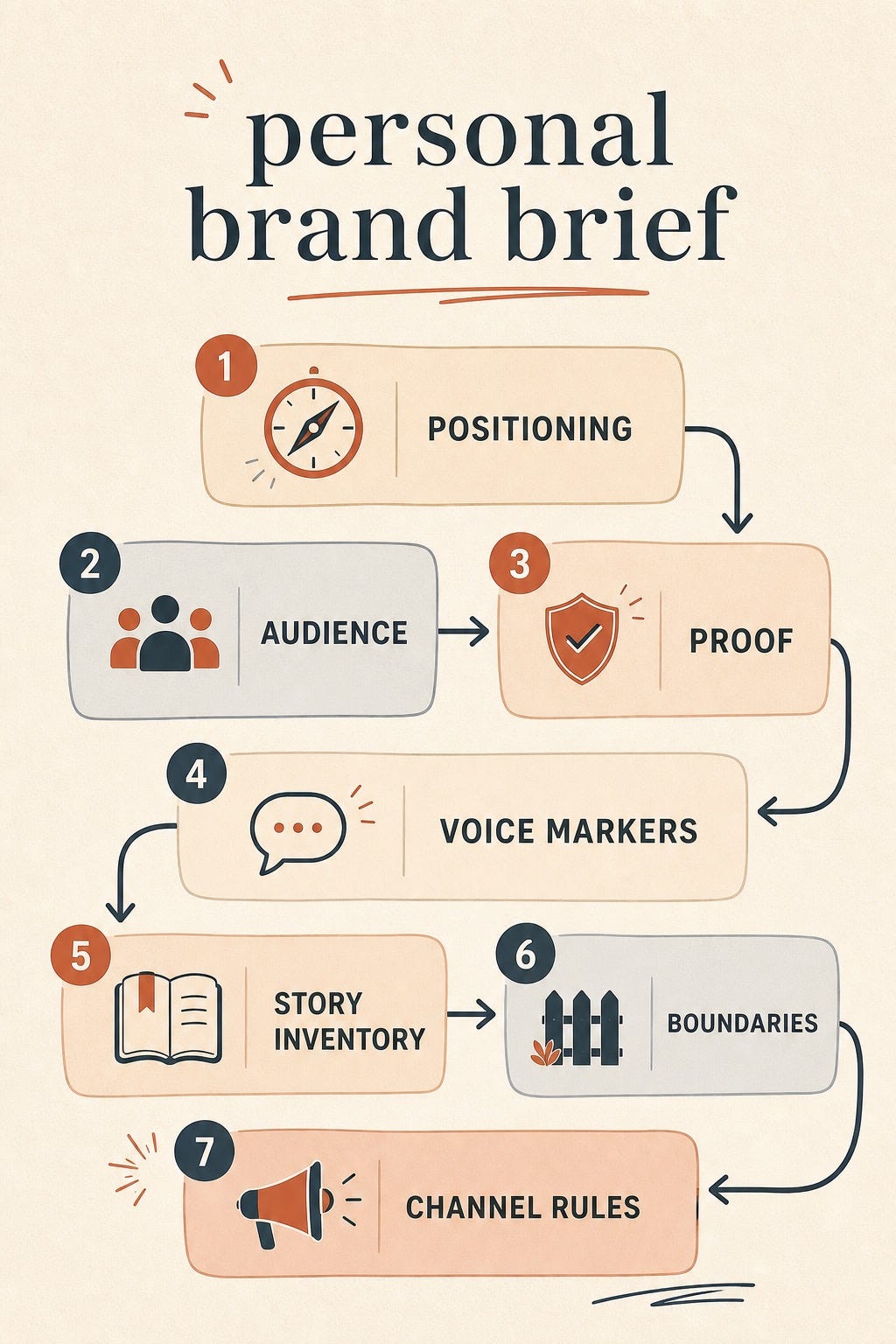
The 7 Blocks Every Personal Brand Brief Should Include
You do not need a 20-page document. One page is usually enough if the information is sharp. These are the seven blocks that matter most.
1. Positioning sentence
Write one sentence that explains who you help, what kind of problem you solve, and how you are different. This becomes the anchor for LinkedIn headlines, website intros, and AI-generated summaries.
2. Audience filter
List the people you most want to attract and the people you do not want to sound like you serve. This prevents AI from broadening your message until it becomes soft and forgettable.
3. Proof stack
Add 5 to 10 proof points: roles, outcomes, notable projects, credible signals, lived experience, repeatable frameworks, or categories where you have strong pattern recognition. AI needs facts to build authority without exaggeration.
4. Voice markers
Describe how you naturally communicate. Are you crisp and analytical? Warm but direct? Contrarian without being dramatic? Add examples of words you use often and words you avoid. This is the difference between human voice and generic business sludge.
5. Story inventory
List the 5 to 8 stories, turning points, mistakes, or observations you keep returning to. These stories give AI raw material that feels lived-in rather than fabricated.
6. Boundaries and red flags
Tell AI what not to do. For example: do not call me a thought leader, do not overstate certainty, do not use startup clichés, do not imply I have managed teams larger than I actually have, do not sound salesy, do not write fake vulnerability.
7. Channel rules
Add quick instructions for LinkedIn, website, newsletter, and podcast bios. Maybe your LinkedIn voice is punchier, your website copy is more stable, and your newsletter is more reflective. This helps AI adapt without losing your core identity.
How to Build a Personal Brand Brief in 45 Minutes
This does not need to become a branding retreat. You can build a strong first version in one focused session.
Step 1: Start with raw material, not polished copy
Pull together voice notes, old posts, emails you are proud of, website snippets, podcast answers, proposal language, and messages where you sounded natural. AI performs better when the source material comes from moments where you were already thinking clearly.
Step 2: Ask AI to extract patterns, not write the final brief yet
Use AI as an analyst first. Ask it to identify repeated phrases, audience clues, strongest proof points, clear opinions, and tone patterns from your existing material. This is much safer than asking it to invent a brand identity from scratch.
Step 3: Write the one-page version yourself
Once AI has surfaced patterns, write the final brief in your own words. Keep it short. If a sentence feels too polished or too abstract, simplify it. The brief should sound like notes from a smart operator, not a pitch deck.
Step 4: Test it on three outputs
Use the brief to generate a LinkedIn post, a short bio, and a homepage intro. If all three feel recognizably yours, the brief is working. If they still sound bland, your proof points or voice markers are too weak.
Step 5: Update it monthly
Your personal brand is not static. New projects, stronger opinions, better case studies, and sharper audience focus should all update the document. Think of the brief as a living source of truth, not a one-time worksheet.
A Practical AI Prompt for Using the Brief
Once the brief exists, your prompts get much simpler. You do not need a giant chain-of-thought ritual. You need clear context.
Use the attached personal brand brief as the source of truth. Draft a LinkedIn post for professionals dealing with generic AI content. Keep the tone direct, observant, and useful. Use one concrete example, avoid clichés, and do not make claims that are not supported by the proof section.
That single instruction usually performs better than elaborate prompts because the identity layer is already handled. The prompt only needs to describe the task, audience, and format.
How Different Professionals Should Use This
Founders
Use a founder brand brief to align your company story with your personal voice. This is especially useful when AI is helping with LinkedIn posts, investor-facing bios, media responses, and your website about page. The brief should keep the founder visible as a real operator, not a generic startup narrator.
Consultants and freelancers
Your brief should emphasize methodology, proof, and the kinds of clients you do best work for. This helps AI write sharper profile copy, case-study intros, and authority posts that convert because they sound specific, not broad.
Job seekers and students
A personal brand brief can stop AI from turning your profile into inflated corporate language. Focus on real projects, concrete skills, learning velocity, and the problems you enjoy solving. This produces better LinkedIn summaries and networking messages without sounding fake-senior.
Creators and operators building a quiet brand
If you do not want to post constantly, the brief helps AI repurpose what you already think. A strong document turns a handful of weekly notes into posts, bios, guest pitches, and newsletter intros that still sound grounded in your actual work.
The Biggest Mistakes to Avoid
Making it too aspirational: if the brief describes the brand you wish you had instead of the one your work supports, AI will magnify the gap.
Using only adjectives: words like visionary, authentic, and innovative are nearly useless without evidence.
Forgetting anti-rules: the fastest way to sound generic is to tell AI what you want without telling it what you reject.
Ignoring channel differences: one voice can stretch across channels, but one format should not.
Never refreshing the document: an old brief creates stale outputs, even if the prompts are smart.
Why This Asset Matters More Than Another Content Calendar
Most personal branding systems overfocus on publishing frequency. But AI has changed the bottleneck. The problem is no longer getting words on the page. The problem is making sure those words deepen recognition instead of diluting it.
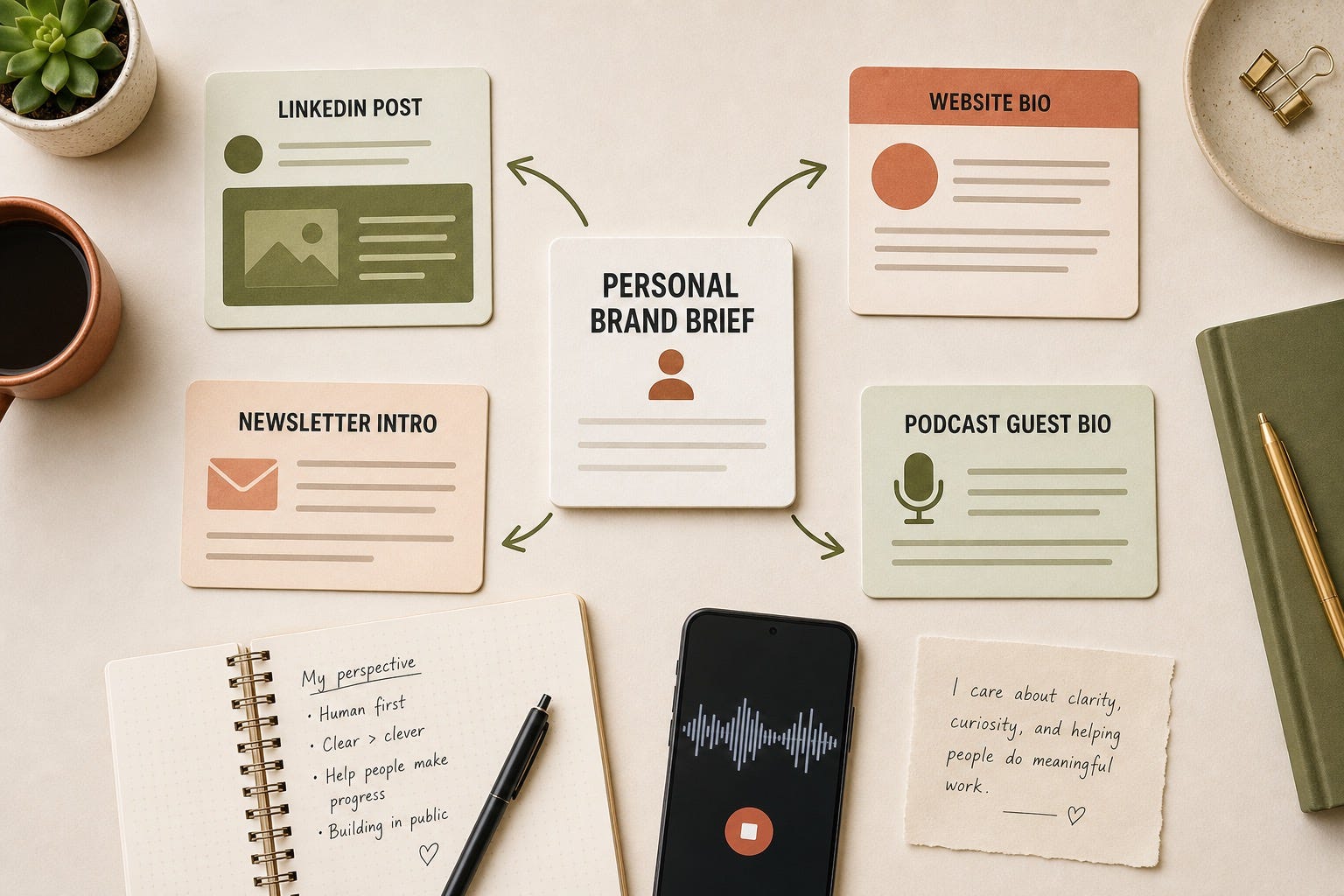
A personal brand brief helps because it improves every downstream asset at once: your LinkedIn profile, your website copy, your speaker bio, your Substack introduction, your comment style, your outreach messages, and your AI-assisted content drafts. It is one of the few small documents that can make an entire public identity feel more coherent.
If you only make one upgrade to your AI personal branding workflow this month, make it this one. Stop asking AI to guess who you are. Give it a better brief.
FAQ: Personal Brand Brief and AI Personal Branding
What is a personal brand brief?
A personal brand brief is a short document that explains your positioning, audience, proof, voice, stories, boundaries, and channel rules so AI tools and human collaborators can represent you more accurately.
How is a personal brand brief different from a personal brand statement?
A personal brand statement is usually one line. A personal brand brief is the working document behind that line. It gives enough detail to guide bios, LinkedIn posts, website copy, newsletters, and speaking materials.
Can I use AI to create my personal brand brief?
Yes, but use AI to analyze your existing material first. Let it extract patterns from your posts, emails, voice notes, and project examples. Then write or heavily edit the final brief yourself so it reflects your real voice and evidence.
What should I include in a founder brand brief?
A founder brand brief should include your company context, the problem space you understand deeply, founder proof points, your public point of view, your credibility signals, and the language you want to avoid when discussing growth, leadership, or vision.
Will a personal brand brief help LinkedIn content sound less robotic?
Usually yes. The main reason AI LinkedIn posts sound robotic is that the model lacks real voice inputs and clear boundaries. A brief gives AI better context, which leads to more specific, more human drafts.
How often should I update my personal brand brief?
Review it at least once a month or after any major project, role shift, niche change, or stronger piece of proof. The brief should evolve as your work and public identity evolve.