



For founders, consultants, freelancers, executives, and experts who have real work to show but very little they can publicly name.
A lot of professionals think they have a visibility problem. In reality, they have a proof problem.
The internet is full of people posting opinions, summaries, and polished AI-assisted takes. That does help with awareness. But trust usually moves when someone can see how you think, what problem you solved, what constraints you worked under, and what changed because of your work.
That is why the personal brand case study page matters more now. Google said on May 27, 2026 that AI Search is adding more ways to surface original content, creator insights, and firsthand perspectives. Then on June 4, 2026, Google announced Search profiles to help creators and publishers highlight their work. LinkedIn has also been emphasizing trusted voices and network-led credibility. In plain English: generic content is easier to make, so visible evidence is becoming more valuable.
The problem is that many of the strongest projects sit behind NDAs, client privacy rules, internal decks, or plain old professional discretion. That leaves smart people stuck in a loop. They know they need stronger personal branding, but they do not know how to show proof without oversharing or sounding fake.
This article gives you a practical answer: build a personal brand case study page that is specific enough to earn trust, abstract enough to protect confidentiality, and structured enough for both humans and AI systems to understand what you are actually good at.
Why this page matters more than another post
A post can start a conversation. A case study page closes the credibility gap.
When someone lands on your LinkedIn profile, website, Substack archive, or speaker page, they are usually trying to answer a short list of questions:
Is this person actually experienced?
Can they solve the kind of problem I have?
Do they sound thoughtful, or just polished?
Is there evidence behind the positioning?
A case study page answers those questions faster than a general About page because it moves from identity to evidence. It shows your thinking in motion. That is a much stronger trust signal than a stack of self-descriptions.
The personal brand mistake is thinking more visibility automatically creates more trust. Usually, it only creates more scrutiny.
If your public presence is heavy on commentary but light on proof, people feel the mismatch. That is especially true in an AI-saturated environment where clean writing is no longer rare. A personal brand case study page gives your reputation something solid to stand on.
What a personal brand case study page actually is
A personal brand case study page is not just a portfolio screenshot dump. It is a narrative proof asset built around one meaningful project, transformation, or decision process.
The best version usually includes:
The type of client or context
The problem or opportunity
The constraints
Your specific role
The thinking or method you used
The outcome, with as much evidence as you can safely share
The broader lesson about how you work
That last part matters. A case study page is not only there to say, “Look what I did.” It should also say, “Here is how I think when this kind of problem appears.” That is what turns a one-off project into a reusable personal branding asset.
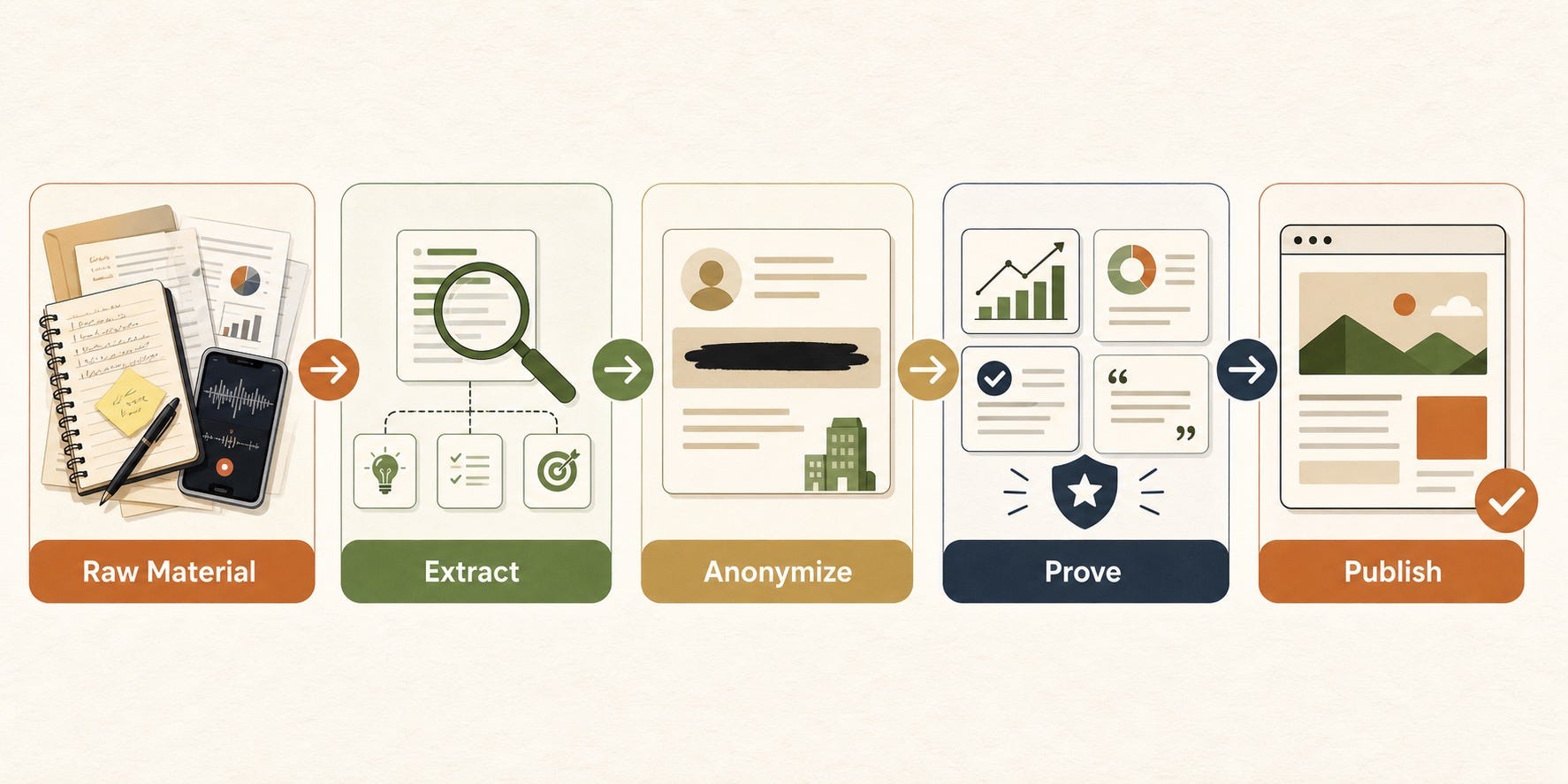
The NDA-safe anatomy of a strong case study page
If you cannot publish the client name, you have to replace that missing trust signal with stronger ones. Here is the structure I recommend.
1. A sharp outcome headline
Do not title the page “Case Study” or “Project Example.” Lead with what changed. A better pattern is outcome plus context, such as:
How a mid-market healthcare platform reduced onboarding friction in 10 weeks
How an executive team clarified product positioning before a major launch
How a creator business rebuilt its authority system after audience stagnation
2. A believable client descriptor
You do not need the name if you can make the context legible. “A fintech client” is too vague. “A Series A fintech startup serving independent wealth advisors” is much better. Specificity builds trust. Identification breaks it. Your job is to sit in the middle.
3. The real constraint set
Most weak case studies skip the hard part. They describe the solution without the mess. But the constraints are often what make your expertise believable. Mention things like limited time, compliance restrictions, low internal alignment, thin data, brand confusion, or stakeholder politics. That is where readers recognize real work.
4. Your role, in plain language
Say what you did. Do not make people guess. If it was a team project, separate your contribution from the larger effort. Prospects and recruiters are not trying to decode your humility. They are trying to assess fit.
5. Evidence over adjectives
Replace self-congratulatory language with observations, artifacts, and outcomes. “Strategic,” “innovative,” and “best-in-class” are weak. “Reduced onboarding time by 40%,” “created a two-layer messaging system for founders and buyers,” or “turned a scattered set of internal notes into a client-facing authority page” are stronger.
6. A short reflection section
This is the most underused part of the page. Add a section called “What this project taught me” or “How I approach this kind of problem.” That turns the case study into a personal-branding asset instead of a static archive.
How to anonymize a case study without making it useless
Most anonymous case studies fail because they overprotect the details and underdeliver the substance. The result reads like fiction.
Use these rules instead:
Hide the name, not the shape of the business.
Blur or crop sensitive screenshots, but keep enough visual evidence to feel real.
Use ranges if exact numbers are too sensitive.
Swap unique identifiers for category-level detail.
Be explicit about the confidentiality constraint.
For example, saying “The actual client work is confidential, so some visual and quantitative details have been redacted while keeping the process and outcomes accurate” often helps more than pretending the limits do not exist. Integrity itself is a trust signal.
Anonymous does not mean vague. It means selectively precise.
If you truly cannot share metrics, share the logic, timeline, decisions, and deliverable structure. If you cannot share deliverables, share the framework. If you cannot share screenshots, share recreated diagrams with the same problem-solution arc. The page still has to teach people something about your competence.
An AI workflow that makes the page sharper, not faker
This is where AI can help a lot, provided you use it as a structuring tool rather than a ghost credibility engine.
Here is a practical workflow:
Dump your raw material into one place: notes, proposal docs, call transcripts, meeting recaps, deliverables, screenshots, and results.
Ask AI to extract claims, evidence, milestones, constraints, and decisions.
Ask AI to flag anything that sounds vague, inflated, or unverifiable.
Ask AI to generate three levels of anonymization: strict, moderate, and publication-ready.
Manually review every sentence that implies an outcome, metric, or causal claim.
A useful prompt looks like this:
You are helping me write an NDA-safe case study page for my personal brand.
Extract:
1. The business context
2. The real problem
3. The constraints
4. My specific contribution
5. Evidence I can safely use
6. Claims that need proof
7. Any sentence that sounds inflated or generic
Do not invent metrics, client details, or outcomes.
If a statement cannot be supported by my notes, label it unsupported.
Then use a second prompt to turn the material into structure:
Using only the verified material, draft a case study page with these sections:
- Outcome headline
- Client context without naming the client
- Challenge
- Constraints
- My role
- Approach
- Results
- What this project taught me
Write in a grounded, intelligent tone. Avoid agency hype, cliches, and generic AI phrasing.
Finally, use AI as an editor, not a closer:
Stress-test this draft for credibility.
Highlight:
- claims that sound too polished
- areas where the story becomes vague
- missing proof
- phrases that could belong to anyone’s portfolio
- places where the real insight is buried
This workflow is powerful because it compresses the documentation burden. Many experts do good work but never package it. AI can help you package it faster. It just cannot be allowed to manufacture the proof itself.
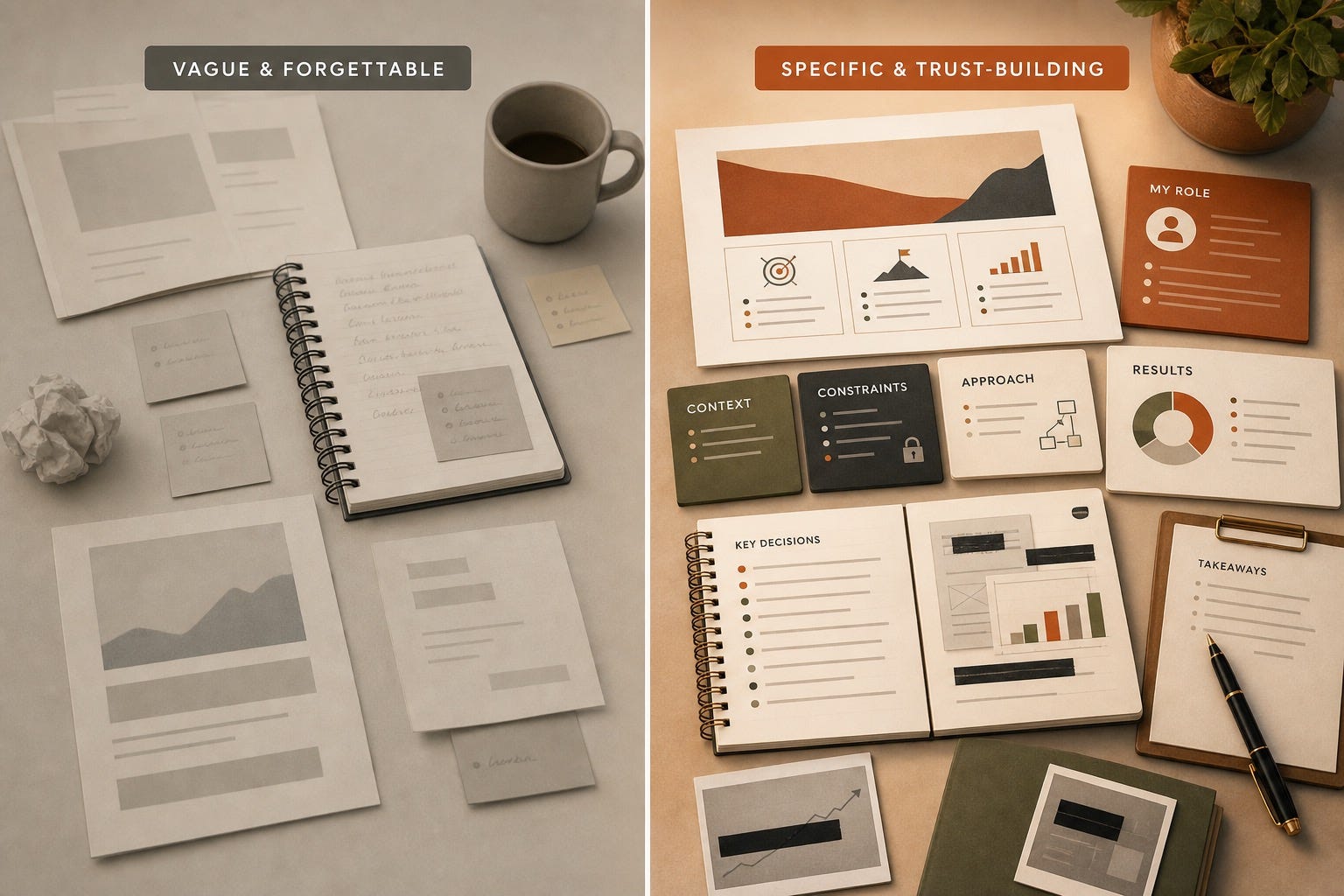
Where this page should live in your personal brand system
Your personal brand case study page works best when it connects multiple surfaces:
Your website should host the full version.
Your LinkedIn Featured section should point to one strong example.
Your Substack profile or archive can reference the lessons from the case study in essays.
Your bio, speaker page, or intro deck can borrow one short proof line from it.
This is how a single case study becomes more than a page. It becomes a proof node in your public identity. Humans understand it quickly. Search systems can connect it to your expertise. AI tools get a clearer sense of what you actually do.
A simple publishing checklist
One result-focused headline
One believable anonymous client descriptor
One clear explanation of your role
Three to five moments of real specificity
At least one visible artifact, diagram, or redacted screenshot
One reflection paragraph that explains how you think
One internal link from your homepage, About page, or LinkedIn Featured section
Mistakes that make a case study page feel fake
Writing around the work instead of through it.
Using anonymous clients as an excuse for zero detail.
Claiming business impact you did not directly influence.
Letting AI smooth out the odd but believable details.
Publishing five weak examples instead of one strong one.
If you only fix one thing, fix this: stop treating confidentiality as a reason to be generic. Most serious buyers, recruiters, and collaborators understand privacy constraints. What they do not forgive is vagueness.
A seven-day sprint to build your first page
If you have been putting this off, do not start with a full portfolio. Start with one project.
Pick one project where the problem, approach, and outcome are clear.
Collect every note, deck, email, screenshot, and recap tied to it.
Use AI to extract the timeline, constraints, and decision points.
Draft an anonymous client descriptor and role statement.
Build the page around evidence, not adjectives.
Redact visuals carefully and add one reflection section.
Publish it and link it from your highest-traffic profile surface.
That one page will often do more for your personal branding than another month of generic posting. Not because content does not matter. Because content becomes more persuasive when it points back to visible proof.
FAQ
Can an anonymous case study still help my personal brand?
Yes, if it is specific. An unnamed client can still feel credible when the challenge, constraints, role, process, and outcome are concrete. Anonymous plus vague fails. Anonymous plus detailed often works.
What if my NDA prevents me from sharing numbers?
Use ranges, percentages, timelines, process changes, or qualitative shifts that you can defend. If that is still too sensitive, focus on the structure of the problem and the method you used. Readers mainly want proof that you can think clearly and solve real problems.
Should I use AI to write the whole case study page?
No. Use AI to organize source material, extract specifics, tighten structure, and pressure-test vague language. Do not let it invent outcomes, polish away uncertainty, or fill evidence gaps with confident language.
How many case study pages does a strong personal brand need?
Usually one to three good ones are enough to start. A single memorable case study with real detail is more powerful than a large archive of thin examples.
Where should I link a personal brand case study page?
Link it from your website navigation, About page, LinkedIn Featured section, speaker page, media kit, and any proposal or intro deck where trust matters. The goal is to make proof easy to find.
What if I am early in my career and do not have a public client story?
You can create a case study around a self-initiated project, internal initiative, volunteer engagement, or reconstructed scenario that uses public or fictionalized data. Just label it honestly. Credibility comes from clarity and integrity, not only from famous logos.