



The best personal brand content calendar is not a machine for posting more. It is a system for turning your real work, judgment, and proof into visible trust.
Most professionals do not have a content problem. They have a memory problem.
You do useful work all week. You answer hard questions, make decisions, notice patterns, fix mistakes, calm clients, teach teammates, review tools, reject bad advice, and learn small lessons that would help someone else. Then Monday arrives, LinkedIn feels blank, Substack feels too big, and AI offers a polished post that could have been written by anyone.
That is how good people end up publishing generic personal brand content. Not because they lack ideas. Because their ideas never get captured while they are still alive.
A personal brand content calendar should solve that. Used well, AI can help you organize your thinking, find patterns in your week, shape posts for different platforms, and keep a steady publishing rhythm. Used poorly, it becomes a fast way to manufacture bland thought leadership at scale.
The difference is the input. If your calendar starts with prompts like “write five LinkedIn posts about leadership,” you will sound like the internet. If it starts with real work evidence, audience questions, and your point of view, AI becomes an editor, not a ghost wearing your name.
Why Content Calendars Fail Personal Brands
Most content calendar advice was built for companies. It assumes campaigns, product launches, approval cycles, and a brand voice document. A person needs something simpler: a reliable way to decide what is worth saying.
That is why so many personal branding calendars become either too rigid or too random. One version says Monday is motivation, Wednesday is tips, Friday is a story. Another is a blank spreadsheet with dates and platform names. Both miss the real question: what proof, insight, or useful perspective does this post make visible?
Recent Reddit threads around LinkedIn and personal branding show the same pain from different angles. People ask what to post, how often to post, whether consistency matters, how to avoid burning out, and how to balance AI assistance with authenticity. One thread in r/personalbranding described the “post consistently” advice as impossible because the person kept running out of things to say. That is the exact problem a better calendar should fix.
The calendar is not the strategy. It is the operating surface for the strategy.

The Trust-First Calendar Principle
Here is the rule that changes everything:
Do not schedule a post until you can name the trust signal it creates.
A trust signal is evidence that helps the right person believe you are credible. It can be a decision you made, a mistake you corrected, a pattern you noticed, a question you keep hearing, a useful framework, or a sharp opinion backed by experience.
This matters more now because audiences are getting better at detecting generic AI content. Platforms are also responding to AI-heavy feeds. LinkedIn’s own help center explains Content Credentials for media provenance, and recent reporting has covered the reputational risk creators face when content is perceived as AI-made or mislabeled. The direction is clear: credibility is becoming part of distribution.
Your content calendar should not ask, “What can I post on Tuesday?” It should ask, “What should someone trust me for by the end of this month?”
Build the Calendar From Proof, Not Topics
Most people start with topics: AI, leadership, hiring, design, marketing, product, finance, career change. Topics are useful, but they are too broad to protect your voice. AI can produce topic-based content forever, and much of it will feel clean, plausible, and forgettable.
Start with proof instead. Create a simple proof inventory before you create the calendar.
Work moments: decisions, meetings, launches, audits, experiments, fixes, reviews, and lessons from the week.
Audience questions: questions from clients, colleagues, students, customers, recruiters, peers, comments, DMs, and communities.
Point-of-view notes: beliefs you hold because of what you have seen, not because they sound fashionable.
Proof assets: case snippets, screenshots you can ethically share, anonymized outcomes, checklists, templates, frameworks, and public work.
Reputation goals: the specific association you want to strengthen, such as “practical AI operator,” “trusted fractional CFO,” “clear technical educator,” or “calm product strategist.”
Once you have those inputs, AI can help you cluster them into calendar slots. The order matters. You are not asking AI to invent your brand. You are asking it to organize the evidence your week already produced.
The Four-Lane Personal Brand Content Calendar
A strong calendar needs enough structure to reduce decision fatigue, but not so much structure that every post sounds pre-planned. A four-lane system works for founders, consultants, creators, job seekers, students, freelancers, executives, and technical professionals.
Lane 1: Proof Posts
Proof posts show that you do the work. They can include project lessons, teardown notes, decision logs, anonymized client situations, before-and-after thinking, or a small process artifact. The goal is not to brag. The goal is to make competence visible.
Example: “I reviewed three AI onboarding flows this week. The biggest trust problem was not hallucination. It was that users could not tell when the tool was confident, guessing, or asking for context.”
Lane 2: Point-of-View Posts
Point-of-view posts make your judgment legible. They explain what you believe, what you no longer believe, what most advice misses, or where your field is changing.
Example: “A content calendar does not make a personal brand consistent. A repeatable point of view does. The calendar only keeps it visible.”
Lane 3: Teaching Posts
Teaching posts help people solve a specific problem. They can be checklists, mini-frameworks, examples, prompts, mistakes to avoid, or short guides.
Example: “Before you ask AI to draft a LinkedIn post, feed it three inputs: what happened, what changed your mind, and what the reader should do differently.”
Lane 4: Relationship Posts
Relationship posts build warmth and context. They can mention people you learned from, events you attended, books you are applying, communities you value, or questions you are still wrestling with. They stop your personal brand from becoming a broadcast channel.
Example: “A founder asked me why their posts get views but no serious conversations. We found the issue quickly: the content showed opinions, but almost no proof of process.”
A simple weekly rhythm: one proof post, one teaching post, one point-of-view post, and one relationship post. For many professionals, two or three strong posts per week is enough. The goal is not daily output. The goal is repeated evidence.
Use AI as a Calendar Strategist, Not a Content Factory
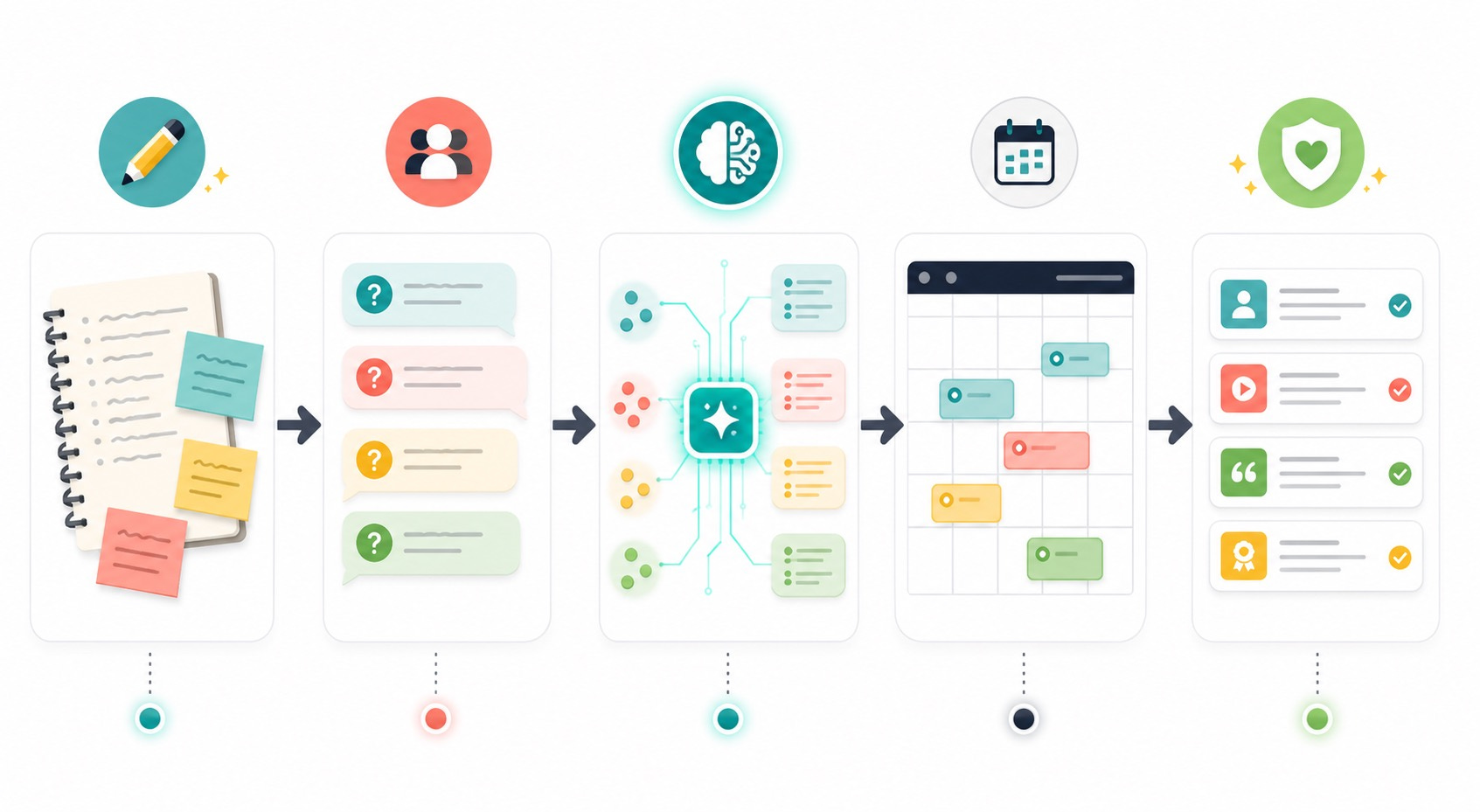
AI is very good at sorting, clustering, reformatting, and finding gaps. It is risky when you let it invent your experience. The practical workflow is capture first, synthesize second, draft third.
Step 1: Capture Raw Material During the Week
Keep a running note called “content evidence.” Add rough bullets, not polished ideas. Capture questions people ask, decisions you made, phrases you said in meetings, mistakes you fixed, and moments that made you think. Do not judge the material yet.
Step 2: Ask AI to Find Patterns
At the end of the week, paste your notes into AI and ask it to group them by audience need, trust signal, and content lane. This turns messy experience into a draft calendar without erasing your voice.
Prompt:
You are my personal brand editor. I will give you rough notes from my real work week. Do not invent claims, wins, clients, metrics, or stories. Cluster the notes into four content lanes: proof, point of view, teaching, and relationship. For each idea, name the audience, the trust signal, the likely platform, and the reason it is worth publishing.
Step 3: Choose a Small Number of High-Trust Slots
Do not publish every idea AI finds. Choose the ideas that connect to your positioning. If your brand is about AI operations for healthcare teams, a generic productivity lesson may not belong.
A calendar gets stronger when it has constraints. Pick fewer posts and make each one sharper.
A Practical Weekly Workflow
Here is a repeatable workflow you can run in about 45 minutes per week once your capture habit is in place.
Review the week: gather meeting notes, project notes, DMs, comments, saved links, and voice notes.
Mark the proof: highlight anything that shows judgment, process, result, taste, decision-making, or useful failure.
Cluster with AI: ask AI to sort ideas into proof, point of view, teaching, and relationship lanes.
Select three to four posts: choose the ideas that best support your current reputation goal.
Draft one layer at a time: start with the claim, then add the context, then the example, then the takeaway.
Human edit: remove generic openings, exaggerated claims, fake certainty, and anything you would not say out loud.
Schedule lightly: place posts on the calendar, but leave room for one timely idea or live conversation.
Review signal quality: after publishing, track saves, replies, profile visits, meaningful comments, and conversations, not just likes.
What to Put in Each Calendar Slot
Every slot should have more than a title. A useful personal brand content calendar includes the ingredients that protect trust.
Working title: a clear draft headline for the post.
Content lane: proof, point of view, teaching, or relationship.
Audience: who this is for, named specifically.
Trust signal: what credibility this post should create.
Raw evidence: the note, story, question, example, or artifact behind the post.
Platform: LinkedIn, Substack, X, website, newsletter, or another channel.
Format: short post, long post, article, note, carousel outline, comment, or profile update.
AI role: research, outline, edit, headline options, repurpose, or proofreading.
Human check: what must be verified before publishing.
This is why a personal brand calendar should not look like a normal marketing calendar. It needs a field for evidence. Without evidence, AI will fill the gap with smooth language.
How to Keep AI From Flattening Your Voice
The easiest way to lose your voice is to ask AI for a finished post too early. Drafting should be late in the process. First, make AI understand your boundaries.
Give it a short voice rule set:
Use plain language.
Do not overstate certainty.
Do not use inspirational clichés.
Use concrete examples before abstract advice.
Keep one clear idea per post.
Preserve phrases from my raw notes when they are stronger than polished alternatives.
Then ask for options, not final copy. For example: “Give me five possible angles from this note. Do not draft the post yet.” That small instruction keeps you in control. You choose the idea before AI shapes the language.
You can also ask AI to create a “generic risk report” before publishing:
Prompt:
Review this draft for generic AI personal branding signals. Flag vague claims, overused phrases, unsupported advice, fake vulnerability, exaggerated certainty, and sentences that could apply to anyone in my field. Suggest more specific replacements using only the evidence provided.
Platform Notes: LinkedIn, Substack, X, and Your Website
Your calendar should adapt the same proof into different surfaces without copying and pasting everywhere. LinkedIn is usually best for proof, point of view, and professional conversation. Substack is better for deeper arguments, playbooks, and owned-audience trust. X can test sharper observations. Your website should hold durable assets such as FAQs, case studies, media kits, resource pages, and proof archives.
The calendar connects these surfaces so your personal brand does not become scattered activity.
What to Measure Instead of Vanity Metrics
A personal brand content calendar should compound reputation, not just impressions. Track the signals that show trust is increasing.
Saves and sends: people found the idea useful enough to keep or share.
Profile visits: the post created enough curiosity to inspect your identity.
Specific comments: people responded to the substance, not just the vibe.
Qualified conversations: the right people asked better questions.
Search lift: your name becomes easier to associate with the problem you solve.
AI can help summarize these signals weekly. Feed it your post links, performance notes, and qualitative replies. Ask it what themes created trust, what topics attracted weak-fit attention, and what questions deserve deeper treatment.
The Real Goal: Recognizable Judgment
Consistency is useful, but consistency alone is not a personal brand. A person can post every day and still be forgettable. Another person can post twice a week and become known for clear judgment, useful proof, and a specific way of seeing the world.
AI makes both paths easier. It can help you publish more generic content, or it can help you notice the real material hidden in your work.
Choose the second path. Build a personal brand content calendar that starts with evidence, protects your voice, and makes your judgment easier to trust. That is the kind of consistency people remember.
FAQ
What is a personal brand content calendar?
A personal brand content calendar is a planning system for turning your expertise, work evidence, stories, audience questions, and point of view into scheduled content across platforms such as LinkedIn, Substack, X, and your website. Unlike a normal marketing calendar, it should track the trust signal behind each post.
How can I use AI to create a personal brand content calendar?
Use AI after you capture real notes from your work. Ask it to cluster your notes by audience, content lane, trust signal, and platform. Then choose the strongest ideas yourself before asking AI to outline, edit, or adapt drafts.
How often should I post for personal branding?
For many professionals, two to four strong posts per week is enough to build consistency without burning out. The better question is whether each post strengthens a clear reputation goal. A lower volume of specific, proof-based content usually beats a higher volume of generic AI posts.
What should I put in a personal branding content calendar?
Include the working title, content lane, audience, trust signal, raw evidence, platform, format, AI role, and human verification check. The raw evidence field is especially important because it keeps your content grounded in real experience.
How do I avoid sounding generic when using AI for personal branding?
Do not ask AI to invent posts from broad topics. Give it real work notes, examples, questions, and voice rules. Ask for angles before drafts, and run a generic-risk review before publishing. Keep the final judgment and approval with you.
Is a content calendar useful for job seekers and students?
Yes. Job seekers and students can use a personal brand content calendar to turn projects, coursework, career lessons, portfolio updates, reading notes, and field observations into proof of direction. The goal is not to become an influencer. The goal is to make growth and capability visible.