



The fastest way to make AI ruin your personal brand is also the most common: ask it for ideas before you give it anything real to work with. A blank prompt creates blank authority. If your AI tool only knows your title, industry, and target audience, it will write the same polished nothing it writes for everyone else.
That problem is becoming harder to hide. Readers are more sensitive to generic AI content, platforms are adding transparency tools, and professional audiences can feel when a post has no lived experience behind it. On July 21, Substack introduced AI-text scanning and a creator statement called “How I make this”. Chris Best framed the issue as a trust problem: a mismatch between what readers expect and what they get.
That is the right lens for personal branding. The question is not, “Can I use AI?” The better question is, “What human source material is AI helping me package?”
A personal brand content library answers that question. It is a small, searchable collection of your real stories, decisions, screenshots, client questions, work artifacts, voice notes, lessons, opinions, and proof points. It gives AI the raw material it needs to help you sound specific, useful, and recognizable. Instead of using AI as a personality replacement, you use it as an editor, pattern finder, and distribution assistant.
Why Generic AI Posts Are Now a Reputation Risk
Professionals used to worry that posting online would make them look self-promotional. Now the bigger risk is looking synthetic. The feed is full of smooth posts with no friction, no memory, no evidence, and no cost of insight. They sound confident, but nothing in them proves the author had to earn the idea.
That matters because personal branding is not content production. It is reputation compression. Every profile update, article, comment, bio, and talk page compresses a bigger question into a small signal: “Can this person be trusted with attention, money, opportunity, or responsibility?”
AI can help you express that signal. It cannot invent the real-world substance behind it.
Recent creator economy research makes the tension clear. Billion Dollar Boy reported rising use of generative AI by marketers and creators, while consumer preference for AI-generated creator content fell sharply in its sample. Pangram, after polling with YouGov, reported lower trust in AI-generated content than human-made content. Emplifi’s consumer research points in the same direction: people reward authentic engagement as AI-powered workflows become more common.
The practical takeaway is simple. If AI helps you move faster, you need a stronger proof layer, not a louder posting schedule.
Your advantage is not that you can generate more content. Your advantage is that you can give AI better evidence than the person using the same tool with an empty prompt.
What a Personal Brand Content Library Actually Is
A personal brand content library is not a content calendar. A calendar answers, “What will I publish next Tuesday?” A library answers, “What do I know, believe, notice, and prove that is worth publishing at all?”
It is also not a folder of finished posts. Finished posts are outputs. Your library is the input layer. It should contain the fragments that make your content hard to fake.
For a founder, that might include customer objections, product decisions, failed experiments, investor questions, pricing lessons, and market observations. For a consultant, it might include anonymized client problems, before-and-after notes, frameworks, audit patterns, and questions prospects ask repeatedly. For a job seeker, it might include project notes, learning logs, feedback, and examples of how they solve problems.
The point is not to create a giant archive. The point is to create a reusable memory system that makes your public identity more accurate over time.
The Five Buckets Every Library Needs
You can build the first useful version in a single afternoon. Do not start with a complex Notion dashboard or tagging taxonomy. Start with five buckets that map directly to trust.
1. Proof
Proof is anything that shows you have done real work: project screenshots, shipped features, public talks, GitHub commits, client outcomes, testimonials, teardown notes, portfolio links, and anonymized before-and-after examples.
AI use case: Ask AI to turn proof into a short case-study paragraph, a profile bullet, a speaker bio detail, or a LinkedIn post that explains what changed and why it mattered.
2. Stories
Stories are moments with tension: a surprising customer call, a mistake you changed your mind about, a project that failed for hidden reasons, or a career decision that taught you what you value.
AI use case: Ask AI to find the stakes, clarify the lesson, and suggest three ways to tell the story for different audiences without making it dramatic or fake.
3. Questions
Questions are the hidden demand signal inside your personal brand. Save what people ask in DMs, sales calls, comments, interviews, onboarding sessions, and team meetings. If three people ask a version of the same question, you probably have a useful post, FAQ, article, or profile update.
AI use case: Ask AI to group recurring questions into themes, identify which ones deserve public answers, and turn them into search-friendly headings.
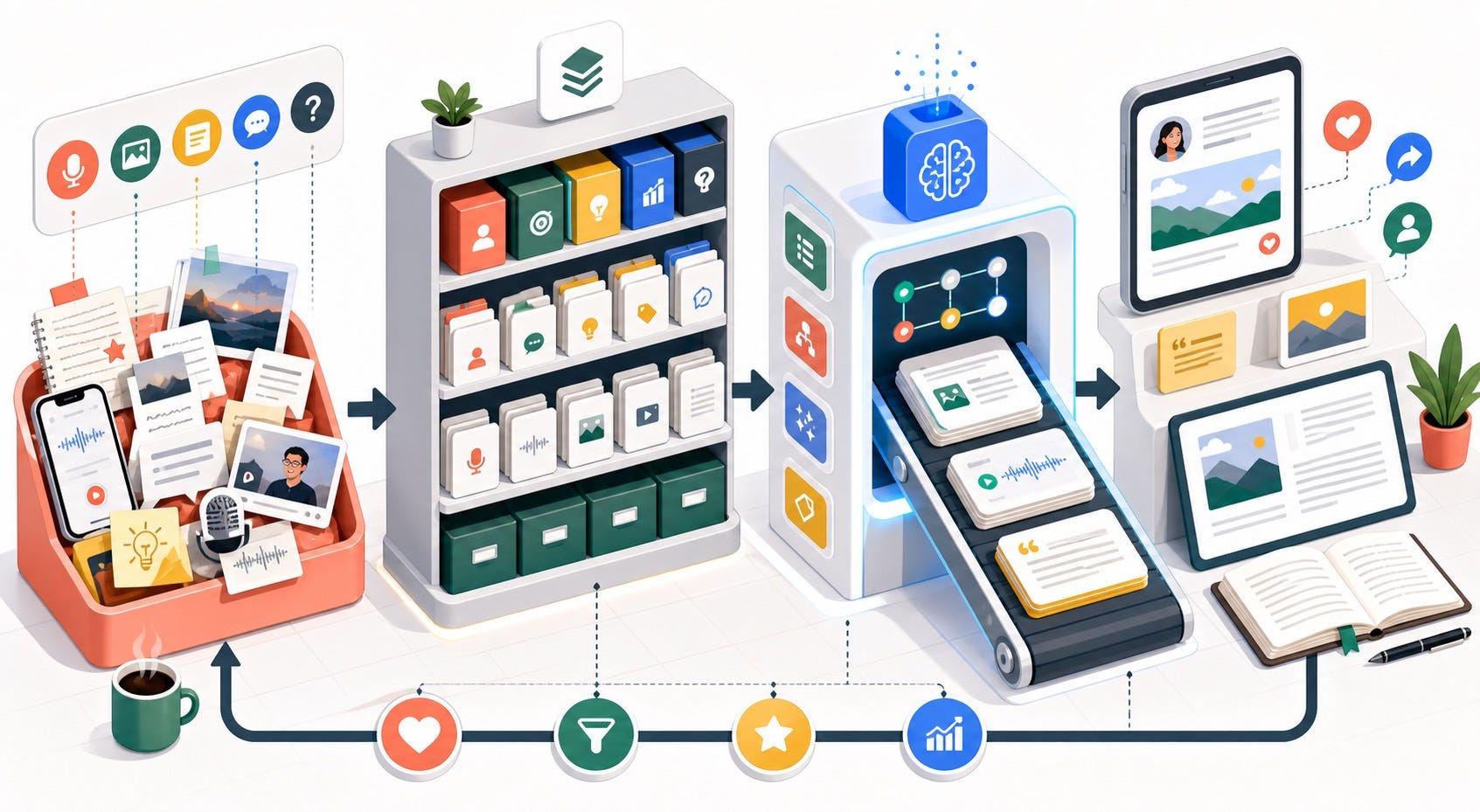
A useful AI workflow starts with messy real inputs, not perfect prompts.
4. Opinions
Opinions are where your brand stops sounding interchangeable. Save your point of view on repeated debates in your field. What do people overvalue? What advice sounds smart but fails in practice? What tradeoff should professionals be more honest about?
AI use case: Ask AI to pressure-test your opinion, find the strongest counterargument, and help you express the idea clearly without sanding off the edge.
5. Voice
Voice is not a list of adjectives like “clear, warm, expert, direct.” Voice is evidence of how you naturally explain things. Save your best emails, voice notes, comments, interview answers, Slack explanations, and rough drafts. The rougher material is often more useful than polished content because it shows how you think before you perform.
AI use case: Ask AI to compare a draft against your voice samples and flag where the language feels too polished, vague, inflated, or unlike you.
How to Build the First Version in One Hour
Open a document, notes app, Airtable base, Notion page, Drive folder, or local markdown file. The tool does not matter at first. The habit matters more.
Create five sections: Proof, Stories, Questions, Opinions, and Voice. Then set a timer for 20 minutes and collect what already exists. Do not rewrite anything. Drop in links, fragments, screenshots, bullets, file names, quotes you are allowed to use, and short context notes.
Next, add a short note under each item with three fields:
Context: What was happening?
Lesson: What did this prove or change?
Use: Where could this help: LinkedIn, Substack, bio, website, pitch, interview, talk, FAQ, or sales conversation?
That small structure gives AI enough context to help without inventing. It also protects you from a common personal branding failure: confusing “what I want people to think about me” with “what I can actually show them.”
Quick rule: if a library item cannot answer “what happened, what changed, or what did I learn?”, it is probably not source material yet. It may be an idea, but it is not evidence.
The AI Workflow: Capture, Classify, Convert, Check
Once your personal brand content library has 20 to 30 items, AI becomes much more useful. Use a four-step workflow.
Capture
Capture raw material as close to the real event as possible. After a client call, record a 60-second voice note. After shipping a project, save three screenshots and write what the hard part was. After a good question, paste it into your Questions bucket. After reading a trend report, write the implication in your own words.
Prompt: “Turn this rough note into three reusable personal brand source cards. Keep the factual details. Do not create claims I did not make. For each card, suggest one post idea, one profile use, and one FAQ question.”
Classify
Every week, ask AI to classify new items by theme. Useful tags might include audience, problem, proof type, channel, emotional tone, credibility signal, and buyer or recruiter relevance.
Prompt: “Group these source cards into themes. Identify repeated questions, strongest proof points, weak claims that need evidence, and ideas that are too similar to what I already publish.”
Convert
Conversion is where most people start, but it should come third. Now you can ask AI for drafts because you are giving it a source packet, not a blank prompt.
Prompt: “Using only the source cards below, draft a 700-word Substack essay for consultants who want to build trust without overposting. Preserve my point of view. Include one concrete example, one counterargument, and one practical checklist. If evidence is missing, ask before filling the gap.”
Check
Before publishing, run a trust check. This matters more than a grammar pass.
Prompt: “Review this draft for personal brand risk. Flag anything that sounds generic, inflated, unsupported, too salesy, too perfect, or unlike my source material. Suggest edits that make the piece more specific and human.”
What to Put in the Library If You Are Starting From Scratch
If you feel like you have nothing to collect, you are probably looking for finished achievements instead of raw material.
Start with small evidence:
Three problems people ask you to explain more than once.
Three mistakes you made and would now advise others to avoid.
Three decisions you made under constraint.
Three examples of work you can show safely.
Three phrases you say naturally when explaining your field.
Three unpopular opinions you can defend with experience.
Three questions you wish more people asked before hiring, buying, applying, or building.
That gives you 21 source cards. With those alone, AI can help you create stronger LinkedIn posts, a sharper About section, a better bio, a Substack outline, a website FAQ, and grounded interview answers.
How Different Professionals Can Use It
Founders can turn product learning into public trust by saving customer objections, pivots, market surprises, hiring lessons, and hard decisions.
Consultants and freelancers can save anonymized patterns from client work: what breaks, what gets delayed, what stakeholders misunderstand, and what improves outcomes.
Job seekers and students can save project notes, learning logs, technical decisions, feedback, and examples of how they solved problems without becoming full-time creators.
Executives can save decision memos, leadership principles, recurring team questions, market beliefs, and examples of judgment under pressure.
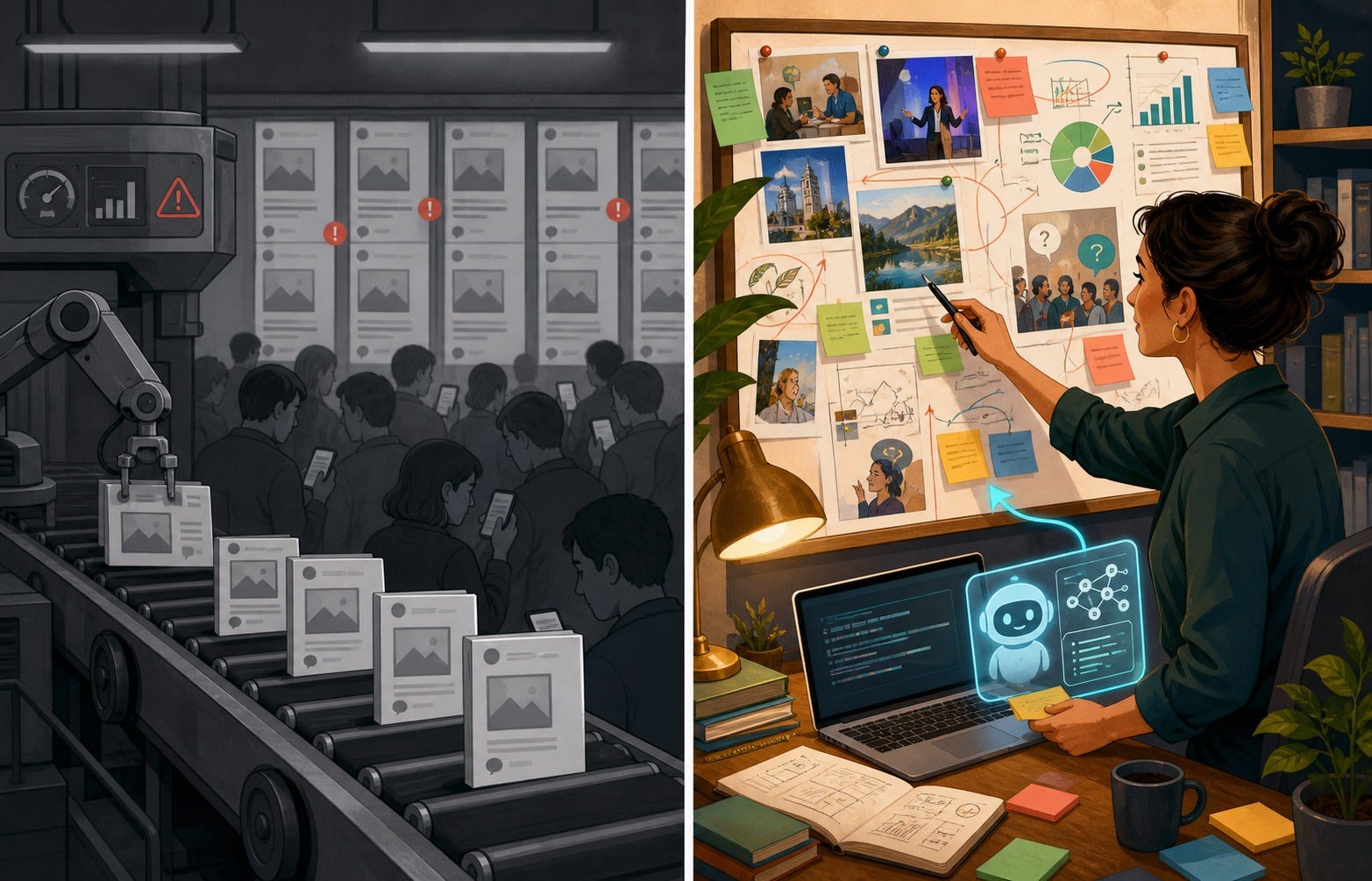
The difference is not whether AI is present. The difference is whether human judgment is visible.
The Ethics: Do Not Feed AI What You Would Not Publish Safely
A strong personal brand content library should make you more trustworthy, not more careless. Before adding source material, ask:
Do I have permission to use this?
Does it reveal confidential client, employer, student, investor, or candidate information?
Can I anonymize the lesson without weakening the truth?
Would a reasonable person feel misled if they knew how this content was made?
When in doubt, generalize the pattern and remove identifying details. Use AI to clarify your experience, not to launder private information into public content. And when AI materially shapes a public piece, consider a short process note such as: “I use AI for outlining and editing; the examples and final judgment are mine.”
The Weekly Maintenance Routine
The library only works if it stays alive. A realistic routine takes 25 minutes a week:
Add five new raw items from the week.
Tag each item as Proof, Story, Question, Opinion, or Voice.
Ask AI to identify the strongest three public angles.
Choose one item to convert into content.
Archive anything that feels too private, too weak, or too repetitive.
This routine gives you consistency without forcing you to chase trends every morning. You can still respond to trends, but you respond through your own source material.
A Simple Publishing Rule
Before you publish any AI-assisted personal brand content, check for three signals.
Specificity: Does this include a detail only someone with real experience would know?
Stakes: Does the reader understand why the idea matters now?
Ownership: Is there a clear human judgment, not just a summary of common advice?
If the answer is no, go back to the library. The fix for generic AI content is rarely a better adjective. It is usually better source material.
The Real Goal: Make Your Name Easier to Trust
The best personal brands do not feel like campaigns. They feel like repeated evidence. People see the same pattern across your posts, profile, comments, website, talks, and conversations: this person notices useful things and stands behind the work.
AI can help you show that pattern more consistently. But it needs your archive of lived proof. A personal brand content library gives you that archive. It turns your everyday work into reusable trust signals. It makes your content easier to write, easier to verify, and harder to mistake for generic AI output.
In a world where anyone can generate confident prose, the scarce asset is not content. It is credible source material. Build the library first. Then let AI help you carry the signal farther.
FAQ
What is a personal brand content library?
A personal brand content library is a searchable collection of your real work evidence, stories, questions, opinions, and voice samples. It helps you create posts, bios, essays, website copy, and interview answers that are grounded in your actual experience.
How is a personal brand content library different from a content calendar?
A content calendar schedules finished content. A content library stores the raw material that makes finished content credible.
Can AI help build my personal brand content library?
Yes. AI can summarize notes, tag source material, group recurring questions, turn voice notes into source cards, and suggest content angles. You should still control what gets stored, what stays private, and what gets published.
What should I put in an AI content library for personal branding?
Start with proof, stories, questions, opinions, and voice samples. Useful examples include project screenshots, anonymized client lessons, repeated audience questions, hard-won decisions, interview stories, feedback, and examples of how you naturally explain your work.
How do I use AI for personal branding without sounding generic?
Give AI specific source material before asking for drafts. Use real examples, constraints, stories, and voice samples. Then ask AI to flag unsupported claims, vague language, inflated tone, and anything that does not match your actual experience.
Should I disclose AI use in my personal brand content?
Disclosure depends on the platform, audience, and level of AI involvement. If AI helped with outlining, editing, summarizing, or formatting, a short process note can strengthen trust. If AI invented claims, examples, or expertise, the problem is not disclosure; the problem is the content.